

Alexander Grabovetskiy, woodcarver, School of Woodcarving · Published 2020
What does a wood carver mean by "charge"?
Quick answer: "Charges" is in one line of Venice Room 89.9, spoken about a leather strop and its rough side. Across my stropping lessons the same word goes with wood, an MDF board and wheels, and a honing sandpaper in part 7 gets no paste.
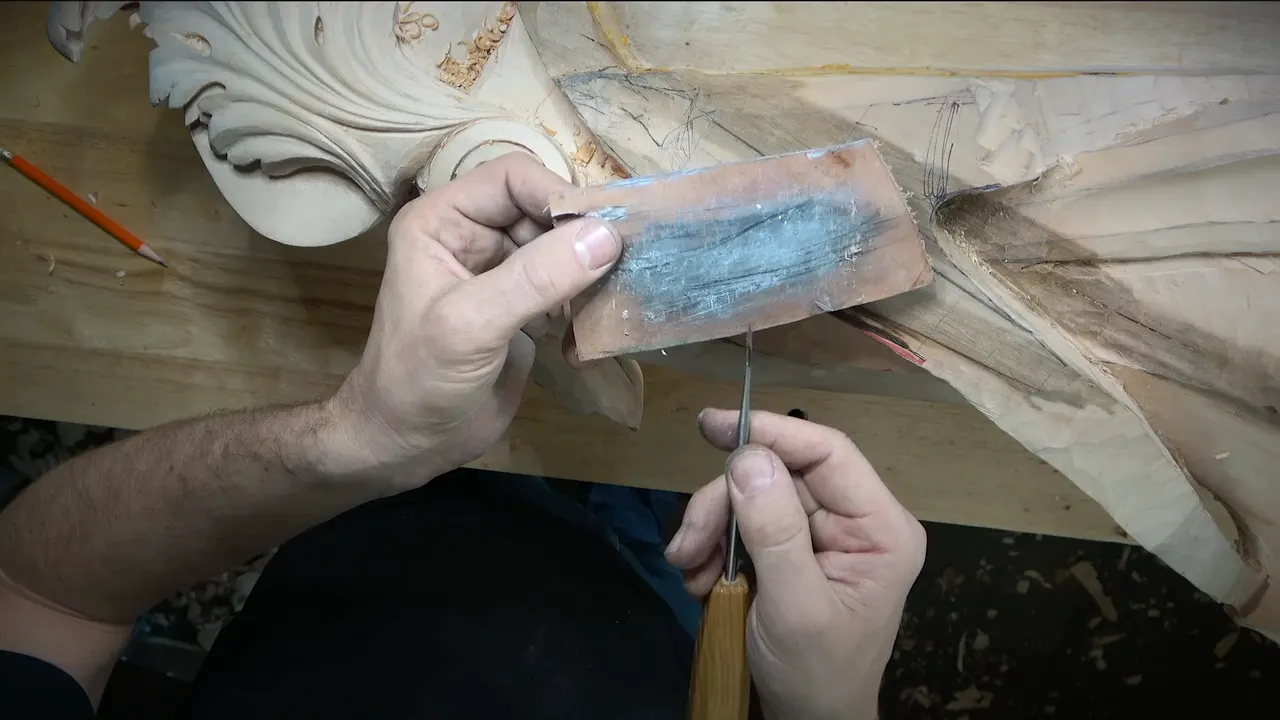

"Charges," in Venice Room 89.9, sits in one line about the rough side of a leather strop: "Reason why I use a rough side, because it charges a lot easier." In my stropping lessons the same word goes with pastes, a board and a few wheels. A honing sandpaper in part 7 gets no paste.
Ever rubbed paste on a scrap of leather and wondered which side takes it better? Did you ever try bare wood in its place? Then walk through part 9 with me, and through the lessons where I use the same word.
What did I say about the leather in part 9?
Part 9 starts in the middle of a cleanup: "And with the same tool, I can actually clean right away pretty much that background." I hold the flute "about 9:00 o'clock," and my plan is to "turn opposite direction, 3:00 o'clock," and to clean "that background" from there.

Next the wall of the volute gets its turn: "So now I need to clean this wall of my volute." My plan names a few tools, "number three" and "a knife or even a skew." One of you had asked me about the chisel: "one of you asked me why I like this tool, why I'm not using number three or just a knife."
My answer starts with "Absolutely no problem with that," and goes on to "I really love knives." Of the chisel itself I say "it's a really handy chisel," one that "has whatever the angle I want to use." With it, "I can get a lots of operations," and it suits "cleaning areas like that and for general purpose even."

Where does the paste come in?
Right after the chisel talk comes a strop: "And let me also strop it little bit." The paste is named next ("Again, I'm going to use mirror paste"), with a reason: "in this section, I'm stropping much more for the reason I already mentioned, because of the wood." The rest of that wood story is on the page for workshop 89.
Now the leather itself: "And see, it becomes really black. The area I stropped, that's actually metal." The leather has two faces, and I name both: "I'm using both sides, by the way, rough side and a clean, flat side."

Two lines follow, and they sit side by side: "But it does the job. Pretty much in this case, it's mirror paste does the job."
After the leather the chisel comes back, and I count my sizes: "I do have a couple sizes. I have a bigger one and I have a smaller one, okay? And I'll use just the smaller one." That small one gets a plan of its own, to "blend this movement."

What happens to the shape?
My words turn to it. "Although it's not the final shape because I also want to see some kind of S curvature maybe." Two routes are open: I could "flip completely and make that piece returning this way," or let it "go all the way this way," which in my words is "a little too far." Then: "I think I like to have my point somewhere right there." A plan follows, to "establish that curvature, letter S curvature."
A small detail comes as an offer: "I can actually create a small separation and give a little nicer touch to that curl." A second offer is a knife. "I could use just a knife," which "would give me exactly the same result."

Last in part 9 is a gouge with a number: "And now I could take number seven and about half an inch" (about 13 mm), "and just right on top of those facets and give a clean cut or cleaning cut." Then the roll: "see how I'm rolling my tool? Really important. Slicing it." The finish is "absolutely gorgeous finish," in my words. The part ends on a plan: "let me use the same tool and knock down a little bit this section."

What do the other parts of workshop 89 show about the leather?
Part 7 has the same setup: "Let me take number 11, and I'll take seven millimeters" (about 0.28 in), then "I'll use just a piece of leather and mirror paste." The inside of the tool comes next, and the leather is "a little too thick," so "I need different leather." Later: "I always wipe it," and then "Because I don't want to get that stuff in wood."
Part 8 has an edge check: "Every time when I'm grabbing my tool, I'm actually trying to check if the edge is sharp or not." In part 10 the chisel is "right on my workbench," and a size is named: "Two millimeters, number 11" (about 0.08 in). A plan comes later in that part: "I'll take one millimeter. Of course, it will be same number 11" (about 0.04 in).

The burr I felt on a small tool in part 8 has its own page in the lesson, on workshop 89. Part 9 is where I say "charges."
Which leather side holds the paste better?
The rough side, in the Stropping and Compound lesson, part 3. That part opens on rounding: "Number one, I'm not afraid of rounding my edges if I'm stropping from two sides." Later in that part: "There's a shiny side and there's a rough side." It "depends on the paste," and the rough side "holds a lot better." Next: "You can charge a lot better with the paste." But "it has a tendency to round a lot more because it's a softer side."

The same part shows a "chunk of leather," and my words about it are "I believe it's just a leather supply." Then: "you can get that pretty much anywhere in the world." There is an "old leather belt," too, and I add "that is one of the ways to strop it." Some woodworkers glue pieces of leather on a board, and I tell you how they go on from there: "If you've got three different pieces, you charge with different pastes."
Colors come next: "That one is green, which is going to be aggressive." Then: "This is a dark green, more aggressive. This is a light green, it's less aggressive. And this one is blue, which is a really, really super fine paste."

About the blue one: "When you're charging it, it's hard to charge just the leather. Okay? It's almost impossible unless you're just doing the opposite side. So you can charge with this blue one, the backside." A line about machines follows: "if you're using this one on machine, it's actually cooling down your tool. It's not going to overheat your tool." For hand work, "it's okay when you're just honing by hand, just the charging, whatever the leather you do, and it doesn't produce too much mess."

Can a block of wood take the paste?
Part 4 of the same lesson begins "if you don't have money," and goes on: "you get to the other technique and get the piece of wood." Then: "Just a block of basswood, whatever you carve." Next: "you can just charge block of wood like this with any of the pastes, and it's still going to do the trick." The wood shows it: "It becomes black, which means I'm actually sharpening it."

Wood works for the inside of a gouge too: "you really don't have any limitations, okay? You just create your profile." The profile is the tool's own: "You've got the inner profile of your particular tool. You're still charging it, and you're using it inside, okay?" And on the number of profiles: "on one block, you can get hundreds of different stropping profiles if you wish." The summary line: "So a piece of wood is your friend."
A harder board gets the same word. "That one is 10 millimeters, 3/8 of an inch, just MDF board. And what you do, you just charge it, and using it like a stone. That way, you're not going to round because it doesn't have that thickness and you're not pushing in, okay? So when you're pushing in, you create that roundness."

How do I charge a wheel?
Parts 5 and 6 show wheels on a machine. "There's four wheels. Four wheels. There's a yellow, green, blue, and red." On how they differ: "yellow and the green wheel, they are softer, and that's actually pressed paper," while "the blue and the red wheel, they are harder." Then: "So you're actually safer on the harder."

The paste goes on by color. On one wheel it is "you just charging with the green paste," and then "the blue paste other wheels, which is density is the same." The red wheel gets this: "I'm charging with the blue, and that's a really fine diamond paste. And that just gives me super sharp edge." Then, about the color: "It became black because it taken some metal out."
On the mess: "It's not messy at all. In my case, I really love it because it just doesn't fly all over my bench. And those paste can fly." On the pressure: "I'm not creating any pressure pretty much, but it's already super sharp."
Part 6 brings a slow attachment: "I can charge it only with the green paste because the blue paste is so hard." A leather wheel is "the same idea." Then: "Like you would do it by hand, you're just rocking back and forth," and "you're pretty much honing it."

A soft felt wheel gets the blue paste: "I charge this one usually with blue paste," and then "With the really, really hard paste." Then: "I'm not pressing too hard because the green paste took already most of what needs to be taken out." And last, for the same wheel: "But I'm just rocking back and forth," and "Without even pressure, and it's really safe."
Inside a tool, I correct my own word. "If you are using felt, you can actually strop on inside," and then: "It's buffing. You're buffing it."
When do I not charge at all?
Part 7 starts with soft felt: "if you are afraid of soft felt, there is a solution for you." The solution is a sandpaper for honing, at "6,000 grit. You can go up to 12,000 if you wish." My words on the paste: "you just place that, and you can keep it right there. You don't have to charge that. Please don't."

A story from teaching in person comes with it: "someone always almost grabbing my paste and just trying to charge." Then: "It's a sandpaper. And it lasts long time." And: "that actually gives you the same effect as a leather if you keeping your hand really steady."
A carving knife gets the paste in that part: "To get with the knife, I'm using exactly the same. I'm charging it with the blue paste usually." Next: "But anyway, find your bevel on a knife and just go on the edge like this." Also: "it becomes black."
Where else do I put paste on leather?
Other lessons use other verbs. Each row names the lesson, so you can find the line on its page.
| Lesson | Words | On what |
|---|---|---|
| Beginner Workshop 5.2 | I'll just apply some green paste on the leather. | Leather |
| Fingernail gouge | I'll apply blue paste this time. | Leather wheel |
| Large gouge 4 | Let me apply a blue paste, the fine paste | buffing |
| V tool 4 | Just put some paste on a profile and use it as a stropping. | A piece of basswood |
| Maine class 1-6 | So the green paste goes on the leather. | Leather |
| Grape Onlay 12.2 | In this case, it's just a piece of leather and a mirror paste. | Leather |

Where else do I name the Mirror Paste?
Venice Room 75 has this: "By the way, I should probably mention to you some of the products I'm using. It's mirror paste. It's a really good mirror polishing product." And: "But it's messy, that's why I don't use it too much. But it gives perfect sharp edge." In Venice Room 82 I call it "one of the really good products, actually, for stropping," and add: "But it has a short life." Also: "It dries out."
Venice Room 87 has "that is one of my favorite pastes for stropping," followed by "I'll do an inside first." Floral and Molding 7 adds: "Not buff it, but strop it. Okay? Just to strop it. I'll use Mirror Paste." Then: "a really, really good product, and it helps a lot, actually." And Grinling Gibbons, Maine class 13 says: "they all do the job. But some paste. Better than others," with "I'm not selling it."
Where does your leather sit right now: on a bench, glued to a board, or on a wheel? And which side did you charge? This part waits inside one tuition plan, with the rest of Part 8 of the Venice Room.
How it's done
- Turn the flute to the other side. From about 9:00 o'clock to 3:00 o'clock, as in part 9.
- Use both faces of the leather. Rough on one face, clean and flat on the other.
- Charge the rough face. Part 9 names the rough side as the one that takes the charge easier.
- Make a profile in wood. You just create the profile of the tool.
- Leave a honing sandpaper alone. In part 7, you keep paste off the honing sandpaper.
Frequently asked questions
Which side of the leather did I name in part 9?
The rough one, with a clean, flat one beside it. Both sides get used in that part, and my reason for the rough one is that it "charges a lot easier."
Does wood take paste like leather does?
Part 4 of the Stropping and Compound lesson shows me charging basswood with any of the pastes, and it turns black. A profile in the wood lets me use the inside of a gouge.
Why use only the green paste on one wheel?
On a slow attachment I use the green paste alone because "the blue paste is so hard." The felt wheel takes the blue paste, and I'm not pressing too hard.
What to carve next