

Alexander Grabovetskiy, woodcarver, School of Woodcarving · Published 2020
What does a wood carver mean by "laminated"?
Quick answer: Workshop 92, part 11, has "laminated" beside a glue line. Other lessons use the word for table-apron boards, a sculpture block, a layer that marks how deep to go, and steel. Each passage has its place below, with its course named.
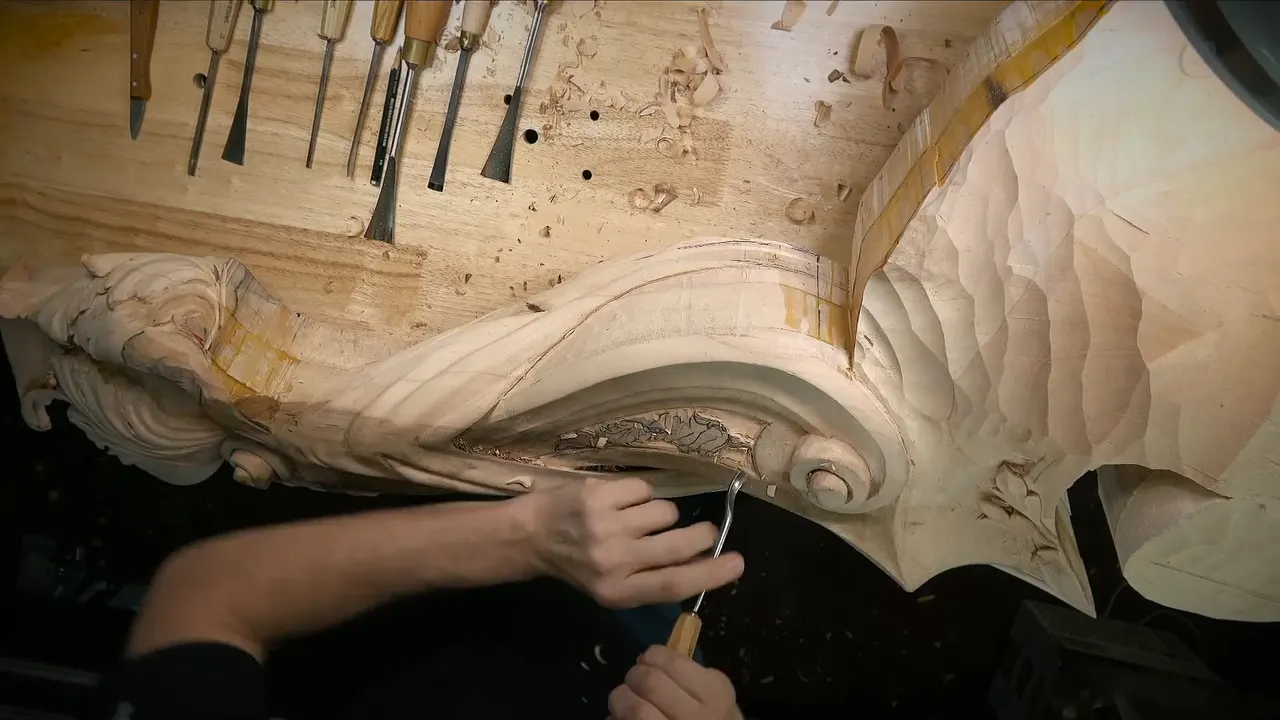

In Venice Room workshop 92, part 11, "laminated" sits beside a lower layer and a glue line. In other lessons I use the same word for boards, a sculpture block, a table apron and steel, and each passage has its place below.
Ever glued two boards and then wondered what was waiting inside? This page begins in workshop 92. From there it walks through the school, with sizes in millimeters and inches and my own figure first.
What does "laminated" mean in Venice Room 92.11?
A knife line opens it: "And my knife cut, I think I made it about one-eighth of an inch deep." In metric, 3 mm. A plan sits beside it, "I can always deepen it if I need to right on the go."

A smaller tool is named next, with a hedge: "Let me also use a smaller tool, maybe three millimeters." (Close to 1/8 in.) After that, the layer. "I do have a lower layer of wood. It's laminated, so I already got that to the glue line to this point. So right here."
Part 12 of the same lesson names the piece. "It's Venice, Italy. And this particular piece is kind of a little bit confusing, I would say." Then it gets its name: "But it is a corbel."
Which tools sit beside that glue line?

A spoon gouge is named too: "This one is a number seven and 10 millimeters tool, spoon gouge, but I probably should switch to number three." Ten millimeters is about 0.4 in. The reason is in the next line, "It would give me better control how deep I'm going."
A smaller number is named next. "So let me use a small number. Let me see. Number five. Let me try number five first." These are plans. The size follows: "Number five and six millimeters, about a quarter inch," and in inches 6 mm is 0.24.

Clean-up carries two more plans: "Clean it with the number 11." And later in the same stretch, "I'm going to follow with the knife." Neither gets a result.
Can I go deeper in that part?
Short and flat: "And I cannot go deeper than that." Beside it sits "That would be a mistake if I go deeper than this," and after that "All right, that's good."

A note to self follows, "Recreate this cut." Soon after, "I will use a little bigger number five." A straight tool is only a maybe: "And maybe I can use just a straight tool, which is kind of challenging, so I'll just have to use a small spoon again."

One size is given as in use, "I'm using right now one-eighth of an inch, number three" (3 mm). A warning rides beside it, "I have to be careful in this section."
What did the glue line look like in that light?

"And that is really interesting. The glue line looks almost like metal, just shines from the light source I have. Kind of scared me for a second."

A question comes straight after. "So I thought, what in the world is going on inside of that wood?" Then a plan: "Okay, I'll use a spoon again, but that would be number seven and four millimeters, just to get in a space like this." Four millimeters equals 0.16 in.

A further need sits in the last lines: "And I need to create a little better cut in this section." It stays a need.
Where else do I say "laminated" in the school?
Several lessons carry the word, and the lines below are word for word. Each one has its course in front.
Is a table apron laminated?
Two workshops of Carving a Dining Table Apron give the word to a board. In workshop 3 it belongs to a molding: "This molding, the upper molding, is applied right on the top of the main piece, which is a three-quarter inch laminated wood."

The size follows: "And three-quarter inch, it's about 19 millimeters, 19, 20 millimeters, something closer to that." Three-quarters of an inch is 19 mm.
The next workshop turns to a board that needs a check: "So let's check this piece." After it, "It is not laminated all the way, the right way." Numbers fill the lines that follow: "So this one is three-quarter exactly" (19 mm), then "Now, 11/16" (about 17.5 mm).

The molding gets a figure: "And the molding itself is 3/16, so it's five millimeters." A flip follows, "Let's flip it, and the bottom looks much thicker." Then the board: "It is laminated from four pieces, and it's much thicker on the bottom." The bottom reads "15/16," about 24 mm.
A further number: "So my board is 13/16, and that should work," or 20.6 mm. Good news follows: "I don't have to plane it, so that is actually good news."
Why laminate small pieces, in the livestreams?
The April 2020 livestreams use the word in several videos, and each has its own place for it.

The lighting-bench livestream has the plainest line: "But you can always glue together. Just get a couple small pieces and glue them together. Laminate." The lines go: "Take a look at this piece. Okay. This is not the solid wood. I would not use a big piece like that. Okay. I glued that together in multiple layers."
Layers get numbers. "I've got one, two, and three boards like this. And there's like a two inches thick the first layer, then I've got another two inches thick second layer." Two inches is about 51 mm. Then "that way I'm just building up."
Price enters. "I could buy four inches thick for this piece, but I would spend a lot of money for that, and that would not be wise, because they charging a lot for the thicker piece." Four inches is 102 mm. And "the thicker piece is a lot more movement, by the way."
Can lamination help a block hold still? The same video says "If you need exactly the same block, and if you just get some lamination going, okay. Let's say you've got the grain like this, then you just alter it." Next: "And this way, this piece is not going to move as much. It's not going to warp." Wikipedia has pages on grain and on how wood can warp.

A sculpture gets its own line: "I always laminate for this reason, even if I'm getting a sculpture." The sentence after it gives the reason, "I laminated that together, those pieces, because I want to prevent the movement." One more, "I did not want to carve a solid log, otherwise it would just crack."
The topic ends on a plain sentence. "That is always safer, just laminate multiple pieces." A caution follows: "Again, I'm telling you just my opinion, and I'm not saying that I understand 100% everything, but I just use logic, and also my teacher taught me that way."
How thick is the laminated block in the wood-movement livestream?

Here the numbers get a block. "So please understand, this is not a solid board, from one piece of wood. It's not solid chunk. Okay? So I laminated that. I glued those pieces together, three layers."
Every layer is named: "I've got layer number one on the bottom, two inches. Then I've got layer number two, two inches. Then I have layer number three, two inches." The stack stands at six inches, about 152 mm, in the words "So the highest point right here, it's six inches from the bottom."
Width is next. "I laminated that together. But also I did not have boards wide like that. That's about 25 inches." Twenty-five inches is 635 mm.
A tip for a small budget sits in the same video: "You don't really have to buy thick stuff. So you can get just the four quarters material, which is three quarter of an inch material." In metric, 19 mm. Then "just laminate together. And here you go, you got a thicker board."
Earlier in that video the word goes to wood flooring: "And those wood flooring companies, they glue that on top, laminate that on top of plywood, and sell it really expensive." Lines before it name heart pine, "taken from the middle part of a tree, of the pine, big trees, huge trees."
Which machine comes before the glue?

In the April 5 livestream the process gets a short description: "Pretty much the process is easy. You plane your pieces of wood." Then "It depends how big project you do."
A planer follows. "I do have a huge planer I've got a couple of planers, actually." Then "I'm talking about machines, I'm not talking about hand planes." Sizes are "I have a 25 inches planer and I have a 16 inches planer," which is 635 mm and 406 mm.
The questions livestream has a similar line: "I have to be authentic to the Venetian style." Next, "I did use machines at the beginning stage." And "So I use machines just in preparation of wood for the lamination, for gluing, okay?" The carving line: "But as far as the carving goes, no, I did not use machines at all."
Can steel be laminated too?
The word turns to steel in that same livestream. "Japanese steel, it's laminated steel, okay?" Then "if you break that laminated steel edge, your tool is pretty much gone, okay?"
The same lines carry a liking: "As much as I love the quality of those tools, how they built, Japanese tools, I love how they built." It is steel here.
How do lines on a block show lamination?
The clay-modeling livestream puts the word on a picture. "I'll show you a picture. See that model and the block of wood? It's those lines actually how I laminated."
How does one laminated layer give the boundary for how deep to go?
Two Venice Room workshops sit closest to 92.11. The first, workshop 101, has the sentence "And I also laminated together some pieces, and I've got a layer of wood, and that's going to give me the boundary pretty much how deep I should go."

The lines go on: "So it's going to give me a really good idea that I'm right there." Next to it sits a tool plan, "And yes, I'll take probably number seven or even number five will work."
Then the layer shows. "Here you go. You can see that is another layer, lighter wood." Then "That is my boundary. That's how I want to go." One note holds the thing back, "Of course, not everywhere because it still has to kind of blend together."
Do I glue up more layers later?
The word goes to a plan in workshop 104, with the first step named. "But anyway, step number one, just the bossing. It's pretty much the normal step what you do with any of the projects."

The plan has "later on" as its only time word: "So I'm going to glue up, laminate some more."
Does a glued spot show while carving?
In Venice Room 43, part 2, a spot looks odd: "Oh, I know what that is. It's just the glue line. Two pieces glued together right here, and I had a little void. But there, it all blends it."
A tool plan follows, "Let me use a bigger number 11 and recreate this cut." Number 11 is also in 92.11, in "Clean it with the number 11."
Hashemi Flowers 44, part 1, has the word "glued" beside a wish: "But my main goal, to go as deep as possible right here." Then "And make it look like it's not solid piece, but glued together." The excavation gets a look too, "And you can see how deep that excavation is."
How do I glue a second layer?
Lily Box 3 has a step: "So the next step, I have to glue my second layer." Then "I made the decision to glue that right on top."
Two ways are named. "You can always do a sandwich method when you glue a paper between the MDF and piece of wood, and you glue that together, and then once you've done it, you just take it apart."
A second way uses masking tape. The line is "Apply masking tape on this side also. Then use a spray glue, and glue tape to tape, and it's going to be also holding really good."
Which lesson holds which line?
| Lesson | What sits next to the word |
|---|---|
| Corbel, Venice 92.11 | A lower layer that is laminated, and a glue line. |
| Table apron, Workshop 3 | A molding applied on top of a three-quarter inch (19 mm) piece of laminated wood. |
| Table apron, Workshop 4 | A board that is not laminated all the way, then one laminated from four pieces. |
| Livestream on a lighting bench | Small pieces glued together, three layers of boards, and the grain turned to move less. |
| Livestream, wood movement | A block of three laminated layers, its highest point six inches (152 mm) from the bottom. |
| Livestream, April 5 | A planer for the boards, and steel that is laminated. |
| Livestream, clay modeling | A model and a block of wood, with lines showing how the block was laminated. |
| Livestream, questions | Machines used only to prepare the wood for lamination and gluing. |
| 101.5 in Venice Room | Laminated pieces, and a layer that gives a boundary for depth. |
| 104.3 in Venice Room | A plan to glue up and laminate some more. |
| Part 3 of Venice Room, 43.2 | A little void, the spot blending, and a bigger number 11 planned. |
| Hashemi 44.1 | A wish to make a carving look glued together, not solid. |
| Lily Box 3.11 | A second layer to glue, and two ways to hold the pieces. |
Does a board in your own hand ever hold a surprise? You know that small jolt. These courses sit inside one tuition plan. The rest of workshop 92 waits on the Part 8 course page, with the Hashemi course, the Lily Box course and the table apron course beside it. For plain words on the craft, Wikipedia has wood carving, gouge, plywood, lamination and glulam beams.
How it's done
- Set the knife depth. The knife line is 3 mm deep, by my own guess, and it can be deepened on the go.
- Name the lower layer. The layer below is laminated, and a glue line is named.
- Pick a smaller number for control. A number seven spoon gouge of 10 mm (about 0.4 in) is named, with a switch to number three planned for better control of the depth.
- Stop at the depth named. The part calls going deeper than this "a mistake," and that is the depth named in it.
Frequently asked questions
How deep was the knife line in 92.11?
3 mm, by my own "I think," with a plan to deepen it on the go.
Which tools sit next to the glue line?
A number seven spoon gouge of 10 mm (0.39 in), then a number five of 6 mm (0.24 in), the knife and a number 11, each as named in the part.
How thick is the laminated board in Apron Workshop 3?
A three-quarter inch (19 mm) laminated wood, with a molding applied on top.
How many pieces is the board in Apron Workshop 4?
What to carve next