

Alexander Grabovetskiy, woodcarver, School of Woodcarving · Published 2020
What does a wood carver mean by "the quickest"?
Quick answer: Part 9 of workshop 92 has "quickest" beside a knife outlining a border, and the verdict reads "at least for me." Part 9 adds "you really have to control the depth of cut." Other lessons put the word beside a skew chisel, a larger gouge, a knife shaping big pieces and a sharpening machine. Each passage has its place below.
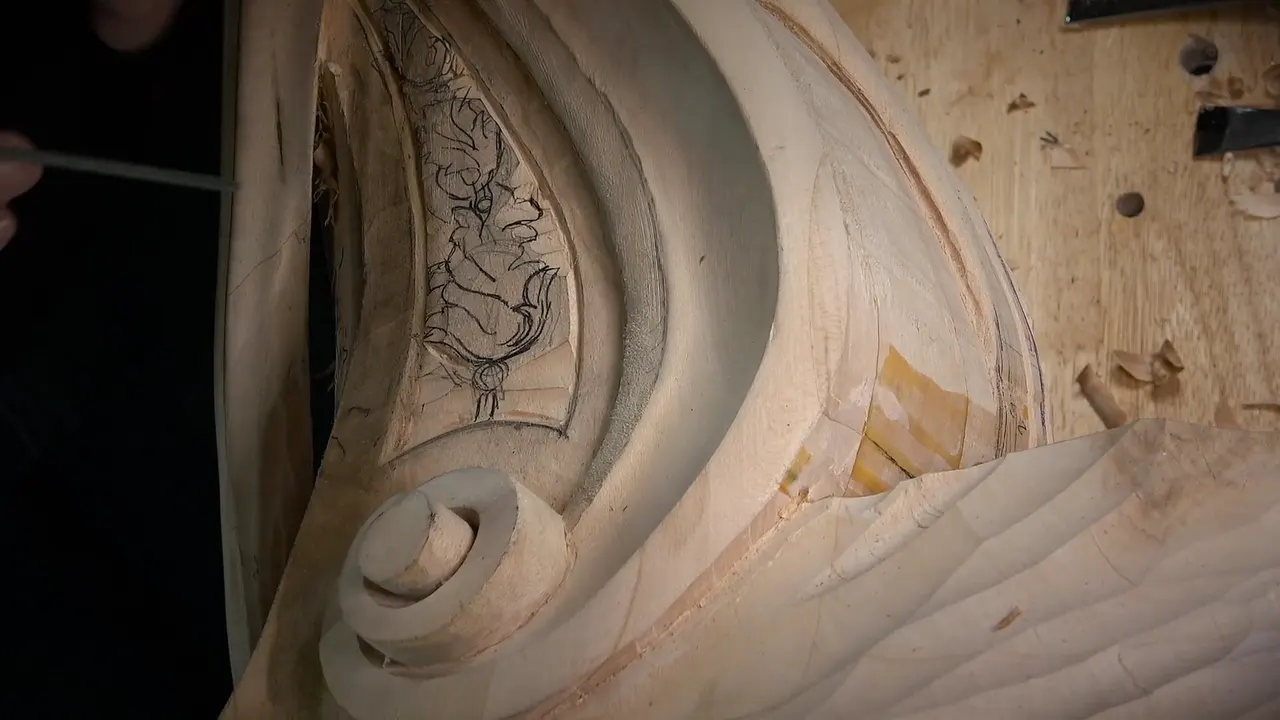

In part 9 of workshop 92, "quickest" sits beside a knife outlining a border. In other lessons the same word sits next to a skew, a bigger gouge, one knife on a big shape and a sharpening machine, and each passage has its place below.
Ever stood over a drawn line and wondered which tool gets you to it fastest? This page starts in workshop 92, then visits the Venice Room and a few other courses. Sizes come in millimeters and inches, with my own figure first.
What happens in part 9 before the knife?
A tool goes missing, and turns up in the wrong drawer. "Yeah, that is really strange that I can't find my two millimeters because I actually keep all of my tools at the same location. Found it. So it was just in the wrong drawer."
Two millimeters is 2 mm (about 0.08 in). The size is explained: "But two millimeters will work probably better in this case. I don't really need too wide of a cut for this outlining." A plan follows: "Going to strop it first."

How deep does the outlined area go, and what waits for the end?
The plan for the area is a quarter inch, with a habit attached. "about quarter inch, the final depth. But I usually go to the final depth at the last moment. I can always clean it, so I'm leaving about one millimeter to the end." One millimeter is 0.04 in.
The figures arrive in my own pairs. "So if quarter inch, six millimeters, I would carve approximately five millimeters, which is 3/16th of an inch." A quarter inch is 6.35 mm. My six is 0.24 in, and five millimeters is 0.2 in. The plan ends on "and then I'll just go all the way to six millimeters to a quarter inch."
Which gouges get named for the waste?
A number seven gets named for the waste. "And by the way, I can take number seven right away, and 14 millimeters, half an inch, and remove some of that material right away, pretty much." Fourteen millimeters is 14 mm (0.55 in).
A spoon gouge comes in. "And I think spoon would work much better in this case. And I'm going to grab maybe number five spoon. Or number seven will work also. Maybe number seven and 10 millimeters, 3/8th of an inch." Ten millimeters is 10 mm (0.39 in).

Which sizes carve the channel around the outline?
A small tool goes around the outline, with a note on bigger spots. "And take again two millimeters number 11, and excavate a little deeper channel all around. Although I could use actually bigger in the bigger spots. In the bigger spots." Four millimeters is named further on: "I'm using four millimeters as of now, and that's probably the only spot I can work with the four millimeters." In inches, 4 mm is 0.16.

The wood gets a remark, and one spot gets a plan. "And see, because there's some green stuff in the wood." Then "a little hump right here." For that spot the plan is "So let me grab number three and make a clean cut. Get rid of that hump." Afterward, the cue reads "Okay, wonderful."
How does part 9 judge the knife for the border?
A new road opens with a preface. "But this not the only way, actually, you can do areas like that." Then "I do like to use knives." Then the pick, a knife: "Let me check which knife I want to use. And I'll just use my favorite one, number 12." It continues with "And I can just outline it all."

The vise needs attention, and the next lines say so in plain words. "I need to fasten it little better. I apologize. That's my vice, so I needed to crank it a little better."
After that the word arrives, with a downside named in the next sentence. "And it's probably one of the quickest ways. The only downside of using knife, so you really have to control the depth of cut, okay?"
What goes wrong when a knife goes too deep?
The warning is plain: "So if you're cutting too deep, so you can get in really big trouble. So you're not going to be able to clean the background, okay?"
The verdict that follows carries a limit on whose it is. "But the result it gives, it's absolutely, really the quickest probably way I would say, at least for me."

The border comes next. "And I can actually outline right away the whole border with the knife, just like that. Even if I going to move it, I'm okay with that." A side gets named with "One side," and "And I can do right away another side, too." The part ends on a plan to turn the board: "And let me turn this side, and I can continue my cut this way."
How much depth does part 10 add?
The next video, part 10, opens on the outline. "That is my outline. And yes, I will have to double-check how straight that is. I'm talking about if there's any waviness, but it's a little too early for me right now."
A related word shows up: "See how quickly I can outline everything." The caution is close by. "But like I said, I do have to be careful how deep I carve, because my knife is super sharp, and it can penetrate really deeply. And so that way, I can damage my background."

The reason for the calm follows that caution: "Although, not in this case." Then "because I'm going to have the background texture."
A time is named: "And pretty much in a couple of minutes, I can outline the whole thing." Then comes the spot I flag as the hardest. "And this is the last part. And the tiniest part." It goes on with "And hardest part because of the material in this area. I don't have too much space also."
Cleanup follows. "So now, it's just a matter of cleanup. Let me use a knife and present at an angle. But I also don't want to cut too deep because I don't want to damage the wall." A gouge is named as an option: "But right now, actually, I could use pretty much any gouge because I do have a previous cut, so it's going to just butt against that cut." Wikipedia covers the gouge.

Which other tools get the word in the Venice Room?
Other Venice Room lessons give the word to several tools, one workshop at a time. Each one is below, with its lesson in front.
First notches, in workshop 6
In workshop 6, part 10 of Venice Room 6 starts partway into a thought. "which is a little more dangerous, but a little quicker. So just take a straight gouge, like a number one, and create the preliminary notches."

A note on the grain comes next. "And in this case, that is working fine because my grain goes that direction, and it just goes inside. But keep also in mind, that is actually creating some stress. So it spreads apart the fibers of the wood." Then "That is quickest way. Not always the best way, by the way. Okay?"
Another road is named at once. "So other way, just take a V tool and create preliminary cuts like that with the V tool attacking from the sides." The fibers get a caution too: "Because when you're pushing fibers, next day, they're going to go back."
A skew chisel for blending, in workshop 34
Venice Room 34 gives the word to a skew chisel, in part 6. "just use a skew chisel. Yeah. Give a really nice slope like that."

A verdict follows: "So it's always the quickest way I'd say." And "Quickest and sometimes it's the cleanest." The lesson adds "Gives really clean results, especially when you don't do a lot of details, let's say. So that would be a lifesaver because you can get your shapes really quickly."
A bigger tool, in workshop 36
Workshop 36 plans an outline first, in part 2 of Venice Room 36. "Well, first I need to outline nicely around. And of course, the quickest way would be to use bigger tool." A size follows: "I would say, like number 11."
Sizes get weighed next. "Let me see which one I should use. I could use actually 18 millimeters or even 20 millimeters, like three-quarter of an inch, because I have to lower this down a lot." Eighteen millimeters is 18 mm (0.71 in). Twenty millimeters is 20 mm (0.79 in), and a true three-quarter inch is 19 mm.
The closest gouge, in workshop 57
In Venice Room 57, part 1, the word follows a shape. "Now I can finalize pretty much the shape. And the quickest way is always just use whatever closest gouge you have." The tool is "number five" and "about 10 millimeters, I would say, about three-eighths of an inch." Ten millimeters is 10 mm (0.39 in).

A super huge gouge, in workshop 75
Venice Room 75 has a mess to clear in part 1. "All right. So now I need to remove the mess, just to get really gradual movement. And to do that, there is a couple ways I could achieve it."
The answer reads "The quickest way, probably just to use a super huge gouge like this, number seven." A short line follows: "Really quick."

Where do other courses put the quickest?
Outside the Venice Room the same word turns up near a knife, a set of gouges and a first stage. The knife passages come closest to part 9.
A knife line near the drawing
Part 1 of Greek Acanthus Leaf 2 gives a safe distance. "You can always leave a space about eighth of an inch away from the line. If you feel more safer that way, that's absolutely fine." An eighth of an inch is about 3 mm. On limewood: "I found with the knife, especially on the limewood, sometimes it's the quickest just to go this route. And I'll go all around. Just outlining my design."

A later video of that lesson names another way. "The second way you could do, I would use still the same knife, what I used before, and I'll just stay away approximately five millimeters, 3/16 of an inch, and just make my outline cut toward the leaf itself." Five millimeters is 5 mm (0.2 in).
The result follows: "That is actually really one of the quickest ways to remove a lot of waste material. And especially on a soft wood, it works really good. I can make even deeper cuts if I have to." The aim reads "The main idea, what we're doing right now, is just setting that main picture in place."

An outline and its mark, in the furniture panel course
In the furniture panel course, workshop 22 names a knife in part 10. "You could take just a normal knife." The number I name is "number 12." The lines after it read "And you could use the knife to outline first and cut it." That stretch ends on "quickest ways."
The cost is a different one from part 9. "But the only problem is when you dig in, you limited how much undercut you're going to do. Okay? Well, you're still able to undercut a lot, but the point of the knife can leave, on a background or on a lower level, a mark, tool mark, which is not going to look as nice."

A one-knife style, in Greek Acroterion 3
Greek Acroterion 3 puts the word after a talk about a one-knife style, in part 2: "It's just probably the quickest way." The chips are named too. "Just really big, you can call it chips or chunks of wood. Really heavy cuts." The force and the angle are named: "Of course, you have to create a lot of force, and also really important to do the same angle when you angle it to make sure it's a consistent angle." The Greek Acroterion has its own Wikipedia page.

A selection of gouges, in Roman Acanthus 10
Over in Roman Acanthus Leaf 10, part 5, the knife is named, and a gouge that fits is named after it. "And for the shape, whatever you have, I could use just a knife, but if you do have a selection of gouges, you can find the gouge which fits the profile, and that's probably going to be the quickest." Next, "And just place it on the line and make your cut down. Exactly the same, I'll do exactly with the same tool."

The stage that goes fast, in the Hashemi course
In Hashemi Flowers 29, part 2 has me saying "Hopefully, you can see four flowers." Then "I know it doesn't look appealing yet." A remark about that stage reads "the quickest stage, which doesn't take too long to do. Then we're going to work on details. That's the longest."
Sharpening, in a lesson of its own
Time is the subject in Sharpening Straight Gouge. "If you're just like me, and you're doing that for a living, you actually carve for a living, sometimes by hand is just too long." A few lines on, "concentrate on sharpening tools with machines. Okay. So that is the quickest way." For sharpening in general, Wikipedia has an article.
A place is named there: "I'm actually taking that to my job sites." A little further on: "So that was the quickest to set up to get out, and that was the quickest to get the job done."
Which lesson holds which line?
| Lesson | What sits beside the word in that lesson |
|---|---|
| Venice 6.10 and 34.6 | First notches with a straight gouge, and a skew chisel for a clean slope. |
| Venice 36.2, 57.1 and 75.1 | A bigger tool, the closest gouge, and a number seven on a mess to clear. |
| Greek Acanthus 2.1 | Limewood, and a knife going all around. |
| Greek Acanthus 2.2 | A line five millimeters from the drawing. |
| Furniture 22.10 | Outline first, and a tool mark a knife can leave. |
| Acroterion 3.2 | Heavy chips, with one knife. |
| Roman 10.5 | A gouge picked for the shape. |
| Hashemi 29.2 | The stage that does not take long. |
| Sharpening Straight Gouge | Machines, and carving for a living. |
Does a blade in your own hand ever run deeper than you planned? You know the picture I mean. These courses sit inside one tuition plan. The rest of workshop 92 waits on the Part 8 course page, with lesson 93 beside it. For plain words on the craft, Wikipedia has wood carving and acanthus.
How it's done
- Pick a small tool for the outline. Part 9 picks 2 mm (0.08 in) for the outlining and plans to strop the tool first.
- Hold the final depth back. The final depth is about a quarter inch (roughly 6 mm), and about 1 mm (0.039 in) is left to the end.
- Watch the knife depth. The knife outlines the border quickly, and its depth has to stay under control.
- Clean the wall with care. Part 10 plans a knife at an angle for the cleanup, with care for the wall.
Frequently asked questions
Which knife did part 9 pick for the border?
"I'll just use my favorite one, number 12," says part 9.
Why does knife depth matter?
Part 9 warns of "really big trouble," and adds that you will not be able to clean the background.
Why was a deep knife acceptable in part 10?
Part 10 points to "the background texture," after "Although, not in this case."
How deep was the area meant to go in part 9?
What to carve next