

Alexander Grabovetskiy, woodcarver, School of Woodcarving · Published 2020
What does a wood carver mean by the "inner part"?
Quick answer: The inner part is a phrase I say in Venice Room 92.1, and in other courses too. In 92.1 the words come right after a side of wood with a quarter inch left on it, and my plan covered both sides, with design to come.
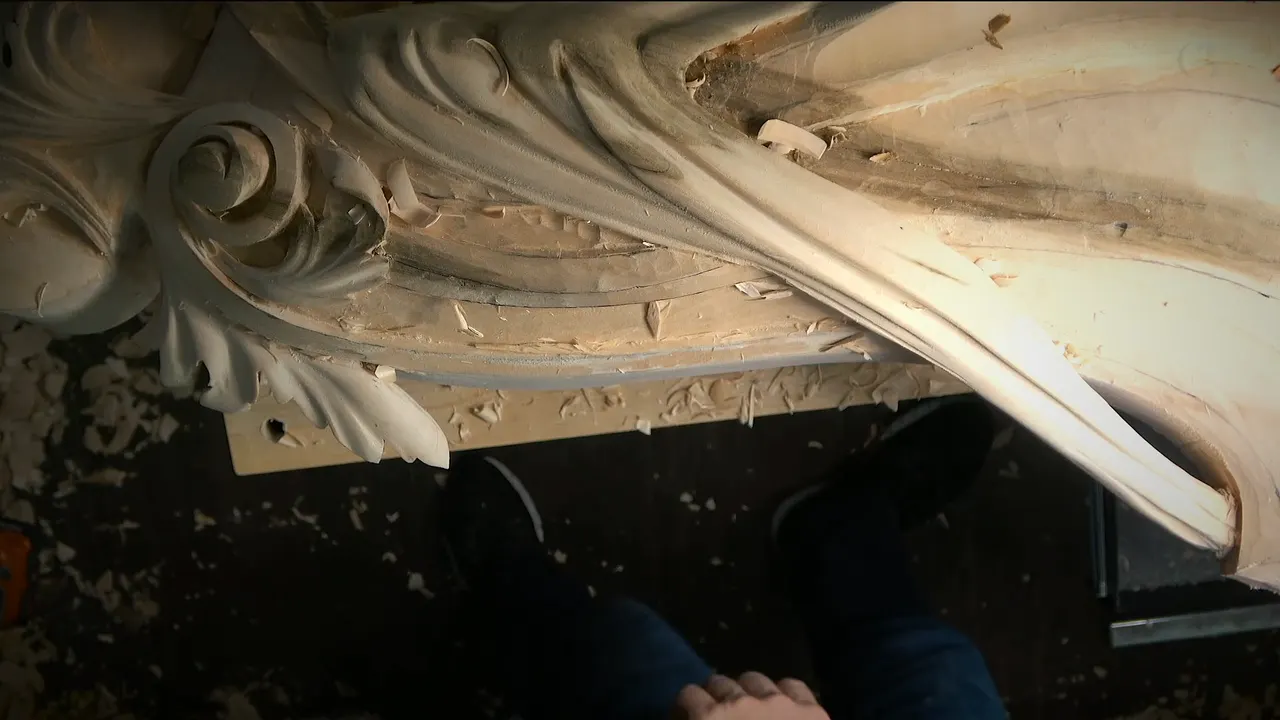

The inner part is a phrase I say in Venice Room 92.1, and in lessons from my other courses. In 92.1 it follows about six millimeters of wood I'd left on the side, a quarter inch (6 mm is 0.24 in).
Have you ever carved the side of a piece and wondered what the middle would get? Did you look at the edge before you looked inside? Follow the two words through my wood carving videos. You will find a Venice Room workshop, a furniture panel, a lily, a rosette, a leaf and a nut.
Six lines from workshop 92
- Its spot is "right here," right after the side is shown.
- My plan runs up both sides to the top.
- Some design would go on inside.
- Two tools are named, a skew and a card scraper.
- A bead on inside is only a possibility.
- One area stays a little higher, because of doubts, and it is left without finishing.
What did I say about the inner part in workshop 92?
Here is what I said in video 1 of workshop 92. "Well, let me actually show it to you." Next, "So that is how it looks on the side. Like I said, it's about six millimeters. That's what I've left, about a quarter inch." Then came the two words. "And the inner part, and that's going to be right here, and I'm also going to continue all the way to the top on both sides. And there's going to be some design on inside."

Lines after those look ahead. "But now, what I have to do, just to clean little bit," and after that "inserts or maybe actually do something else."
A skew was the tool I named in the same video. "Let me just clean it. And I'll use a skew. It's going to give me a really, really sharp line. Just right on top. Almost like planing it."

Next came the card scraper, second among the tools I named in this video. "So I've got a small card scraper, and that way I'll know exactly that is really straight and nice." Video 2 of the same workshop adds "you don't have to use a small one." Then "You could use a normal scraper, a cabinet scraper." For the big scraper, the result would be "absolutely flat and nice."

Did video 2 add words about the inside?
Video 2 gives the inside a bead idea, as a possibility only. "I could do a bead on inside. I don't know if I'm going to do it or not, but that's a possibility, just to add the beads." Then "Not bead like what you saw previously," and "just a continuous beading on inside," at "about eighth of an inch probably." An eighth of an inch is about 3 mm. Of that spot I said "That's why I'm leaving that one like it is, without finishing."

One area stayed a little higher. "I still left a little higher this area because I still have doubts." After it comes "Maybe I'm going to add something, but this section, I'm pretty much done."
Which Venice Room workshops name the inner part?
Workshop 62 reads "But I really need to expose that inner part. Okay? So that's really important for me. I'm using number five." Then "now I can actually exaggerate that slope a little more." Right now, I said, "it's just pretty much like a relief carving almost." A plan in video 12 is to give "a slight shape of sloping," and then "develop an inner part."

Some triangles show in workshop 54, video 7. "I can easily attack those triangles right now and get rid of that." Getting rid of "this" would "expose a lot more inner part, but it's okay."

Over in workshop 56, video 6, comes "I have excavation on inside, and I don't want to get through." Then "it gave me ability to get a little closer to this inner part and clean it a little better." After that came "Let me use a mallet," and then "Really good."

A leaf has the words in workshop 65, video 1. "Unfortunately, you can't see it, but from the bottom, you really see that inner part." Something to clean up came from the back bend. "I need to excavate whatever I've got right there." And "start removing some of that mess I created with the back bend." Number 11 comes into it too. "I just like the idea that number 11 doesn't leave me that sharp meeting line."

Numbers show up in workshop 46, video 1. The ridge comes right after "the inner part." My plan was to leave "approximately, not a quarter inch, but maybe 5 millimeters, about 3/16 of an inch ridge all around like that." Five millimeters is 0.20 in, and 3/16 in is 4.8 mm.

A short line sits in workshop 44, video 2. "But only inner part. Okay?" It follows a line about something exposed. A plan in workshop 16, video 5, reads "let me start with the detail inside right here, so I can just develop inner part." Before it came "when you look from the top," then "what's going on underneath inside," and "the goal is to make it as beautiful as possible."

Another short one is in workshop 23, video 9. "So this part, inside inner part," would "become the part of this outer shell." Measuring is the subject of Venice Room 6, video 2. "I also want to make sure I measure from the inner part." After that, "so 3/16" and "about one-eighth right here. So 5 millimeters and 3 millimeters." Before that I said "I really don't want to measure." One-eighth inch equals about 3 mm, and 3/16 inch about 5 mm.
Workshop 104, video 3, gives a depth. The distance between the highest spot and the lowest spot, on the side of my future flourish, would be about 10 millimeters, maybe about 11 millimeters or so. Those figures equal 0.39 in, maybe 0.43 in. The number one area to work on would be "pretty much just to outline" the inner part, with number 11 and a mallet. The mallet would be "probably a heavier mallet, like 30 ounces or so." Thirty ounces weigh about 850 grams.

A nut got the words in workshop 99, video 8. "I'm after the inner part of the nut," I said, and it would sit "below the head or hat." Then "got to be a little smaller, but not much." In workshop 126, video 1, one part would be "much higher than the inner parts."
How did the furniture panel use the inner part?
Furniture panel lesson 3, video 1, names a point on the board. That point would be the major. The minor has to be found on the "inside perimeter of the inner part," where it would still be the golden point.
Lesson 5, video 3, reads "But I want to establish the feel like everything grows from this point, from my focal point of the inner part." In lesson 7, video 1, I said "I did just the six parts out of 10." Then "This is from the main outline or border, and this is for the inner part. But I'm also going to have another panel inside of those movements." Video 2 adds "So let me get my pencil again." And "Get my inner part."
"Make the subdivisions." The source is lesson 13, video 2. Then "since we've done the inner parts, something like that, so that's a really good idea to do that also right here."
Furniture Panel 23, video 5, has "And go all the way. And again, I have to do exactly the same on the inner part. So give some of the waviness, and I can probably give a really nice concave right there."

In Furniture Panel 25, video 1, I said "Right that flower is not that really complicated." The flower itself would be the inner part. Then "what I would like to do right in the center, I would like to make it. More like a 3D looking one." The center in lesson 33, video 3, is "the center inner part." Lesson 34, video 3, gives "Just the one, uh, the inner part."

Where does a flower have an inner part?
"This side is pretty much completed. I'm talking about the clean side, except the inner part." It is video 4 of lesson 11 in the Lily Box course, on a lily. In video 5: "The only part we need to do for this flower is our inner part or whatever you call it, stamens."

Later in that video I said "it has to be semi-flat at the top." And "So I'll take it to scroll saw." One more line reads "Inner part of a flower, mushrooms growing from inside." That one is video 7.
Two more come from lesson 10. "And they are quite extreme on those inner parts. I'm talking about the concave." Of the edge of a real petal, "they never are really straight line. They're all wavy."
The Hashemi course gives a direction. In lesson 43, video 5, I said "the petals grow from inside out," and the upper part would be "always above the inner part." Also "I could do opposite direction on this side with just a knife."

The rosette courses count them. Venetian Flowers Rosette 2, video 2, gives "five inner parts or petals, whatever you call them. Petals or not petals, but still something like that. But inside of those petals, I need to create some concaves and convexes." And video 3 carries "it has outer petals and inner petals," and "this was the first one when I worked on the inner part."
Rosette 4, video 2, reads "So now, inner part going to go right underneath." A concave was a plan too, "on inner part right here." The Flower Rosette course, lesson 6, video 5, has "my dome form of the inner part."
Do leaves and volutes have one too?
Byzantine Acanthus lesson 3, video 1, reads "On the opposite side, on the inner part on those two leaves." Roman Acanthus lesson 2, video 2, adds "Just keep an eye your grain, okay, where it's not going to snap. And we're going to outline also inner part."

One more line from lesson 16 of the Roman Acanthus course, video 5, is "I need to take care of inner parts. It doesn't look too clean. I need to get smaller, like number five, I'd say."
The plate course pairs the words with a knife. A line in lesson 6 reads "now I can remove the inner part." Then "I'm not rushing anything. That would be a big mistake." Over in lesson 9, "Since we're just using a knife, let me just show you what we can do." And "Outline the inner part this way." Then lesson 11 has "slightly bend toward the inner part."

Maine class lesson 1, video 3, has it with a sloped piece. "To remove the material coming from outside inward. But in this case since we just sloping everything we're gonna go from the inner part toward the outside, but be careful." And lesson 8 has "the center part supposed to be also wavy and so on that is the inner part right there. That's the excavation you've done."
A camera line rides with it in lesson 16, video 2. "I'm gonna finish the inner part which you don't see, you know, there's no way I can put the camera right there a little later, but you should be able to get an idea."
Which figures stand next to the words?
The lines I gave are below, with the size in the other system beside each one.
| Where I said it, by lesson | What stood beside it |
|---|---|
| The side shown in workshop 92, video 1, was left at | six millimeters, a quarter inch |
| Venice Room 46, video 1, shows a ridge planned all around it | 5 millimeters, about 3/16 of an inch |
| I want to measure from it in Venice Room 6, video 2, at | 5 millimeters and 3 millimeters |
| Beside a future flourish, workshop 104 gives a distance of | about 10 millimeters, maybe 11 |
| Exposing it is really important in workshop 62, and I'm using | number five |
| A nut in workshop 99 has it below the hat, and it's got to be | a little bit smaller |
| Lily Box 11, video 5, pairs the words with a name | stamens |
| The Venetian rosette course counts them as petals in lesson 2 | five inner parts or petals |
Which part of your own carving is the inner part? Workshop 92 holds the side, the plan and the two tools I named. The Part 8 course lists all twelve workshops from 86 to 97.
How it's done
- Look at the side. "That is how it looks on the side," with a quarter inch (6 mm) left.
- Name the spot. Its place would be "right here," I said, next to the side I had just shown.
- Plan what goes on inside. Some design was planned for the inside.
- Take a skew. I would use a skew, for a sharp line right on top.
- Check with a card scraper. The scraper was how I would know it is really straight.
- Leave one area open. Doubts kept one area a little higher, and a continuous beading stayed a possibility.
Frequently asked questions
What did I leave beside the inner part?
A quarter inch of wood (6 mm is 0.24 in) on the side. Then came the inner part, with a plan for both sides, and design for the inside.
Which tools did I name in 92.1?
First a skew, then a card scraper, and the skew was for a sharp line on top, the scraper for knowing that something is straight and nice.
Which flowers have an inner part?
The Lily Box puts it beside stamens, as in "our inner part." Venetian rosette lessons count petals as inner parts. The Hashemi course has an upper part "always above the inner part."
How far down did workshop 104 plan to go?
What to carve next