

Alexander Grabovetskiy, woodcarver, School of Woodcarving · Published 2020
What does a wood carver mean by "pinching"?
Quick answer: In part 8 of workshop 92, pinching sits beside an iPad, a panel design and a sheet of paper. Other lessons put the same word beside a tool handle held by two fingers. Each passage has its place below, and its lesson is linked.
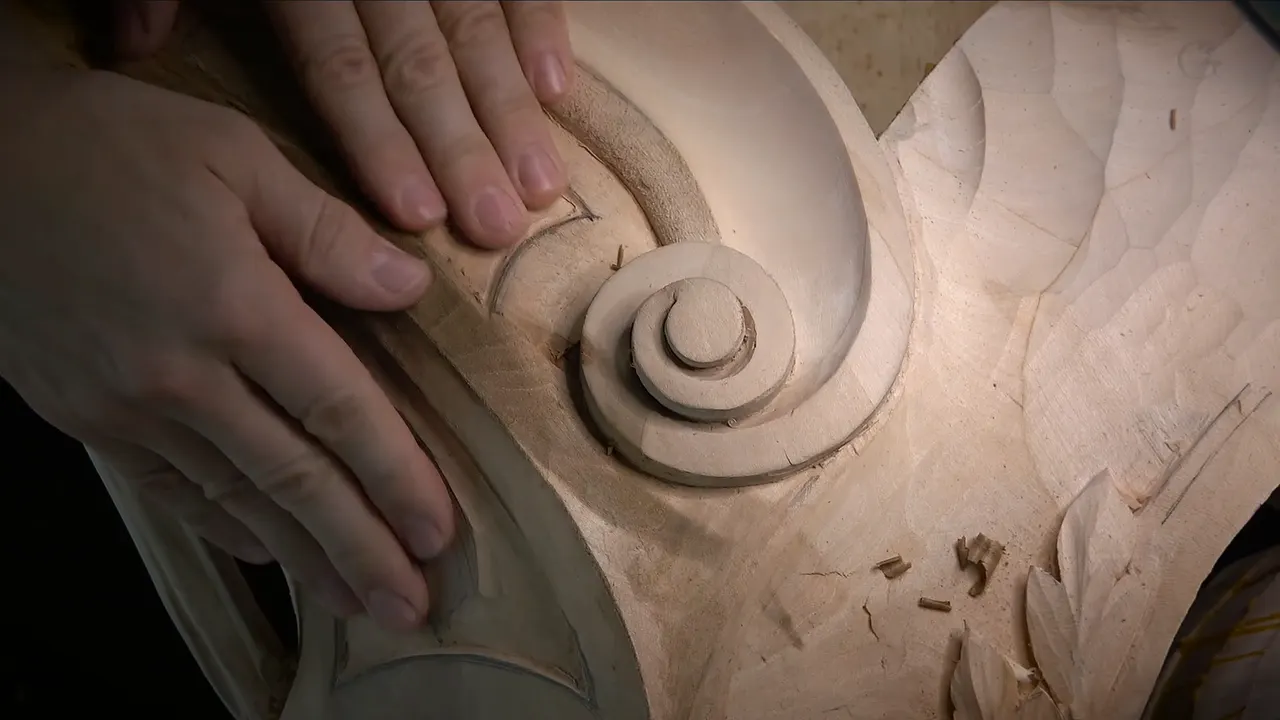

In part 8 of workshop 92, the word pinching sits beside an iPad, a sheet of paper and a measurement for a panel design. In other lessons it sits beside two fingers on a tool handle, and each passage has its place below.
Ever held a drawing against a carving and seen that it looked wrong? You know where this page begins, then. We start in workshop 92, and then visit Hashemi 13, Furniture Panel 18, Rosette 3 and more. Sizes come in millimeters and inches, with my own figure first.
Before the iPad, what does part 8 say?
Part 8 opens on a change of design. "One of the places I have to make the change of design, it is actually inside of those panel areas. Okay? So that is what I'm working right now." A reason follows in the next breath: "But the original design, when I did that on the computer, it looks okay on a computer, but it doesn't really look good in real life. It's just a little too small, and I have to just make it bigger."

Redrawing is named, and left alone. "And, yes, of course, I can just probably redraw that right in place, and I have absolutely no problem with that. All right? But why would I do that if I do have, let's say, really good tools?" The tools get a quick roll call, and the list ends on "I got my iPad. I've got this piece of paper."
Which job does the pinching on the iPad do?
A photo comes first. "I just made the cutout. And what I did, I actually took a picture of this paper and sent it to myself on email." Then the word itself, "And the beautiful thing on the iPad, just the pinching." The pinch gesture has its own Wikipedia page.
The next line says what it gives: "So that's giving me a good ability to measure everything." A job follows, and it names two measures. "And let's say I measured inside how long the space I can fill, both sides, and also how wide the widest spot is here. So that way I know exactly what's the widest I can go with my design."

A plain line sits after them: "So I can just pinch it, whatever, measure approximately." The number comes a few lines on, "So now I'll do inch and three-eighths, maybe a little smaller even." It comes to 1 3/8 in (about 35 mm).
Which old trick comes with the plastic in part 8?
Plastic joins the paper. "And the old trick," then "I'm going to take just the plastic." Pinching returns: "So what I did, actually, I just readjusted with the pinching on my iPad, and now I'm going to take plastic, place it, and be careful because you can pinch it, readjust that, something like that."

A color is chosen next, "some kind of blue," and then "the fine point." One more note on size follows. "I even don't need the whole piece," and then "just a small section of it."
How does the outline get onto the wood from the paper?
Next comes the drawing itself, and then a short note on how exact it must be. "And let me just draw that outline. It doesn't have to be too perfect." The reason is "but at least I will have the outline for that detail." A detail is named after it, "And yes, I do have some kind of round detail. I have a little stem going in."

A more complicated way is named in the same breath as 3D software. "I could just go to 3D software." The line after it is "But it would take time." Then a verdict on size: "So this came a little bigger than what I wanted to do, but it's okay."
The drawing closes on "So now, let me get the lines correct," and on "That's the final result of it."
How does the drawing reach the piece?
By carbon paper, with another road named beside it. "by using just the carbon paper, or you could use different techniques to transfer it, like a graphite paper. It's actually even better, graphite paper. It's just like a pencil, very much." Wikipedia explains carbon paper and graphite paper in two short pages.

Done on two sides, says the part. "Okay. I transferred that on both sides. You don't see this side, but it's about the same idea." A first look follows. "Okay? So now it doesn't look as good, but at least I've got the outline and I can probably start working around."
The iPad stays close to the work. "Okay, let me double-check. I do have my iPad close by, and I can probably place it right here, and that way I'll see exactly what is going on."

Space is short, too. "I don't have too much space. Maybe I'll just shrink a little bit this border, but I can do that a little later."
The part ends on a tool hunt. "So just take my number 11, and in this case, I probably should go with two millimeters or so." Two millimeters is 2 mm (0.08 in). Then "But for some reason, I can't find my two millimeters." The last line is "Let me use three millimeters, and I'll just outline it." Three millimeters is 3 mm (about 1/8 in). Wikipedia covers millimeters and inches as plain words for the two systems.

Its outline in part 9
The outline is picked up again in part 9, and the missing tool is found. "Yeah, that is really strange that I can't find my two millimeters because I actually keep all of my tools at the same location. Found it. So it was just in the wrong drawer."
A depth is named too. "And again, the depth of this area is going to be about quarter inch, the final depth. But I usually go to the final depth at the last moment," and "so I'm leaving about one millimeter to the end." One millimeter is 0.04 in. "So if quarter inch, six millimeters, I would carve approximately five millimeters, which is 3/16th of an inch." Five millimeters is 5 mm (0.2 in).
Is pinching only an iPad word, or does it show up elsewhere?
Here it sits beside the iPad. In the lessons below the same word sits beside a hand and a handle, while each passage keeps its own place.
A finger underneath, in Hashemi 13
Hashemi 13 has it, in part 4, in a talk about prying. "What I'm doing, I'm actually pinching my fingers like this, and I'm creating that space between, and this finger underneath." That stretch has "I'm actually prying against my finger. And I'm not touching wood with the metal." A tool is named just before, "it's number nine, and 10 millimeters." It equals 10 mm (0.4 in).

Earlier in the part sits "I like extreme excavation or undercutting." Just before the pinching sits "Again, I have to keep an eye how I am leveraging." The leverage idea has a page on Wikipedia.

A second tool is named after it: "Now, I could use a spoon gouge." Then "Maybe about seven millimeters," which is 7 mm (0.28 in). Further on sits "Okay. And I like the result what I see." For the tool, see gouge.
The middle finger, part 6 of the panel lesson
Caution sits a few lines before the word in part 6 of workshop 18 of the Furniture Panel course: "Make sure you don't undercut it, okay? Just don't go underneath. Please hold it straight." A one millimeter number 11 is named just before it. One millimeter is 0.04 in.

The hand is described next. "so that's my controlling finger, the middle finger. So I'm placing my tool right on the middle finger and holding like this, and controlling, like pinching between with the other hand, just like that, okay? And that way, you can gain much more control."
Both hands get a place on the board. "Do not raise your hands." Airbrushing is named too, "it doesn't work in wood carving, okay?" See airbrush. The pinky comes next: "I still place my pinky right on the board and just support with the pinky." A line about slippage comes later, "But I still really solidly placed, so that's going to prevent me from slippage."
The handle in Rosette workshop 3
In Rosette workshop 3, a number nine is named first, "just remove the mass of it to dig in." The hold is described a little later, with the handle. "just the pinching between my two fingers, about maybe an inch from the edge." An inch is about 25 mm.

A look ahead is added: "And you'll find yourself doing it actually more and more when you're doing the final details, when you're actually pretty much controlling your edge by two pinching fingers." A little later comes "Again, my number seven."
A thumb in Modern Acanthus 5
Modern Acanthus 5 begins, in part 2, on the middle finger. "That's the right way to use the middle finger, by the way." It shows up a little later, and the line reads "kind of pinching between the two fingers."

The edge is named next. "Use the sharpness of tool you don't have to force it." The thumb gets its line, "But see what I'm doing with the thumb. I'm kind of pushing this hand. I'm not doing anything pretty much," and the line after it ends on "my thumb does all the work."
Pressure in Roman 12, part 5
A warning comes ahead of the word in Roman Acanthus 12: "not to create a lot of pressure. If you do create a lot of pressure, you can just mess up big way." Pinching itself is a short line, "And I'm controlling my tool just by my fingers, just like that, just pinching."

A small spoon gouge is named next, with the finger as a lever. "I'm using, right now, my finger as leverage, just pressing on this part of a tool and leveraging." One finger is held to the piece too: "I'm just holding really tight to the piece, just to get some support for the finger."
Air carving, from part 2 of Roman 16
Roman Acanthus 16 has number 17, "Again, I took number 17." Pinching shows in "I'm actually just pinching between those two fingers, okay?" A wrong way gets a name a little later. "a lot of people who's never carved before making a big mistake when they're carving, I call it air carving."
The fix is a hand with a support. "You have to always find the support for your hand, for one of the hands." Then comes "I'm right-handed," and the gain, "you'll be able to control your tool much better." A limit is named too, "when you're working on really complicated flowers."
Edge distance in Venice Room 93, part 1
Venice Room 93 gives, in part 1, a size and a wish. "One-eighth of an inch, Ok three millimeters. That is what I'm after." The wish gets a word, "I'm after consistency." Then "And keep an eye also I'm holding my hands and how I'm pinching my tool."

A distance follows, "I'm approximately about half an inch from the edge." Half an inch is about 13 mm. Next to that distance sits "But this Hand supporting," and further on, "That is my first cut."
A wall and a blend in the Lily Box
A size on a handle sits a little before the word in part 2 of Lily Box 2. "It's exactly 10 millimeters. It's what it says on the handle." A goal comes next, "to kind of blend everything together. Just carefully." The hold is short: "I'm actually holding just by the two fingers, just pinching."

A reason is given for the care. "I don't want to slip and break my edge, because if you remember, it's really tiny." Two hands get a nod. "Well, you could also hold by two hands. It's okay, too." Then "Just make sure you're not forcing too much."
A wall gets a warning, and a comfort. "If you're going to dig in this wall, you're going to break it." And "You have plenty of material. You can dig deeper, but it's better not to break it."
A pencil hold in the Butterflies course
A hold gets its own line in part 3 of Butterflies 7: "I'm holding that as a pencil." Pinching comes a little later. "Okay, so I'm pinching that and that way I can get really really accurate cut." Two more lines are "I have a lot of control that way" and "I can do really clean cut that way."

Which lesson holds which line?
| Lesson | Where the word sits in that lesson |
|---|---|
| This part | The iPad, a piece of paper, and a pinch to measure. |
| Part 9 | The same outline, a depth of a quarter inch. |
| Hashemi 13.4 | Prying against a finger, and a spoon gouge. |
| Furniture 18.6 | A middle finger, and the hands on the board. |
| Rosette 3 | A handle, two fingers, and a spot near the edge. |
| Acanthus 5.2 | The middle finger, the thumb, and the sharp tool. |
| Roman 12.5 | Pressure, and the finger as leverage. |
| Roman 16.2 | Two fingers, air carving, and a support for the hand. |
| Venice 93.1 | The edge, and a wish for consistency. |
| Lily Box 2.2 | Two fingers, a wall, and a blend. |
| Butterflies 7.3 | A pencil hold, and a lot of control. |
Does a hand on your own tool ever drift in the air? You know the picture I mean. These courses sit inside one tuition plan. The rest of workshop 92 waits on the Part 8 course page, with lesson 93 beside it. For plain words, Wikipedia has pages on the finger, chisel, and pencil.
How it's done
- Measure the space. Part 8 pinches the photo of the paper to measure the space and the widest spot.
- Place the plastic. Plastic is placed, and "you can pinch it, readjust that."
- Draw the outline. The outline "doesn't have to be too perfect."
- Transfer the lines. Carbon paper carries the outline to the piece, on both sides.
Frequently asked questions
What did the pinching do on the iPad?
Right after the word, part 8 says "So that's giving me a good ability to measure everything." Two measures are named, how long the space is and how wide the widest spot is.
How wide did the design go?
"Inch and three-eighths, maybe a little smaller even," in part 8. That is 1 3/8 in, or about 35 mm, and the line itself allows a little less.
Which paper goes between the design and the wood?
Carbon paper, in part 8. Graphite paper is named as another way, "even better."
Which fingers do the other lessons name for pinching?
What to carve next