

Alexander Grabovetskiy, woodcarver, School of Woodcarving · Published 2020
What does a wood carver mean by "traditional"?
Quick answer: In Venice Room 92, part 2, the word sits beside three separations and "a common thing." In other lessons it sits beside English handles, a method with background punches, a way of working by hand, and carving with a long history.
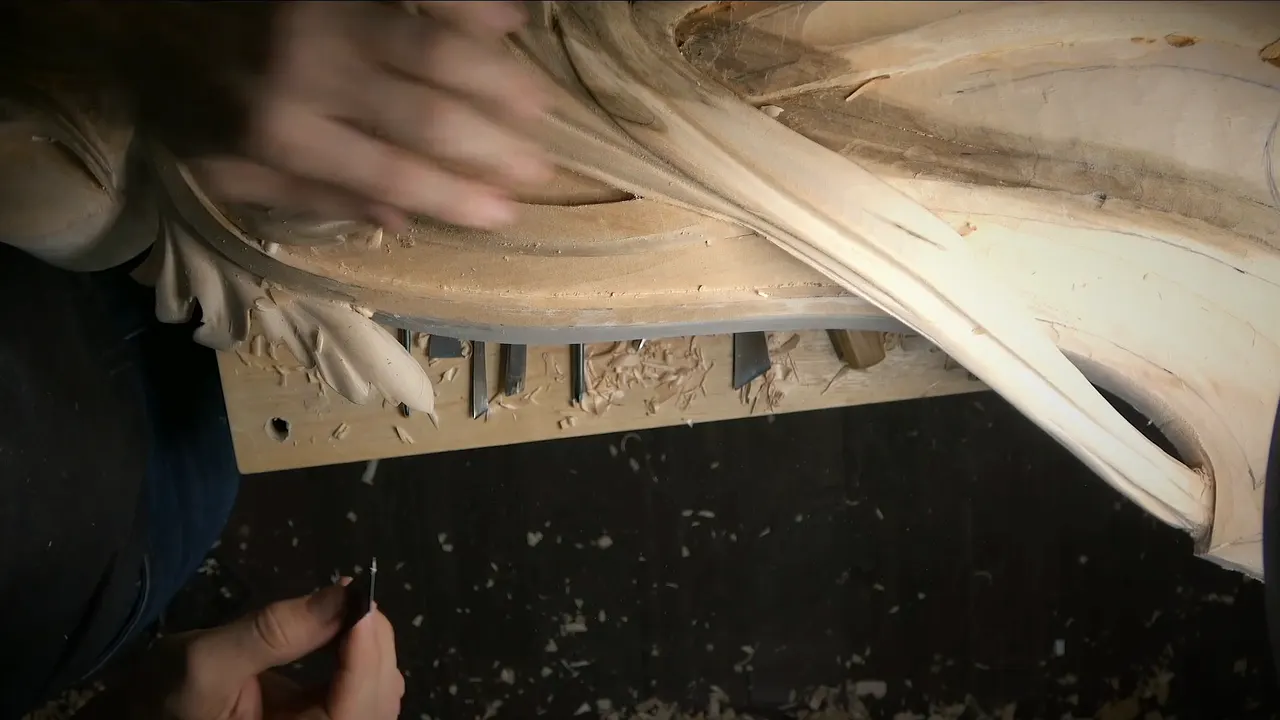

Traditional is a word I use in my videos, and in part 2 of Venice Room 92 it sits beside three separations. The line reads "And just more to the traditional idea," and a few words later "a common thing."
Have you ever looked at a carved leaf and wondered whether the way you divide it is old or just yours? Did you ask which of your tools is old before you asked about the design? Follow this one word through my wood carving lessons, and you will find leaf designs, handles, punches, a frame, a knife and a kitchen board.
How does this video use the word traditional?
Three leaves lead the plan, "free-flowing" ones that go in one direction. No special design goes with them: "It's not like a special design or anything special." The look is "just going to look like it's overlapping from this side."

Divisions are planned, "like three divisions and so on." A second spot has its own plan, "a couple or even three leaves," and I gave a reason for the direction of the first: "continue to flow." Right after that comes "that line, the movement." Then a short line of liking follows: "So and I kind of like that idea."

A third leaf was planned too, going "opposite direction." Both directions share one movement: "So pretty much it's actually continuous, all the movements go in that direction and that direction," and it ends "fluent, or it's going to be organic, I should say."

Then the word itself. "Same idea. It's going to be just the three separations." Straight after, "And just more to the traditional idea," and one more line closes the thought, "also from underneath."
A short verdict follows: "easy," "nice, simple," and "beautiful."
A tool and a depth follow. My first number was 3 millimeters (0.12 in), and then "you know what, I can take bigger one." The bigger one named is "7 millimeters" (0.28 in), "Number 11, of course," and "I'll outline it."

The planned depth is "about 10 millimeters deep," which is 0.39 in, and also "about three-eighths of an inch deep," which is about 9.5 mm. Its range reads "From almost nothing to 10 millimeters, okay?" Then comes "And outline it."

What else is in part 2 besides the leaves?
The video begins with an edge, "beautiful and really sharp," and a doubt about one area that stayed higher: "I still left a little higher this area because I still have doubts." The section itself is nearly done. "Maybe I'm going to add something, but this section, I'm pretty much done."
A scraper does the next job. "So I can just scrape it and make it look nice." Smaller is not required, since "you don't have to use a small one." The choice named is "a normal scraper, a cabinet scraper," and the next line says "Just scrape it with the big scraper," for something "absolutely flat and nice." Sides go "the same way." Flat tools stay possible as well: "And sometimes I could use even flat tools. No, it's not going to dull too much."


A bead stayed only a possibility. "I could do a bead on inside," but "that's a possibility, just to add the beads." It would not look like the beads "you saw previously," but would be "a continuous beading on inside," about an eighth of an inch, probably, which is about 3 mm. The spot waits, left "without finishing."

A look from above is a plan: "I can probably just show you from above how it looks." Then "So that is actually the drop I was working on," and "I am ready to jump all the way to another section right here."

Where does the word traditional sit in my lessons?
Ten places and what stood beside the word in each are in the table. The sections after it hold the lines, with a lesson number for every one.
| Lesson and part | What stood beside the word |
|---|---|
| 92.2 | three separations, "a common thing"; number 11 at 7 mm (0.28 in) in my plan |
| 65.6 | "my traditional way" |
| 72.7 | tools that did not suit a slope, then 5 mm (0.20 in) |
| Lily Box 2.6 | "traditional English handles" and a reason about holding the tool all day |
| Tools Selection | a rounded handle with a satin finish |
| Vase 3.6 | "a traditional method" with background punches, a normal hammer and a shallow depth |
| Rosette 5.3 | a frame made "traditional" and "classical" by movement |
| 132.3 | "traditional rules like a letter S" |
| 135.3 | "Traditional flair" on separated petals, three millimeters (1/8 in) with number 11 |
| Kitchen Board 14.2 | "traditional because it's a tradition" |
Which tools and handles are traditional in my lessons?
Lily Box 2, part 6, has a line on comfort in the hand: "how comfortable my handle is," and "I really like traditional English handles." A reason follows: "I love it because when you're holding that all day long."

The Tools Selection lesson sets two handles side by side. One is "not octagonal, but it's traditional English, and that's a rounded one," with "satin finish on it." I like how it feels in the hand. "If you hold that tool all day long and if it's rounded, for me, it feels more comfortable than octagonal handle like this."

Hashemi Flowers 23, part 1, has the word again. "But it's a traditional English handle," and "I really like it." My opinion stays "still the same" for "traditional tools made in England," even when they are machined: "they're just nicely done." The next plan turns to the volute. "Let me make sure my volute is rounded nicely," with "number seven, 14 millimeters" (0.55 in).

A viewer in my April 2020 livestream on sharpening a spoon gouge asked about handles, and the answer has "That is a traditional English handle." A few minutes on, the same stream adds, about a maker "based in the UK," "they're actually switching from a traditional English to octagonal," and "Some of the tools they're already making octagonal."
A strop lesson sets two ways side by side. In the tool sharpening course, Stropping and Compound 1 has "One approach is using a traditional approach by hand, and another approach is using machines." I was introduced to stropping through my grandfather and his razor: "he would just take a leather, just a leather like that, like a hide, and he would just strop that on the leather." The history behind it reads "He was taught by his grandfather, his grandfather by his grandfather, and so on," followed by "a historical idea." That story has "my grandfather who gave me the first chisel," and "By age of six, I started to carve." The first of three stages reads "One, when you get brand-new tool, so you have to actually reshape it."
In Grape Leaves Vase 3, part 6, the word joins tools and a method: "And since I used the traditional tools, I'm going to use a traditional method." The tool is "those punches." They are "background punches," and "actually made for the wood carving." A normal hammer does the work in the plan, with a mallet left out, and the depth stays low: "So not too deep."

In workshop 72, part 7, traditional tools are ruled out for one spot. "So I cannot use traditional tools or normal tools in this case because I'm working right on the slope, as you understand, but whatever." Next, "5 millimeters first" (0.20 in), with number 11.

In Venice Room 65, part 6, my own way sits beside rifflers and rasps. "Yes, I tried those rifflers, those rasps, and I still kind of like my traditional way." Sanding and shaping stay out of that way. A line on the finish follows: "But I really like the finish out of the gouge or chisel. So it just gives those beautiful marks." The job was "the side of this pipe," and of the rasps and rifflers the line is "Might be I'll use it again."

Which kinds of carving carry the word?
The first lesson for beginners lays out a long plan. In part 2 the plan is to "start step by step from the most ancient forms of carving," and "walk all the way to the most used classical, traditional carving." That lesson names "just one knife." It also says "carving existed 2,000 years ago, 3,000 years ago."

The Curly Kitchen Cutting Board lessons, in workshop 14, part 2, give the word a history. The carving is "still classical, still traditional," though "you can't say that traditional probably." Then the correction: "It is traditional because it's a tradition, but it's a historical carving," with "a long, long history of wood carving."

A livestream on carving knives from April 2020 uses the word about the knife: "I'm using a wood carving knife in traditional wood carving, okay?" In Italy, "they didn't use knives too much." A knife works "even on a complicated forms like that," and on that project the aim was "to be authentic to original carvers." Two rosettes are in the school, "one ancient style rosette and one more contemporary, I mean, modern or traditional modern, I should say."
A story sits in the same stream. The client "wanted to do coffered ceiling," with sides "supposed to be hand carved," and "I had a tight deadline." In my words, "if you're doing a traditional carving, it's almost impossible to cover." My answer was "I designed a carving for just one knife." The coffered ceiling was done, and "it took me one month," with "I made it right on time."
The Dining Table Apron course has two lines in different workshops. In the eighth workshop, a form made "in a clay" and used "as a pattern" can "just establish the form," and then comes "Especially traditional carving." The clients in workshop 17 get the word: "they are more traditional than modern." They like "traditional styles inside of the houses" and are "buying a lot of antique furniture."

A question I read aloud in Venice Room 55, part 4, uses the phrase "the traditional carving" about drawing first and carving from the form. My answer includes "I've done both, to be honest." It goes on to Michelangelo, "a sculptor which probably known to all over the world," who would "take a piece of marble" and "already see the form in the marble." The other approach is "You draw on a piece of paper."
The Tray of Blessing course, in lesson 3, part 3, answers a question about a non-classical approach. "Well you could say no." Then: "There is a traditional approach. You still using traditional tools, but the design wise, you can just do whatever," and "you don't follow those rules."
One more place, a livestream from October 2020. A viewer asked about the carving on a grand staircase in a famous movie, and the reply has "I watched Titanic long time ago." It goes on, "But anyway, it was traditional carving, and I am doing a lot of traditional carving."
Does traditional change what I do with a design?
The Venetian Rosette course, in lesson 5, part 3, joins the word to a frame, "just a standalone project, just a frame," with a pointer to look "online in archives." Making it "beautiful," "traditional" and "classical" takes "some kind of movement, some kind of carving." I drew the oval "just by eye, the old ancient way," and the plan for the divisions uses calipers, with "maybe about an inch spacing between those movements" (25 mm). Another size in that part reads "approximately half an inch, I would say," then "Maybe about 12 millimeters." Half an inch is 12.7 mm, and 12 mm is 0.47 in.

A letter shows up in workshop 132, part 3: "It is not acanthus leaves, but like I said, I'm still going to apply some traditional rules like a letter S. You don't see it." The letter is "what I did right here in this section," and "probably you don't see it, but it is there."

Venice Room 135, part 3, gives a flower a flair. The plan for the petals is "separated," not "laying on top of each other." The flower is "not truly acanthus flower, but it still has a classical flair in it. Traditional flair." The tool is "Number 11 and three millimeters, in this case, one-eighth of an inch," which is 0.12 in, and then a switch to "two millimeters" (0.08 in).

The last place is a question about sanding that I answered in a video on whether to use sandpaper. The answer rests on the finish: "It's all depends On the finish," and "on the application." For that piece it will be "traditionally done gold leafing," "water gilded," in a style that is "mid German Baroque."
What is traditional in your own carving, the tool, the way or the design? The leaves are shown in workshop 92. The Part 8 course lists all twelve workshops from 86 to 97.
How it's done
- Plan the free-flowing leaves. Three leaves in one direction, free-flowing and overlapping from this side, were the first plan.
- Continue the line. A second spot was planned to have a couple or even three leaves, so that the movement would continue to flow.
- Add the opposite direction. Another leaf would go the opposite direction and flow with the movement.
- Count the divisions. Same idea stayed, just the three separations.
- Take number 11. My plan named number 11, and an outline first.
- Plan the depth. Depth starts at almost nothing and ends deeper.
Frequently asked questions
Where does the word sit in workshop 92?
In part 2, right after "Same idea." The line ends with "a common thing," a few words after "three separations."
How deep did my plan go?
About 10 mm (0.39 in), the depth I gave in part 2.
What did I name for the flat surfaces?
A normal scraper, "a cabinet scraper," and "the big scraper," for something "absolutely flat and nice."
Which handle do I call traditional?
What to carve next