

Alexander Grabovetskiy, woodcarver, School of Woodcarving · Published 2020
What does a wood carver mean by "I just missed it"?
Quick answer: In workshop 92, part 3, I name a side I missed. In other lessons I name missed lines, missed spots, another side, the underside of a flower and, in one lesson, a wall, with a check before I move on.
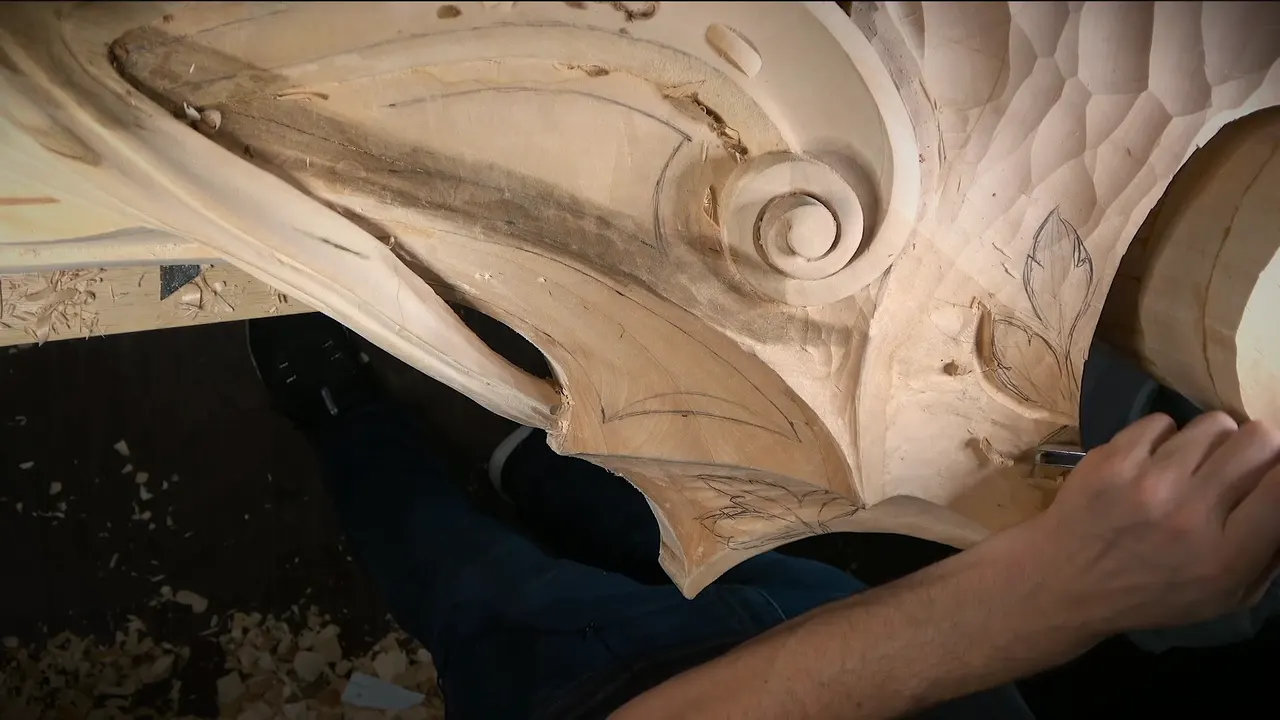

Workshop 92, part 3, has me saying "missed it" about a side I forgot to outline. The line before it adds "Did not forget."
Have you ever gone over a wood carving piece a second time and found a spot you skipped? Did you see it before the gouge got there, or after? Follow one word, "missed," through my lessons, and you will meet missed lines and missed spots.
What was the plan before I missed that side?
This part of workshop 92 opens mid-outline with a plan about notches: "I really don't need to worry about those separations right away, although I could actually notch them right away." A brief line follows, "It's not a big deal."

Shape comes next. The piece has to look "organic," so "I have to round this section and lower down a little bit right here." Another line admits "it's somewhat faking it because I have a straight cut, and you'll understand what I mean."
For the overlap, the words are "to create the illusion that it's just overlapping this way." A deep notch is not needed: "I really don't have to do anything like a big notch or a really deep cut right here. So just indication of it, okay?" That part is "growing from the other side."

On depth, the numbers are "about 3/8 of an inch deep cut," and a moment later "3/8 of an inch deep, so it would be 10 millimeters" (3/8 in is 9.5 mm).

A big hollow is on the list: "So now I need to create a big concave," and "Just remove material around without breaking that point." My plan for it: "I would take probably a number seven, one inch I would say would be a really good idea, and carefully start removing some of that material." One inch is 25 mm.

What did I miss on that side?
Here it is, in full: "And yes, I forgot to outline this side. Did not forget, but I missed it, I should say. I just missed it."

The fix is a plan with a tool in it. "I'll take just a smaller number 11" to "outline it," and a note on that tool reads "This one is a little dull."

Back to the big hollow, with "number seven at one inch, about 25 millimeters" and "I'm going to remove excess." Limits come with it: "I don't want to overdo it because there's going to be also oak leaves growing in this area. So I need that chunk."

The aim is stated plainly. "All I need right now is just to establish this movement right here," and it "has to be gradual, but still nice."
A smaller tool is named next, "a smaller number seven, 14 millimeters" (0.55 in), to "get a little better cut here."

How deep did the hollow go after the miss?
"About 10 millimeters deep," which is 0.39 in, though "It doesn't have to be 10 millimeters deep, by the way. It could be a little less than that."

A reason is given on camera: "The reason why I've done 10 millimeters, just in case if I want to create some kind of movement on the leaves itself." The shape reads "almost from nothing right here. Almost from nothing to much deeper at the end right here."

One spot gets less, where a piece sits higher. "I'll go with just about maybe six millimeters right here at that point because it's too close to the edge." That is 0.24 in, and the line after it reads "Quarter of an inch, six millimeters."
The last lines of the part give one method: "I'm just eyeballing it, okay? So I'm not measuring anything."

Which other lessons mention a miss?
The table lists twelve places, and the sections after it hold the lines with the lesson named.
| Lesson and part | What I missed in it |
|---|---|
| 92.3 | a side left unoutlined, then a number 11 for outlining it |
| Room 3, part 9 | a check for missed spots before digging |
| Venice Room 11.4 | something missed, so a rasp for the high spots |
| Workshop 79, part 7 | a small section, then a line marked "Really important" |
| Panel 18, part 12 | a line, found with a number one |
| Furniture Panel 16.11 | a couple of spots the knife passes left behind, fixed with a tiny knife |
| Antique Rosette 5 | one spot found beside a ridge, with a tool check after |
| Grape Vase 1.12 | a second side that was background |
| Chamomile Rosette 4.3 | an undercut under the flower, found before the paper came off |
| Apron 5 | a part, a spot, then the center |
| Lily 13.10 | a spot without flakes, found while flocking |
| Hashemi 43, parts 4 and 7 | a side not worked yet, plus petals checked one by one |
Do I miss a drawn line before I carve?
In Venice Room 79, part 7, a repositioning step closes with a check: "Let me see if I missed something. And yes, I did miss just a small section, which is this one." After it comes "Going to align those two lines." A line on plastic follows: "I have two corbels like that, so I can save that plastic for another corbel." The method gets a verdict: "So that is a really, really good method."

Another check follows, "double check," and a bigger find: "I forgot to place this line. Really important line." The reason is "V cut almost."
Its ends get marked, "the beginning of the line" and "the end of the line." For a straight edge the plan reads "a ruler," or "a piece of plywood."

In Furniture Panel 18, part 12, the slip lands while a number one makes an indication, with the plan "I'll use a bigger number one." The slip: "missed my line. No bueno." A moment on, "Wait, now it's good." Digging starts right after, "And now I can dig in."

Two more tools are named, "let me use a number two" to "outline right away," and "number three" to "Get inside."
Over in Venice Room 3, part 9, a plan to dig leads into the check, "let me start digging," and the verdict is "And nope, looks fine."

What do I do about a spot I missed?
Antique Style Rosette, workshop 5, puts the miss beside a ridge: "Oh, I missed a spot." Then "It's right here. A couple more pipes." The tool gets a look next, "sharpen that a little bit," and the verdict is "Yeah, much better." The work after it: "I'm just kind of creating a concave, if you wish," and "Just work from the edges in."

In Grape Leaves Vase 1, part 12, the misses sit on the background: "I missed a second side. Because that is going to be background." A caution goes with them, "it's just preliminary setting in, so it's not detailed or anything. So please do not judge." A little further on, "I also missed right here."

The color is still open, ebonized or not: "I don't know yet. Maybe I'll change my mind."
Furniture Panel 16, part 11, makes a knife plan out of a miss: "I've done a knife cut most of it, but I missed just a couple spots. Maybe I can use just a really small, tiny knife."

Those passes have a stated job: "they're not made to remove the material. It's just pretty much outline your movement." They make the later gouge easier: "a lot easier for you later on, not for you, but for me, in this case, and for you, if you will do exactly the same design, to place the final gouge." A tool is named, "my favorite one, number 12," and "I'm not going deep."
Two reasons are given for staying shallow. One is "I don't want to struggle with the harder wood," and the wood here is walnut, a little harder than lime wood and basswood. The other is pressing: "when you press, so those fibers going to smush both ways, and later on, even if you're going to clean nicely, those fibers are going to pop back."
When do I check for missed spots?
Chamomile and Bow Rosette 4, part 3, puts the check before a piece leaves the paper. That lesson reads "Maybe I missed some stuff, but it's okay. I can attack that from the backside," then a stop: "Well, hold on. I forgot something. I need to attack this side first, completely get it done, and then I'll take it out."

The advice follows: "it's actually a good idea to check everything before you take it out from the background, from the paper, and if you miss something." The slip itself is "I missed to undercut underneath the flower." It "took me a couple seconds, and it's easier when it's attached to the background."
In Dining Table Apron, workshop 5, the check closes a tracing step that includes "I shouldn't say almost done with this piece. I still have to carve it." Here is the find: "I definitely did. And that's really important to check that before you take this pattern out, the drawings out." Then "Yep, I missed right here. Although I thought I did it."

Flowers get set in place next, and another gap shows: "But I forgot to do center." A plan for the tool follows: "I need to make sure I create more pressure right here. I didn't press hard enough."
The flocking lesson, Lily Box 13 part 10, opens its box with "Let me get the box, and we'll flock it." The tube comes first: "So just fill half of the tube. Okay? Don't fill too much." The find reads "I found the spot I missed." Right after it comes a reminder that stretches past that one spot: "So that is actually good time to check everywhere." The reason stays open: "And I don't know why I missed. I thought I applied a lot."

A note on the extra follows: "not everything is going to stick, so that's why I don't worry about it." And a plan: "it's better to do a lot more than you need, and later on we're going to shake it out."
Hashemi Flowers 43, part 4, checks a flower: "let's check if I missed something. Yes, I actually didn't work on this side yet." In part 7 the line is "Looks like I'm almost done with every one. Just a few spots left," and "I always can catch because I'm going to work on every petal separately."

One more small check sits in Lily Box 2, part 1: "missed a small detail right here. Okay. It's okay. We'll see how it's going to look in overall composition." Then "One side is done. Let me rotate and work on an opposite side."
In Venice Room 11, part 4, a plan is stated, "I could do a little more concave on this side," and then a good feeling: "I'm kind of happy with the overall feel, but I think I missed something right here." Then "take a rasp and just to find the high spots, because I kind of don't like how it feels right here." Further on, the verdict on the spots: "kind of bugged me. They're not flowing okay in my opinion."
What do I say when I forgot a step?
The drawing in Lily Box 11, part 7, has a gap in it: "when you look at the drawing right here, I forgot to place connecting lines." The fix reads "Just connect that to something," and the apology "Not on purpose, okay? Just forgot. That's it."

Venice Room 61, part 8, drops a miss into the middle of a plan: "Well, actually, I forgot to knock down one more." The reminder reads "So can't forget those waves." A plan follows, "let me think if a quarter inch will do," which is about 6 mm.

In Roman Acanthus 16, part 1, a pass gets forgotten: "I forgot to create cut right here. And I'll do the last one right here." Next, "I'll just try to make my cut toward this cut, but not too hard," and "It's better to take my time."

Part 2 of Hashemi Flowers 5 gives the reason for a V-tool: "I forgot to make a cut in this area. And the reason why I'm using actually a v-tool, because in some areas, if you're going to make a straight cut, just poking and so on, like I said, the wood is weaker, and I can break, actually, also."

Lily Box 12, part 8, ends the run with a wall: "Let me check, double check. Okay. That is a wall I forgot to take care of. And I'll use a knife." It goes on, "Go to the edge, but also see how much material I have on this side," and the spot is "a really good spot to create extra shadow."
Which spot did you skip on your own piece? The first of these lines is in workshop 92, and the Part 8 course lists all twelve workshops from 86 to 97.
How it's done
- Outline before the notches. Separations can wait while the outline goes in, and notching them early is an option.
- Indicate the overlap. Round the section and lower it a touch, with just an indication of the overlap in place of a big notch.
- Set the depth. About 3/8 in (9.5 mm), given in the video as 10 mm, shallow at one end and deeper at the other.
- Clear the hollow. The plan names a number seven, 1 in (25 mm), to clear waste around the point without breaking it.
- Outline the side you missed. A smaller number 11 is the plan for outlining that side.
- Ease off at the high piece. Where one piece sits higher than the rest, about 6 mm (0.24 in) is the plan for that spot.
Frequently asked questions
Where is the line about the unoutlined side?
In the third part of workshop 92, a few lines before the number 11 is named.
What was my plan after the miss?
A number 11 for the outline of that side, and a number seven, 1 in (25 mm), for the waste. A second number seven is named too, at 14 mm (0.55 in).
How deep did the hollow go?
Up to 10 mm (0.39 in) at the deep end, and less close to a high piece, where I chose about a quarter inch (6 mm).
Which lesson has a missed spot in a flocking step?
What to carve next