

Alexander Grabovetskiy, woodcarver, School of Woodcarving · Published 2020
What does a wood carver mean by "go ahead"?
Quick answer: In workshop 92, part 5, I said "go ahead and just do" before a plan for a double-step molding. Other lessons put the words after a fact, a mark or a size I know, and after an offer to you.
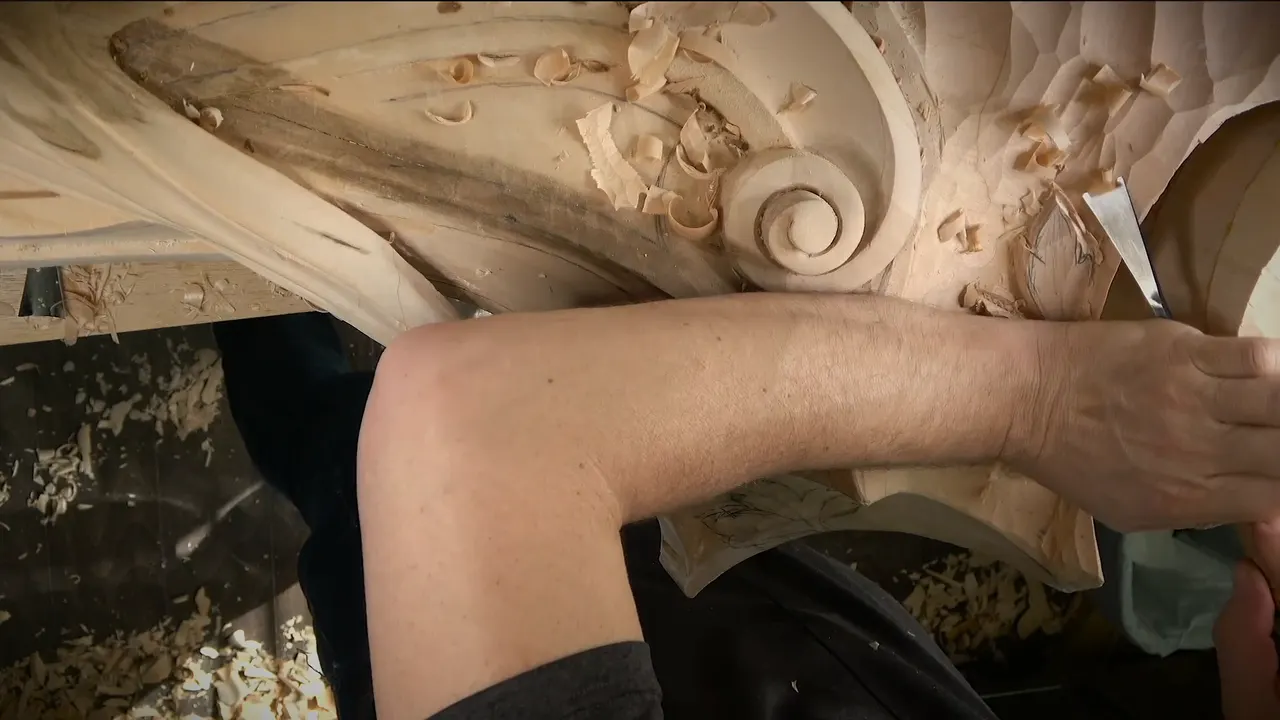

In Venice Room 92, part 5, I said "go ahead" while planning a double-step molding. The same two words turn up in my other wood carving lessons after something I know for sure, and sometimes after I hand the choice to you.
Have you ever known one step while the next one was still open? This page follows my two words through moments like that, one lesson after another.
What was I deciding in Venice Room 92.5 before go ahead?
The part reaches a tool early. "And maybe I can actually use number three right here, too." Then comes the architectural detail and a plan for the drawing: "Maybe I can just draw it right away and just make it look like somewhat how it's supposed to look."

How wide did I make the detail on each side?
One side first: "And that detail is going to be about three-quarter of an inch from this end. So about 20 millimeters this way." In metric the first figure is 19 millimeters, close to my 20. A split follows. One part is "a three-quarter of an inch, and another one, I'll just make a quarter of an inch. About six millimeters."
The other side is the same idea, with a plan to "reduce it because the distance is smaller." Next figure: "about five-eighths of an inch or so" (16 mm). A few seconds on: "And actually, it doesn't look good, five-eighths of an inch. I have to do it probably half an inch" (13 mm). Then a smaller part, "another quarter inch" (6 mm), goes to "a detail."

When did go ahead come in part 5?
Earlier, my words were "I have to make the decision how it's going to look. Let me think first, okay?" A goal follows: "I want to be authentic to the original Venetian styles."
Next was a start: "Okay, let me start. I'm going to now excavate little deeper right here, and then I'm going to excavate another detail on this side." More thinking: "So let me think what I should do."

The line itself reads "Maybe actually go ahead and just do my preliminary deep cut right here." A line follows: "It's going to be like a double-step molding." Look at the words around the line. A "maybe" sits in front, and a plan sits behind.
How deep did the double-step go?
A tool and a size come first. "Going to use number 11" is the tool, with "four millimeters in this case" (0.16 in). A depth I was not sure of follows: "And I'll do, I don't know, maybe even all the way quarter inch" (6 mm). Also "I'm okay" with "a little deeper."

More depth came with the next tool, and the words were "And number seven, and clean it. And maybe even deeper than that." A figure follows: "I'll go 10 millimeters, like three-eighths of an inch right there at this point" (0.39 in, and 3/8 in is 9.5 mm). My reason is "double-stepped one," with "a much deeper area right here. Otherwise, it's not going to look nice."

A route comes in: "Let me go around that leaf." Later: "And take again number 7 and 14 millimeters and remove some of that stuff" (0.55 in). After it I said "See, I'm still not losing my overall feel. That's what I'm after."
Why stop short of the final depth?
My words for it: "So that is why I'm not excavating from step number one all the way to the final depth." The side next to it is "the same thing," and my plan is to "just do up to that point, approximately." Why the side stays short: "I still have to develop a lot more designs right there."

A note to you came next. "show you only this section, but you will understand" what comes after it, which is "exactly the same idea, just those leaves."

The last lines of the part are plans. "Yeah, let me use a bigger number 7." And "let me also indicate right away this movement this way."

Where else does go ahead follow a fact?
Venice Room 85, part 1, starts from what I know. "But one thing I know, this part going to go underneath of this line no matter what." The next sentence begins "Which means I can now go ahead..." then closes on "outline it right away." A second thought sits close by: "But on the other hand, I also have to lower that down somehow."

Workshop 88, part 8, has the fact as a level. "Which means I have to get rid of-- not get rid, but make this part much lower. Well, everything has to be much lower, no matter what." The gouge follows: "chop right now with the big gouge with three inches" (76 mm), "And I'll take big mallet." A mallet sits in that plan too. The sentence after it, "So like I said, anyway, it has to be lower everything, so I can just go ahead...", reaches "chop this out." Then: "Here you go. That is plenty."

Over in workshop 128, part 3, the fact can buy something. "Also, I do have acanthus head going right on top." Then "So I can go ahead..." goes on to "remove a lots of material right here." My limit: "go almost as low as this side, about 30 millimeters almost" (1.18 in). Next: "I think I'll be safe. Well, maybe about 25 millimeters, let's say" (0.98 in), and the cushion is "about a 3/16 of an inch safety for myself" (5 mm).

What follows go ahead when a size matters?
Calipers come first in workshop 86, part 6, and the plan reads "measure that from the end with the different calipers. And let me put the mark approximately." After it: "So now I can lower that with no problem." The next words in the lesson are "let me get the number 7 at 14 millimeters" (about 9/16 in) with "go ahead" before "remove it."

The same part says what the first one is allowed to be: "this is the first one, and I can allow some mistakes on the first one, and changes of the design and so on." For the second one it is "opposite direction," and measuring there is "a lot easier, actually."
My Dining Table Apron workshop 16 has a plan with a later check inside it. The words are "not going to go as deep right now because later on," then "compare that to the original" and "stick edge to edge and make sure it fits perfectly." A line of mine for the section is "So let's go ahead..." with "remove this section" at the end. The tool I name is "my small, tiny number three."
Floral and Molding for the Panel 10, part 1, counts the wood I leave. "And I am leaving some of the material between my line and the end of my cut." The reason is "a lot easier to clean." One figure is "five millimeters, about three-sixteenth of an inch" (0.20 in), and another "about 10 millimeters material" (0.39 in). Last in the run: "I have absolutely no problem now just to go ahead" before "clean the opposite side of my cut."

Floral and Molding 4, part 3, hedges it. "So I've got approximately a pseudo line" is what I said, and then the line "really low, so I could probably go ahead..." continues "do it even more."
Grape Onlay 8, part 2, puts a verdict before it, in two short lines, "I don't wanna overdo it" and "for me it looks good." Then "I can probably go ahead..." closes on "undercut with the same tool with the small number 11 and two and a half millimeters" (0.10 in).
A detail needs protecting in workshop 93, part 6: "I do have a small detail actually flipping above right in this section, so I don't want to lose it." Next in that run, "So let me go ahead...", closes on "outline it with the same tool, that detail also."

Furniture Panel 19, part 11, has a very small size. "looks like I need to take care of this side a little better." Next, "Let's go ahead..." reaches "remove about 1/32 of an inch" (about 0.8 mm).
When do I wait for a yes first?
Hazelnuts 7, part 3, has two go aheads in one stretch. "Again, I'm not after the final detail." Then, to you: "But if you want to go ahead..." continues "just work ahead of me, feel free to be creative in this case." Mine: "I'm not getting veins yet in my leaves." The reason is "I'm not sure yet if I'm happy with the overall shape."

For me: "Once I can say that, yeah, I'm happy, I can go ahead..." ends with "do the finalized shape," and the leaves in that clip belong to the course on hazelnut carving.
When is go ahead an offer to you?
Next, workshop 142, part 2, has me saying "I'm just trying to be as close as possible to the golden ratio, and yeah, I'm eyeballing it. I really don't need to measure it, but if you feel you really need to measure, just go ahead..." The cue ends on "do that." My tool there was "the same number seven, what I used before. In my case, it was about an inch" (25 mm). I name the golden ratio there.

Lily Box 4, part 10, comes from a lily box course and puts it close. "I'm not measuring how much I'm leaving. I'm just eyeballing it. For me, it works fine, eyeballing effect." The offer: "if you don't feel comfortable with just eyeballing distance between your surface and to the detail, go ahead" is followed by "measure." Then "There are many different ways to measure it. There's the calipers you can use."

I use them too: "I'm using, actually, calipers a lot when I'm working on big projects, like three-dimensional big projects." Also: "without the calipers, it's almost impossible sometimes to do, especially if I have to do a couple, almost the same things, like duplicate."
Chamomile and Bow Rosette 4, part 1, has paper where other lessons have calipers, in a chamomile rosette course. "And obviously, I'll just eyeball it. I don't really need 100% accurate. If you worry about being 100% accurate, so you go ahead..." leads to "just use a paper again." One more line: "Much easier to just twist the paper than like a ruler or something like that."

Venetian Rosette 3, part 2, hands you the tool choice. "By the way, in my case, I'm using number 11s, but you could use V tools." Then: "But you go ahead..." leads on to "feel free to use whatever you feel the best." About my own pick: "I really don't have to use it. I'll use a number 11 and like a half a millimeter, and I'll achieve exactly the same result" (0.02 in).

Furniture Panel 21, part 13, hands you a design change. "I have to fix this curvature. It doesn't look good." A size comes: "number eight again, whatever fits, and in this case, it's about half an inch" (13 mm), then "about maybe 14 millimeters" (0.55 in).
Then the offer. "It does not have to be 14 millimeters. Whatever fits. Okay?" Then "I mean, I'm talking about your panel." It reads "And go ahead..." which carries on to "change the design if you need to. I'm talking about what tools you have."

What comes after go ahead across my lessons?
The table sets my words beside what follows them, one lesson per row.
| Lesson | What comes next |
|---|---|
| This part, 92.5 | a first deep pass planned, with maybe in front |
| Room 85.1 | a thing I know, then outline it right away |
| Lesson 88.8 | lower everything, so chop it out with the big gouge |
| Room 128.3 | an acanthus head on top, so remove a lot of material |
| Calipers in 86.6 | a mark first, then the number seven |
| Apron 16 | compare to the original later, so remove this section |
| Floral 10.1 | some wood left, so clean the opposite side |
| Floral 4.3 | really low, so probably do it even more |
| Detail in 93.6 | a small detail I do not want to lose, so outline it |
| Panel 19.11 | this side needs care, so remove a thin amount |
| Hazelnuts 7.3 | work ahead of me if you want, and mine comes once I am happy |
| Workshop 142.2 | eyeballing is fine for me, measure if you feel you must |
| Lily Box 4.10 | calipers when you are not comfortable with eyeballing |
| Chamomile 4.1 | worried about 100% accurate, so use paper again |
| Rosette 3.2 | number 11s for me, use whatever you feel is best |
| Furniture 21.13 | change the design if you need to, whatever fits |
This video belongs to workshop 92, and the Part 8 course lists all twelve workshops from 86 to 97. Part 7 holds workshops 74 to 85, and the Hazelnuts course and the Dining Table Apron course hold two of the lessons above.
Would you like to watch where my go ahead lands in the wood, and where it waits? Tuition opens the whole school, and this room is one course inside it.
How it's done
- Note the sizes. Part 5 gives a width near three-quarter inch (19 mm) on one side, then about five-eighths (16 mm) and 1/2 in (13 mm) on the other.
- Stop and think. A pause comes before the start, with a goal: "I want to be authentic to the original Venetian styles."
- Say the plan. A hedge comes first, then the deep first pass, then "double-step molding."
- Pick the tool. Number 11 at four millimeters (0.16 in) was my plan, then a number seven for 10 mm (about 3/8 in).
- Hold back. My plan was to go only up to that point, approximately.
- Hand it over. Other lessons offer you the same choice about calipers, paper or a tool of your own.
Frequently asked questions
Where in workshop 92 does go ahead appear?
In part 5, near the start of the double-step molding plan, with "Maybe actually" in front of it.
How deep did I plan the double-step?
"I'll go 10 millimeters, like three-eighths of an inch right there at this point," because I needed a much deeper area there.
Is it meant for you or for me?
Both. In 92.5 it sits in a plan for me, and in Venice Room 142 it comes as an offer about measuring.
Which tools sat beside go ahead?
What to carve next