

Alexander Grabovetskiy, woodcarver, School of Woodcarving · Published 2020
What does a wood carver mean by "simple"?
Quick answer: In Venice Room workshop 92, part 7, my line about the leaves is "They're just pretty much really simple ones." Slopes, a number 11 and a few concaves and convexes follow. Other lessons carry the word for an acanthus, a flower, a molding and a jig.
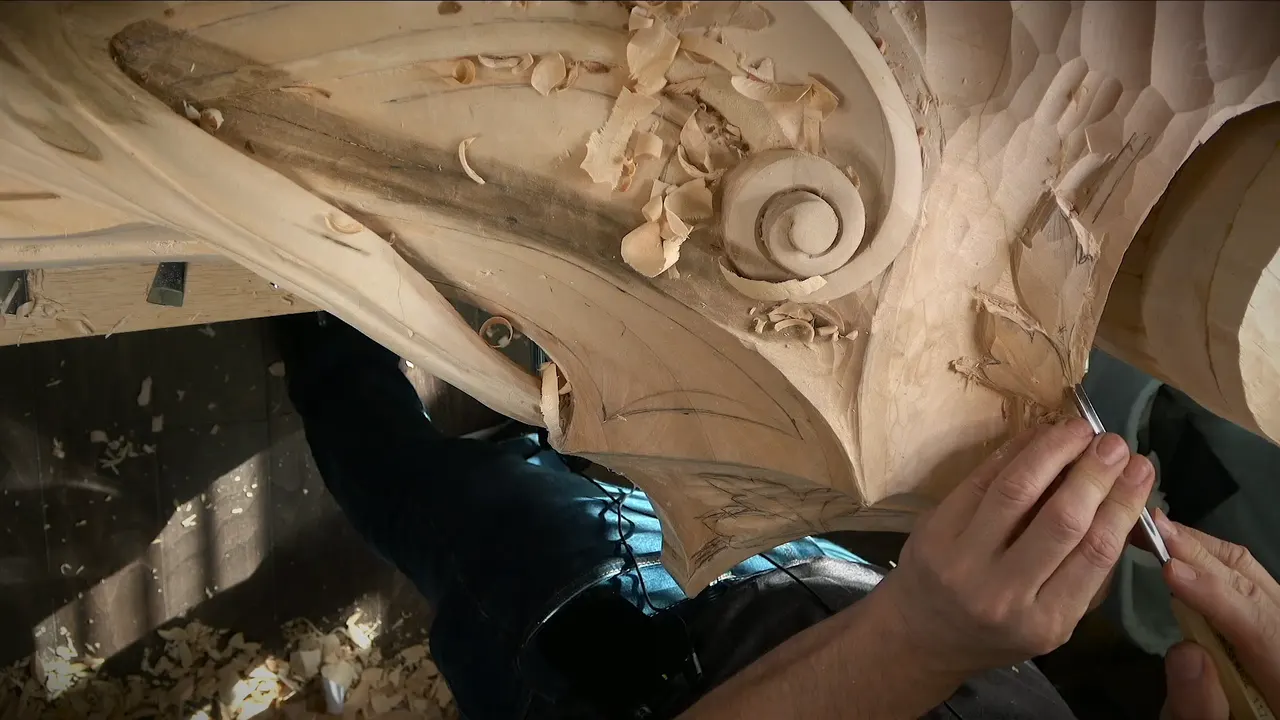

In Venice Room 92, part 7, I put the word "simple" on the leaves, with slopes, a number 11 and a few concave and convex shapes to follow. The same word shows up in my other wood carving lessons.
Have you ever looked at a carving and thought it must be hard, then watched it go in and found it was not? This page follows one word through a Venetian part and a long run of older lessons.
What do I call simple in Venice Room 92.7?
The part opens on a plan to finish one leaf: "I'm going to finish just one leaf, and you'll get an idea because it's nothing complicated."

Shape is the first plan on the leaf. Sloping is the way to give "a little more movement." The plan for the next leaf is the opposite direction, and for the one after, "the same thing." The aim is "a little 3D shape."

Then comes the line this page is built on: "Like I said, nothing special about those leaves. They're just pretty much really simple ones."
One line gets a rule. Its right side goes lower in the plan, and the tool is a number 11, leaned "a little away."

Cleaning is for later: "all that cleaning I'll get done little later." The undercut waits too, with "the same tool," at the end and "not right away."
Which size does the simple leaf get?
A plan names it: "Going to need two millimeters, or pretty much any, three millimeters, four millimeters will work, but I'll take two millimeters. Number 11, of course." In inches that reads 0.08, 0.12 and 0.16.
A careful undercut is the next plan, "from all of the sides." After it, "it doesn't look clean," and "you should get an idea."

A few concave movements go along the middle line: "Here is the middle line, and I'm just going to create a few concave movements." Then: "So pretty much like I said, it's going to be really, really simple. But still nice."

Depth stays shallow. "I'm not going to do really deep," so a number seven is named, at "14 millimeters, half an inch." The two figures sit close, since 14 mm is 0.55 in and half an inch is 12.7 mm.

These leaves are not acanthus, and so "I don't have to follow the rules." Still, "they still have to look good or somewhat good."
An option is a number 11 at 10 millimeters (0.39 in) to "exaggerate some of that movements." The part ends on a plan for all of them: "I'm going to do on all of them and clean around."

Where else in the Venice Room does the word land?
Venice Room 68, part 6, gives it to an acanthus that goes down: "Very simple. Really simple acanthus." Then "that part definitely will go also down underneath." A reason for stopping short: "I just damaged a little bit this piece. That's why I'm not finishing completely until I've done with all the roughing in, like rough carving, like rough carpentry."

Part 4 of that workshop names a part as "probably the most simple one because most of it's going to be hidden." What it needs is "pretty much those divisions," and to show you: "I would probably just get a marker."

Over in workshop 70, part 4, a section is "probably the most simple one from this composition." Blending a little is the plan, and "the transition" has to be "actually smooth."
Part 7 of workshop 89 has the line "So simple, but beautiful movement, in my opinion, of course." The tool is number 11, with "I'll take seven millimeters" (0.28 in), and "looks like I need to strop a little bit." In part 6 the line is "a simple one. Nothing complicated." The middle line there comes "by the golden ratio," with "a three-leg calipers": "this leg falls on about 60% out of this distance. So 60/40." And "If you do have a golden ratio calipers, it would be much easier."

In the Part 3 course, workshop 37 has a maybe: "maybe I could start removing some of it underneath, but not much because we still have to work on the shell." The warning is "I don't want to make a mistake and excavate too deep." Then a verdict: "it's just simple but beautiful, I'd say." And a need: "I need to blend it better."

Workshop 100, part 10, gives it to a small detail: "that really simple detail," and with it "a really nice movement." More time for cleaning it is the plan.

Workshop 139, part 1, has a flower and the same pair of shapes as 92.7. "Here is that type of flower, which is a really simple flower. It's simple, but looks good." Then a plan for "some concaves and convexes," with "make sure that feels really round" as the check. Another line: "Just get that concave right to the middle of it." And "I need little by little, just cut by cut, slice by slice."

Part 2 of workshop 147 reads "Just a simple acanthus. Nothing complicated, but it divides in two parts," and one part is "going to go underneath that flower." A long pipe is in the plan: "I think that pipe will work a miracle." Then "That pipe is going to just complement that movement."

Over in workshop 133, a flower gets it, in part 3: "this is a simple one, okay." An outline with number 11 at "12 millimeters" (0.47 in) is the plan, and "I can go actually low with this. Really low." And in workshop 146, part 1, a "simple one" is "just a rolling shelf," and a rasp is on the list for the blending.
Which other courses say it?
Floral and Molding for the Panel 12, part 2: "that acanthus, which is simple." Its shape in the plan is "concave, convex, concave," with "concave number one and concave number two," and the middle line at "60-40." The tool is "number 11 again," at "five millimeters, three-sixteenths of an inch" (about 0.2 in).

The Chamomile and Bow Rosette course, part 1.2, gives the word to five petals: "really not that complicated." Between them, "much deeper cut and wider cut," and a shadow in the plan. The deep spots could take "the small, tiny gouge I used previously. Like one and a half millimeters" (about 0.06 in).
The Byzantine acanthus course starts with "really simple form" and three divisions: "division number one, division number two, and the main movement." Lesson 8 has "just the simple stuff. Simple leaf, nothing more." A twist is allowed: "as much as you wish."

Greek Acanthus Leaf 1, part 3, puts a limit on it: "it's still somewhat simple." What follows: "later on you'll see we're going to work on a really complicated acanthus leaves."

In the design stage of Furniture Panel 9, part 4: "I think I could just put the simple acanthus leaf." The molding gets a plan too, and then a verdict: "I do like what I see right here."

The Flower Rosette course, part 1.1, has a design that needs no redrawing, "because it's a really simple design, although it's a really nice design, actually." It is "a nice practice piece" for "architectural carving, designs, and also in furniture."
Acanthus over Moldings 1 says "a really couple simple moldings" in its first part. The drawing is on "a normal printer's paper," and the tape makes it "a lot easier to trace and check."
In Butterflies 7, part 1, flowers are "really simple." What I did: outline them, then "excavated really really deep at the point where it's supposed to be connected to the stem," about "1/8 of an inch deep" (3 mm), on "every flower." Butterflies 13 calls the elements "really simple" too, and Butterflies 6 has "the idea is pretty simple."

The Grinling Gibbons class in Maine, lesson 4, part 3, has it on filler flowers: "Really simple. Don't overcomplicate." A warning follows: "please don't overdo it. That would be big mistake." They are "so simple, the 6-year-old child can do it," and "you got to have 5 petals." On the flowers Grinling Gibbons made: "his flowers really simple." My line for mine: "I still want to create some kind of movement on inside." Class lesson 15 adds "pretty simple, but this flower gonna look really nice."
Venetian Flowers Rosette 4, part 1: "Nothing complicated. It's a simple couple leaves." The leaves get "a twist down on this side and twist up on that side." One side stays "as a high spot," and "overall, it's still going to go downhill that direction and that direction."
The beginner workshops course uses the word on whole designs. The first lesson, part 4, has "we'll do a simple design. Really simple design." Then "Let's do a stem, and let's say few leaves. Just freehand drawing." In workshop 2, part 6: "that is a simple design. But with exactly the same technique, you can do really beautiful things."
Greek Acroterion 4, part 5: "Really simple." Then "I'll just use knife and remove this section," with "one-eighth of an inch" (3 mm) and "a really low angle."
Does simple mean easy?
Lily Box 13, part 1, says no: "They look really simple to do, but don't be fooled. They're not as simple as it looks. Sometimes it takes longer to do alephs than some of the flowers." Then: "I've got two sets, and there's a double and there's a triple."

The beginner course turns it around in the curly kitchen cutting board lesson: "I know some of you maybe think it's too simple, and the course called for the beginners." Then: "so many beautiful things" from "limited amount of tools." The warning: "it's not that easy to utilize just one knife."
The Schaaf tools lesson picks a middle road for a test piece: "but not too simple." Grapes are the plan.
Roman Acanthus 16, part 3, says "nothing complicated whatsoever," then adds: "make sure you're not pressing anything. You're just slicing, okay? Let the knife, let the tool do all the work." And "you don't have to use a knife. If you have a number one, just a chisel or a single bevel, or if you have a double bevel."
The word sits beside tools in Lily Box 7, part 10: "really simple wood carving," where "you can get by with smaller amounts of tools." More tools go with the "more complicated" kind.
Do I use it for tools and steps too?
A livestream on plastic has "I know it's really simple, but a lot of people didn't think about it." It is "one of the probably most useful tool in wood carving." That one sits in the livestream events course.

The straight gouge sharpening lesson plans "just one attachment," and "a really simple jig." On a machine in the stropping lesson: "It's so simple. That's what I love about it." Its parts are "Just a motor, pretty much," and a wheel of felt.
Grape Leaves 3, part 8, puts it on a step, with "black stain" in hand: "Application is really simple pretty much." A note: "it's a good idea sometimes to cover and just make it wet with denatured alcohol." Then: "Don't pay attention to blotchiness yet."
How do the lessons compare on this word?
The table sets one lesson per row, with sizes in millimeters and in fractions of an inch, as they are said in the lessons.
| Lesson | Where I put the word on the carving | What I add |
|---|---|---|
| 92.7, my own part | the leaves, with "nothing complicated" said at the start | slopes, number 11 |
| 68.4 in the Venice Room | a part that stays hidden, so only the divisions are needed | a middle line |
| 68.6, same room | acanthus that goes down and under | rough work first |
| Venice Room 89.7 | a movement that is "beautiful" as well as simple | number 11, 7 mm (0.28 in) |
| Workshop 100.10 | a small detail that still gives a nice movement | more time cleaning |
| 139.1, a flower | a flower that "looks good" and has to feel round | slice by slice |
| Part 147.2 | a two-part acanthus, with one part under a flower | a long pipe |
| Floral and Molding 12.2 | leaf with a concave, a convex and a concave | number 11, 5 mm (0.2 in) |
| Chamomile Rosette 1.2 | five petals, then much deeper spots between them | a gouge of 1.5 mm (0.06 in) |
| Byzantine 1.1 | a form with three divisions, one of them the main movement | markers and twists |
| Furniture Panel 9.4 | a leaf for a molding that moves | a good look |
| Butterflies 7.1 | flowers outlined, then dug deep where each meets the stem | 1/8 in (3 mm) |
| Gibbons class 4.3 | filler flowers with five petals, most of them hidden | a warning |
| Lily Box 13.1 | parts that look easy and still take time | a surprise |
This video belongs to workshop 92, and the Part 8 course lists all twelve workshops from 86 to 97.
Would you like to see where "simple" lands in the wood? Tuition opens the whole school, and this room is one course inside it.
How it's done
- Name the plan. Part 7 opens with one leaf to finish.
- Give the shape. Sloping on each leaf, and "a little 3D shape."
- Pick the size. Two millimeters, 0.08 in, and number 11, "of course."
- Add the shallow shapes. A number seven, 14 millimeters (about 0.55 in), is named.
- Leave the cleaning. "All that cleaning I'll get done little later."
- Look at other lessons. The same word sits on an acanthus in workshop 68 and on a flower in workshop 139.
Frequently asked questions
Which gouge is named for the leaf in part 7?
Number 11, with two millimeters (0.079 in). Three or four millimeters, 0.12 or 0.16 in, are named as working too.
How deep are the shallow shapes meant to go?
The seven again, 14 millimeters (0.55 inch), and not really deep.
Which other Venice Room parts say it?
Workshop 68, parts 4 and 6, workshop 89, part 7, workshop 139, part 1, and workshop 147, part 2.
Does simple mean easy?
What to carve next