

Alexander Grabovetskiy, woodcarver, School of Woodcarving · Published 2020
What does a wood carver mean by "the tiniest"?
Quick answer: Workshop 92 has "the tiniest" beside the last stretch of an outline, with a wish not to spoil it nearby. Other lessons put the word beside a small spoon, a back bent, a V tool, a router plane, a lamp and the shadow of each move. Each passage has its place below.
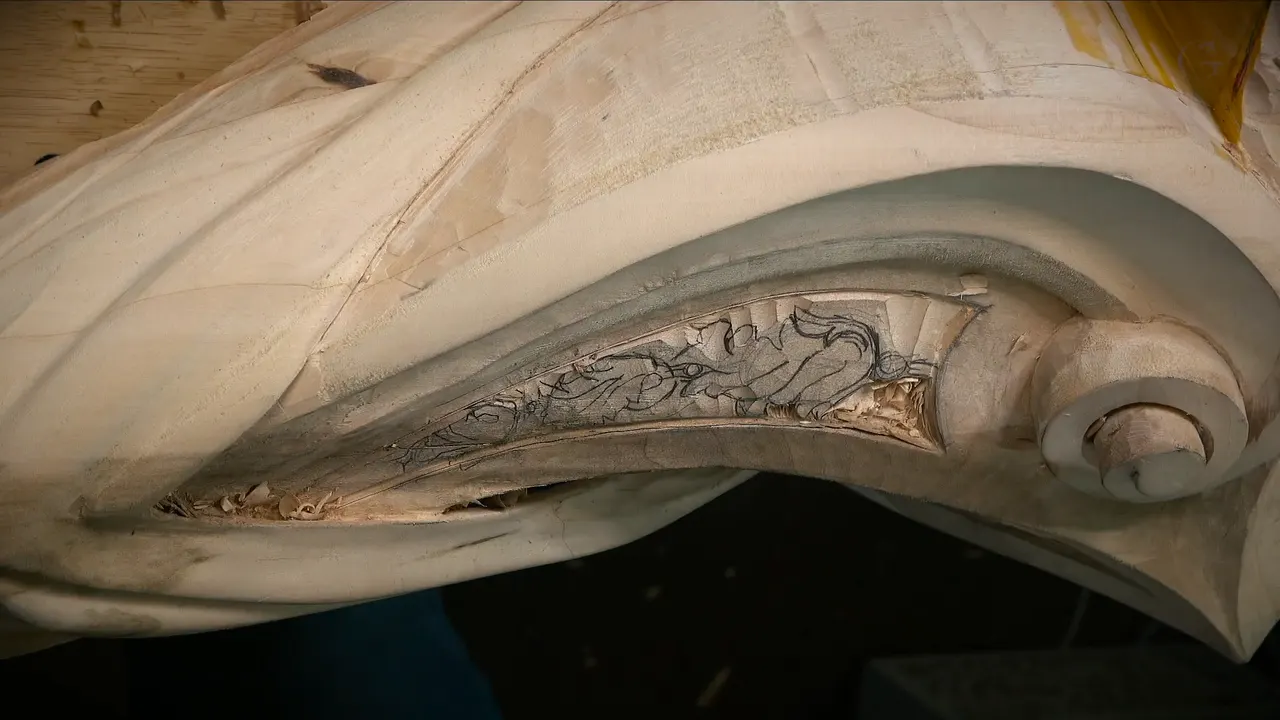

In part 10 of workshop 92, "the tiniest" sits beside the last stretch of an outline, with a knife near a wall. In other lessons the same word sits next to small tools, a lamp and a shadow, and each passage has its place below.
Ever bent over a drawn line and felt the spot you were afraid of getting close? This page starts in workshop 92, then visits the Venice Room and other courses. Sizes come in millimeters and inches, with my own figure first.
What happens in the outline video before the tiniest part?
The video opens on a line already drawn, with "So here you go. That is my outline." A check is planned right after, and the wording is "I will have to double-check how straight that is." The doubt is about "any waviness," and the same line says "it's a little too early for me right now."
Then the speed. "See how quickly I can outline everything." A warning rides on the same breath, about a knife that "is super sharp, and it can penetrate really deeply." The result named is "I can damage my background."

Next comes the reason the risk is small here. "In this case, it's going to be okay because I'm going to have the background texture." The lines close with "So it should not be a problem."
After a short "Just go around," a time is given: "pretty much in a couple of minutes, I can outline the whole thing."
Where does "the tiniest" land in the outline video?
It sits near the end of the outline, in the line "And this is the last part. And the tiniest part." Two details follow in the next lines, "hardest part because of the material in this area" and "I don't have too much space also."

Two short lines follow, "Make a little change right here," and soon after, "And that's pretty much it."
Nothing in these lines gives a size for the spot. What sits around the word is the material, the space and a wish not to spoil it.
Which plan follows the finished outline?
Cleanup is next, and it is a plan, in the words "It's just a matter of cleanup." Then "Let me use a knife and present at an angle." A limit comes with the plan, "I don't want to cut too deep."

The wall gets a second mention, with a condition: "If I'm going to dig too deep," then "damage this wall." Then, on this piece, "In this case, it's okay, but usually, I don't want to see that damage."
Later a spot gets a note, "I need to carve a little deeper right here," and the next lines say "I can always remove some of the material quickly with the knife." One more reminder: "Still have to be careful."

A tool choice sits near the end, "I could use pretty much any gouge because I do have a previous cut, so it's going to just butt against that cut." The closing warning reads "got to be careful not to damage it."
How deep was the knife line in the next video?
It opens on a depth. "I think I made it about one-eighth of an inch deep." The metric figure is about 3 mm. A plan comes along: "I can always deepen it if I need to right on the go."
The same video names the wood. "I do have a lower layer of wood. It's laminated, so I already got that to the glue line to this point."
Which Venice Room tool reaches the tiniest spots?
Two other Venice Room lessons give the word to tools, and each has its workshop in front.
Number nine, in workshop 52
Venice Room 52 names a starting tool in part 10. "Sometimes it's a good idea to start actually with the smaller number nine. And I really love this small number nine. It has a cutting part only at the end."

After that comes the word, with a place to try the tool. "It's still full-size tool, but the beautiful thing about it, I can get to the tiniest spots, like here, okay, using just like that, and start carving on inside." One limit is named next, "I can't pull it like this. I still have to rotate, but I can excavate really, really deep and create beautiful cavities."
A smaller punch, in workshop 93
Punches sit beside the word in part 12 of Venice Room 93. "I need to use a smaller punch, and I'll use just the rectangle one." A thought follows, "Maybe it's a good idea to get two sets and then reshape some of them to make it smaller a little bit."

A note on one angle comes next. "For example, this angle, I could make it just a single run to get to the tiniest spots." Right after it, "But usually, it doesn't really necessary." And then "It fits pretty much in most of the visible areas."
Which small tools reach those spots in other courses?
Outside the Venice Room the word sits beside a spoon, a back bent, a skew, a fishtail, a V tool and a plane.
A tiny spoon
Part 3 of Floral and Molding for the Panel 13 puts a choice before the word. "You can just attack from two sides, and some of the details you're going to leave out, so you're not going to be able to work."

The tool comes next. "But with a tool like this, I can get in the tiniest spots," followed by "I can create my cut with no problem." For its size and shape, the lesson says "This one is a one-millimeter tool," with "Number 9" next and "Really small, tiny spoon" after that. In inches, one millimeter is 0.04.
A short back bent hook
Floral and Molding for the Panel 8 picks an old tool in part 3, "It's an antique one," and the hook is called "really short" and "still back bent." The tiniest spots sit within reach of it, and the lesson adds "Any back bent will work."
The reason for the pick is a feeling, "I could probably get by with the straight tools." Then "I just feel" it is "safer just to use that back bent."
Back bent, upside down
Lily Box 11 has the tool on a finger, in part 9. "It's a back bent, and it's also really comfortable to work like I'm working because it's placed on my finger, and it comfortably fits my profile right here."

Turning the tool over brings the word, "I can work upside down with my tool and get really into the tiniest spots." A short line on time follows, "All it takes, just a lot of time." Then "And patience, of course."
Back bend and V tool
A spot close to an edge sits in part 2 of Greek Acanthus Leaf 10, and the tool for it is "just a small back bend." The lesson goes on with "With the back bend, I can get really in the smallest, tiniest spots," in one line.

A reason comes right after, "At least I can get the true undercut with the back bend." Then a plan, "I could use, actually, a small gouge, which is a two millimeters number nine." Two millimeters is 0.08 in.
Over in Greek Acanthus Leaf 6, part 1, the word sits beside a V tool of 6 mm (0.24 in). "I like 45 degrees V tool. Well, 60 will work also, but 45 degrees, I can get really to the tiniest spots without damaging the sides, if it makes sense."

The wider V gets a line too, "With 60 degrees, I would remove much more material at once from both sides." For the narrow one, the lesson says "But with this, I can actually manage to do micro cuts."
A router plane
Acanthus over Moldings 1 brings a router plane and a reason, in part 1. "Really good to have router planes that I can change blades because sometimes you really have to get in the tiniest spots, like one millimeter or 16th of an inch, like millimeter and a half."
Both figures are the lesson's own. One millimeter is 0.04 in, and 1/16 in is 1.6 mm. The blade change gets a note, "Quick, really quick process. I really like how it works."
A plane blade gets the same word in Furniture Panel 15, part 1, and the range is given first, "I can go from a 1/16 of an inch blade to 3/4 of an inch blade, or whatever, 20 millimeters, 19 millimeters blade." A sixteenth is 1.6 mm, and 3/4 in is 19 mm. Then comes "So with this type of blade, I can get to tiniest spots if I need to."

A fishtail, a skew and a livestream
A sharpening lesson holds the word beside a gouge edge. Sharpening Straight Gouge compares two tools. One has a fishtail end, and the line is "With fishtail, you can get actually to the tiniest corners." Next is "You can just dig really to the smallest part you can take with that fishtail."

How to Sharpen Skew Bent Gouge 3 turns to the word after a test on wood, "And it's just like a butter." The line is about "the tiniest points," and it carries on with "even when you're just doing a push cut, just like that, just because it's a skewed, it's a less stress."

An April 2020 livestream gives the word to a skew chisel, with a safe spot first. "Let me find the area where I'm safely can use. So you can actually get to even tiniest spots and use it in the tiniest spots," and then "Just as a knife."

How does the word read when it is about detail?
In some lessons the spot is a detail, not a place for a tool, and a shadow sits beside it.
Shadow, in Roman Acanthus 7 and Hashemi 49
Roman Acanthus Leaf 7 comes after a tool choice, in part 2, with "number seven will not," then "eight or number nine," and "the small one will work." The reason for the word is a short chain. "Those details, they do matter. They really matter. Carving is actually all about the smallest, tiniest details. Because every cut, every move produces some type of shadow."

The lesson ties the word to light, "As you remember, I told you before, wood carving is all about light and shadow."
Hashemi Flowers 49, part 1, keeps the tool marks. "I really like the chisel marks or tool marks and the overall composition with all those facets, with all those side cuts and so on, gouge cuts. They're going to create the shadow. Even tiniest shadow casting will do a big difference."
Lamp and finger
Part 7 of the same Hashemi lesson names a lamp. "When I'm not talking, when I'm not trying to teach anything, I am using lamp." Then "that type of lamp with the magnifier glass, and I could see much better." Then "the tiniest of details with no problem." A limit on the lamp comes last: "But it's not practical when I'm filming it."

In part 8, the word goes to touch in Lily Box 7, after a plan to take "a smaller gouge, like number three" and check for "micro bumps." "I can feel it by finger. That's a good practice also to use a finger. And sometimes by finger, you can feel the tiniest movements."
A bump follows. "I had a small, tiny bump, and I couldn't see that, first of all, because of the grain, and I can just detect it by the finger."
Micro tools, a light hand and a small blade
Furniture Panel 4, part 2, has a plan for a panel. "I would love to get as many details as possible," and "almost micro carving." The same lines say how deep it goes, "Though we have to carve it not as deep, but I still would like to get as many details as possible, the tiniest." Then "We're going to use probably some micro tools to get that."
In Greek Acanthus 4, part 4, details are "almost weightless, like air," with "really tiniest details" in the same line. The risk comes straight after. "You can easily break it if you're not controlling the tool, if you don't have enough support."

Design Principles 3 puts the word on an alphabet, in part 2, after a stretch on the spacing between letters. "Even the tiniest details, everything has a wisdom. But without the knowledge of those details, you really have no idea."
In the Grinling Gibbons class in Maine, workshop 18, a flower needs a small tool. "I have to get really close. You know to the flower and you're not gonna be able to see anyway." Then "Just a really tiniest small number eight," and the next line says "It's only one millimeter." That is about 1/25 in.
Lily Box 1 carries the word to scroll saw blades, in part 3. "The difference between those blades, it's actually the thickness." Then "Number two is the most tiniest one." One more line follows, "And that is more for fine work."
Which lesson holds which line?
| Lesson | What sits next to it in that lesson |
|---|---|
| Outline, Venice 92.10 | Last part of an outline, with the area's material and little space. |
| Number nine, Venice 52.10 | A number nine, with "a cutting part only at the end," reaches the spots. |
| Punches, Venice 93.12 | Punch sizes, a thought about reshaping a set, and a single run for one angle. |
| Spoon, Floral 13 | A one-millimeter number 9 spoon, called really small and tiny. |
| Hook, Floral 8 | A really short back bent hook, with the tiniest spots in reach. |
| Back bend, Greek 10 | The back bend near an edge, and the true undercut it gives. |
| V tool, Greek 6 | A 45 degree V tool that works without damaging the sides of the spot. |
| Back bent, Lily 11 | One back bent worked upside down, with a lot of time and patience. |
| Router plane, Moldings 1 | Blades that change on a router plane, for spots near one millimeter. |
| Detail, Roman 7 | All about the smallest, tiniest details, and the shadow every move makes. |
| Lamp, Hashemi 49 | Lamp with a magnifier, and the shadow that tool marks create. |
Does a blade in your own hand ever reach a spot you cannot see well? You know the picture I mean. These courses sit inside one tuition plan. The rest of workshop 92 waits on the Part 8 course page, with lesson 93 beside it. For plain words on the craft, Wikipedia has wood carving, acanthus and the corbel.
How it's done
- Check the outline for waviness. The outline video plans to double-check how straight the outline is, and calls it a little too early for that.
- Hold the knife depth in mind. The knife is super sharp, so the plan is to be careful how deep it carves.
- Take the tiniest part slowly. Little space and the area's material sit around it.
- Plan the cleanup. A knife is planned for the cleanup, with care for the wall.
Frequently asked questions
Which stretch of the outline gets the word tiniest?
The last part, with the material in that area and little space close by.
Why was a deep knife acceptable there?
The outline video points to "the background texture," after "Although, not in this case."
Which plan comes with the cleanup?
A knife for the cleanup, with care for the wall, and a gouge named as an option because of "a previous cut".
Which tool did workshop 52 name?
What to carve next