

Alexander Grabovetskiy, woodcarver, School of Woodcarving · Published 2020
What does a wood carver mean by "Swiss made"?
Quick answer: In the fourth video of workshop 92, my wish for a bigger tool sits a few lines before "Swiss made" itself, and a line about 60 millimeters (2.36 in) follows. Other lessons put it beside a first set and a stamp, a number 11 and a knife.
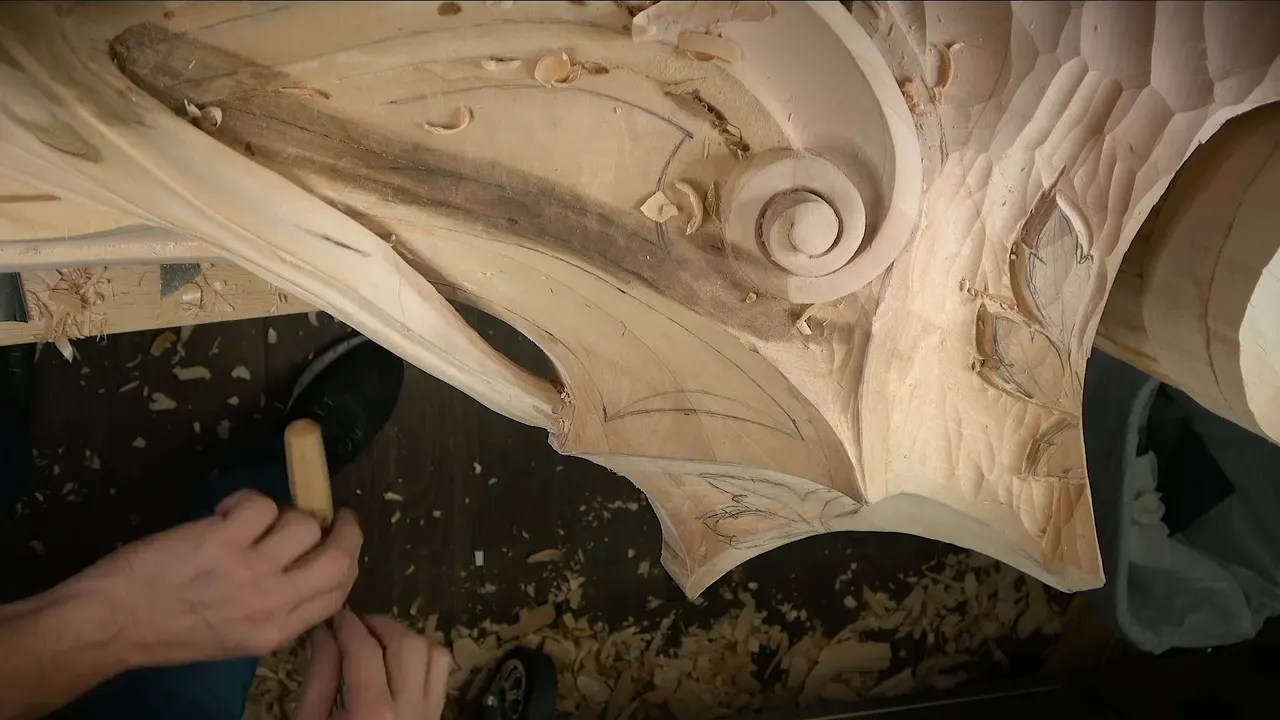

Swiss made is a phrase from Venice Room 92, part 4, where it sits a few lines after my wish for a bigger number seven. The same words cross my wood carving lessons beside stamps, a first set and a knife. A second thread, tools that modern manufacturers do not make, ends the page.
Have you ever reached for a gouge size that no shop sells? This page follows the phrase from that stretch of the video out into my other lessons.
How does the fourth video of workshop 92 use Swiss made?
It opens on a plan: "And now I'll take again number seven and one inch" (25 mm), "and blend a little more." Then "Blend to the leaves." Next comes a bigger tool, "a big number seven," with "30 millimeters" (1.18 in) in the line, and "I'll create a couple cuts with that."

Next, the tool is "really dull. I need to sharpen it." A detail waits too: "so I don't want to take too much material." A figure follows: "from this point all the way to the bottom of it, it's about 10 millimeters, about three-eighths of an inch." Those figures sit close, since 10 mm is 0.39 in and 3/8 in is 9.5 mm.

"All right. That is enough." After it: "See, I did not destroy my point, I mean, my line, but I still was able to excavate nicely that concave." And one more: "And yes, I can always clean it."

Now the stretch this page follows. "And I wish I have bigger than that number seven, but they don't make it, okay? I don't know anybody who would make bigger than that." Soon after: "Swiss made, I don't think they make it anymore."
A size and a guess close the stretch. "Also, they've got only 60 millimeters right now, the latest what they do," which is 2.36 in. Then: "I guess just because not too many people using it, but it's one of the most useful tools for the big projects."

What else is in part 4?
A small tool comes in: "So I'm using number 11, four millimeters to clean around a little bit," which is 0.16 in. Then: "And here you go. That is going to be my separation."

A new job is named: "And now I need to clean on inside. I mean, not inside, but close to the leaves itself." The plan for it is "And I'll use just number seven and 14 millimeters. The small ones, okay?" Fourteen millimeters is 0.55 in.

A flatter tool is wanted next: "And I'm going to need something flatter. Maybe like number three or so." A check follows, "Let me think if this one will work," and a verdict, "And yes, it does work really good." The last line of the part is a plan: "Well, of course, I need to clean this side anyway, so now just do it to number three."

Where else do I use the phrase?
The table lists the passages, and the sections after it give each one in full.
| Lesson | What the passage says |
|---|---|
| Venice Room 92.4 | the bigger tool I wish for, then a line on whether it is still made |
| Tools Selection | the first set I bought, "a really nice tool to work with" |
| Beaver Craft video | brands sold in many countries, with cost as "the problem number one" |
| Livestream, April 5 2020 | "actual marking," an 11 for the sweep and a 4 for millimeters |
| Workshop 140.3 | a stamp number to ignore, an eight for the sweep |
| Roman Acanthus 8.3 | a back bend "marked 28" and "that's the way they mark" |
| Roman Acanthus 15.3 | the 7 mm (0.28 in) number 11 spoon gouge "marked A" |
| Workshop 53.6 | a number 11 with a shape that is "little different" |
| Hazelnuts 7.1 | the number 11 that is "always veiner" |
| Greek Acroterion 4.1 | number three at 16 millimeters (0.63 in) |
| Butterflies 1.1 | a brand new knife and a drop in quality |
| Lily Box 2.6 | the claim that it is "the best" |
| Rosette 3.3 | a tiny tool that "no modern manufacturers make" |
Which Swiss made set did I buy first?
Tools Selection for Wood Carving tells it: "I bought what was available right away, and that was Swiss Made set. That's what I bought a long time ago." The same lesson repeats it, "The first set was, like I said, Swiss Made." Of the tools themselves: "I look how straight it was assembled, how nicely it was done, and it was just a really nice tool to work with. So that was my first choice."

On brands in a shop, the line is "Probably you can find couple, maybe three brands of wood carving tools. The main one is a Swiss Made." Rolling is a topic too: "Especially if the tool is small and they saying it just rolls out versus, let's say, the Swiss Made, it's not rolling out." Right after, the handle talk adds "Like I said, I like both."
A talk in the Beaver Craft tools video lists brand names: "Swiss Made, which is almost you can buy in every country, even in Ukraine you can buy that, in Russia." The cost line: "Swiss Made, or any other known brands, the problem number one is how much it cost."
Class 10 on Grinling Gibbons, part 3, covers antique tools: "I also still I still use that same tool. That would be number 16. 35 millimeters" (1.38 in), "It is antique." The turn: "But you don't have to have antique tools. You can buy a Swiss made."

How do you read the stamp on a Swiss made tool?
A livestream from April 2020 took a question on markings. "They do have actual marking." The tool shown: "See number 11, it's a sweep. It's a U-shape, how it's shaped. And a four, it's millimeters." Four millimeters comes to 0.16 in, and the line goes on with "little less than 3/16 of an inch."

A second livestream, on lighting a bench, has a line on the stamp of the Swiss Made one: "they made it obvious." The other brand it sets beside has "absolutely no marking," and "You have no idea what tool that is."
In Venice Room 140, part 3, the plan is "a different back bend," number eight: "Don't pay attention to number two. It's just the way Swiss made they mark it." Then "an eight means it's a sweep, number of sweep. So the curvature." The width is "the 6 millimeters, which is a quarter inch, how wide that is." Six millimeters is 0.24 in, and a quarter inch is 6.35 mm. It ends on "just a quarter-inch bead."

Venice Room 57, part 6, offers "I have to use just a number three, I would say, back bend." "In this case, I would use 13 millimeters" (0.51 in), and the stamp line is "Don't pay attention to zero."

Back bends turn up in the acanthus course too. Carving Roman Acanthus 8, part 3, shows a back bend of "six millimeters" (0.24 in) that is "marked 28," with "that's the way they mark." In Roman Acanthus 15, the number 11 spoon gouge is "marked A if it's by Swiss Made, and it's a 7 millimeters" (0.28 in).

Which shape does a Swiss made 11 have?
The plan in Venice Room 53, part 6, reads "5 millimeters, 3/16 of an inch, and again, that's number 11." It is "a Swiss Made." Then: "I could use other brands also." A liking follows: "As far as the number 11s, I like Swiss made shape with it." The shape is "little different." The next line is "It's not really true, like a letter U shape."

In part 3 of that workshop, the plan is a number 11 at 12 millimeters (0.47 in), "a Swiss made in this case," for "my first outline." Strength gets a line: "I'm not afraid to hit much stronger."
Carving Hazelnuts, workshop 7, part 1, has "I'll take Swiss Made number 11 and seven millimeters, little bigger than a quarter of an inch." A doubt follows, "Maybe this one is a little too big." The next try is "Maybe smaller one," with "five millimeters number 11," about "three-sixteenth of an inch." A rule follows: "it's always veiner. It's like a U-shaped tool, or letter U."
In Greek Acroterion 4, part 1: "I think number three will do in this case," with "Swiss Made" right after. Its size is "16 millimeters" (0.63 in), and a careful start follows: "But really careful because I don't want to dig too deep."
On how numbers differ by region, Roman Acanthus 16, part 2, offers "If you are in Europe, so number two, let's say in Germany and Swiss made, it's already going to be a gouge." Then: "So it's not flat. Of course, I exaggerate that, but it's almost flat."
Is a Swiss made knife worth the money?
Beginner in Woodcarving 1, part 2, names "my favorite knife, and that's number 12 Swiss Made." The price: "It is somewhat expensive, but worth it." The age: "this knife lasts 20 years on my shelf already," with "I'm still using it every day."
A number 12 gets another word in Greek Acroterion 2, part 1. First comes "I'm going to use just a cheap carving knife for now," then "That is a soft wood, and I'm not afraid to use my knife." After that: "Let me use a number 12," then "Swiss made," then "just a cheap carving knife."

Carving Plate with Butterflies 1, part 1, is about a newer version. "I've got like a brand new. Swiss made knife and I noticed it's my opinion." Of use: "you can still use it." Of make: "But the quality is not there any longer. I mean not this the same as my knife, which is over 20 years old."

A story from Russia sits beside it, in this order: "to prove the point so you really don't need to use just that brand. Okay, pretty much any knife will work. For example, I didn't have when I was in Russia." Then "Swiss made tools or any professional level tools. So we had to make those knives whatever the material we could find."
In Lily Box 13, part 1, there is "one of my favorite knives," number 12, and a palm tool where "you get really close to the blade and sometimes it gives you better control."
Is a Swiss made tool the best one?
Lily Box 2, part 6, takes on the claim: "Although some people claiming" those tools, "Swiss made, they are the best. It's not necessarily true. They're really good tools, but they also have some short fallings. They also have some problems like everybody else does."

One problem is named: "And not all sweeps and profiles available in the United States." For those not carving as a trade, "sufficient, so you can get most of the wood carving done." On cost: "They're not cheap. So if people think they're a cheaper option, it's not true."
Hashemi Flowers 23, part 1, gives "definitely Swiss Made, and those tools are really, really good tools." In Hashemi Flowers 19, part 3, V-tools get "And not every manufacturer, by the way, makes those at 35 degrees," followed by "some of you call it Swiss Made. Really excellent tools also."
A livestream on sharpening a spoon gouge has a line on octagonal handles: "most of the wood carvers, they prefer right now octagonal. This is a Swiss made, actually, handle." A reason follows: "people when they laying on a workbench, it's not rolling out."
Which tools do makers not make?
The Venetian Rosette 3 lesson, part 3, shows a tiny back bend: "It's about number nine, I would say, and it only curves about five millimeters or so" (0.20 in). Then: "For me to have a tool like that is just like a lifesaver. Just get underneath and get really deep excavations."

The line is "Again, no modern manufacturers make those tools." A hedge and a plan sit next to it: "As you know, I'm waiting. Maybe, I don't know yet." My own tool line is the plan, and the tools I want are "those unique ones which nobody else does." Part 4 of that lesson has "I could use a different back bend. It's really short." Then "unfortunately, modern manufacturers, they don't do that. They don't make anymore those really, really short ones."
The phrase also labels goods from Switzerland, so what tool would you wish for that no maker sells? The tool is in workshop 92, and the Part 8 course lists all twelve workshops from 86 to 97.
How it's done
- Take a number seven. My plan in part 4 was a number seven at one inch (25 mm), to blend a little more and blend to the leaves.
- Get a big tool. A bigger one was next, with 30 millimeters (about 1.2 in) in my line and a couple of passes planned.
- Reach enough. Next came "That is enough," then "I did not destroy my point, I mean, my line."
- Take number 11. My words were "So I'm using number 11, four millimeters to clean around a little bit," which is about 5/32 in.
- Clean near the leaves. A 14 mm (0.55 in) number seven was the plan for the area by the leaves themselves.
- Try something flatter. The test line is "Let me think if this one will work," and the verdict is "it does work really good."
Frequently asked questions
Where in workshop 92 do I say Swiss made?
A few lines on from a number seven I wished were bigger, in the fourth video.
How large was that bigger tool?
The line reads 30 millimeters, which is 1.18 in.
How deep did I say the detail goes?
"About 10 millimeters" (0.39 in), "about three-eighths of an inch" (9.5 mm), from "this point all the way to the bottom of it."
Is Swiss made the best?
What to carve next