
Alexander Grabovetskiy, woodcarver, School of Woodcarving · Published 2020
What does a wood carver mean by "doesn't look right"?
Quick answer: Workshop 95, part 1, has the line at 00:02:05, after an outline and before a number three. Other lessons of mine have it beside a waste line, an element I do not like, a measured side, a pencil mark and a mistake.
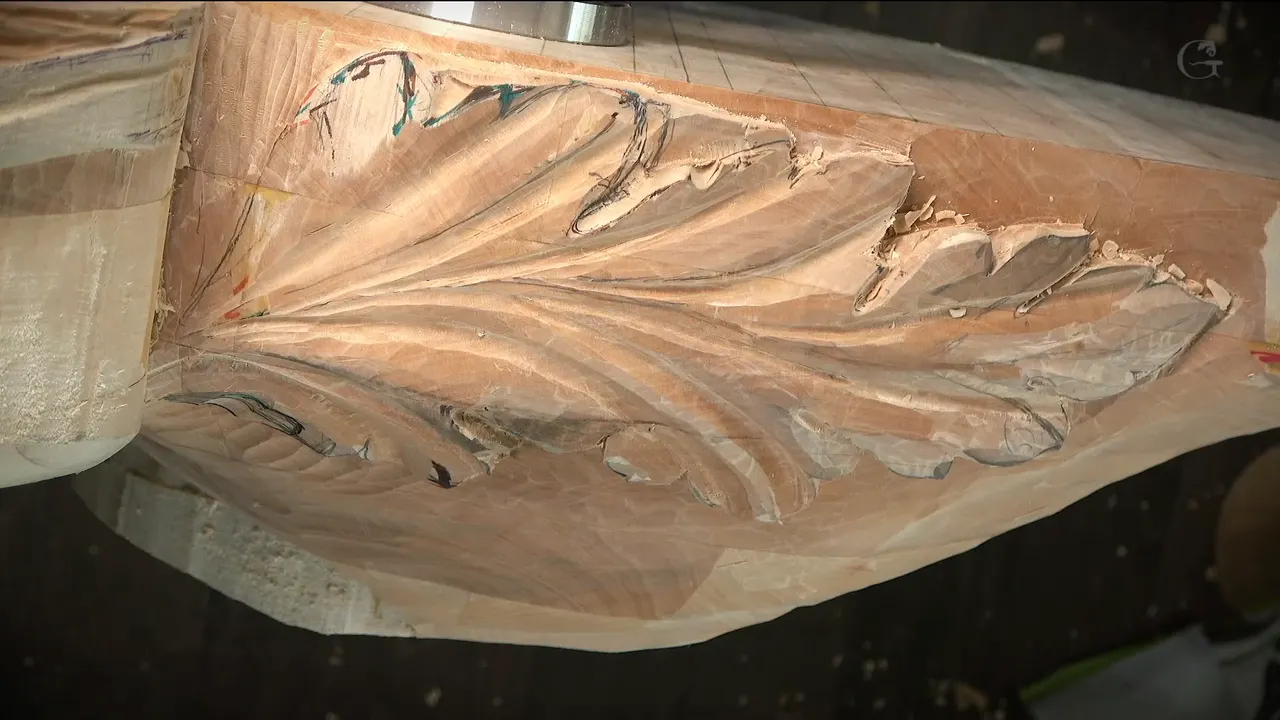

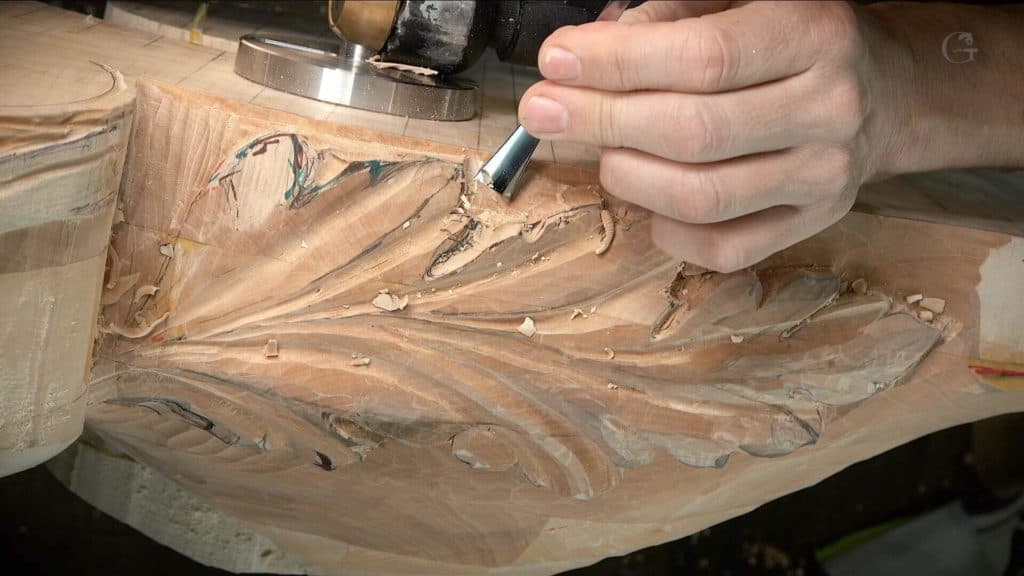
Part 1 of workshop 95 has the line at 00:02:05, after an outline and before a number three. Other lessons of mine have it beside a waste line, an element I do not like, a measured side, a pencil mark and a mistake in the hazelnut course.
Have you ever stood over a carving and felt something was off, but could not name it? Would you like to hear what I do next, lesson by lesson? Come through workshop 95 with me. Every lesson I borrow from is named and linked.
A short list for part 1
- A piece fastened a new way on the workbench.
- An outline.
- An eye, another separation and a little dilemma.
- Number three, then a twist.
- A number 11, with a bigger one as the plan, and then the number seven with a note about going lower still.
How is the piece fastened in this video?
The video opens on the bench. My words: "I changed the position how I fastened my piece workbench, and now you'll be able to actually see that surface and that is the backside of it and you can see how thick that piece is."

Then: "So it's a really, really thick." Next: "But at least I can concentrate right now on some of the areas which I couldn't show you previously."

What comes before the first tool?
A plan and a need share one line: "let me outline it, although, I have to look from different points of view."

The cue names an eye and a separation: "my eye" and "another separation." Then comes a feeling, "But for me, it doesn't look too good," and then "so that is kind of a little dilemma for me."
The small plan is "so I have to just start with a little bit and get rid of some of the side material."

Which line comes right after the page title?
After the page title the cue reads "And yes, I have to attack from the right position."
Which gouge comes first, and what size?
The gouge is named first: "I'll use just number three." The size comes next: "Number three in about 18 mm, let's say 18, 19 mm three-quarters of an inch" (18 mm is 0.71 in, and 19 mm is 0.75 in).

My look at the movement: "It does have a movement, but not as much, so I'm not really happy with that movement yet, so let me do something else." Then a plan: "Maybe I'll just twist even further."
More of my words: "my point is just that it doesn't look too appealing to me, Ok I should say." The plan is "I will twist this way." Then: "And this is already looking much better."

Which plan comes next?
Another section gets a plan: "so let me jump right here." Then: "I can actually just outline the main body and then I'll see if I like it or not."
The gouge here: "And yes, I am using number 11 and five mm" (0.20 in).

For the movement: "that is actually going to give me a much better movement." Also "Moving this way, so that actually makes more sense."
A bigger tool is a plan: "Let me use a bigger number 11." Its size: "I will use 12 mm" (0.47 in).

How big are the tools after that?
Next: "now I'll take number seven and 14 millimeters" (0.55 in). Then: "Carve like this."

A depth is both a plan and a note: "I could actually go about the eighth of an inch lower, but I'll do it later, I'm taking about one-eighths of an inch lower" (1/8 in is 3.2 mm).
A form is a plan too: "Now, let's establish better form of this piece and let me use #7 again and maybe I'll cut like this." Then "that's going to show me much better what is going on."

The last cues are a look and a plan: "Ok, I am not too happy how it looks?" Last, "And what I'll do," and the plan itself: "make a little deeper excavation right here."
How does workshop 95 go on in the next video?
A feeling opens it: "I just don't like how it looks. I mean, the overall feel of it." Later in that video: "And yes, it does look much better."

Which waste is in the Hashemi course?
Hashemi Flowers, lesson 22, second video, holds a maybe: "Maybe I need to remove a lot more on inside." The title words sit in the line between that one and the next. What follows is "So that would be my waste."
Before that: "I'm going to leave it like that because it's too fragile and I don't want to overdo it." Number seven is next: "And I'm going to use exactly the same number seven." Later: "And later on, I can attack that from opposite side and clean that." A later cue is "now, overall shape, I'm happy with."

Which element do I not like?
The sixth video of the design lessons, Furniture Panel 14, has "I believe I found one spot I don't like." Then: "what I don't like, I don't like this element." The next cue opens with the h1 phrase and ends with "so I'll just get rid of it."
Further down the video: "I don't really want to see any symmetry in it."

Where does the grain come in?
Furniture Panel 20, second video, gives a reason: "if you look really close at the grain, and if it's going to be too flat, that grain strikes the eye." That cue ends with words like the title.
More follows: "But if you create the right movements with the concave cuts, your eye going to be drawn by the shadow it creates, and it just kind of blends better with overall movements."

What if the line itself is missing?
The rosette lesson Antique Style Rosette, workshop 5, has "First of all, I think I missed my line right here." The same cue goes on with a line close to the h1. Later: "Okay, I do see there's some kind of concave goes inside this section."

Is there a measure in the video?
Down in Venice Room 160, third video, has a measure: "I measured." Then "Well, actually, it does look right. I'm sorry." And "I'm just looking at the height of it, and it does look right."
Earlier in that stretch: "And yes, exactly the same on this side, actually." Then the number: "approximately 2 millimeters right now" (0.08 in), and the plan: "I'm still going to need space for the cleaning up." Last, a note: "It's a quarter inch down" (6.35 mm).

Which pencil mark gets a plan?
In Venice Room 43, first video, a plan opens: "And let me clean a little bit pencil mark, because it just throws me off." The h1 words are in the next line. Then: "Fix that eye."

Which spot bugs me in the first course?
Take Venice Room 12, fourth video: "I'm kinda happy, but not completely yet." Then "now, this is just kind of bugs me here." Right after that sits the h1 line.
A look follows: "It almost looks like it's asking for another separation. Right. Extra notch." Also a plan: "I still want to do another separation on inside."

Which part is too thick?
Lily Box 11, ninth video, holds this: "although this one is really fragile, really small. We're talking about really just one millimeter thickness" (0.04 in).
Then "this one is a little too thick, so I need to take care of this one." A line in the style of the h1 follows it in the same cue. The cues go on with "Again," and "carefully," and later comes "I am absolutely okay with that."

Which ridge do I lower in Roman Acanthus?
Roman Acanthus 7, fourth video, has a plan: "Let me refine this section." The page title line follows. Next: "I need to lower this ridge."
Before the line: "And you can use just a straight gouge, number five, to achieve the same result." Then "But I'll use a backbend." The size of the tool: "really small, tiny gouge," at "about 3/32 of an inch" (2.4 mm).

What is the mistake?
Hazelnuts 3, first video, carries a look: "It actually looks absolutely awful." In the cue before it sits a line near the title, and after it comes "But like I said, that is the mistake. It's an error I did. I have to admit that."
Before that: "Again, I don't have to be super accurate. All I have to do just to keep an eye on what the grain of the wood does." Fixing it is a plan: "And now I have to fix it somehow." The depth: "maybe one-eighth of an inch, about three millimeters deep" (0.12 in).

Can I point at the problem on a panel?
Take Furniture Panel 30, first video: "I'm not sure if you see the problem or not. I can point you to the problem." Then "The problem, what I have is, uh, how wide this area is versus this part."
Words close to the h1 sit in the next cue. After it: "So it has to be fixed." The tool is "I'll grab, uh, I'll grab number seven", with the size at "little less than half an inch" (under 12.7 mm).

Why do I roll a petal?
Here, Venice Room 136, first video, gives a reason: "see how short distance from the flower it is?" Then "When you look at it without rolling it, it's just a little off."
Earlier in the stretch: "Maybe I should do a slope also this direction," and "I think it's going to look good." After "it's just a little off" come the h1 words. Next up: "And when you roll it, it feels like if you're going to stretch those petals."

Does a turn of the work change the look?
Carving Plate with Butterflies 4, second video, turns the work: "Just turn around for you could see you know, how it's supposed to look." Then "once you just rotate that it becomes right." Its cue opens with "You can see" and carries the h1 words.
A caution follows, with parallel projection: "again, please keep in mind. It's not parallel projection."

What about an edge that is not straight?
Chamomile and Bow Rosette 3, a chamomile flower, first video: "And again, I'm really happy that my edge is not really straight." The line goes on with "Otherwise," and words much like the h1. Last: "It doesn't have to be straight also."

Where do position and angle matter in a carving?
Try Venice Room 17 in its first video, where it starts with "It just bugs me, plainly." Later: "Again, that is all about the point of view" and "from what position, what angle."
Then "Okay. I think that is much better now." Next "It just gave me so much worry. It just didn't look right." Next: "let me get a little deeper right here with number seven." Also "Cut deep because I really need that shadow right there."

How do I lower a part?
Over in Venice Room 112, second video, the cues read "I think it looks good" and "Of course, I need to clean it a little bit." Then "Let's lower this guy, okay, because right now it's really high."
Next, "and let's give that thing some kind of shape." Then "Does not look right." The tool is "a number seven" at "14 millimeters" (about 9/16 in).

When does a shape need more rounding?
Back in Furniture Panel 23, fifth video: "And I can see that this one needs to be taken down a little more because it does not look right just like that."
Then "It has to also have more rounded like this, and this one needs to be also rounded a little more." Further on: "So now it feels like it's going in all right, but what I want to do, I want to make it feel like it's growing that direction."

Which lines did I borrow, and from where?
| Where I say it, by lesson and video | The words beside it |
|---|---|
| This video, around the outline and the twist | a little dilemma |
| The video after this one in workshop 95 | the overall feel of it |
| Hashemi Flowers, lesson 22, second video | my waste |
| Sixth video of the design course, Furniture Panel 14, a spot on the upper panel | I don't like this element |
| Second video of Furniture Panel 20, flowers in the upper right corner | that grain strikes the eye |
| Rosette, workshop 5 | First of all, I think I missed my line |
| Third video, Venice Room 160 | I measured |
| In Venice Room 43, video one | because it just throws me off |
| Fourth video, Venice Room 12, in the first course | Extra notch |
| Lily Box 11, ninth video | a little too thick |
| Roman Acanthus 7, in the fourth video | I need to lower this ridge |
| Hazelnuts 3, in the first video of its lesson | It's an error I did |
| Furniture Panel 30, first video | how wide this area is versus this part |
| Venice Room 136, in its first video | stretch those petals |
| Butterflies plate 4, the second video | it becomes right |
| Chamomile and Bow Rosette 3, first video | my edge is not really straight |
| Lesson 17 of the Venice Room, first video, in the second course | the point of view |
| Venice Room 112, in the second video of that lesson | Let's lower this guy |
| Fifth video of Furniture Panel 23, main flowers | rounded a little more |
Is there a spot on your own carving that feels off? Would you like to hear what I do next, one lesson at a time? You will find workshop 95 inside one tuition plan, with the rest of the Venice Room, Part 8, in the Venetian style.
How it's done
- Change the position. I changed how I fastened the piece to the workbench, and now you can see that surface and the back side.
- Outline it. My plan is to outline it.
- Name the tool. My tool is number three, about 18 mm (0.71 in).
- Twist. The plan is "I will twist this way."
- Switch to the number 11. I am using number 11, five mm (0.20 in).
- Take the number seven. Now I take number seven.
- Go deeper. The last plan is a little deeper excavation right here.
Frequently asked questions
Which gouge comes first in part 1?
Number three, 18 or 19 mm (0.71 to 0.75 in), with the twist after it.
What do I check before I outline?
My words are "I have to look from different points of view."
Which line follows the page title?
It is "And yes, I have to attack from the right position."
Which sizes are the number 11 and the number seven?
What to carve next