

Alexander Grabovetskiy, woodcarver, School of Woodcarving · Published 2020
What does a wood carver mean by "much longer"?
Quick answer: In workshop 95, part 8, "much longer" sits beside "on the end grain" and a line about extra care. Other lessons of mine carry the same two words, and each is linked below.
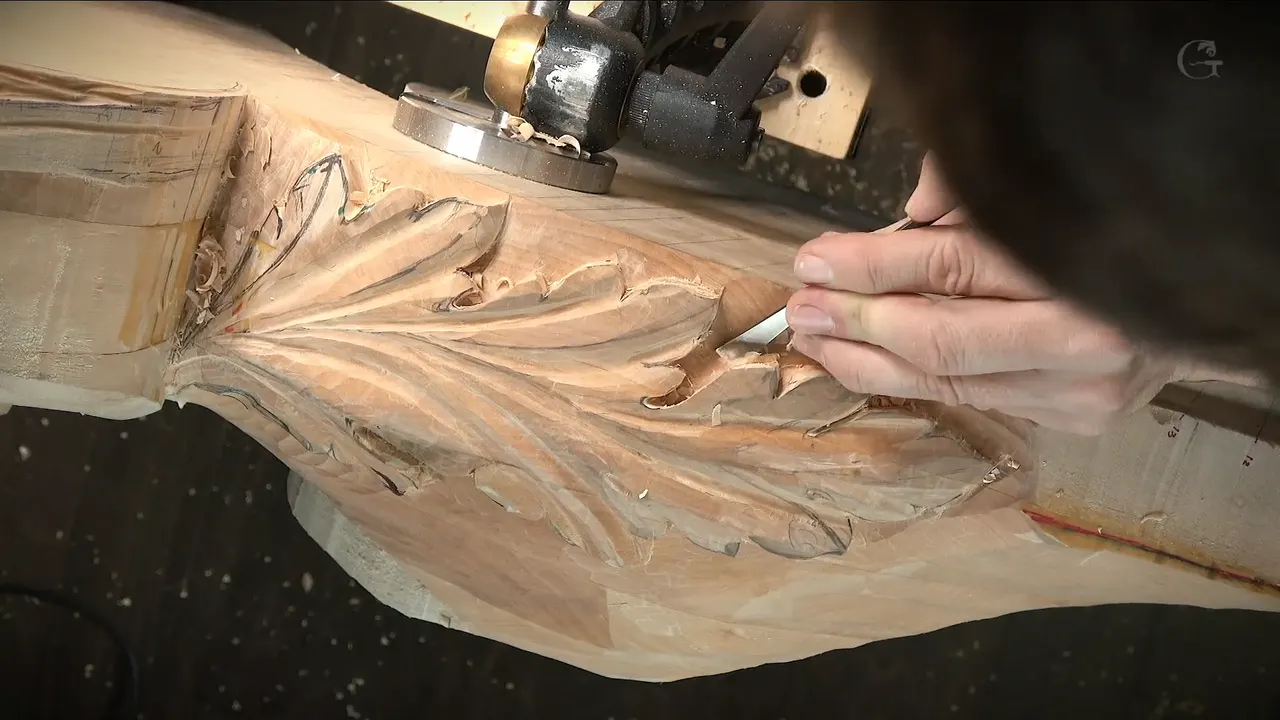

In part 8 of workshop 95, near 00:00:29, I say: "it does take much longer when you're working right," and the next caption line reads "on the end grain". Other lessons of mine carry the same two words.
Have you ever slowed your gouge down on one spot and wondered how long the job would run? Part 8 of workshop 95 starts right there. Each lesson I borrow from below is named and linked.
What does part 8 say about time?
The captions open on the line about time, and a place follows it: "on the end grain". Next I say, "I have to be extra careful."
Now the plan: "Ok, I am going to do". A plan for the shape comes after, "I am going to roll it slightly", and straight behind it a limit: "But I can't do too much."
How much is too much?
I fix my own wording a few lines later: "Or I should say, I don't want to do too much, not can't". Two short lines follow. "Of course I can." And "I'm able to, but it's too much."
A new section gets a look: "looks like I can do micro separations". A repeat is next. "And I have to repeat that on that side," and "and I'm going to do exactly the same right here."
Then comes "with the straight down cut," and, a few lines on, "which in this case is just pretty much with the fibers, with the grain". My aim is "I will make the separation look good."
How does it look from where I stand?
Near 00:03:00 the line is "so that is looking good," and two lines later it turns: "from my point of view, it does not look too good." An explanation starts, "What I mean by that, that's it has to flow in all".
Short lines settle it: "and right now it still doesn't." Six seconds on, "And now it does." Beside them, "Just a little bit extra attention,"

A maybe about a deeper pass follows, "I can probably undercut".
Which small tools take over?
They arrive one at a time, and the first is "Clean up with that number 11." Then "Follow with the number three." Near 00:04:27 the plan is "And I'll take" and "2mm," which is 0.08 in.

Another line ends "take out too much." By 00:05:31 the plan is "I will use 1mm" (0.04 in) and "and clean a little better, this section."
A later job is mentioned: "So I can do that a little later." After it, a correction of a name: "final clean cut, I should say, that's what I was trying to say."
Around 00:05:43 comes "underneath of this part". At 00:05:58 and 00:06:00 the captions read "And it does look" and "good." Later come "little shaving" and, at 00:06:12, "final cleaning". And near 00:06:27: "so and that is looking good"

Where does part 8 stop?
At 00:06:53 I say "create some micro separations the same operation, pretty much," and then name the tool, "number 11 on the side, laying right on the side." The size follows: "And in this case, I'm using 5 mm." About 1/5 in. The type comes last, "Number 11 Veiner and just create cut like this."

The last two lines read "This one has already done" and "so, I don't want to overdo it."
Do parts 7 and 9 add anything?
In part 7 the size is "five millimeters three-sixteenth of an inch" (0.2 in, and 3/16 in is 4.8 mm). The limit there is "But again, I cannot do too deep." It also has "now I need to use a smaller one." Next, a size as a maybe: "maybe even a half a millimeter" (0.02 in).

Part 9 asks for a small one too: "I need to use the small one," and "like 1mm" (0.04 in). Behind that sit "otherwise" and "I am undercutting too much." Earlier in that part sits a need, "I need to get a little deeper excavation right here at number 11,".
Does a smaller tool cost time?
Venice Room 70, video 10, begins with a plan for small tools. "So maybe it's a good idea to use the smaller tools first," and "and then clean it with the big tools." Close behind: "A smaller tool is a lot easier to control."
Next, a little before the tool is named: "is going to take much longer, but I'm okay with that." And after it, "much better control, I'm okay with that."

The tool is "I'll use number nine" and "and 10 millimeters," which is 0.39 in. Then "and carefully start excavating little by little." On pace I say, "it is better sometimes not to rush it." And later, "I'm getting much better results."
The Q and A course has a talk on big tools against small. It sets an airplane against driving. "Okay? It's the same to the tools. When you take a huge" is one line, and "tool, it's just like airplane. You can do anything with the huge" is the next. Earlier I say "But fly, it's much quicker."

A medium tool is next. "tool, let's say three-quarters of an inch tool, is just" (that is 19 mm) and then "like a driving. You're still going to get there," The time sits in "but it's going to take you a lot longer."
The third size is the small one, with "about forever, like 10 years," beside it. A tale goes with it: "I had a piece, I was working 10 years on it. Okay?"
"I could get it done in one month, but I spent 10 years." The cause follows in plain words: "Not because the tools, it's just because I had other projects."
Hashemi Flowers 10, twelfth video, opens on small tools: "Definitely small tools" and "also will work." Next, "You're still going to be able to achieve the same results."
Then "just takes much longer." Beside it sit "creates much more" and "ridges," and then "but still possible." And "And remember, I am working against the grain." A size shows up later, "about five millimeters" (0.2 in).

Where does a painter fit in?
Two jobs share one spot in Hashemi Flowers 24, first video. The painter's part has "take a brush" and "and start painting." The painter is the slower one: "it will take him much longer" and "than just to snap the photography."
That line ends on "much longer." Then "Picture versus fine art" and "canvas." Later in the talk: "It's a different culture and different traditions."

The fine artist leaves marks, "the brush marks and so on," and "it's considered as a piece of art." On a quicker way: "you could get probably those results much quicker." Then "Just use the sandpaper". For me, "I really love those tool marks."
Does rushing save time?
Furniture Panel 15, first video, has "you really have to keep that area high." Next, "Do not do undercut or opposite cut." Then, on pace: "And don't rush it. Take your time."
Then, in order: "It's going to save you actually" and "time if you not rush it." Next, "If you're going to rush it," followed by "you will have to fix it." The cost is "much longer" and "to fix the mistake". The last lines are "first time right." and "So try not to make any mistakes."

Greek Acanthus 11, video 1, warns about forcing: "Just little by little, both directions," and "without forcing." Close behind come "That is probably the biggest mistake what" and "some people do when they're forcing, trying to rush it,".

The same talk goes on: "rush something in wood carving, you can make a lot more mistakes, and" and "to take you a lot longer to fix it." One more line, "wood carving is an art of deduction." And "you can't add that back."
A background is the subject in video 7 of Venice Room 56. "Still have to be careful how hard I hit because I really" and "with the background cleaning later on." Then comes "When you dig your tool too deep in the background, then you have to spend time".
Then "And to clean sometimes takes much longer than just to". After a short gap, "unfortunately, but it's true."

What is the price of one knife and one gouge?
In video 6 of Venice Room 50, an old way of carving is named: "carving, I call it." Then "Yes, those people carved only with one tool." And "But if you look at the work they've done, it's beautiful,".
Next comes my story: "working with just one knife and one gouge, and I was able to do some really". The words "much longer" sit in the line before "to have just one gouge and one knife."

Venice Room 4, video 8, has "Just think about the tools which you have," plus "how you're going to carve it,".
The choice is easy to hear: "Because I can carve it without that," and then "but that's just going to". The cue ends on "much longer." A short run follows: "But here, I just chop." And "And that's pretty much done." Earlier, about the design, "I thought about it when I was designing it."

Does thinking before a pass take time?
In Lily Box 8, video 6, the line has "so you really have to make the decision how it's supposed to look" and goes on to "you place your tool. So there is no such a thing as undo" and "and redo."
Then: "So that's why when I'm carving," and "it takes sometimes a much longer time". The line after is "because I want to think before I make the cut." After it come "Okay, that's exactly what I'm doing right now." and "I'm thinking and cutting."

Which jobs outlast the main form?
The Greek acanthus leaf course, in Greek Acanthus 10, video 2, has "And it takes time also to nicely undercut." Then "sometimes it takes longer to undercut" and "than to establish the main form."
Right after: "When those shadows," and "especially with the right lighting,".

Roman Acanthus 16, video 2, has "We have to take time," and "and woodcarving is probably the most" and "time-involving trade in woodworking." Then "much longer", then "to do woodcarving", then "sometimes than to build a really nice piece of" and "furniture."
A question follows, "how I'm charging for my work." And then "I'm actually estimating approximately how long it's". The cue stops there.

In the Grinling Gibbons class in Maine, class 7, video 3, layers are named: "they can have double layer if we" and "wanted to but double layer gonna take longer or" and "it can have a single layer."
Then the split. "Yes, the three of those are single layer and" and "just the lower one is a double". Time sits at the end of the next cue, "much longer. In this case." Soon after, "can probably save some time."

Cleaning is the subject of Modern Acanthus 7, video 1. "And spend your time." and "cleaning" in the next line. A few lines on, "It takes a lot longer than to" and "longer to clean all of those facets then".

How long does a big tool take to regrind?
In the second video of Sharpening Large Gouge: "And of course, this tool takes a little longer," and "metal I have to remove, it takes so much longer."
The talk goes on with "it still would take me only minutes" and "versus hours."

Which lines did I borrow?
| Where I say it, by lesson and video | What sits beside the words |
|---|---|
| Lesson 95, my own video | Work on the end grain, and extra care |
| Venice 70, video 10 | Smaller tool, with a trade for better control |
| Q and A, big tools against small | A huge tool, a medium one and a small one, and a piece that took ten years |
| Hashemi 10 | More ridges from small tools |
| The painter story in Hashemi 24, video 1 | A painting and a photograph of one scene |
| Furniture Panel 15 | Taking time, and a mistake that has to be fixed |
| Greek 11, video 1 | Forcing a pass, and the mistakes that follow |
| Venice 56, video 7 | A background dug too deep, and the cleaning later on |
| Old ways of carving, Venice 50, video 6 | One knife |
| Workshop 4 of the Venice Room, video 8 | A tool I could skip, and one chop |
| Roman 16 | Woodcarving beside a nice piece of furniture, and the way I charge |
| Lily Box 8, video 6 | A decision before the tool lands, with no undo |
| Video 2 of Greek 10 | An undercut, then the main form |
| Class 7 of the Maine Gibbons course, video 3 | A double layer, against a single layer, in the Venetian style |
| Modern Acanthus 7, video 1 | Cleaning all the facets against carving the whole thing |
| Sharpening Large Gouge, video 2 | A big tool and the metal to remove, and hours by hand |
Is there a spot on your own carving that asks for more time? You will find workshop 95 inside one tuition plan, with the rest of the Venice Room, Part 8, in the Venetian style. Workshop 94 sits before it, and workshop 96 follows.
How it's done
- Slow down on the end grain. Extra care is my plan for that spot.
- Start with a slight roll. My plan is a slight roll, and I stay short of too much.
- Check how it flows. From where I stand it does not look good at first, and later it does.
- Reach for a small tool. A small number 11 is in the plan, and then one smaller.
- Leave the final clean for later. A little later is when I plan the final cleaning.
- Stop short of overdoing it. One more Veiner goes on the side, and I stop before I overdo the spot.
Frequently asked questions
Which lines sit beside the end grain?
Right after the line about time, the captions give "on the end grain". The next line in the video is about being extra careful.
Which tools are named in part 8?
Number 11 comes first and number three follows. A smaller number 11 and a smaller one still come later, then a number 11 Veiner for the side.
Where else do I use the words much longer?
Venice 70 trades a smaller tool for better control. Hashemi 10 has small tools that leave more ridges, and a background dug too deep needs cleaning in workshop 56.
Which three tool sizes does the big tools video compare?
What to carve next