

Alexander Grabovetskiy, woodcarver, School of Woodcarving · Published 2020
What does it mean to "lose the whole thing" in wood carving?
Quick answer: Losing the whole thing is the result I name when a pass runs too deep for a weak spot. Workshop 95, part 7, has me call the wood too weak for a deep one. Other courses give the same kind of warning for a head, a wing and a flower, and also for a section.
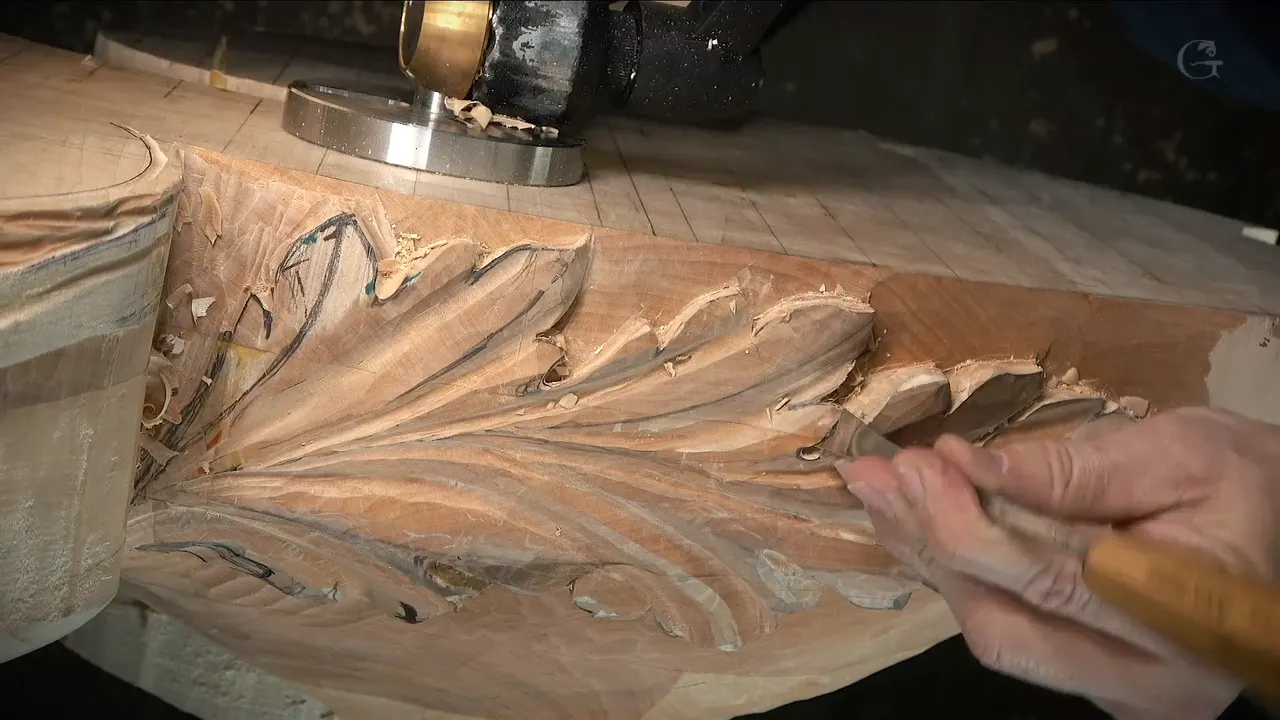

Losing the whole thing is the result I name when a pass is too deep for a weak spot. Part 7 of workshop 95 has the line near 00:01:13: "It's going to be too weak and I'm going to lose the whole thing." Other courses of mine carry that same warning.
Have you ever held a gouge over a spot you thought was too weak and taken only a little at a time? That is part 7 of workshop 95. Each lesson I borrow from below is named and linked.
A short list for part 7
- A #7 gouge first, ready for a good pass.
- Wood to undercut, with too much material.
- Number 11 at five millimeters (0.2 in), for the side of a wing.
- A warning about depth.
- A #7 upside down for a dome effect, short of a line I do not want to pass.
- Smaller tools to end, with a half millimeter (0.02 in) as a maybe.
What happens before the first deep pass?
The video opens with two short lines: "All right, so now." and "It looks much better." A plan with a number follows: "Let me use, #7". Next is a hope for the pass itself, "let me give some really good cut just like that."
At 00:00:39 comes "Now, if you were able to see". A phrase from that sentence follows: "really nice movement."
Next is a need: "I also have to undercut a little bit all that material because it's just a little too much, let's say." The tool comes straight after: "I'll use number 11 again" and "five millimeters three-sixteenth of an inch." Five millimeters is 0.2 in, and 3/16 in is 4.8 mm.

The place is a plan too: "I'll place it right on the side of one of the wings" and "start excavating." Next, in the same breath, "But again, I cannot do too deep."
A single line carries this page, the one in bold above, and it calls the wood "too weak". Next: "Just a little bit." at 00:01:27, and the same words follow again 15 seconds later.
Which tool turns upside down?
Near 00:01:45: "I can do the same trick". Next, a boundary: "pass this line", and then the plan itself. It reads "I'll take number seven and use it upside down and create that dome effect."

Right after: "Just like that," and "Careful, careful approaching this area." One maybe sits by 00:02:22: "And maybe now I can actually undercut a little deeper slightly deeper."
A second plan for the same tool follows: "And again, I'll take the same number seven and create a little cleaner cut". Each of these is a plan, and none says it is done.
Which small tools finish the part?
Another side needs attention: "now I have to attack this side". The size is "I'll just use a small number of five", with an aim of "a little bit undercut."

A smaller tool shows up from 00:03:37, "with a small like two millimeters, number 11, I can carefully start removing". Two millimeters is 0.08 in. My hand gets a mention: "yes, I'm wiggling slightly". And a short fix, "Control my tool, that's what I tried to say."
The captions hold no line between 00:03:55 and 00:04:57, which is 62 seconds. "OK, that is good." comes after. A silence shows nothing, so I leave those seconds alone.

Next, near 00:05:20, a need arrives: "now I need to use a smaller one." "number 11, maybe even a half a millimeter and just clean" names the tool, and half a millimeter is 0.02 in. Ten seconds on: "whatever is left right there, let me use Again, number five."
A plan for a chop follows, "And I am also going to chop a little bit underneath of this side with number three." Then "And clean up with the number #11 2mm" (5/64 in).

Last lines: "All right." and "And now with the really tiny small tool, I can go in and finalize my opening." Nothing in these lines says the opening is finished.

What do the other parts of workshop 95 add?
Part 6 has a reason to worry less about breaking: "Once is going to be painted." That stretch has "I'm not going to worry about breaking it".
Part 8 has a plan to "roll it slightly" and, right after, "But I can't do too much." A fix swaps "can't" for a wish, with "Of course I can." and "I'm able to, but it's too much." The end grain gets "extra careful" earlier in the same part.
Where else could a head be lost?
Workshop 69, eleventh video, gives a size first, a number seven at "14 millimeters" (0.55 in). Then "But it's not working out." The need that follows is "just the bigger number nine."
Another tool is next, "maybe I should use long bend number 11". Its size is "Maybe about 10 millimeters or so." A fix of mine: "Although it's not really 10" and then "it's about 12" (0.39 in and 0.47 in).

Next comes "I have to be careful. It's a bigger tool" and, behind it, "pushing too much". The head is the thing at stake, and the verdict is "That would be a big mistake."
What is a marriage line, and what breaks there?
Modern Acanthus 5, third video, names it. Its tool is "Big Tool number nine and 20 millimeters" (0.79 in), and its name is "we call it marriage line." The grain is where it sits: "when the grain changes Direction".
One line says it all: "if I gonna push it, I'm gonna break the whole thing." The way around is "I have to attack that from the opposite side". Then comes "in my case, it's kind of hard."

In workshop 125, first video, the same name goes to a spot: "take my time because there is a marriage line if I going to force it." The outcome is a break, and it is "not good."
Chamomile and Bow Rosette 1, a chamomile rosette course, holds "I really have to be careful not to push it, especially in this area". A reason sits right behind it, in its second video: "The grain runs that direction". A break is the outcome.
The answer is "I've got to attack from the other side."

Does a wing or a flower get the same warning?
Over in Butterflies 9, first video, one line about a butterfly stands alone: "I don't want to break the whole wing." Right after: "So there's possibility." And "I really don't see my cut." And "Where's my cut?"

Hashemi 33, first video, names a V tool, "number 16" at "a quarter inch" (6.35 mm). One word is "carefully," and the job is a "preliminary undercut." Then "also important not to touch this piece." A weak flower is next: "See, that becomes really kind of weak because I undercut some parts of it."
A push on that piece would break the part, "I mean, this flower." That is the worry, said plainly.

The sixth video of Lily Box 10 shows a crack in the wood: "there is some crack on inside of the wood". Also "See that crack?" and "it goes all the way here, too."
A hope follows: "I hope I'm not going to lose this flower." Plan: the "smallest tools I could use." Tool: "number eight" at "3/32 of an inch" (2.4 mm).

The second video of Lily Box 11 has a plan with plenty of wood: "I do have plenty of the material, so I can create a little deeper concave." Then "And I should be safe."
A caveat sits behind it: "when I'm saying should be safe, I still have some doubts. A little bit, but still doubts, okay?" That passage ends on "I really, really don't want to lose this piece."

How does a section get lost?
In the seventh video of workshop 84 the challenge comes "Because of the grain." Then "it's super easy to break while carving, of course."
Near 00:02:25 sits the line I mean: "If I would just continue to carve, I would just lose that section right here." Then a question and an answer, "Do I want to lose it? No, I'm not."

What is said about the grain, and about how hard to push?
Workshop 85, second video, calls the grain "way uphill." The warning is "I can easily break it." Then a choice: "I've got to be carving this, in this case, with the grain." See Venice Room 85.
Hashemi 12, first video, carries "I can't make really heavy cuts just because, like I said, piece becomes more fragile". About the big tools, the line is "kind of really careful."

Over in Hashemi 40, first video, a gouge is named, "maybe about 20 millimeters" (0.79 in), "number seven". First line: "I don't force it". Reason: "that becomes really fragile".
It goes on with "It's better not to force it and just approach with different tools multiple times."
Workshop 67, fifth video, sits beside the wiggle: "two millimeters again, number 11" (0.08 in). Behind it: "I have to control because, again, the grain goes that direction, and I can easily break it if I'm not careful."
Then: "So that's why I'm a little wiggly. A little wiggle."

Workshop 71, tenth video, names an edge, "not to touch this edge", and adds "use it as a leverage point". The verdict is "It would be a mistake." And the fix: "So that's why I'm placing my finger underneath." See Venice Room 71.

Which spots are fragile, and which is a high spot?
Byzantine Acanthus 9, second video, has "right now it becomes fragile," and then "if you're going to overdo it, you're going to break it."
A border is the spot in Chamomile and Bow Rosette 3, third video: "Be really careful not to break the border."
Workshop 66, sixth video, names a high spot, "this is a high spot". A worry about breaking sits in the same breath. Then "Although it's solid yet." Another line follows: "I did not undercut anything, but still, it's one of the tougher spots." After that, a need: "I need the full depths of it". Visit Venice Room 66.

Pressure is the subject in the Greek acroterion course, lesson 4, fifth video: "I barely create any pressure right now". A mistake is the reason named. Behind it: "This part and that part is actually fragile, and you can easily snap this out if you create too much pressure."

Flower Rosette 3, first video, has "there is a lot of weak spots." Then "if you just push that too hard, this part can be easily snapped out".

Flower Rosette 4, second video, has "the angle is really low" and a knife working "away from myself". The worry is "if I'm pushing too much, I can snap this side". Then "It's better to make a couple passes than snap it".
The first video of Modern Acanthus 4 names two overlapping pieces: "that piece intersects with this piece". Then "do not create too deep of a cut." Its reason is "that's gonna become really weak" and "floating in the air".
It continues: "you're gonna break it. Okay, please don't do that."

End grain turns up in the third workshop of the antique style rosette course: "if I would push it, it's end grain." Next: "I could easily snap this part right here." A short one follows: "I can't do that."
Which lines did I borrow?
| Where I say it, by lesson and video | What sits beside the line |
|---|---|
| Lesson 95, my own video | Weak wood, a deep pass and a limit on depth |
| Venice 69, video 11 | A bigger tool, then a push too much for the head |
| Acanthus 5, video 3 | A marriage line, where one push breaks the whole thing |
| Venice 125, first video | A marriage line again, with time taken before a forced pass |
| Chamomile 1, video 2 | Excavating where the grain runs one way, and a warning |
| Butterflies 9, video 1 | A line about the whole wing, then a question |
| Hashemi 33, video 1 | A V tool, number 16, then a flower made weak by an undercut |
| Lily 10, video 6 | A crack inside the wood, and a hope to keep the flower |
| Lily 11, video 2 | Plenty of material, a deeper concave and some doubts |
| Venice 84, video 7 | Grain makes it a challenge, and it is easy to break while I carve |
| Venice 85, video 2 | Way uphill grain, so the carving goes with the grain |
| Hashemi 12, first video | Big tools, a fragile piece and no heavy passes |
| Antique Rosette 3 | End grain and a part that could snap |
Is there a thin corner on your own carving where you slow down? You will find workshop 95 inside one tuition plan, with the rest of the Venice Room, Part 8, in the Venetian style. Workshop 94 sits before it, and workshop 96 follows.
How it's done
- Take number seven first. My plan is a #7 gouge for a good pass.
- Name the extra wood. I have to undercut some of the material, because there is too much.
- Set number 11 beside a wing. Five millimeters, about 1/5 in, is the plan, with a start on excavating.
- Hold the depth. Deep is too much for weak wood, so I keep each pass small.
- Turn number seven upside down. The plan is a dome effect, short of a line I do not want to pass.
- Finish with smaller tools. A smaller one is needed, maybe a half millimeter (about 1/50 in), then a tiny tool for my opening.
Frequently asked questions
What does part 7 say about going deep?
First, around 00:01:13: "I cannot do too deep." Weak wood is the reason. That short line comes twice, 15 seconds apart.
Which tools are named in part 7, and in what order?
Number 7 opens the list. Number 11, at five millimeters (3/16 in), goes to a wing. A small number five, a two millimeter 11, number three and one last tiny tool follow, with a half millimeter as a maybe.
Where else do I warn that a push could break a whole piece?
Workshop 69 names the head. The whole thing sits in the words of Modern Acanthus 5. Butterflies 9 gives the wing the same line.
What to carve next