

Alexander Grabovetskiy, woodcarver, School of Woodcarving · Published 2020
What does a wood carver mean by "this triangle"?
Quick answer: Workshop 95, part 4, has my plan for a triangle at 00:04:59. The next words are "And I do have some of that extra material I can remove easily with no problem." Other lessons of mine use the word triangle too, and each one is linked below.
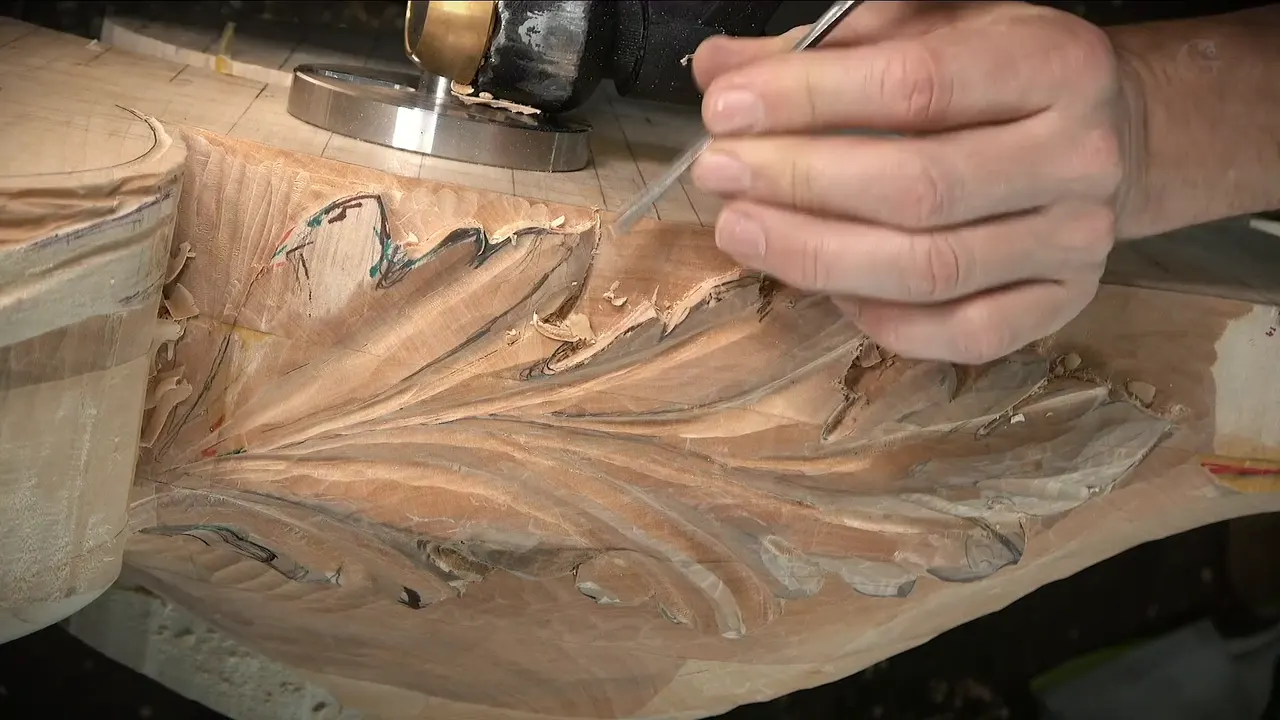

Part 4 of workshop 95 holds a plan about a triangle. The wood it points to is the subject of this page. The word shows up in other lessons of mine too, and the spot it points to changes what I do next. This page sets those lessons side by side, one video at a time.
Have you ever stood over a carving with a gouge in your hand and looked at a wedge of wood you did not want? Come through workshop 95 with me and see what I say about it. Every lesson I borrow from is named and linked.
A short list for part 4
- Veiner number 11, two millimeters first, then one, with a smaller option after that.
- The grain direction is the reason against going too deep.
- Gouge number 7 is a maybe, for a dome effect underneath.
- Clearing one triangle is the plan.
- Extra material, a separation, a clean-up and a deeper eye are on the list at the end.
What tool do I take before the triangle?
"OK, that is good." opens the video. After it comes the tool: "Now I'll take two millimeters again, number 11" (0.08 in).
A limit follows right away: "again, I don't want to go too deep the reason I said it multiple times because of the grain direction in this case, that would be a big mistake."

Next the size drops. "But the little bit I could" and "But not much," lead to "let's use one millimeter number 11 Veiner" (0.04 in). At 00:01:12 the line is a plan: "And I could probably use half a millimeter" (0.5 mm, or 0.02 in). The same line ends "Shadow."
What do I say about the edge?
"And yes, I have to be careful," is the warning, and the spot is the "mess at the edge." For it, a number three is in the line "I can use the same tool like number three". At 00:02:21 the words are "There's a lot of junk underneath."

Where does the dome come in?
The area arrives as "it's the last area," with "just undercut but not much but little bit." A gouge is a maybe here: "I can get maybe a #7 gouge."
The picture that follows is "Undercut almost undercut it's not undercut, but create some kind of dome effect." After it: "It's going to look much cleaner and nicer."

A doubt sits in the next lines: "I'm not sure if the camera shows that it's a curvature like this". And then "So it's going to cast some of the Shadow."
What follows the line about the triangle?
A plan is next: "And let me right away, a little bit undercut underneath here." Then "Again, I cannot do it too deep." And "just slightly."

The line this page is named for sits at 00:04:59: "Let me get rid of this triangle." It is a plan. Speech picks up with "And I do have some of that extra material I can remove easily with no problem."

Back comes the tool: "I will take number 11", with "2 mm" (0.08 in). The limit is "And little bit undercut not much,".
How is part 4 closed out?
The plan is "And let me make this separation right here". The verdict is "I think this is looking really good," and the overall look gets "I'm happy with the overall movement, how it looks."

A clean-up is on the list at the end: "Of course, I need to clean up a little bit". "marks and stuff like this" and "No Bueno" sit in the same line. The video closes on "And let me excavate this eye a little deeper."

Where else do I say triangle?
The same word sits in my Venice Room workshops, in a furniture panel, in a floral molding and in a Hashemi flower. Each passage below is cued to its video and linked to its lesson page. Some of them want the triangle gone, and some want it kept.
Which corner warning is in workshop 3?
In Venice Room 3, the tenth video says "Got to be careful in corners like that, so let me make a relief cut." Then "when I have a situation like a triangle, okay, so I'm talking about the triangles like that."
"There is another triangle." And "I always like to make the relief cuts." For the gouge, the words are "16 millimeters, number nine" (0.63 in).

Which mistake does workshop 4 own?
The tenth video in Venice Room 4 begins with "I broke underneath because I did not relieve it, the triangle." Straight after: "But it's okay. I have plenty of material right here."
The verdict on the slip is "that is kind of a mistake." Then "Not at this stage. That's not really a mistake right now". Further into the video the plan is "first I need to relieve that triangle." Then comes "that's a tiny triangle." The size is "10 millimeters" on a number nine (0.39 in).

A triangle inside a corner, in panel lesson 16
Over in Furniture Panel 16, fourth video, the line is "I have a triangle on inside, and that's better to do relief with the number 11, I would say."
Instructions follow: "Get as close as possible to the corner, relief straight down like this, okay, before you use a flatter gouge." Later in that video come "I'll just get straight down cut." and "I've got a couple more spots right here." And "I'll create multiple small cuts."

When is the relief too late in Furniture Panel 19?
Seventh video of Furniture Panel 19: "That is not the way to do that, by the way." Then "When you have triangles, if you remember what I said, if you have a triangle, you're supposed to make a relief cut first".
The better way is "smart way would be to do a relief cut with the number 11" followed by "1 millimeter" (1/25 in). The slip gets "That's why I should do that before, but it's okay."

Which way does the tool come at a triangle?
Furniture Panel 18, second video, has "Okay, again, I've got the triangle, and when I'm doing a triangle, I have to attack that from inside out".
Ninth video of Furniture Panel 21: "whenever I see the triangle, so I really have to attack from the opposite direction from the triangle itself, okay?" The result is "That's going to give me a much cleaner cut," and the tool is "number 11" at "one millimeter" (0.04 in).

The tenth video of that lesson says "from the triangle side. From the point side, I should say." The two lines point different ways, and each belongs to its own video and its own spot.
In Venice Room 73, third video, there is "really don't want to mess up that triangle and the edge." Then "So I need to somehow hit from an opposite direction, and I'm not sure if I have a tool to do that."
What is the warning in Furniture Panel 22?
The seventh video in Furniture Panel 22 begins "whenever you see a triangle like that". The picture is "if you would just take a matching gouge and make a cut like that and then flip it and cut this direction, sometimes you can damage the surrounding area."
Advice follows: "It is always better to relieve it, and I'm going to relieve it with the one millimeter number 11." Then "Just one cut. Boom, and that's it."

Then "So I made my relief, and now I can take number seven and a quarter inch" (6.4 mm). The goal is "I can create a straight-down cut".
How does a crack happen near a corner?
The first video of Floral and Molding 10 begins "I do have a small area, the triangle area, and I need to relieve it first."
A danger is named: "If I would just continue pushing my tool and just go closer to that intersection, so what would happen, I would split and it would just create a crack in the wood, so that would not be the safest."

Next comes an aside: "I know I mentioned that a lot of times, maybe sometimes too many times, but it's important just in case if you didn't hear or if you didn't catch." And the name: "I call it relief cut. You can call it whatever."
On tools: "I really like to use number 11s on this project." Then "You could do even V-tool."
Which tool does a molding lesson use for it?
Molding lesson 3, first video, has "a triangle area." The plan there is "relieve it with a straight down cut," and the tool line has "Same tool pretty much" and "Number 9, 10 millimeters" (0.39 inch).

Molding lesson 1, first video, brings in a scroll saw: "that is my own approach, doesn't mean it's the only approach." The blade is "only one millimeter" (0.04 inch), and "I'm able to get on inside".
A band saw gets a mention in that video as well. The line on size is "Also applies to small triangles." Then "you're going to be able to use a band saw pretty much and get rid of the most of the waste."
Can a triangle be there when you do not see it?
The fourth video of Venice Room 54 has "And see this triangle? You really don't see it, but it's there."

Further on in that video: "I know I can take out left side," and "refine little bit those movements right here." For a tool there is "Number 11, of course, four millimeters" (0.16 in).
The fifth video of the same lesson has "And there is a triangle which needs to be gone." Then "And I can undercut deeper, actually."
What do I mean by a triangle in Venice Room 71?
Venice Room 71 has, in its first video, "this triangle right here. You don't see it. I apologize." Then there is "you will understand what I mean by a triangle," and then "It has to flow on inside, okay?" A skew follows, which is a kind of chisel.

When is a triangle a waste?
Hashemi Flowers 47, sixth video, has "so there is a triangle. This triangle is a waste, because I have a movement, curls out, so I have to remove that, but not touching the edge of it."
Help comes from "my number 11 and 1 millimeter will help me" (0.04 inch).

When do I keep a triangle?
The ninth video in Venice Room 82 has "which is a really nice triangle." Then "No, it's not too big at all." And "So I need to exaggerate the triangle."
The way is "I have to carry the concave and separate in two cuts." The size is "three millimeters" (0.12 in).

A triangle can be the goal too. Cabernet Sauvignon 8, third video, has "Stay away as much as possible from quads." and "A triangle gonna give you much better result." The starting point is "my first excavating point gonna be that triangle". The tool is "the number seven 14 millimeters" (0.55 in).
Carving Hazelnuts 4, third video, has "I need to create a preliminary triangle." Then "And a triangle's always better than quads."
Over in Venice Room 73, seventh video, the line is "That triangle. See, and that just gives beautiful-- I think it gives beautiful shadow." Then "Extra small triangle, but huge difference."

One triangle I do not want is in Venice Room 57, fourth video: "the only thing I don't like about moving that direction is this triangle." The reason is "It creates that triangle, and that just creates the". The word is "off", and the line ends "look from this line."

Which lines did I borrow?
| Where I say it, by lesson and video | What I say beside it |
|---|---|
| Own video, part 4 | Plan: clear one triangle, extra material to remove |
| Room 3 | Relief first in the corners, number nine, 16 mm (0.63 in) |
| Venice Room 4 | A slip, since no relief came before it, then number nine, 10 mm (0.39 in) |
| Panel 16 | Relief near the corner, number 11, flatter gouge after |
| Panel lesson 19 | Relief named after the slip, number 11, 1 mm (1/25 in) |
| Furniture Panel 21 | Opposite side, or the point side, using number 11 |
| Panel 22 video | One relief, number 11, and then a number seven |
| Floral and Molding 10 | Crack if the tool pushes closer, number 11 or a V-tool |
| Room 54 | Triangle you do not see, one that needs to be gone |
| Venice 71 | Has to flow on inside, with a skew |
| Hashemi 47 | Waste, because of a curl, with number 11 |
| Venice 73 | Big one relieved first, tiny one gives shadow |
| Cabernet 8 | Kept as the starting point, number seven |
Is there a wedge of wood on your own carving that you would like to hear about? You will find workshop 95 inside one tuition plan, with the rest of the Venice Room, Part 8, in the Venetian style. Workshop 94 sits ahead of it, and workshop 96 follows.
How it's done
- Begin with number 11. Now I'll take two millimeters again, number 11 (about 1/12 in).
- Hold back on depth. Not too deep, because of the grain direction in this case.
- Go down to one millimeter. A number 11 veiner at one millimeter (about 1/25 inch) is next, and I could probably use half a millimeter (1/50 in).
- Name the triangle. My plan is to clear this triangle away.
- Take the extra material. Extra material can come off easily here.
- Clean up. I need to clean up a little bit, and my plan is to excavate the eye a little deeper.
Frequently asked questions
Which tools does part 4 name?
The video names a number 11 at two millimeters (0.08 inch), one millimeter (1/25 inch) and a half-millimeter option (0.02 in). A number 7 gouge is a maybe, and the number three is the same tool.
How deep can the undercut go in part 4?
The grain direction is the reason given for holding back. Next to it sit "I cannot do it too deep" and "just slightly."
Where do my lessons put a relief beside a triangle?
Workshop 3, workshop 4, two furniture panel lessons, a molding lesson and workshop 73 all do. Each one names a number nine or a number 11 for it.
What to carve next