

Alexander Grabovetskiy, woodcarver, School of Woodcarving · Published 2020
What does a wood carver mean by "looking good"?
Quick answer: The ninth video of workshop 95 carries the words after the dome plan and a small tool, and before a line about adding extra separations. Other lessons of mine carry the same two words, and each one is linked below.
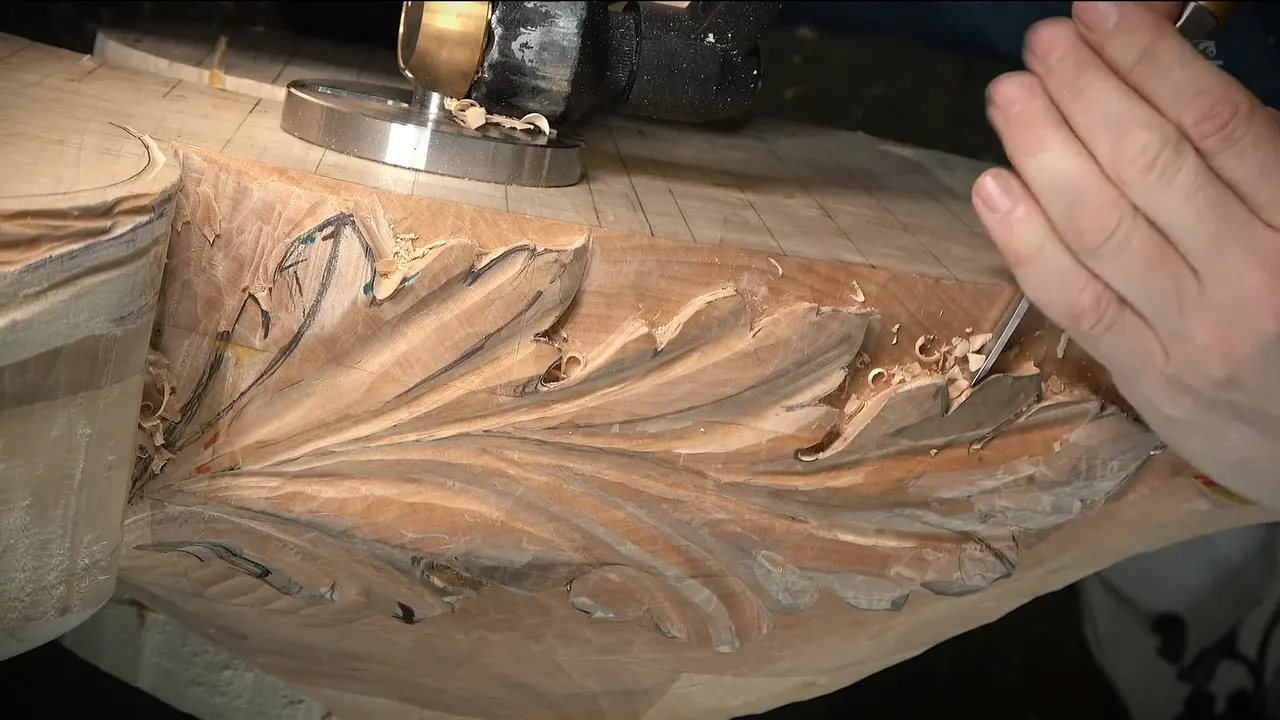

In part 9 of workshop 95, I say "now it's looking good." Earlier in the part sit a plan for a dome effect, a small tool, "like 1mm", and a deeper pass with number 11. Behind the line come "movements and extra separations to give" and a plan for a number 3. Other lessons of mine carry the same two words, each one linked below.
Have you ever stepped back from a spot you just carved and wondered if it was done? Workshop 95 holds the words. Every lesson I borrow from below gets its name and a link.
What is the plan before the line?
The video opens on a plan, "I'll take again, number seven", and on the words "and create a dome effect." A need follows, "I need to get a little deeper excavation right here at number 11,". More cues sit beside it.

They read "otherwise I don't get it." and, near 00:00:30, "I mean, I'm talking about the dome I'm not talking about my understanding." Last of the group is "Otherwise, it's not going to be there."
Which small tools show up before the line?
Around 00:01:09 the cue reads "Ok, I can get in on some of the spots and clean," and soon I say "I will use". The gouge number is "number three."

"Without getting too deep" is the next limit, and a size and a plan sit beside it. I say "I need to use the small one," and then "like 1mm" (1 millimeter is about 0.04 in), with "otherwise" and "I am undercutting too much." right behind.

What follows the line in part 9?
The line from the top of this page sits near 00:03:04. Behind it comes a thought of adding, "movements and extra separations to give". Soon comes "here and right there, I think it's going to look really good," and then "carefully I got to do it."

A plan for tools rides along: "I probably should use a number 3" and "it would give me a much better result." Near 00:04:11 the cue is "And that looks good."
Can a doubt sit beside a good line?
Inside this very part the words are "This area," and then "I don't know if I like it or not, maybe maybe if I add extra movement like this." A plain doubt lives in the same video as the good lines.

Tools named after it start with "I will use" and "Number five." Right behind come "got to be careful." and "And number three." Around 00:05:38 the captions give "Number 11," and "get a little bit undercut", and soon after, "And upside down, number seven."

A last plan is in the captions: "OK, let me clean that with the one millimeter." (that is 1/25 in). Past that sits the final line of the part, "And I also need to get rid of this side a little bit."

Do the neighbor videos of workshop 95 say it too?
The eighth video has the words close to 00:03:00, "so that is looking good," and right behind them: "from my point of view, it does not look too good." Right after come "What I mean by that, that's it has to flow in all" and "dimensions and 3-D".
After that comes "and right now it still doesn't." Around 00:03:26 comes "And now it does." Tools in that video are "I will use 1mm" (0.04 in) and "and clean a little better, this section." plus "Follow with the number three." Near the end there is "And in this case, I'm using 5 mm." (0.2 in).

In the tenth video the captions have "looking good." near 00:01:34. A job follows, "I need to work on this edge right now" and "I'll clean a little later."
Tools follow in that video: "I will use" and "number seven." A smaller one is "And maybe number five, but small one", and a tiny one is "I will use a small, tiny tool to get rid of this left over." The size is "half a millimeter," (0.02 in).
One of the last calls is "And I think I could leave this side alone." Next to it, "may be I could use" and "rasps." A rasp plan ends the video: "Maybe I'll just give a rasp job to it".
Does the underneath have to look good too?
Video 1 of Venice Room 44 opens on depth: "Okay. Go much deeper underneath of this." Soon it adds "But I also have to keep in mind it's going to be visible from the bottom." And "It has to be clean underneath."
Next come the words themselves, "It has to be looking good underneath also." An outline follows: "And yes, maybe I have to outline all around also, because" and "otherwise you're going to lose overall picture." A tool is named too, "Maybe with the bigger." and "Number 11."

How do I check a flowing line?
Lesson 3 of Hashemi Flowers, video 3, starts on a plan, "I will concentrate right now on the upper part." Its cues after that are "my flowing line" and "is actually looking good from the side view." The lesson page sits at Hashemi Flowers 3.
A dislike sits near 00:04:17: "I don't like the flow," and "so I want to make sure it's lower down a little bit." After it comes "So it just doesn't look as nice. Okay."

The high side in Acanthus over Moldings 4 is "gonna lower down" and "little bit this side because it's just little", with "too high" and "for my taste" after it. The look at the whole shape is "and again, I'm looking from" and "side", and then "not. I want to see overall picture". Its test line ends on "good or not."
Soon after, the cue is "and I'm happy so" and then "that is good." A blend follows: "So now some blending on this side."

What if a part is separated from the main one?
In lesson 19 of Hashemi Flowers, video 2, the cue reads "against the grain, but I do have to be careful." Next is "But for now," and "looking good." That page is Hashemi Flowers 19.
A broken piece follows, "is separated from this main part, and I" and "wasn't too careful." The choice is "and I decided not to glue it."
What if a lesson needs no extra holes?
In Hashemi Flowers 48, video 5, the holes start as a plan: "I said I could add" and "those holes" and "on the go." Next, "And looks like I don't really need to add anything." Then "Just like that, without extra holes."
Close behind sit "Well, in my opinion, okay, it's looking good." and "big curl, just like that." After them: "Big movement."

The other side of the story is in Hashemi Flowers 45, video 7: "Like I said, you don't have to do those holes everywhere". The same cues talk about petals. The verdict on too many holes is "And that's not always looking good. Okay?" A tool plan follows, "Maybe it's probably good idea to use number 11." And then "excavate toward the hole."

Can looking good mean I leave a spot alone?
Lily Box 4, video 6, holds the clearest case. My plan is "I could probably leave it" and "like that for now." A correction lands next: "Not for now, actually, forever, because it's actually already looking good."
Behind it a new job starts with "And now I need to make sure" and "that is actually looking also really nice and smooth." A maybe names the tool: "Maybe I can use a number five." Around 00:03:03 come "number eight again." and "And one-eighth of an inch," which is about 3 mm. Another detail sits between them: "a small pipe effect. It's not real" and "pipe, but still like a vein, if you wish."

Over in Floral and Molding for the Panel 6, video 1, the cue is "I didn't clean that yet, and it's already looking good." Next comes sandpaper: "you feel free, if you want to use a sandpaper,". Next to it I say "I don't need to because that project is going to".
A smaller tool is the plan near 00:02:23, "have to get a smaller number" and "11, maybe about 3 millimeters. Let me do that." That size is about 0.12 in, a little under an eighth of an inch.

Does patience belong beside the words?
Video 2 of Furniture Panel 10 has "lots of patience to develop something" and then "looking good."
A doubt sits there too. The cue is "I still kind of don't like what I see right here." Over in lesson 7 of the moldings course, at Acanthus over Moldings 7, video 3 has "I'm not sure if I" and "like what I see." Then "I think it's gonna be looking good. So now let me". The tool idea is "I think number nine."
Can a movement upward look good already?
In Venice Room 67, video 7, has "But I don't have to because I have a movement upward" and then "and that's looking good already." A question follows, "But how do I attack" and "this side?" My plan is "I guess I would attack it" and "exactly the same way, just breaking the rule".

Does a rolled part look good at once?
Doubt starts Venice Room 76, video 2: "I'm not sure if the rolling going to help or not." Then "Maybe not,". Near 00:00:57 I say "I can roll it" and "looking good". At 00:01:14 the cue is "looking much better."
The tool is small, "with 2 millimeters" (0.08 in) and "number 11 veiner. Okay. And remove that". Two cues follow, "Here you go. There is another" and "shadow I created,", so a shadow is the thing named there.

Which lessons doubt a part?
In Venice Room 38, video 1, I say "But this one doesn't look too good to me" and "I need to probably move it a little bit this way because it just doesn't". One cue later is "look too nice. Okay, I need to move it".
The line after it is "Otherwise, it just looks a little too straight." Then "at this point, I have to work with just the smaller tools," and "To figure out the right movements." Then comes "And this side is looking good." Right after it is a doubt: "But what bugs me," and "actually not that bad at all."

Does an early step look good?
Within the hazelnut course, Carving Hazelnuts 1, video 3, has "But you can see" and "at that stage, it's actually looking good". Then "I love it." A block plane is the job after it: "I would use just a block plane. It doesn't have to be".
"All I need is just a flat surface for gluing." I say "So like you see, I'm not going to worry about some of the tool" and "marks." Beyond that, "Doesn't take too long. Let me get the blocks, and I'm going to glue it." The glue is plain: "wood glue will work, any PVA glue."

A curl outward is the plan in Carving Hazelnuts 5, video 3: "idea to just curl it outward slightly." After it come "That is good." and near 00:07:12 "That is looking good."
Step number one sits in "you don't concentrate on" and "details". A size sits farther on, "for now, half an inch" (that is 12.7 mm).

Butterflies 11, video 2, has "We get step number one, and you can see the effect." Then "But even with that, it already looks good."
More follows: "And by the way, that is not the end." Before all of it, near 00:06:50, comes "I'm talking about don't raise it, don't lower it." and "Just to try to keep that angle the same."

Which lines did I borrow?
| Where I say it, by lesson and video | What sits beside the words |
|---|---|
| Part 9 of workshop 95 | A dome, a deeper pass, and a small tool |
| Eighth video of that workshop | A view that did not flow in all dimensions, and then did |
| Tenth video of that workshop | An edge to work on right now, and a clean for a little later |
| Venice 44, video 1 | Depth underneath, a bottom that shows, and an outline all around |
| Hashemi 3, video 3 | A flowing line checked from the side view |
| Hashemi Flowers 19, video 2 | Separated piece, care against the grain, and no glue for it |
| Hashemi 45, video 7 | Holes everywhere, petals closer or farther, and a verdict on too many holes |
| Hashemi Flowers 48, video 5 | No extra holes added, and then a big curl with a big movement |
| Moldings 4, video 2 | High side lowered to my taste, then a view of the whole |
| Moldings 7, video 3 | A doubt about the look, then a forecast |
| Floral Panel 6, video 1 | A detail not cleaned yet, with a smaller number 11 after it |
| Lily box, lesson 4 | A detail left as it is, then a smooth surface and a small pipe effect |
| Furniture Panel 10, video 2 | Patience to develop something, and then looking good |
| Venice Room 67, video 7 | A movement upward that already looks good, and a side to attack |
| Venice 76, video 2 | Rolled part, doubt about it, and a 2 mm number 11 veiner |
| Venice Room 38, video 1 | A part that looks too straight, a move of it, and a plan to clean the other side |
| Hazelnuts 1, video 3 | Blocks planed flat for gluing, and wood glue |
| Hazelnuts 5, video 3 | Curl outward slightly, and half an inch to keep for now |
| Butterflies 11, video 2 | A first step with its effect, and a second step to come |
Is there a spot on your own carving that you can step back from today? You will find workshop 95 inside one tuition plan, with the rest of the Venice Room, Part 8, in the Venetian style. Workshop 94 sits before it, and workshop 96 follows.
How it's done
- Plan a dome with number seven. Number seven is my first pick, with a dome effect and a deeper pass at number 11.
- Reach for a small tool. A small one, "like 1mm", is in my plan, "otherwise" I am undercutting too much.
- Look at the spot. Near 00:03:04 the captions read "looking good" for the spot.
- Think about extra movements. Extra separations follow, with a number 3 in my plan.
- Doubt one area. On one area I say "I don't know if I like it or not".
- Plan the clean for later. A clean with the one millimeter is my plan, and the last line is about one side.
Frequently asked questions
Which tools sit in part 9 before the good line?
Number seven and number 11 sit in the plan for the dome effect. Number three comes next, and a small one, "like 1mm", follows. Number five is named after the line.
What comes after the good line in part 9?
A line about extra separations comes first, then a forecast with "here and right there", and a number 3 in my plan.
Where do I leave a good spot alone?
The fourth Lily Box lesson has the plan to leave a detail as it is. The sixth Floral and Molding lesson has a detail I did not clean yet. Hashemi 19 has a piece I decided not to glue.
What to carve next