

Alexander Grabovetskiy, woodcarver, School of Woodcarving · Published 2020
What does a wood carver mean by "curly"?
Quick answer: In workshop 95, part 5, I describe a shape as curly at 00:01:31, right after I name a spot for the end of an arc. Other lessons of mine use the word too, for flowers, a panel, an acanthus, a grape tray and board grain, and each is linked below.
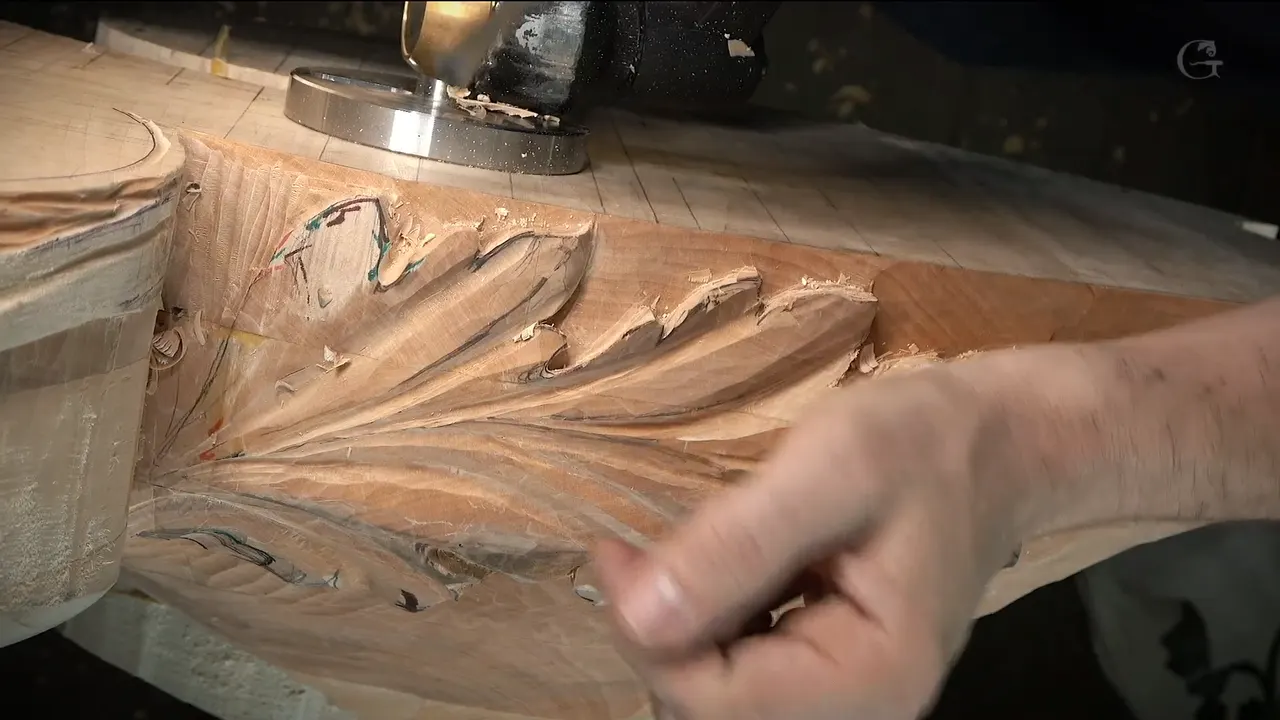

Part 5 of workshop 95 holds a plan for a shape I picture as curly. The word shows up in many other lessons of mine, for a carved shape and for the grain of a board. This page sets those lessons side by side.
Have you ever looked at a leaf on your bench and pictured it curling, like a spiral? Come through workshop 95 with me and see what I say about it. Every lesson I borrow from is named and linked.
A short list for part 5
- An arc, and the question "where is that going to end?"
- A mallet, a separation and a relief come next, and I add a limit on depth.
- One spot in the middle, before the next section.
- Number 11, a veiner, is named while I work on that spot, and a skew tool is a maybe for the corner at the end.
- Number seven and number three, then a small chunk.
Where does the word curly come in?
The video starts with spare wood: "I've got extra three-eighths of an inch" (9.5 mm). Then I say "I'm still safe because I have to lower that down anyway."
Next is "I also want to give some kind of arc", with the question "where is that going to end?" After it comes a point: "right there."

The word itself sits at 00:01:31: "I think it's going to be really good and curly." It is a plan. A second plan follows, about how the shape will "blend together, you know, the main movement" and "go like this wrapping."
A small extra detail is a maybe: "somewhere right here." Then comes "all the way. To the base."
What follows that plan in the video?
Tools come next: "I will use Mallet again, I'll get my separation and make a relief cut. And yet not too deep." The relief is a plan.

More lines: "And I can clean this direction also" and then "all the way. To that point."
At 00:04:22: "So I'm not going to worry about cleaning up yet this area, because this surface needs to be also Carved and that's going to happen a little bit later," I say.
How does the veiner meet the high spot?
My first word is ridge, and then I name the spot I mean: "the high spot middle and I can blend a little nice with this section."
Said as I work: "Number 11, of course, Veiner #11, and I'm positioning my tool at approximately one o'clock and using just the side of my tool."

A size is next: "Should use a little bigger because right here in this area right in this section." Then the direction: "Supposed to twist, although I'm Carving wrong direction, so I have to attack from the side."
Next: "Oh, not really. So I guess it's still better from this side." And "That is good."

How does the video close, from the chunk to the corner?
Next on the list: "let me get rid of this small chunk right here," I say. Then "let me use number seven and create a little better looking separation and I'll use a number three."
Last comes a corner: "Although in this case would probably help me a small, tiny tool like a skew tool". Then "that's No Bueno that there's no way I see it." Right after it come these words: "That's just the really easy to break." The final line is "I rushed it slightly."
Where else do I say curly?
This word sits in my Venetian workshops, a furniture panel, an acanthus lesson, a Hashemi flower, a Cabernet Sauvignon tray and a lily box. Each passage below is cued to its video and linked to its lesson page. A few mean a carved shape, and a few mean what a board itself is doing.
What is a curly element in workshop 42?
The seventh video in workshop 42 has "It's a curly element. Really curly element. But let me think." Then "Okay, I'll use a 1.5 millimeters right now" (0.06 in).

Why do the curls matter in workshop 41?
Workshop 41, third video: the opening line has "some curliness to this detail." The Venetians come in next: "regional, those people in Venice."
Then comes this: "That was probably one of the things I found while researching. They really love those curls. Everything was curly."

Which video says nice and curly?
The eleventh video in workshop 44 has "I could probably already subdivide this piece". Right after it: "really, really nice and curly."
Subdivisions are on the list there, and the line "otherwise it's not going to look good" follows.

When does a shape become curly?
Twelfth video, workshop 47: after "another division" come the words "flip this way", "this part going to go underneath" and "create a full motion."
Then "See, it's already becoming curly." And "more careful how I do my stuff." The tool is "Number 11, of course, and it's two millimeters" (0.08 in).

Does a division make it curlier?
Workshop 48, first video: "Maybe actually get a little more curly this way." Over in workshop 56, the first video says "another division again" and then "uniform and also curly."
How curly is curly enough?
Over in workshop 55, the twelfth video has "Okay, so it's curly enough." Earlier in that video come the words "nicer convexes" and "more details", as jobs I still need.

Is there a name for a Venetian acanthus?
Workshop 58 uses it in the third video: "that curly style acanthus, I would call it. Venetian style, Italian 16th century, Venice, Venezia."

The third video of workshop 61 has a plan for "really low cut." Then "really wavy and curly. Beautiful movement."
Which video shows a curly effect near an edge?
Workshop 76, first video: I say "And see it's already giving me that curly effect." The edge is named: "yes, I am close right on the edge, but if you go inside, there is a thicker material."
Then "Which means I can excavate little deeper on inside" and "even better shadow." One more warning: "really careful not to overdo it."

Two more lines belong here. Workshop 70, seventh video, has "extra detail on inside going like this" and then "a lot more curly look, I would say." Workshop 77, seventh video, has "still, it's somewhat curly." Links: workshop 70 and workshop 77.
Which side of a panel is curly?
A design video in Furniture Panel 10, the fourth one, says "look more curly." Then "But maybe make that curl a little smaller. The reason because it's just too close to the size of those."
Later: "my curly side with all the flowers and movements". That passage names a straight side, and then "this actually hits right at the golden ratio of the inner panel."

Video four of Furniture Panel 14 holds "some kind of curly flowers" as a plan. Panel 20, first video, has "more twisty, more curly, I would say." In that video I also say "And yes, I do like curly flowers in my wood carving."
In Furniture Panel 29, second video, I say "I don't like it's uh, not too curly. I'm gonna fix that." Then "I'm gonna make it little curlier."
Which tool gives a curly look in the panel?
Furniture Panel 23, eleventh video, has "I'm using right now number eight and 7 millimeters" (0.28 in). I add "kind of big concave, but that gives me a really interesting move."
The curly line comes after: "And those concaves, by the way, they give a curly look, really curly look."

One more passage comes from Furniture Panel 18, eighth video: "let me work around that curly detail", with a plan to stay away "a millimeter on both sides" (0.04 in). Next is "Maybe less."
How do I make a petal curly in a Hashemi flower?
Sixth video in Hashemi Flowers 44: "I could excavate right here and just cut on the inside" and then "create a curly effect, which I kind of like." After that, "So make it like this part curls in."
In Floral and Molding 7, second video, a plan has a petal go under "this curly one", and the tool talk is "one millimeter tool, number 11" (0.04 in).

Do acanthus lessons use the word curly too?
Yes. Byzantine Acanthus 10, first video: "an extra separation right here. We're going to make it curly." Then "See, it looks already different," and after it one word: "Curly."
Byzantine Acanthus 8, second video, has "just kind of repeat the movement, just curly that, okay? Make it curly."

Why call a grape tray curly?
Cabernet Sauvignon 8, first video: "I call it like a curly style because it's, it's a grape, a lot of curls." Beside it: "It's gonna probably be good in this case." Then "Not too hard to do, but it's gonna look really nice."
A wavy choice sits beside it in Cabernet Sauvignon 7, first video: "like a curly one if you want to, or you can do more like, you know, wavy like this."
When is a carving too curly?
In Venetian Flowers Rosette 3, the first video has "a curliness, if you wish, to say it that way", then "more curly". It adds "please, if you're going to do those flowers, you don't really have to repeat exactly my movements."
In Carving Hazelnuts, lesson 7, second video, I want "a really flowing line." Then "a little too curly if I'm going to create too much." Another Venice Room line, from workshop 163, is a maybe: "to make it more curly if I need to". Then "Sometimes it's just overkill also."
When does curly mean the board itself?
Lily Box 4, second video: "why I'm using that smaller tool right now." The reason follows, "Because it's so curly", and then I add "I am catching grain" about the bigger tool and "in the curly spots, the grain changes."

That lesson goes on in its tenth video: "I can lose it, especially on a curly wood". Then "easy to catch that grain and break it."
Its first video holds "as you remember, that is olive wood" and then "my olive slab was really curly".
Video three of Lily Box 7 gives "a curly wood like this, on a curly grain." A story follows: "I had to make cherry legs for the furniture for one of my clients, and that was curly cherry."
That video lists basswood, walnut, cherry and oak. And "Beautiful. But also, grain was going all the directions."

Lily Box 8 has "wood is really curly. You never know," in its fourth video, after a plan of "two millimeters first" (0.08 in). Its seventh one carries "It has a curly grain on inside." The blend is next: "blend that marriage line where my grain changes direction."
The olive wood in Lily Box 3, eleventh video, is "already warping" and "you saw that piece, it was all curly." The next line is "The grain was really curly and beautiful."
What is a curly lily doing here?
In the fourth video of Lily Box 10, I say "I am doing more with the curls." Then "there's a curly lily." A book of the Bible comes in, the Song of Songs, with a girl who "has some curly hair."
"And I made the decision to do a curly flower just because" is next, and then "she had curly hair." A later line is "from almost no curl on this side."

Which lines did I borrow?
| Where I say the word, by lesson and video | What sits beside it |
|---|---|
| Workshop 95, part 5, my own video | A relief with the mallet, then veiner 11, with a depth limit |
| Workshop 41, third video | Some curliness for one detail, and a mention of the people in Venice |
| The lily box, lesson 4, second video | A smaller tool, because the wood is curly and catches grain |
| Workshop 44 | A piece to subdivide, with a line on how it looks |
| Panel 10, design video | A curly side of the design set beside a straight side of it |
| Workshop 47 | A division that flips, then number 11 at 2 mm (about 1/12 in) |
| Cabernet Sauvignon 8 | A grape with a lot of curls, and a style named after them |
| Workshop 55 | Curly enough, with nicer convexes and more details nearby |
| Hashemi Flowers 44 | A petal that curls in, with a possible excavation on the inside |
| Workshop 61 | Planned: a really low pass, beside wavy and curly with beautiful movement |
| Panel 23, eleventh video | Big concaves, with a number eight at 7 mm (0.28 in) |
| Workshop 76 | A point close to the edge, then a deeper dig planned, for shadow |
Is there a shape on your own carving that you picture curling? You will find workshop 95 inside one tuition plan, with the rest of the Venice Room, Part 8, in the Venetian style. Workshop 94 sits ahead of it, and workshop 96 follows. For the gouge you take, see the chisel page too.
How it's done
- Give the shape an arc. I want an arc, and I ask where it ends.
- Point to the spot. I name a spot, probably right there.
- Plan the mallet and the relief. My plan is the mallet again, my separation and a relief, with a depth limit.
- Hold off on one area. Cleanup waits on that area, because the surface needs to be carved too.
- Blend the middle spot. I can blend the middle spot with this section.
- Keep the veiner on its side. Veiner number 11 works with just its side, and a little bigger one may suit the section.
Frequently asked questions
Which tool does part 5 name?
Number 11, a veiner, positioned at approximately one o'clock, using just the side of the tool. My plan also has number seven for a better-looking separation, then a number three.
How much extra wood is in part 5?
Three-eighths of an inch (9.5 mm) sits spare in an area that went a bit too deep. The video says "I'm still safe," because that surface has to come down anyway.
Which of my lessons use curly for the grain?
Three lily box lessons do: 3, 4 and 7. Lesson 4 says the grain changes in the curly spots, and its tenth video says it is easy to catch that grain and break it.
What to carve next