

Alexander Grabovetskiy, woodcarver, School of Woodcarving · Published 2020
What does a wood carver mean by "supported grain"?
Quick answer: Workshop 95, part 3, has the words at 00:04:11, after a line that ends "in the direction of the grain." The words after it are "And that's No Bueno." My other lessons use "supporting grain" as well, and workshop 112 uses "supported grain" again.
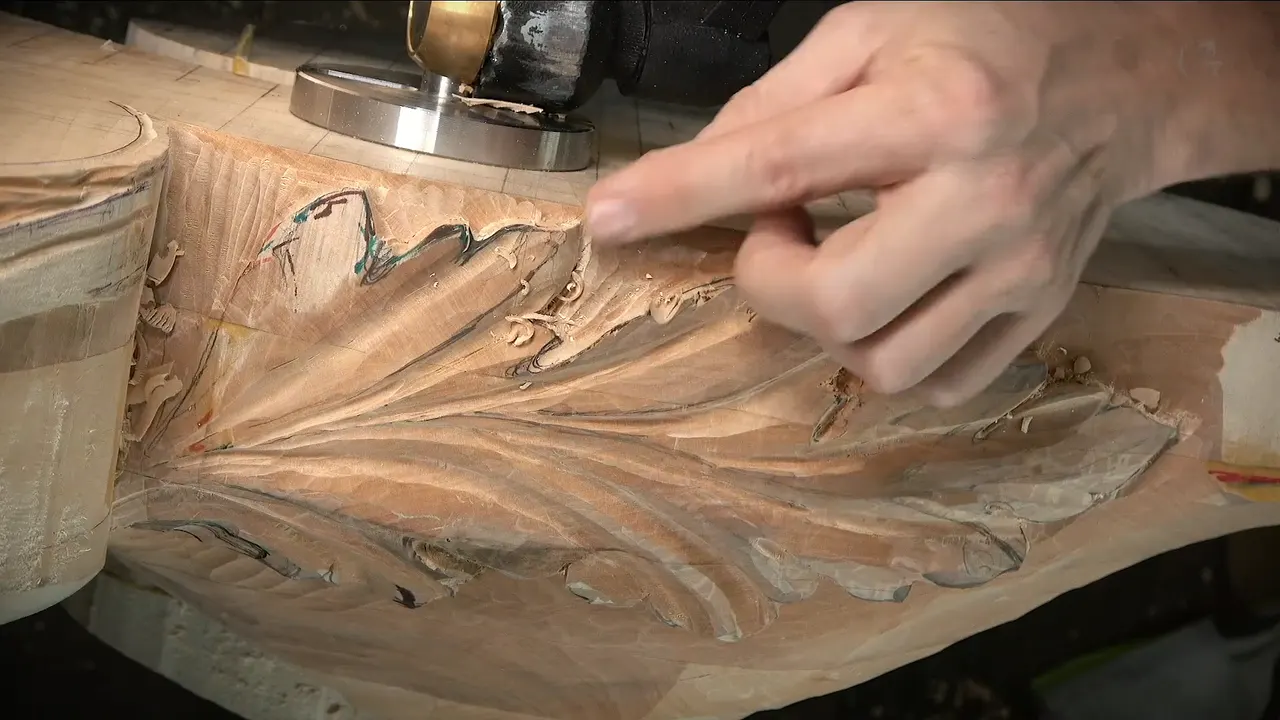

Part 3 of workshop 95 has the words "supported grain" in its reasons against a deep undercut. My other lessons put the word supporting beside grain too, and in workshop 112 the same words stand next to a plan to open an undercut underneath.
Have you ever pushed a gouge under a thin edge and watched the fibers snap? Would you like to hear what I say about the wood under them, lesson by lesson? Walk through workshop 95 with me. Every lesson I borrow from is named and linked.
A short list for part 3
- Thickness is left in those regions, otherwise they break.
- The number 11 veiner starts, and a smaller one cleans inside.
- Number five gouges come at two sizes, and then a number three rides on the fibers.
- The undercut cannot go deep, and the words "supported grain" give the reason.
- Super sharp tools, in this area.
What do I say before I touch the wood?
The video opens on a warning: "I have to be really careful and my tools, they must be super sharp." A few lines later comes "not to create too much damage."
Thickness is next: "I have to leave a little extra thickness, you know, in those regions." Without it the wood breaks, and "really important to understand that" comes after it.
Which veiner goes in first?
The line at 00:01:19 is "And let me excavate this way." The tool follows: "And I can probably use one millimeter, I think it would be wiser, one millimeter, number 11, of course" (0.04 in).
One area stays as it is: "OK, so I would leave it just like that for now and let me create this separation and then I can undercut to the final look what I'm after." Before it, at 00:02:09, the cue is "little by little."

Which number five comes next?
The sizes are in my words: "I'm going to use again, number five, and that would be 10mm Three-eighths of an inch" (10 mm comes to 0.39 in, and 3/8 in to 9.5 mm). Next come "I gonna chop" and "I will also use number five and one inch to create this cut like 25mm 25.4 if you wish."

Next: "See how easy it breaks off," and the reason is "so that's why I have to be really careful."

Why is a deep undercut out here?
Two reasons begin with "And yes, I cannot do super like a deep undercut in this case." First, this side is the back side, and it will not be visible. The second begins "Second, think about it."

The grain follows: "if you look at the grain in the direction of the grain and it runs like that, I doubt you can see that." Then comes "But if I can undercut so some of the grain not going to be supported anymore."
Next comes the line this page is named for: "So that's not going to be a supported grain." After it comes a verdict, "And that's No Bueno," and a name for the spot: "So that is the weak spot."
A limit follows: "Little bit, little bit, it's OK, but not much, I still have to create the support for the grain."

What does the half millimeter do?
A half millimeter comes at 00:04:37: "I will use half a millimeter to clean a little bit inside right here" (0.5 mm, or 0.02 in). Then "See how easy I can remove that grain?"
A look at my hands explains it: "the grain goes this direction and this piece if you look at my hands, it just running like that straight up." Then "and I'm Carving this surface," and then "OK, so now it makes sense."

How sharp must the next gouge be?
A smaller tool comes in: "I will use a smaller tool." It stays a number three, "a small one like 10 millimeters" (about 0.4 in). The plan reads "I am going to ride on top of those fibers and slice them."
The warning returns at 00:05:54 with "the tools they must they just must be super sharp, especially if you working in this area." A wider line follows: "tools must be sharp, no matter where you work, probably. But some of the areas more forgivable."

The result is at 00:07:16: "And see how translucent my cuts are." Then the line starts "So I'm really barely taking."
What did parts 2 and 4 say about the fibers?
In part 2 the cue at 00:07:29 reads "those fibers, which you see they're breaking because of the grain direction and how I'm working, I'm actually working on the end-grain." Then "So direction the grain actually runs in this direction."

Over in part 4 a limit gets a reason: "I don't want to go too deep the reason I said it multiple times because of the grain direction in this case, that would be a big mistake." Next: "But the little bit I could."

The full words sit in part 3. The lessons below say "supporting grain" and "supported grain" as well, each one cued to its video and linked to its lesson page.
How does a donut explain supporting grain?
The Woodcarving Techniques, Tips, and Tricks Q and A course has the lesson Carving with the Grain. A picture of a donut comes first, then "carve short grain to the long grain," and the words arrive at 00:06:05: "There's a terminology, is that supported grain or not supported grain?" After it: "I'm not sure if you're familiar with that terminology or not."
The picture is "That is the upper part of the grain, and below is a supporting grain." Then "And it supports the upper part of the grain. So it makes sense."
The other end is "If you're going to start carving from this part, there's no supporting grain. They're going to just rise up." Then there is "They're going to fight."
The lesson goes on to a channel made with a gouge or a veiner, where one side gets "clean cut" and the other "really rough cut."
For Grinling Gibbons style the words are "Absolutely no." The rest of the line is "You have to attack from some angles," and later comes "If it fights you, just sharpen your tools. That's it."
What if I start from the wrong end?
Tray of Blessing, Cabernet Sauvignon 6, second video, has "But I have to attack from this side. If you remember the grain direction, that is actually a really good representation right there."
Right after: "So I really have to start from this point. If I want to cut with supporting grain, that grain supports my previous." Later comes "I'm actually carving against the grain right here, but my tool is sharp and I'm okay with that." Next comes the angle, "you always have to present at 45 degrees." Its reason follows: "you're gonna get much cleaner cut, it's gonna be more slicing cut, okay?"

When did the same words open an undercut?
The third video of Venice Room 112 has a first section that is "a little too thick, so I'm going to use only about 1/8 of an inch" (about 3.2 mm). Then a plan: "I could go, actually, you know what? And create an open spot underneath."
Next come the words: "Maybe I should because it's a supported grain, so I shouldn't have any problem." Then, at 00:02:05, "Hope it makes sense. Because like I said, that is a supported grain, so along the grain, it should not be as fragile."

A fallback sits in the same video: "I can always reinforce it." The fallback plan reads "I can just get glue diluted with water and penetrate it with the glue." Because it is a paint grade, "it should not create any problem."
The other case is a stain grade, where "it would be blotchy." Later: "So I'm attacking that from the opposite side." And last: "And yes, I am all the way through right there."
Where does resistance show up?
Workshop 100, third video, has a line on care, "because the grain direction goes this way, and my cut is actually against the grain." Then "I'm kind of raising up the grain," and the line ends "at least on the left side of my tool."
Next: "I'm supposed to attack from this side, but I cannot because I have that leaf in the way." A check comes at 00:03:57: "I want to make sure I'm not undercutting." The position of the tool is "straight up," and "My flute is actually to 12 o'clock."
At 00:05:02 the words are "Feels like I am getting some kind of resistance, but I know for sure my tool is sharp, really sharp. But the resistance comes from the grain."

Then, in the same video: "I'm really going pretty much digging, not supporting grain. So that's why there is some resistance."
In Venice Room 151, first video, comes "There is no supporting grain, so I'm staying a little away from the cut." Then "You can see it's choppy, and this side is cleaner."
A choice follows: "I could go around and attack that from opposite side," and the reason against it is "waste my time."

What changes in my first pass?
A plate of butterflies in Carving Plate with Butterflies 2, first video, starts with "Grain in my case runs that direction so my cut wouldn't be across the grain. So it's much easier to control." Then: "I'm not gonna break anything."
After that: "as you know You really need to get support, you know underneath with the cut when you carve that so there's gonna be supporting grain underneath." At 00:03:12 the line is "you can see when I do across the grain."

Why keep a bridge, or a thicker part?
Byzantine Acanthus 9, third video, is my acanthus lesson: "I knew we're going to bang from the top, and we needed that support. If we would not have anything supporting underneath," and the result is "a big problem."
Further on: "Now, you also please keep that bridge to the end if you do have that bridge." Then "Because once you're going to undercut, so sometimes you have a tendency to crank on it, just use that as a leverage. Try not to hit that."
Next: "remove that too soon, the grain runs that direction, and that becomes really weak. So you can break it."

Furniture Panel 19, second video, puts it in thickness: "that's actually just to give to that panel some strength." A link follows between "a lot more material" and "a lot less support." Next: "And I still would like to see the thicker parts, like supporting parts."
The size is "Because it's a 16th of an inch, 16th of an inch, and it gives me the strength" (1/16 in is 1.6 mm). Of the movement in that panel, the plan is "I probably going to eliminate as much movement as I could."

Where else does the grain direction limit the depth?
Hashemi Flowers 2, fifth video, has "really fragile because the grain goes this direction." The condition that follows is "until I am ready to work on the final detail," and my plan is not to go all the way down yet.
Floral and Molding for the Panel 14, first video, gives "It is really easy to break just because, like I said, the grain direction." The plan there is to "hold it with the fingers."
In the Venice Room, workshop 23, second video, the words are "I don't want to do extreme curl." The reason is the grain in that spot, "really weak." Next: "But little bit of the curl."
Which lines did I borrow?
| Where I say it, by lesson and video | What I say beside it |
|---|---|
| Own video | Little bit, little bit, it's OK |
| Carving with the Grain lesson | below is a supporting grain, it actually holds that upper part |
| Cabernet Sauvignon 6 | I really have to start from this point |
| Venice Room 112 | so along the grain, it should not be as fragile |
| Workshop 100 | I'm really going pretty much digging, not supporting grain |
| Room 151 | so I'm staying a little away |
| Butterflies 2 | there's gonna be supporting grain underneath |
| Byzantine Acanthus 9 | If we would not have anything supporting underneath |
| Furniture Panel 19 | And I still would like to see the thicker parts |
| Hashemi Flowers 2 | until I am ready to work on the final detail |
| Floral and Molding 14 | It is really easy to break |
| Venice Room 23 | But little bit of the curl |
Is there a thin edge on your own carving where the fibers stand straight up? Would you like to hear what I do about it, one lesson at a time? You will find workshop 95 inside one tuition plan, with the rest of the Venice Room, Part 8, in the Venetian style. Workshop 94 sits ahead of it, and workshop 96 follows.
How it's done
- Leave extra thickness. I have to leave a little extra thickness in those regions, otherwise the wood breaks.
- Start with the number 11. A number 11 at one millimeter, which is about 1/25 in, is the wiser tool.
- Two sizes of number five. I plan number five at 10mm (0.39 in), and I will also use it at one inch (25.4 mm).
- Hold the undercut back. Little bit is OK, but not much. I still have to create the support for the grain.
- Clean with the half millimeter. Half a millimeter (about 1/50 in) cleans inside.
- Ride on the fibers. I plan a small number three, like 10 millimeters, or 25/64 in, riding on top of those fibers to slice them.
Frequently asked questions
Which veiner goes in first in part 3?
The words are "I think it would be wiser," about a number 11 at one millimeter (1/25 in or so). Later a half millimeter cleans inside (about 1/50 in).
Which number five sizes come next?
I say 10mm, three-eighths of an inch (a little under 0.4 in). A second number five follows, and it is one inch, which is 25.4 mm.
Why can the undercut not go deep in part 3?
I give a back side that will not be visible, and I give the grain, where some of it loses its support.
How sharp must the tools be?
What to carve next