

Alexander Grabovetskiy, woodcarver, School of Woodcarving · Published 2020
What does "really bad" mean when a wood carver says it?
Quick answer: Workshop 95, part 2, has the two words at 00:04:16, at the end of my rule for a letter S line. Other lessons of mine put them beside a hard push and a broken edge, and one more beside a pass that goes too deep.
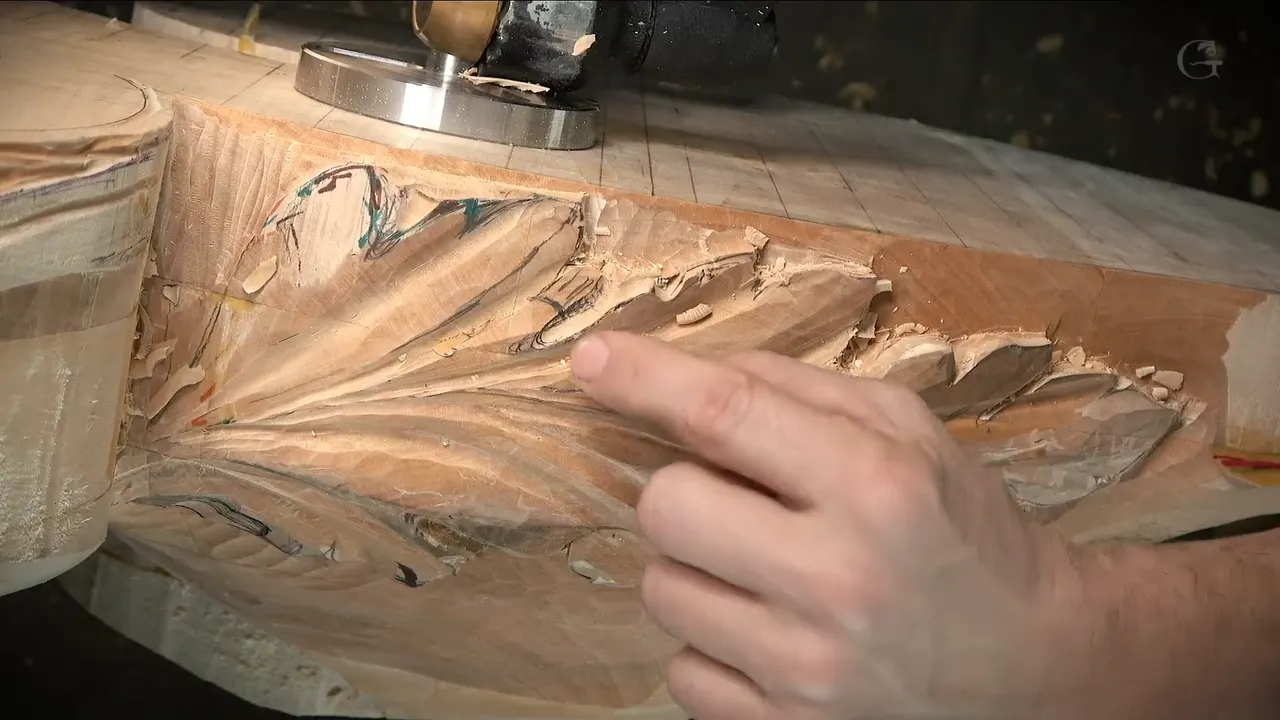

Part 2 of workshop 95 has the two words at 00:04:16, at the end of my rule for a letter S line. Other lessons of mine put them beside a hard push and a broken edge, and one more beside a pass that goes too deep.
Do you know the feeling when a curve you just made fights the line beside it? Would you like to hear what I say next, lesson by lesson? Walk through workshop 95 with me. Every lesson I borrow from is named and linked.
A short list for part 2
- A section I plan to chop out, then a second thought.
- A number seven that is maybe not the proper tool, then a number five.
- An S-curvature and the rule for it.
- A roll, and an undercut that has to reach a separation point.
- Two veiners, 2mm and 1mm, and then fibers that are breaking on end-grain.
What do I say before I touch the section?
The video opens on a feeling: "I just don't like how it looks." A plan comes next: "maybe I'm going to chop this section out and just leave." Then a second one, with a pipe and an eye: "maybe I could actually bring my pipe or my eye right there."

A turn follows, and its cue ends "better if I not remove this part." At 00:01:02 the line is "And yes, it does look much better," and right after it comes "so that it is more like more like acanthus look." Then comes "OK, so that that part I'm happy."
Which tool is the proper one here?
My number seven gets a doubt, "maybe that is not the proper tool." Then comes "And I'll use something else." The gouge that takes its place is "Number five, much better." The size is in my words, "10mm, #5, about three-eighths of an inch" (10 mm is 0.39 in, and 3/8 in is 9.5 mm).

Smaller work is a need, "I need something smaller to clean that," and at 00:02:50 I say "dig this out."
What is the rule for an S-curvature?
A look comes first: "I like how this movement looks, but I could actually add the S-curvature." A reason follows, "a nicer movement." For the tool I say "I'll take again, number seven and 14 millimeters, half an inch" (14 mm equals 0.55 in, a little over the half inch I name).

The lesson starts with "I hope you already understand about those S-curvatures," and goes on with "this line the middle line and the curvature of a leaf or this part, its actual arc."

The line must go "so it cannot go on the opposite side." After it, "So it has to repeat this side. So it has to be just about the same, like the main movement." The ending is "Then it is going to look good, otherwise it's going to look really bad."
How does a roll change the movement?
A look comes first, "But I'm not happy, how just the movement moves right here." The plan is "I could actually roll it slightly just like that." Then "Just roll it," and a few lines later "So now it is looking much better."

A second plan sits beside the first one: "I can do probably right now lower it down and undercut a little bit."
What starts the undercut?
I say "pay attention what I'm doing in this case right here in this section, if I'm rolling this direction." The rule is "that rolling supposed to start from that point."

The undercut has a condition, "which means my undercut all that material has to be gone." The word "Otherwise" brings a softer verdict that ends "as nice." Later, "And so just kind of bring that undercut all the way to that separation point."

Two veiners are named, "I'll use either 1mm. Or 2mm first and then I'll just use 1mm to clean it" (0.04 in and 0.08 in). The pace is "without any quick movements. without rushing I'll excavate."
Two lines show the wood. "those fibers, which you see they're breaking because of the grain direction and how I'm working, I'm actually working on the end-grain." And last, "So direction the grain actually runs in this direction."

Which S line does Venice Room 90 describe?
In workshop 90, second video, the rule comes in new words: "If the middle line goes like this, in my case, it's just pointing that direction, that also has to point that direction." Then "S curvature is supposed to be just exactly the same."
A wrong side is next, "If you're going to create a S curvature on this side," and the two words follow. Then "I'm really happy with that," and a plan, "Let me clean that edge." Later in that video I say "That gives me a nicer, sharper separation."

What snaps when the push is too hard?
In Furniture Panel 24, first video: "I have to be careful when I'm carving toward the center with the grain, or along the grain, I should say."
Pushing is the risk: "if I'm going to push too hard, I can snap out that middle part." Right after that line the two words arrive, and then a plan: "let me create that half a sphere like a dome."

Is the part worth keeping?
Take Lily Box 11, sixth video: "maybe I shouldn't even keep it. Just remove it completely and forget about it." Then "Let me see if I'll be able to save at least one moment."
The line before "I can always cut this completely out" holds the two words.

Why must a round shape go all around?
In the Maine class, Grinling Gibbons class 7, first video, there is "I gonna start my rolling motion with the number two." Next plan: "multiple chamfer cuts just like that." Then "I really want to make sure it looks Roundy."
The two words come first. Right after them is "like a pancake looking one." Then "So really make sure you understand the roundness and it's supposed to go all around."

What looks wrong from above?
Over in Acanthus over Moldings 2, third video, I give a split verdict: "Okay, that is good." Then "But it is not good how it looks from above so I need to fix that movement."
My goal is "I am looking for a really nice tapered look." A few lines later the h1 words land, and then the tool: "number 11 and 7 millimeters like a little bigger than 1/4 inch" (7 mm comes to 0.28 in, and 1/4 in to 6.35 mm).
When does the grain split inside a design?
In Venice Room 75, second video, the lines begin with "That is, by the way, not the safest way to do along the grain." Next I say "where it splits."
The warning is "if the grain is going to split on the inside of that design, that's going to be really bad." Then "So it's not going to give me the result I'm after." Next, "You have to feel it, okay?" And "not to push it too hard." Last, "So of course, always best to do across the grain like that."

What if a part may break under my tool?
Try Venice Room 74, fifth video. It has "And of course, I need to chop," then "Oops, that is not bueno." The danger is "If I would just continue to do that, I could break this part, and that would not be a good idea."
One cue later the h1 pair comes with "idea." Then "Okay, wonderful. And now I can easily create the line again, recreate the movement."

How thin can a part get before I stop?
In Venice Room 84, seventh video, the size is "about five millimeters thickness, about 3/16 of an inch thickness" (5 mm is 0.20 in, and 3/16 in works out to 4.8 mm).
"can't do anymore." The h1 pair with "idea" after it gives the reason. The tool, in my words, is "Number seven, 14 millimeters" (about 9/16 in).

When is a broken edge okay?
Down in Venice Room 120, second video, a plan opens with "4 millimeters, number 11" (0.16 in). A short line follows, "And carefully."
The slip is "Not carefully. See, I just broke the edge because I wasn't too careful, which is okay in this case, but in another case, it would be really bad." Later I say "I should use 2 millimeters" (about 5/64 in).

How deep can the next pass go?
Look at Hashemi Flowers 16, fourth video: "I have to keep an eye how deep I go, because I don't want to overdo it, because it's going to be a really bad idea."
The tool follows, "Take a number seven and 14 millimeters and try to clean that and blend it" (about 9/16 in).

How do I take the next pass?
The third video of Furniture Panel 17 starts with "I'll take number 11 again," and the size is "Three millimeters" (0.12 in). Then "Carefully remove that waste."
A rule comes next: "It's better to take time and remove little by little, than to rush it and make a big mistake." Last: "So that would be a really bad idea."

What sits underneath a part I dig around?
Back in Floral and Molding 10, first video: "I can go actually really low." The size is "about maybe one-eighth of an inch, about three millimeters at that end" (1/8 in is 3.2 mm). Next, "I'll just excavate like that."
The method is "Attacking that from three sides without undercutting." The trouble is "just dig and go underneath of that part, it would create a big problem later on." The h1 pair follows, with "idea." This molding lesson goes on with "Have to be really, really careful with that."

How deep can I go on an olive?
Here, Lily Box 13, third video, is on an olive: "I have to keep an eye how deep I'm cutting, because here's the line to the middle of the olive itself."
One cue later come the two words, ending with "remove too much." After them: "And here's a little tougher spot."

Which spot was really bad?
In Lily Box 8, fifth video, I start with "Okay. Now it's looking much better." Then, "And I can fix my edge of this one, okay?" Last comes "Just kind of clean my undercut."
Then I say "And nobody's ever going to know that that spot was really bad."

What does a dull tool do to skin?
In Lily Box 12, first video: "please make sure your tools are really sharp, otherwise it's too dangerous." Another line: "And yes, it's a lot more dangerous with dull tools because you create a lot more force."
The two words follow "penetrate your skin," and then "if the tool is dull."

What if a piece may break after all the work?
Take Curly Kitchen Cutting Board 16, second video: "So just be careful." Then "And don't force it." A move is allowed: "If you need to rotate slightly like this, just do it." Last, "Again, be really careful not to break it."
The last line holds the h1 pair and ends with "after all the work you've done."

Which lines did I borrow, and from where?
| Where I say it, by lesson and video | The words beside it |
|---|---|
| Own video | And I hope you already understand about those S-curvatures |
| Venice Room 90 | S curvature is supposed to be just exactly the same |
| Furniture Panel 24 | carving toward the center with the grain |
| Lily Box 11 | Just remove it completely and forget about it |
| Maine class 7 | So really make sure you understand the roundness |
| Acanthus over Moldings 2 | so I need to fix that movement and again, I am looking |
| Room 75 | So of course, always best to do across the grain like that |
| Workshop 74 | If I would just continue to do that, I could break this part |
| Workshop 84 | so I've got approximately, what, about five millimeters thickness |
| Part 10, lesson 120 | See, I just broke the edge because I wasn't too careful |
| Hashemi Flowers 16 | because I don't want to overdo it, because it's going |
| Furniture Panel 17 | than to rush it and make a big mistake |
| Floral and Molding 10 | Attacking that from three sides without undercutting |
| Lily Box 13 | because here's the line to the middle of the olive itself |
| Acacia box 12 | And yes, it's a lot more dangerous with dull tools |
| Acacia box 8 | And nobody's ever going to know that that spot was |
| Curly Kitchen 16 | Again, be really careful not to break it |
Is there a line on your own carving that fights the one beside it? Would you like to hear what I do about it, one lesson at a time? You will find workshop 95 inside one tuition plan, with the rest of the Venice Room, Part 8, in the Venetian style.
How it's done
- Keep the section. I think it will look better if I do not remove this part.
- Swap the tool. The number seven may not be the proper tool, so I use number five, about 10mm (about 0.4 in).
- Add the S-curvature. My plan is a number seven at 14 millimeters (0.55 in), and a line that repeats the main movement.
- Roll it. My plan is to roll it slightly.
- Bring the undercut to the separation point. All that material goes, from the point where the rolling starts.
- Start with the 2mm. I use the 2mm, then the 1mm, without any quick movements.
Frequently asked questions
Which gouge replaces the number seven first?
Number five, about 10mm, which I call three-eighths of an inch (a little under 0.4 in). My words are "Number five, much better."
Which tool do I take for the S-curvature?
A number seven at 14 millimeters (a little over 0.5 in), which I call half an inch. A half inch is 12.7 mm.
What starts the roll?
My words are "that rolling supposed to start from that point," and the undercut goes "all the way to that separation point."
Which veiners clean the undercut?
What to carve next