

Alexander Grabovetskiy, woodcarver, School of Woodcarving · Published 2020
What does a wood carver mean by "back then"?
Quick answer: "Back then" is what I said in part 4 of workshop 96 about carvers in normal shops, right after "just eyeballing." My words were that they "didn't worry about that too much." Other lessons set the same two words beside a reed, a V-tool and a slope.
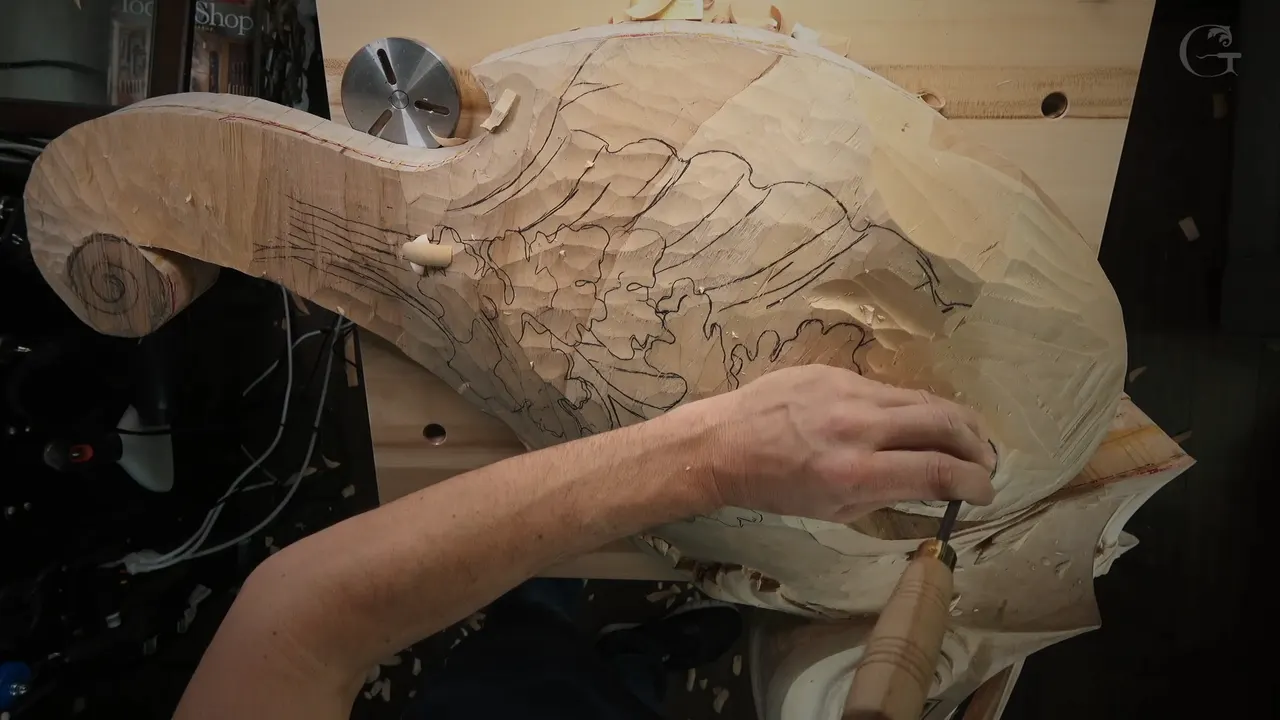

"Back then" is my phrase for how the old carvers worked, and in part 4 of workshop 96 it sits beside "just eyeballing" and "normal shops." Both lines land in the last minute of the video.
Ever watched a carver start a line without a ruler and wondered how those shops worked? Did you ever ask whether they measured every line? Then my short video asks the same thing. I looked through my other lessons for the places where I use these two words, and I found plenty.
Where does "back then" show up in my lessons?
- Workshop 96 sits next to eyeballing, and to shops where "They just worked."
- Panels 14 and 15 go with a style and with techniques.
- Panel 22 and Hashemi 18 bring a reed, plus a question about a router.
- Acroterion 1 and Molding 10 bring gouges and a V-tool.
- Roman 16 has red clay and gold leaf.
- A dining apron lesson has me using my gouges, and changing as few tools as possible.
- Venice 52, 23 and 15 offer a head, a shell and a shadow trick.
- Lily 6 adds a slope, and Venice 18 adds stone carvers.
- Furniture 16 and 38 add walnut and scraping.

What did I say about eyeballing in workshop 96?
The line that gave this page its name is near the end. At 07:01: "And I'm just eyeballing it, Ok, so I'm not." Eleven seconds later, at 07:12: "Wasting time to just measure everything and so on, just eyeballing."
Then, from 07:17: "So a lot of times that's what they did back then Ok so that they didn't worry about that too much of although they did," and right after it "but not as much as people think, especially just in normal shops."

The last two cues are short ones: "They just worked." and "They had to just work". Nothing else in this video says who "they" are, so here the old carvers stay unnamed.
How did I begin with a line I did not want to lose?
It opens with "Start outlining it" and a reason, "that way it's going to be much easier for me not to lose the line." At 00:43 the words are "Ok and I have to be careful, right in those spots." Soon after, at 00:58, "OK, that's enough, like I said, I don't wanna overdo it." And at 01:16: "that would be safer to use that number eight."

Which tool did I name, and how deep was I going?
At 02:49 the tool is "number three and Three-quarters of an inch about 19mm," so three-quarters of an inch (about 19 mm). Next, at 03:11: "Ok, again, that is just the starting point," followed by "and now I need to start lowering down this section."
Depth shows at 04:53: "I have approximately maybe" a figure of about 10 mm (0.39 in) "to this line," with "and I'm constantly checking around how it looks." Later, at 05:27: "And that has to be consistent, like 10mm from this point down," so 10 mm, or about 0.39 in. Short and plain. At 05:40: "depth of here and looks like I need to go a little deeper right here." Last of the four, 05:57: "I really don't want to make a mistake."

The surface came next. The idea at 06:09 is "And maybe it is a good idea for me to use number three and clean the surface a little bit." At 06:28: "Ok, let me draw again some of the lines which I lost, and I don't want to lose them." And at 06:54: "And that's not final-final line, but still got to be kind of careful."

Did the old carvers use a V-tool?
Two courses answer this, and they sit side by side. Roman Acanthus 16, video 2, is about a transition made with a finger and red clay. The line is "it's a lot nicer to actually get with your finger and just to get in those areas and kind of make a really nice smooth transition with the red clay." The next step is gold leaf: "And after that, they would use gold leafing."
I said: "They never used any V tools back then." Right behind it sits "So the V tool was invented later."

Next, about today: "And I know in some countries, even today, wood carvers don't use a V tool at all." And: "Although, V tool is one of my favorite tools, and I really like the V tool." Its last words: "But it's not necessarily you have to have it."
Floral and Molding 10, video 1, comes close to the same thought. At 19:51: "But I'm trying to be more authentic to the original carvers who worked on the project like that back then, and they didn't have that V-tool, but V-tool would be sufficient." Eleven seconds on: "Okay. And in this case, probably, nobody would even know if I used that or not." My plan right after was "So let me grab number 16 V-tool,".
How often did they change tools?
The dining table apron lesson, workshop 7, has my answer at 05:24: "I'm trying to use as much as possible my gouges. That's what they would do back then. Just not to change as much tools as possible." My own habit follows: "same or pretty close to the same radiuses."
Acroterion 1, video 5, starts with what many people ask: "Many people ask the question, how they did back then all the furniture and curves and all the moldings." Then comes "Some stuff you can do with the molding planes" and more. Later: "The only way you could do it, actually, it's just with your gouges, with your chisels." The talk ends with a plain pair of lines, and I quote them whole: "They just carved it. They just did it."

Why not hurry a background with a router?
At 08:50 in Furniture Panel 22, video 6, my plan was a reed brush, for a reason that ends on "really authentic" and "to the original." I answered a question one of you asked me: "why can't we use the router, okay, to remove the background". The cue gives the first answer in four words: "Of course, you could."
It goes on with "It's up to you." Then, in one long run: "So nothing wrong with that. And I've done it also on some projects, but my goal was to show you the more authentic way," and "And for some of you, I know there's some people in school, they're really picky about authenticity."

Could a Dutch reed smooth a sharp edge?
Hashemi Flowers 18, video 4, has a reed. At 04:33: "Let's say if you would be working in the 17th century, you would use a Dutch reed." Then: "I actually placed it on a roll of paper, and it's dried, and they use that actually to work on the edges."

My reason about sandpaper is at 04:56: "any sandpaper, and I don't, I want to be authentic." The easy way is spelled out: "So the easiest way, if you would just use what they used back then, it's not really sanding. It is, but it's not like a sandpaper. So it's a more natural, more authentic way."
What it let me do, at 05:30: "And that way, I can work on my edge, and I can see imperfections." And "I can go back again with the knife and refine a little bit."
Why keep the same depth everywhere?
The panel course, workshop 15, video 8, gives these words at 08:55: "for me, it's not production panel. So I want to create a piece of art, preservation of techniques they used back then." Soon after: "Again, don't dig too deep," and the reason is "because we still want to maintain the same depth."
My plan for the tool followed: "I think I'm going to need to use smaller tools." Then "Maybe I can use two millimeters," which is 2 mm (about 0.08 in). That stayed a maybe.

Workshop 14 of the panel design course, video 2, gives "the panel itself going to be kind of unique." At 12:40: "authentically designed in a style of" and the same cue ends on "back then." A few seconds later: "like I mentioned many times, every little movement, every little detail makes huge impact on the overall feel of the design."

Which ones did they not have?
Workshop 52 of the Venice Room, video 8, has a head. At 04:40: "So we're talking about the head." After it: "And they did not have, back then, the really long ones." Next: "Longer ones developed a little later." Nothing in these cues says what the long ones are, so I leave that open.

Venice Room 23, video 7, has a shell. At 05:05: "should not be as curved in those sections, at least in that style of acanthus they've done back then." A few cues later I correct a word: "I'm sorry, shell." Then: "More or less like a flatter, lesser sweep right there."

Is there a trick for one more shadow?
Over in workshop 15, video 1, a plan sits at 06:24: "I need to create another shadow point somewhere right here." Next: "Let me see if I'll be able to do that or not." A line later: "There is a trick, actually," and the cue ties that trick to "back then" before it ends on "that extra shadow."

Roman Acanthus 11, video 2, has a similar teaser: "Because later on, I'm going to show you a really nice, unique movement" ties again to "back then," and it ends with "to make it look beautiful, not as plain." A little later, at 03:16: "Again, leave some material."

Was a nice slope a common technique in the 17th and 18th centuries?
Lily Box 6, video 5, has a slope, and dates that go with it. At 10:51: "Really common technique back then, okay? 18th century, that was really common." Next: "Well, even not 18th, actually 17th century, end of 17th century, it was really common to give that really nice sloping."
At 11:15: "Actually, I give even better slope right here." And "Maybe even more slope."

Who carved the stone in Italy, and what school was it?
Workshop 18, video 5, adds a trade. At 07:07: "we are talking about Italians." On the trade of stone carving, the next cue says: "They had lots of stone carvers back then." Then marble: "they used a lot of marble." And: "And marble, you really have to sand. You have to make it smooth, otherwise it doesn't look good."

Next: "And it was pretty much the same school who did the stone carving and the wood carving because essentially it's almost the same trade. Almost."
Why take a clay first?
In an April 2020 livestream, the line about Michelangelo is "Most of the sculptors, even back then, even Michelangelo, they used a specific technique." Right after: "It's still good idea to take a clay before."
In an October 2020 livestream, the words are "authentic to Italian style," and "that's 15th, 16th century Italian style." Next: "And I had to study what they used" and the cue ends on "back then," Further on: "a lot of gouges and veiners."
What about wood nobody threw away?
In Furniture Panel 16, video 11, I said "They didn't waste a lot of material as we're doing right now, especially with the walnut." Then, about a little sap in the wood: "it wasn't the case back then. They would use it."

Did they scrape instead?
Scraping gets its own lesson in Furniture Panel 38, video 3. At 26:07: "then let's just scrape it." Fifteen seconds later: "That's how they've done it. By the way." It goes on about glass: "the glass was already available."


Which lessons say it, and what came right after?
Here is the table. It lists the lesson, the topic and a few of my words, and each row is a lesson you can watch.
| Lesson | Topic | Words |
|---|---|---|
| Workshop 96, part 4 | Eyeballing a line instead of measuring everything | Just worked |
| Furniture 14, part 2 | A panel that is kind of unique | Authentically designed |
| Furniture 15, part 8 | A piece of art and the same depth | Production panel |
| Furniture 22, part 6 | A router question that follows a reed brush | More authentic |
| Hashemi 18, part 4 | A Dutch reed that works the sharp edges | Dutch reed |
| Acroterion 1, part 5 | Moldings and curves done with gouges and chisels | Just carved |
| Molding 10, part 1 | A V-tool that the original carvers did not have | Original carvers |
| Roman 16, part 2 | Red clay, gold leafing, and a V-tool invented later | Gold leafing |
| Dining Apron, workshop 7 | The same gouges, with as few swaps as possible | Same radiuses |
| Venice 52, part 8 | A head, and the long ones that developed later | Longer ones |
| Venice 23, part 7 | A shell that should not be as curved | Flatter sweep |
| Venice 15, part 1 | A trick for creating one extra shadow point | A trick |
| Roman 11, part 2 | A really nice, unique movement, not as plain | Unique movement |
| Lily 6, part 5 | A really nice sloping on the second layer | Nice sloping |
| Venice 18, part 5 | Stone carvers and wood carvers from the same school | Same school |
| Furniture 16, part 11 | Walnut with a little sap that was used | Use it |
| Furniture 38, part 3 | Scraping, and glass that was already available | Just scrape |
Where can you watch each of these lessons?
The video for this page belongs to Venice Room 96, and workshops 86 to 97 live together in the Part 8 course. The workshops beside it are workshop 95 and workshop 97.
Other Venice Room lessons are workshop 52, workshop 23, workshop 18 and workshop 15. Their courses are Part 5 and Part 2.
The other courses are Furniture Panel 14, Furniture Panel 15, Furniture Panel 22, Furniture Panel 16, Furniture Panel 38, Hashemi Flowers 18, Greek Acroterion, Floral and Molding 10, Roman Acanthus 16, Roman Acanthus 11, the dining table apron, Lily Box 6 and the livestream events.
If a word here is new, the plain definitions are one click away: gouge, chisel, wood carving, bench, grain, mallet, inch and millimeters.
Want to hear all of this in my own voice? Start here.
How it's done
- Eyeball the line. At 07:12 the line is "Wasting time to just measure everything and so on, just eyeballing."
- Keep depth even. At 05:27 the line is "that has to be consistent, like 10mm from this point down," so about 0.4 in.
- Go slowly in the tight spots. At 00:43 the words are "Ok and I have to be careful, right in those spots."
- Redraw what you lose. At 06:28 my plan was "let me draw again some of the lines which I lost".
- Check the surface. At 06:09 the idea was to "clean the surface a little bit."
Frequently asked questions
What does a wood carver mean by "back then"?
In my lessons it points at how the old carvers worked. Workshop 96 sets it beside eyeballing. Other lessons set it beside a Dutch reed, a missing V-tool and a slope. Each of those is a cue you can read above, with its time.
Did the old carvers measure everything?
Workshop 96 has the cue "especially just in normal shops," and the line before it is about eyeballing. Nothing in this video gives a number for how much they measured. That is all I can point to.
Did old carvers use a V-tool?
The Roman lesson has the line "They never used any V tools back then." The Molding lesson has "they didn't have that V-tool, but V-tool would be sufficient." Both lines are about those projects.
What to carve next