

Alexander Grabovetskiy, woodcarver, School of Woodcarving · Published 2020
What does a wood carver mean by "rotate that"?
Quick answer: Rotate that is my plain way to say I turn the piece, so the tool meets a side from the other direction. Workshop 96, part 8, shows me weighing it, and I decided I did not have to, because the side was within reach. Other lessons of mine turn the work after the grain bites.
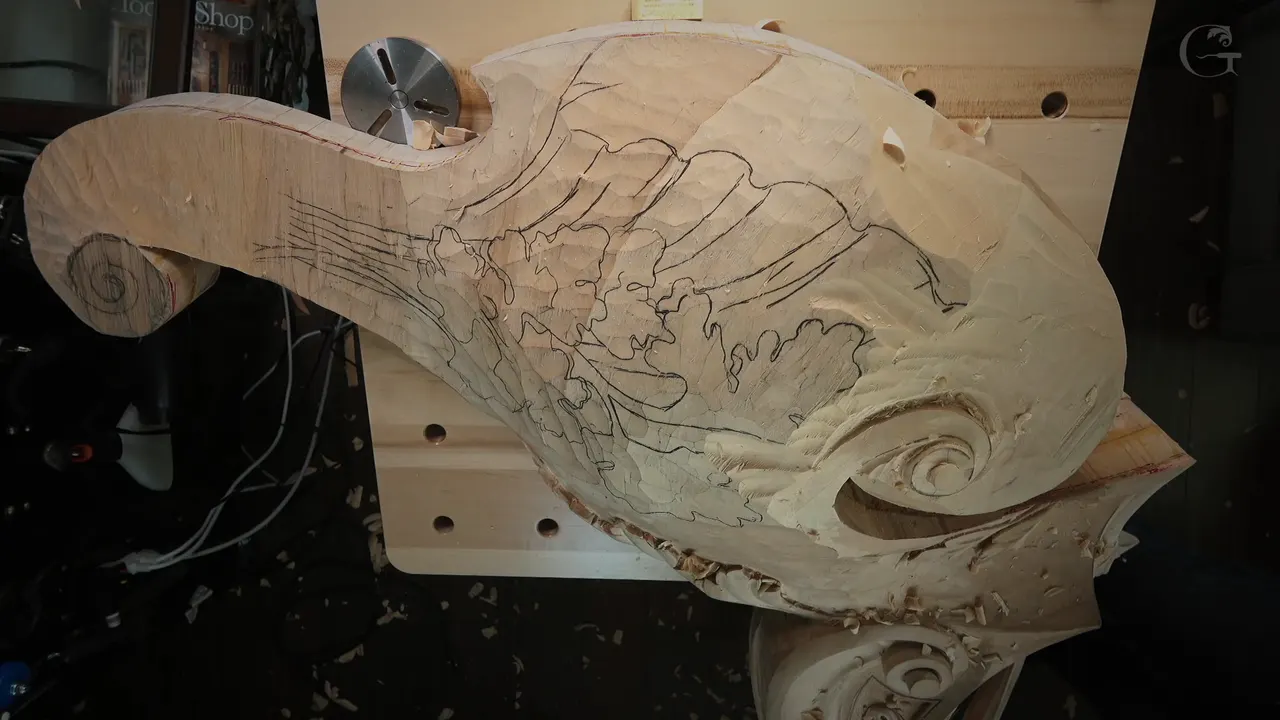

Rotating the piece is turning it so the tool can attack from the other side, and in part 8 of workshop 96 my line is "I thought just to rotate that, but I don't really have to." The reason comes in the next cue: "It's accessible to me."
Ever stopped in the middle of a pass and wondered if the board should turn first? Or did you ask if you could reach a side as it sits? Then my short video and a handful of my other lessons are for you. My part 8 video is short, so this page looks through my other wood carving courses for the places where I rotate and the places where I do not. Every lesson has a link, so you can watch it yourself.
What do my rotate lines add up to?
- In workshop 96 I thought of a turn, then found I did not need one.
- Byzantine acanthus turns the piece the moment the grain bites.
- Two Greek acroterion lessons turn it and then carve from the new side.
- The antique rosette workshop plans a turn after each quarter circle.
- Hashemi and a floral panel lesson use a turn to attack a spot from the opposite side.
- Several Venice Room workshops hold the piece still and give reasons.
- Two other lessons give cameras as the reason, one from a floral panel course.
What did I mean by "rotate that" in workshop 96?
The part opens in the middle of a pass. At 00:37 my words are "That is good, and let me also shave a little bit this section." Soon after, at 01:20, "Again, let me check this side." Both are plans to look.

By 01:34 I am ready to move on: "So now, let me jump and outline". A cue later: "Not the movement, but whatever the leaves or foliage". Then the tool is named, "I'll take number 11 and 12 millimeters." In inches, 0.47. The height, I say, is also 12 millimeters.
The outline comes with a warning to myself: "Got to be careful." Next, at 02:29, "Of course, it's better to go with the grain." And a distance: "But I'm staying away a little bit, about eighth of an inch or so." In metric, about 3 mm.

Later the depth changes. "And I'm not going to have 12 millimeters deep right here, so it's going to be a lot more shallow." The limit follows: "no more than 10 millimeters." In inches, that is 0.39. At 04:31 the next line is "Okay, so and another side."
When did I think about turning the piece?
At 04:47 the words are "And I have to do this side." Then I weigh the next step out loud: "I don't know, maybe I don't have to." That cue goes on to the sentence at the top of this page, and the next one, at 05:00, gives the reason I quoted there. All of it sits inside thirteen seconds.
Two quick cues follow, at 05:24 and 05:27: "So, I've got that section" and "And I've got that section." I do not name the "that". The frames show a pale scroll piece with leaves drawn on it.

At 05:44 comes the big removal: "So now what I have to do, I have to get rid of this hump. So it's a big hump". Then the plan: "I'll take again big gouge, number seven, and start removing across the grain." It is the last cue of the part. A gouge like that is the tool I name. The frame at 04:40 shows a green mallet in one hand, though my words in that part do not mention it.

Which words from the Byzantine lessons cover the grain?
The clearest lines come from Byzantine Acanthus 2, part 2. I work in slow motion, and at 00:11 the words are "feel what the grain does. If it's working against you, change the position". A few words later the order ends with "work opposite direction. Okay?"

Further on, at 01:28, I come back to it: "And like I said, if the grain bites, just rotate the piece." Later, at 03:19, I push harder with "don't be lazy to rotate" and "It's really important."

Why would a carver be lazy about it? Here, at 03:23, is how I put it: "Sometimes, we do have a tendency" and "it's a good idea to rotate and just attack from different directions, especially on the small pieces." A small piece is the case I name there. A huge piece is the opposite case, and you will meet it a few sections down.
Which side comes next after a rotation?
Greek Acroterion 3, part 5, has a short version. At 00:56 the first word is "Carefully", and the second order is "rotate that". Next, "You can see when it changes the direction." At 01:43 it repeats: "So I'll rotate that again and just, again, work from this side." One rotation follows another.

A second Greek lesson names the grain out loud. In Greek Acroterion 4, part 7, at 08:16, "Although I'm cutting right now against the grain, so it's not the best idea." The fix is the next cue: "So I have to just rotate my piece and cut from this side."

Part 4 of the same lesson is a run of short orders. It opens "Rotate that" at 01:03, and at 01:11 the shape follows: "a slight curve toward the inside." Then "Rotate it again." In part 2, at 03:28, the plan is "I'll rotate that" and "make my smoothing cut on this side also until it's clean". At 03:47 comes "Let me" and then "clean that", and a check follows after it: "double-check if there is anything left."

Do I turn it at each quarter?
In Rosette workshop 1, after "Now I got a quarter circle." at 09:02, comes the plan to turn it, and the next cue finishes it: "Make another quarter." Again, at 09:35, it comes around with "rotate that again." The rosette is a circle, so the quarters add up to one.

Workshop 2 of the same course has two turns, and at 13:46 the words are "Rotate that. I'm going to work this direction." Next, a short cue: "Diagonal grain." Seven minutes later, at 21:00, "We rotate that from this direction." Workshop 1 admits there is more than one way: "Of course, there's a couple different ways you can do that." The next words are "You can take it actually to a lathe".
In Flower Rosette 2, part 1, I talk about the hold instead. At 00:08, "you notice how I hold that piece, and I can rotate that easily." Then, "there's different methods you can actually hold the pieces," and, "you can just clamp a piece of wood." That last line follows "a regular bench".

What do I weigh before a turn?
Hashemi 10, part 2, begins with a pass and a verdict. At 05:15 the words are "And right now I am working against the grain." Then "That is not the smartest way to do." The fix is two short cues. First "Rotate that", then "and attack that from opposite side."
Hashemi 10 gives a second option in that part. At 05:33 I add "flip upside down and attack from the backside," and then "but that's okay." Roman Acanthus 16, part 1, has the choice at 51:49: "Let me rotate the opposite side." One line later comes "Or I can just actually work on this side and continue to work on it."
Hashemi 8, part 4, ties a turn to the wood left. The words, at 03:42, are "less than an eighth of an inch, about 3/32nds already left right here." That is under 3 mm, about 2.4 mm, and the next two lines are "So I can't dig too much." and "Just little by little." The plan is "I'll rotate the opposite direction".
Floral and Molding 2, part 2, plans a turn in two places. At 01:26, "rotate that piece," and then "I can attack that from the opposite side." And at 09:55, "Okay, let me rotate my table."
Modern Acanthus 1, part 3, opens a turn with "I'm gonna rotate". The plan after it is "and I'm gonna show you should be able to see that is also gradual movement right here." Then: "So I do not create really sharp transition to the down."

Byzantine Acanthus 10, part 3, has "rotate that piece" at 08:22, then "attack from opposite side." The Tray of Blessing, lesson 6, gives a reason of comfort at 01:11: "It's not really comfortable for me from this position." A plan to turn it comes at 01:16, and I keep it a plan.

When can't I turn the piece?
The piece stays where it is in several workshops. Part 1 of Venice 4 gives, at 03:54, two reasons in one breath: "sometimes you're limited, and I am limited in this case". The first is not wanting to rotate it. The second is "I don't like to swap my hands because it's still not comfortable for me."

Venice Room 55, part 9, is plainer. The ability I lack is the turn: "I just don't have that ability". Then, at 05:59, "It's too big, so it's got to stay in place." Next: "And I don't want to walk around."

Venice Room 57, part 5, says what the better way would be. At 05:46, "Rotate the piece or walk around", then "attack from opposite direction." After that, "That would be smarter. Okay? Safer, I should say." And the other side of it: "sometimes I have to deal with the huge pieces like that."

The Hashemi course holds both sides in a few lines. In Hashemi 47, part 9, at 09:08, "I could rotate my piece and approach from another side." Then, "And it's okay with a piece like that." And later, "I really can't walk around, and I can't rotate".

Two more lessons say it flat. In Venice Room 51, part 11, at 05:03, "because I can't really rotate this direction too much. I can't go in because of the ceiling," and in Venice Room 53, part 8, at 04:47, "But in this case, I can't rotate this piece, and that's probably the only way I can attack".
Is rotate only about the piece?
In my other lessons it can mean the tool. In Floral panel 12, part 1, at 10:58, I put "my tool to about 10 o'clock or so," and then at 11:11 comes "Or I can just rotate that to about 1 o'clock". That time the o'clock figure belongs to the tool.
Part 2 of Floral panel 6 has, at 08:40, "rotate my tool almost upside down" and then "and go underneath." In Byzantine Acanthus 3, part 2, at 06:32, "we place the tool, rotate it to 2 o'clock". I do not name the "that" in workshop 96, so I do not decide which one I meant.
Why do the cameras come into it?
Floral and Molding 10, part 2, and Venice Room 162, part 2, give the same kind of reason. At 06:13 of the first, "I don't want to rotate my table all the time." The cost follows: "I have to redo my cameras, and it just takes time."
Of the second, at 05:15, I have "And yes, I'm working towards myself, but it's not the best way to do it." Right after, at 05:19, "to rotate that or even walk around," followed by "I'm going to cover my cameras". After it: "you're not going to be able to see what I'm doing."
Which lessons turned the work, and which did not?
| Lesson and part | What the turn did there | His words |
|---|---|---|
| 96-8 | Skipped, because the side was reachable | Accessible to me |
| Byzantine 2-2 | Done after the grain fights back, then work the other way | Opposite direction |
| Greek 4-7 | Done after a pass that fights the grain | Just rotate |
| Rosette 1-1 | Planned after each quarter circle | Another quarter |
| Flower 2-1 | Easy, thanks to the way the piece is held | Rotate easily |
| Hashemi 10-2 | Planned, once that pass is called not the smartest way | Opposite side |
| Roman 16-1 | Weighed against staying on one side | This side |
| Modern 1-3 | Planned, with a gradual movement in view | Gradual movement |
| Venice 4-1 | Held back, and swapping hands is no easier | Not comfortable |
| Venice 55-9 | Impossible, since the piece is too big | Too big |
| Venice 57-5 | Called smarter, though huge pieces stay put | Safer |
| Floral 10-2 | Passed over, since cameras need redoing | Takes time |
| Venice 162-2 | Left alone, since turning would cover the cameras | Cover |
What did the other two parts of workshop 96 add?
Part 7 has two lines near its end, one on slicing and one on the shape. At 06:26, "got to slice it nicely." Then, at 06:57, "that movement has to be really gradual and nice and it looks like I got a little hump in this area."
Earlier in part 7, at 02:41, I plan a test against the profile: "I will use #7" and "Let's see if it's going to fit the profile." At 02:58 comes "And it fits actually perfectly." Later, at 04:05, the wording is "I can definitely start my movement from all the way at this point and go around, around and around."
Part 9 stays on removal. At 02:12, "definitely, this section has to be gone," and at 03:24, "Lots of material." Next, at 06:23, a size, "three-quarter of an inch." In millimeters, that is 19. Last, a reason for the small tool: "because the tool is smaller, I can control much better the movement."
Nothing in parts 7 and 9 says rotate. Part 8 has the word, and it has the reason I skip the turn: the side was within reach. The Byzantine lessons cover the other case, a pass that fights the grain.
How it's done
- Check what the grain does. My first order in the Byzantine course is to "change the position" if the wood works against you.
- Turn the work when it bites. Right after changing the position, the order is "work opposite direction."
- Switch to the new side. In Hashemi 10 the words after that pass are "Rotate that", then the other side.
- Turn again after each part. My plan in the rosette workshop is to turn it again after the next quarter.
- Skip the turn when the side is reachable. Workshop 96, part 8, weighs the turn and drops it, since the side is close enough to reach.
Frequently asked questions
Why did I not rotate the work in workshop 96?
Out loud, I weighed it, then decided I did not have to. A few seconds later came the reason, and it was short: I could get to the side. No other cue in that part says rotate, and I name no other reason for skipping it.
How do I handle a bite from the grain?
In an acanthus lesson of mine, a bite from the grain is the time to rotate, and the order that follows is to work the other way. Almost two minutes later in that part I push against laziness, and the line reads "It's really important."
Can every piece be rotated?
In my lessons, some cannot. One has "I just don't have that ability" and "It's too big". Another gives "I can't go in because of the ceiling" as a limit. A Hashemi lesson says "I really can't walk around, and I can't rotate" about the big ones.
What to carve next