

Alexander Grabovetskiy, woodcarver, School of Woodcarving · Published 2020
What does a wood carver mean by "a lot of stuff"?
Quick answer: In workshop 96, part 10, a skew line follows my plan to clean with a bigger tool and comes before my plan for the shell. Other lessons of mine put a similar line beside a knife or a V tool, a number 11 and a chisel. Each lesson has a link below.
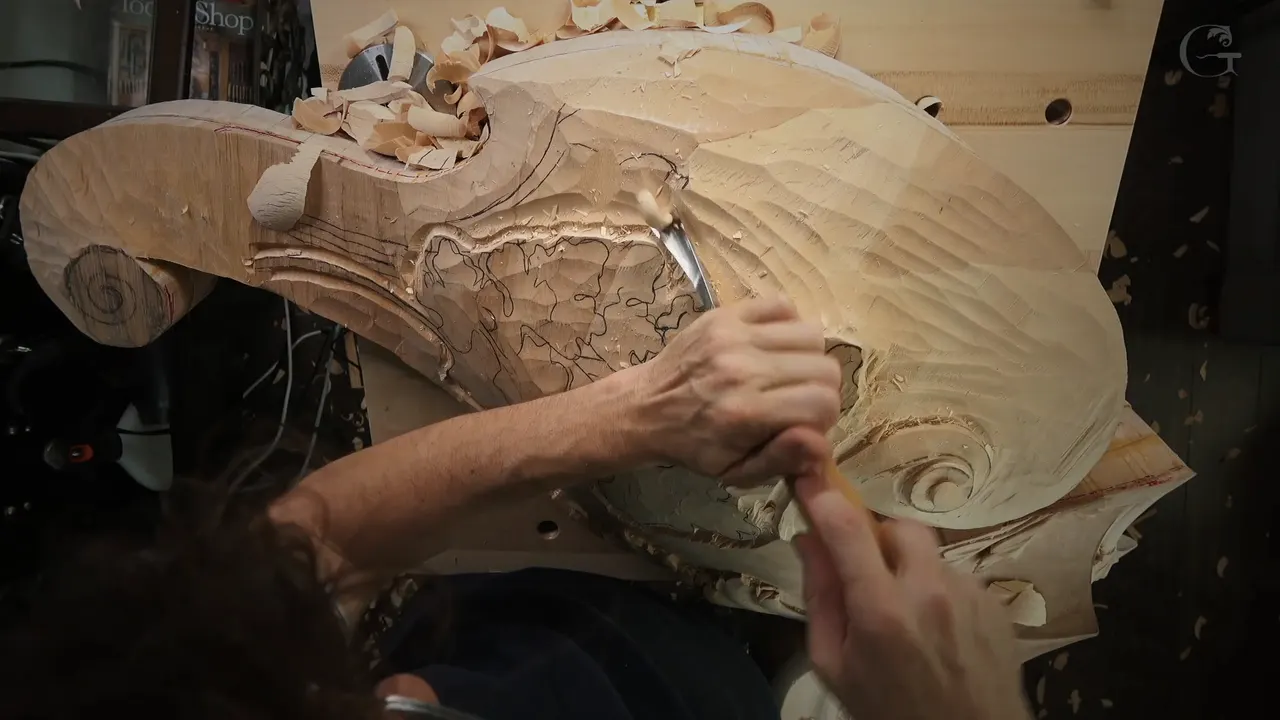

In part 10 of workshop 96 I name a big number two, and then comes my line for anyone who does not own one, which ends on the skew. The part is short, so the rest of this page comes from my other lessons, where I name a knife or a V tool, a chisel and a number 11 in a similar line.
Ever stood at the bench with one tool in your hand and wondered if it could finish the job? Did you ever put it down for a bigger one that you did not own? Then these lines are for you. Every lesson below has a link, and each link goes to a page that is open to everyone.
Where does the skew line sit in part 10?
My first words in part 10 are "Not too convenient, but it's okay." After them: "I'll walk around and work from this side." The target follows. "So what I'm after, again, just a gradual overall feel because like I said, there's going to be a shell, and I want to make sure it also flowing in 3D, in three-dimensional world."

Later in the part I say "That is good enough." My next plan is "And I can probably clean a little better right now with the number two and a big one, like 50 millimeters, two inches."

Plain talk about drawing comes next. "It is going to be just much easier for me to draw." Then "So I'm kind of getting clean canvas." And "This is what I like to do."

Now comes the line this page is named for, spoken to anyone without a bigger gouge. "And of course, if you don't have a big number two, at least just get the skew. All right? At least just get the big skew. Because you can do a lot of stuff with just a skew. This one is one inch" (25 mm) "and you can do a lot of cleaning and shaping."

A verdict follows: "You can get a really good job with the skew, actually." Next up is "Just get really gradual movements and so on."

Which plans follow the skew?
A plan to draw is next: "So now what I have to do, let me just draw a shell, and I'll go from it." Another plan sits right behind it, "So now I'll lower down whatever I need to do on the backside of the shell."

I judge the outline. "So that is approximately the shell of movement that I'm after. I'm not sure if I like it or not. Maybe I'll fix it. But anyway, so that is an outline."

The run of the movement is "That is an outline, and of course, the movement going to go all the way like this." The molding follows. "But on the outside, I do have also molding going on" and "this molding going to go all the way to the volute."

The last cues of the part hold a plan for wood. "But what I have to do, I have to just remove some of that material right here. Okay, let me use just the number seven and start removing some of that stuff." Depth comes last. "I don't know, maybe about half an inch deep" is my plan, and in metric it is 12.7 mm.

The reason for a smaller tool sits in part 9 of the same workshop: "Number seven, but smaller number seven." Its size is "three-quarter of an inch" (19 mm), and the reason reads "because the tool is smaller, I can control much better the movement."
Where else do I name a knife?
In Hashemi Flowers 49, part 6, I plan "I'll use just a knife." The knife is "my favorite knife", and the next line is "any type of wood carving, and I can go as deep as I wish with this knife." A little later my verdict on the shape is "Overall shape is not so good, but not so bad either."

Just before that the tool is "number 11", and I say "it's just the same cuts over and over and over again." Then "And I make it a little smoother."
Lily Box 13, part 1, gives a plain reason: "yes, I do like to use a knife when I can because it's just much quicker for me." Also "I can give a really nice quick shape." A weak spot earns a warning, "this point is kind of weak point, so try not to create too much pressure."

Later I name the tool again: "And I am using one of my favorite knives." And close the thought with "And quickly, like I said."
Greek Acroterion 3, part 1, holds a story. First a line about control, "I guess I'll have a lot more control that way", and later a plan, "I'll take multiple passes, I think". I send you back with "like I mentioned in some of my workshops", and I remember "I think, 1998 or 1999, something like that" and "when I had a project, coffered ceiling." My part in it was "I actually designed the ceiling itself for my client." The carved part was "just the sides of this coffered ceiling."

A route I could have taken comes next: "of course, I could go a really complicated route and do a full 3D design." Then "But what I did, I just designed that ceiling for just the one knife project."
The time I give is "It took me about one month, the whole project, all the sides, and I did it just with the knife and a hand." My verdict was "And that was a really good project." About money I say "I even made some money in one month, just one knife." About my knives I say "to expedite my work because I can remove a lot material in just a single cut."
That lesson also names the fireplace mantels: "I did some fireplace mantels, and also using just the one knife." A verdict follows right after, and it is short: "It looks actually good."
Venice Room 93, part 7, turns to the knife. "And they used knife a lot back then. It's one of the main tools of the trade, at least." The limit comes next: "In England, they didn't use knife too much." One more line, "Well, I shouldn't say that. They used it in the countryside, but not for the palaces and so on."

Which other tools get a line like it?
In Roman Acanthus 7, part 5, I say "it's a good idea to use a V tool." For the reason I say "friendliest tools you should have". The same task has a second answer: "you can solve actually with just a straight knife" and "just a carving knife."

A line about the bench follows: "really handy to have on the table or workbench". Earlier in the part my plan is "Let me get my number five and quarter-inch", which is about 6 mm.
In Venice Room 57, part 7, a pass goes too deep. "It crumples because I've got too deep of a cut, so that's not good." Then comes "I pushed too much, so I have to be a little more careful." The size I think about is "I could go with the 1 millimeter, and I think I should." About the 1 millimeter I add "It's going to give me even more depth."

By the way, "you've probably noticed", and then "I'm using a lot of number 11s." The number 11 itself is "just a really universal tool".
Roman Acanthus 10, part 5, brings a small chisel. "I really love to use a double bevel number one in some of my carvings." Of that tool I say it "works just like a knife, but it's a chisel, and I'm using the small one."

Small tools earn this line: "it's just handy to have small tools you can reach the areas when the big tool is not as convenient."
The apron course, in workshop 17, has a book in it. I mention "English traditions", and then "Almost every carpenter at least knew how to use a carpenter's chisel for wood carving." The chisel there is "Just a flat, I mean, number one chisel". My plan is "Someday I'm probably going to do and show what is possible to do with one knife or one chisel."
What a single tool cannot do is stated flatly: "Although, of course, you're limited. Of course, you are limited." Right after, "I like a lot of tools." And "You don't have to buy all the tools I have, but" with "the more tools you have, you'd be surprised how much more you could do."
The Venice Room 32 lesson, in part 5, is the one where I leave a tool out for a reason. "I want to feel like those guys who did originally, what they felt." My description is "They had pretty much gouges and veiners, and they did a lot of work with those." And "And I not even once touched V tool, because they didn't have it back then."

I could have used it: "Which not really stopping me from using it. I still could, but I don't think I need it." The list I give is "And a knife and a chisel. That's it." My plan for the rasp is "before I finalize all the details, I want to hit this edge with the rasp."
In Venice Room 55, part 1, I describe a tool as "an excellent tool." Later: "But can you see how I developed concave, convex, concave?" For the next separation: "There is a really easy way to create those separations." I plan "I'm going to use a number 11 veiner, and that's four millimeters" (0.16 in).

The size I plan is "One and a half millimeters. That's what I'm going to use." The inch figure follows: "Number 11, of course, and that's a 1/16 of an inch."
What does one tool do on a single carving?
Furniture Panel 26, part 2, shows a blend. "But on another hand I need to blend this part also somewhat underneath." One tool is named right after that line. The target is "the eye itself should look" and "like a shape of the water drop."

The way to get there is "which means carefully, carefully gonna roll and blend somewhat underneath of this line." I also say "I wanna make sure it feels like this side is" raised up.
Byzantine Acanthus 8, part 1, names the skew itself. "The reason I'm using that knife" starts the line. My verdict on the skew is "But the skew is one of the best tools actually you can have also for the wood carving. Fastest."

One tool is named in the cue after that. Then I say "And again, just recreate whatever the channel you have to recreate." And "We still going to develop the details." The cleanup is stated plainly: "Definitely I need to clean it, and so on." Last: "But now you can see the shape more established."
Do the words ever point at a kind of carving instead of a tool?
Floral and Molding 1, part 1, answers yes. "I kind of like it anyway", I say about a separate piece, and a few lines later "What you can do with that stuff". Then comes "those moldings are going to continue and just wrap downhill."
Uses come next: "You can do mirror, you can do picture frame". I name a maker too, "if you are a furniture maker", and "some kind of door".
I end that stretch with "So just endless possibility." The wood is plain: "I still use the same basswood, limewood, linden wood." And "that's carved from a single piece." The thickness is "about maybe 19, 20 millimeters, about three-quarters of an inch", and then "It doesn't really matter."
Which lessons say it, and what did each one do?
Here is the table. It lists the lesson, the tool I name there, and two words of mine. Each row is a lesson you can watch.
| Lesson and part | The tool I name there | My words |
|---|---|---|
| Venice 96, part 10 | Skew of 1 in (25 mm), my fallback without a number two | Big skew |
| Hashemi 49, part 6 | My favorite knife, used for any type of wood carving | As deep |
| Lily Box 13, part 1 | Knife I like to use when I can | Much quicker |
| Greek lesson 3, part 1 | One knife for a whole coffered ceiling, all the sides | One month |
| Workshop 93, part 7 | Knife of carvers back then, but not much in England | Main tools |
| Roman lesson 7, part 5 | V tool, or just a straight carving knife for the same task | Friendliest tools |
| Venice 57, part 7 | Number 11 at 1 mm (0.04 in), used in this section of a room | More depth |
| Roman lesson 10, part 5 | Small double bevel number one, which works just like a knife | Just handy |
| Apron course, workshop 17 | A carpenter's flat number one chisel, or one knife | You're limited |
| Part 5 of workshop 32 | Gouges and veiners, plus one knife and one chisel, no V tool | That's it |
| Part 1 of workshop 55 | Number 11 veiner of 4 mm (0.16 in) for the separations | Easy way |
| Panel 26, part 2 | Single tool to blend somewhat underneath of the line | Water drop |
| Byzantine lesson 8, part 1 | A skew, named with the words best tools and fastest | Fastest. Okay? |
| Floral Molding 1, part 1 | Moldings that wrap down a panel, a mirror or a picture frame | Endless possibility |
Where can you watch each of these lessons?
The video for this page belongs to Venice Room 96, and the twelve workshops 86 through 97 live together in the Part 8 course.
Earlier courses hold more. Workshop 32 sits in Part 3, and workshop 55 and 57 sit in Part 5. Beyond those come Hashemi 49, the lily box olive lesson, Greek 3, Roman 7 and 10, Panel 26, Byzantine 8, Floral 1 and the apron course, all linked above.
If a word here is new, the plain definitions are one click away: gouge, chisel, knife, wood carving, workbench, inch, millimeter, volute, molding, rasp, coffered ceiling, carpenter, grain, basswood, oak and pencil.
Want to hear all of this in my own voice? Start here.
How it's done
- Walk around the piece. Part 10 starts with "I'll walk around and work from this side."
- Pick a tool for cleaning. The tool named is "a big one, like 50 millimeters, two inches."
- Take the skew. The skew is named as "the big skew" for anyone without a number two.
- Keep the movements gradual. The advice is "Just get really gradual movements and so on."
- Draw the shell. The plan after that is "let me just draw a shell, and I'll go from it."
Frequently asked questions
Does a skew do the cleaning?
In part 10 the skew is "one inch" (25 mm). A cue after it says "cleaning" and "shaping", and a later cue says "You can get a really good job with the skew, actually." Part 10 names the number two before the skew.
Which tool did one project need?
The ceiling lesson has a coffered ceiling, and I say "one month" for the whole project. The project used one knife, and about the money I say "just one knife." That lesson also names "fireplace mantels".
Does one knife have limits?
Yes, in my own lines from the apron course: "Although, of course, you're limited." The next cue repeats "Of course, you are limited." Soon after, another cue says "I like a lot of tools." A few lines on I add "You don't have to buy all the tools I have".
What to carve next