

Alexander Grabovetskiy, woodcarver, School of Woodcarving · Published 2020
What does a wood carver mean by "fits perfectly"?
Quick answer: Part 7 of workshop 96 has "I will use #7", then a test, and the answer is yes. Other lessons of mine use the same two words for a gouge in another size, a huge gouge, a drawing from an iPad and a surface to be glued. Each lesson has a link below.
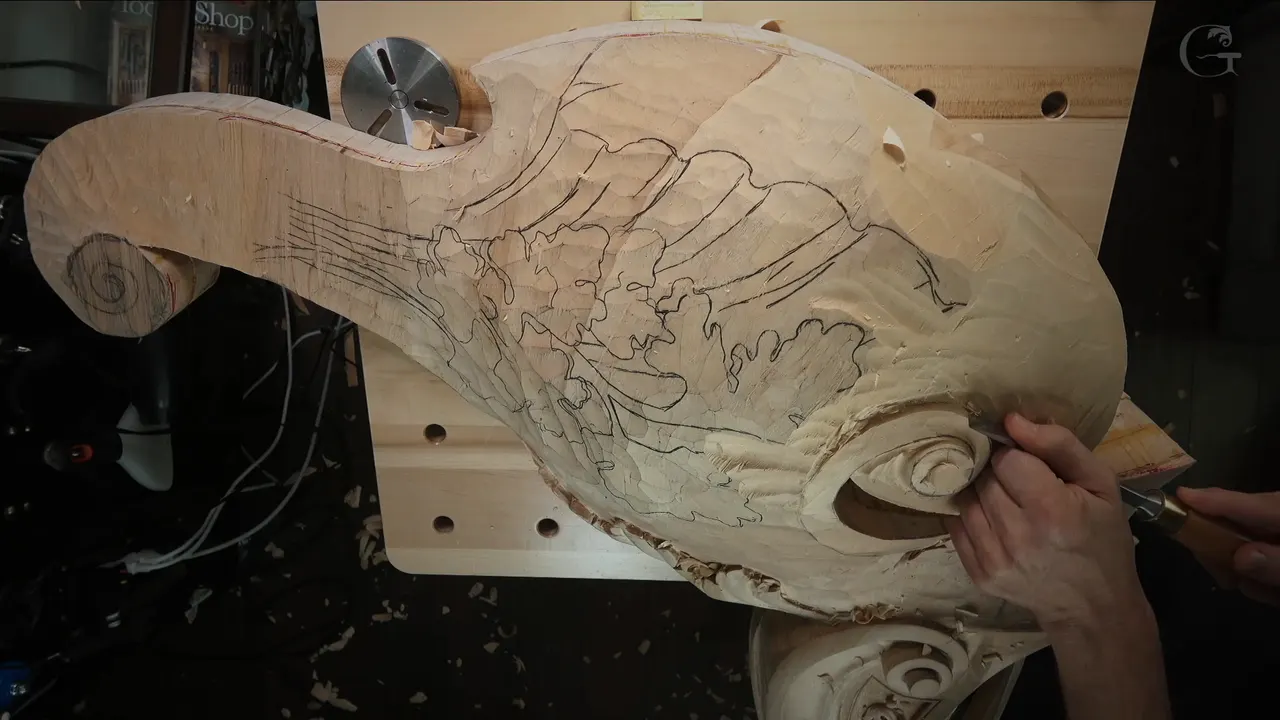

In part 7 of workshop 96 I tested a number 7 against a shape, and the verdict is the title above. Those words show up in other lessons of mine, beside a gouge, a drawing or an area to be glued.
Ever held a gouge over a shape and wondered whether it was the right one? How do you find out before you push? This page follows one test and its answer. My video is short, so this page also visits other lessons where a tool matched or missed, and shows what I did next. Every lesson carries a link. Watch it yourself.
What did I notice before the number 7?
The part opens with "with the same tool" and "clean the waste." Next comes "OK, so I noticed something." Another line follows: "What I don't like." It is followed by "But I'll be able to fix it a little later" and, later still, "maybe yes, maybe no".

One line reads "it has to be a gradual transition." Also "like taper,". The talk goes on with "about the same" and then "wider and wider". One more line says "really wide."
At 02:25 I say "The line." Next comes "Which is common, which is actually pretty much common all the time when you're working and those volutes". At 02:41 the words are "I will use #7".
How does a number 7 get tested against the profile?

The question comes first: "Let's see if it's going to fit the profile." Two lines answer it: "And yes, it does" and "And it fits actually perfectly." At 03:03 comes "It fits perfectly."
A size is spoken at 03:08, "an inch and a quarter", written as 1 1/4 in (31.75 mm).
What did I plan for the number 11 and the skew?

At 03:19 the plan is "I will need #11 and clean all that fuss." The next line is "And I'll use 5mm #11 to do that." That size is 5 mm, about 0.2 in. Both lines are plans, so they stay plans.
At 03:53: "It's actually really good that they had that extra wide space." At 04:05: "I can definitely start my movement from all the way at this point and go around, around and around."

A skew is named at 04:16: "the big skew, like one inch", so 1 in (25.4 mm). Nearby words are "outlines and so on." Also "a lot easier for me to fix," a line said in the same stretch.
Where do slope, grain and a hump come in?
At 04:35: "All right, so this way and I also need to clean this side." At 04:54: "And let me get right down the line." At 05:56: "Just go around and get to the line."

At 06:21 I say "Ok, let me also give the right slope," and then "and I am working against the grain, got to slice it nicely." The grain gets named there, in my own words. At 06:54 comes "I have to check how it looks in 3-D". The final cue says "gradual and nice and it looks like I got a little hump in this area."

Part 8 of workshop 96 also gives a spacing figure: "But I'm staying away a little bit, about eighth of an inch or so." Converted, 1/8 in is 3.2 mm. The same part has the word hump: "I have to get rid of this hump. So it's a big hump," A plan follows: "I'll take again big gouge, number seven, and start removing across the grain." Earlier in that part I say "I'll take number 11 and 12 millimeters", or 0.47 inch.
Which number was too big for a spot?

The Venice Room Part 1 course has a short example in workshop 2, part 4: "So that is going to be waste." Then "Let me use number nine and 20 millimeters." That is 20 mm (0.79 in). The verdict reads "That's a little too big, and I need to probably use something smaller."
Another gouge gets a trial: "Let me see if I'll be able to fit number five." Next, "Yes." And "It fits perfectly." It ends with "Let me get rid of that waste."
Does a tool that suits the job save time?
Workshop 3, part 1, of that course has "I'll use number seven because it fits perfectly." Later in the part: "if you do have a tool which fits perfectly to the job, you can really expedite the process." And in the same part: "And now I can gradually move this part, because right now it's just too bumpy."
Part 5 of workshop 3 names two gouges. "Okay, let me use number five." Then "Well, actually, I can use the number seven." After it come "See?" and "Perfect fit."
Should the design follow the tools you own?

Workshop 43, part 11, names a gouge, "big number seven." Then "It just fits perfectly." A plan follows: "I'm going to start moving inside this direction like that."
Further along: "And that's going to give me perfect roundness." In the same stretch I say "when I designed that movement," and then "what tools I have, okay? What I have to fit."
Can you pick a gouge by eye?
Workshop 57 has "In this case, it's a number five sweep." Then "I like that idea, actually, because I'm not always looking for a specific size, just grabbing visually." And "I can grab it and use it." The pick is "number six and about 16 millimeters", or 16 mm (0.63 in).

It matches "to my outline." Then: "it's not going to work in this case." And "It's a little too small."
Is a huge gouge the right pick for the job?
Workshop 68, part 10, starts at "Number five, I think". The text continues with "And I could use huge, I think, gouge because it fits perfectly. See that?"

Still in that stretch: "It just fits perfectly. Right here. Absolutely perfect fit."
Does every try end with a match?
Workshop 83, part 2, shows the other result. The curvature comes first: "Maybe I have to just clean a little bit this curvature, which is not too nice yet." Then I think about a big gouge, "maybe number seven," with the result "which in this case, it's not." After it: "It is not."
Next: "And I broke the big one, number seven, this one, because I abused one of my cuts and I need to reshape it." And "Let me do just by hand, just with the number seven small one." Then "So I really need to make sure it's a really nice and smooth-looking transition, okay?" Transition is the same word I used in workshop 96.

Will a drawing match the board?
Workshop 104, part 2, is about a drawing, not a gouge: "You saw, I used my iPad." And "I drew pretty much the extra details on my iPad."

The line about it reads "I wanted to make sure it actually fits perfectly to the millimeter, okay, to the board." And "Because I want to make sure everything is just perfect" and "applied on the walls." Also "I exported that as a picture."
Is a big number 2 right for an edge?
Workshop 109, part 3, keeps the tool as a plan: "And you know what? I can probably use big number two," and the target is "to the edge."

How do you choose among a few gouges?

The furniture course has two spots in lesson 17, part 7. One reads "I'll do it with the number seven and quarter inch." It continues "I think it fits perfectly." The quarter inch is 6.35 mm. The other reads "number five and 10 millimeters", or 10 mm (0.39 in).
Later in that part: "This one fits perfectly." "Actually, this is not number five, not number six, it's just a perfect fit." And "And you also just try different ones, and if it fits perfectly, just use it."

Lesson 18 of that course, part 10, begins with a plan to "use a little bigger tool, like number two and 12 millimeters." The answer reads "Almost half an inch, and yes," which in millimeters is a little under 12.7 mm. The plan's 12 mm is 0.47 in. Another plan comes next: "Let me check if number eight and seven millimeters will give me a nice round cut for this filler flower." Seven millimeters is 0.28 in.
Can the same tool match one spot and miss the next?

Flower Rosette 2, part 4, has "So I'll try first if my same tool is going to fit the profile." Also "And while it fits one spot, I can use it right here,".
The following spot differs: "But that is little different." Then "It's little bigger," and "I'll try..." On the new try the line is "Yep, it fits perfect." Also "It's also number five." A figure follows: "this one is a number five, but it's 3/8." Written out, 3/8 in is 9.5 mm. The stretch ends with "It fits just perfectly."
Does a number 7 or a number 5 suit the spot?

The Dining Table Apron course, workshop 11, has "Now let me find out which one" and then "the best fit for this." Next, "This is number seven, but looks like number seven is a little too big." And "This one is number five." The verdict reads "And it looks like number five fits perfectly."

Lily Box 3, part 10, gives a run of short lines: "Okay, number seven." "Number seven will fit this area." Two more follow: "Number seven fits perfectly in this area." The run ends with "Number seven fits right here really nicely."
Can one tool serve a double task?

Greek Acanthus 4, part 2, has me ask the question myself: "You would ask me why number seven." My reply starts with "First of all, we already used this one." Another line: "and it fits perfectly in my pattern." The closing words are "So that can serve me double task."

Roman Acanthus 4, part 2, has "Maybe it's a good idea to find another gouge and also make a straight-down cut." Then "And number 6, 20 millimeters or 3/4 inch fits perfectly". Those sizes are 20 mm (about 0.8 in) and 3/4 in (19 mm).
Does the word fit more than tools?

Hashemi 27, part 2, is about an area to be glued: "I want to make sure it fits perfectly," and then "I have to work on the backside first". The same area gets this line: "to make sure it's flat on this area that is going to be glued."
Which lessons say it, and what did each one try?
Here is the table. It lists the lesson, what I tried and a few of my words. Each row is a lesson you can watch.
| Lesson | What I tried against the shape | My words |
|---|---|---|
| Workshop 96.7 | Number 7, held up to the profile | And yes, it does |
| Workshop 2.4 | Number 9 of 20 mm (0.79 in), and after it a number 5 | Something smaller |
| Workshop 3.1 | Number 7, named as the one that fits | Expedite the process |
| Workshop 3.5 | Number 7, named right after a number 5 | Perfect fit |
| Workshop 43.11 | Big number 7, followed by a plan to start moving | What tools I have |
| Workshop 57.1 | Number 6 of about 16 mm (0.63 in) for an outline | Grabbing visually |
| Workshop 68.10 | Huge gouge, named after a number 5 | Absolutely perfect fit |
| Workshop 83.2 | Number 7 on a curvature that did not match | Reshape it |
| Workshop 104.2 | Drawing from the iPad, sized to match the board | To the millimeter |
| Workshop 109.3 | Big number 2, still a plan for an edge | I can probably use |
| Furniture Panel 17.7 | Number 7 of a quarter inch (6.35 mm), next a number 5 of 10 mm (0.39 in) | Try different ones |
| Furniture Panel 18.10 | Number 2 of 12 mm (0.47 in), asked as a test | Almost half an inch |
| Flower Rosette 2.4 | Number 5 of 3/8 in (9.5 mm) for a spot a little bigger | Just perfectly |
| Dining Table Apron 11 | Number 7 that was too big, followed by a number 5 | Best fit |
| Lily Box 3.10 | Number 7, tried against one area after another | Right here |
| Greek Acanthus 4.2 | Number 7, picked for a reason I give out loud | Double task |
| Roman Acanthus 4.2 | Number 6 of 20 mm or 3/4 in, for straight-down strokes | Maybe it's a good idea |
| Hashemi 27.2 | Surface made flat before the glue goes on | Make sure |
Where can you watch each of these lessons?
The video for this page belongs to Venice Room 96, and workshops 86 to 97 live together in the Part 8 course. Workshops 95 and 97 sit on either side of it.
From other Venice Room courses come workshop 43, workshop 57, workshop 68, workshop 83, workshop 104 and workshop 109. Workshops 2 and 3 are in Part 1.
The rest are the furniture lessons 17 and 18, the rosette lesson, the apron course, the lily box lesson, the Greek acanthus lesson, the Roman acanthus lesson and the Hashemi lesson.
If a word here is new, the plain definitions are one click away: gouge, skew, mallet, grain, volutes, acanthus, template, hand tool, wood carving, woodworking, bench, inch and millimeter.
Want to hear all of this in my own voice? Start here.
How it's done
- Name the tool. Workshop 96 names a number 7.
- Ask the profile. Workshop 96 asks whether the tool fits the profile.
- Swap one gouge. Lesson 17 of the furniture course says "just use it."
- Mind the slope. Workshop 96 says "give the right slope,".
- Look for the hump. The last cue of part 7 is "a little hump in this area."
Frequently asked questions
When a wood carver says "fits perfectly," what is being fitted?
Workshop 96, part 7, tries a number 7 against a profile. Other lessons attach the words to a gouge in another size, a drawing for a board and a surface to be glued.
Do you need the exact number to pick a gouge?
Workshop 57 has "just grabbing visually." Lesson 17 of that course has "not number five, not number six".
What if the tool misses the profile?
Workshop 83 shows it with a number 7 and the words "It is not." After that comes "I need to reshape it."
Can a drawing be matched to a board?
What to carve next