

Alexander Grabovetskiy, woodcarver, School of Woodcarving · Published 2020
What does a wood carver mean by "I understand"?
Quick answer: In workshop 96, part 1, the line reads "I understand not all of you going to work on a huge project like this." The words "I understand" sit in Hashemi Flowers 21, beside "that setup", and in Roman Acanthus 13, part 3, beside "the camera". Each lesson adds its own words after them.
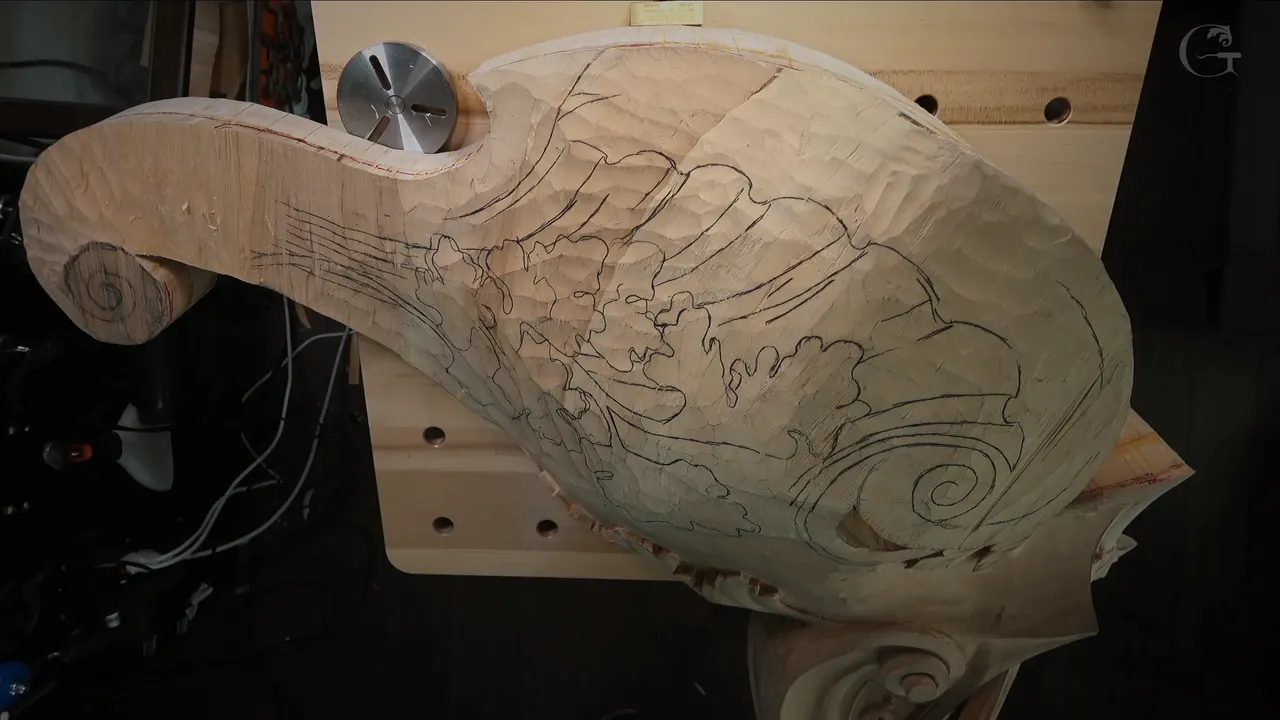

In part 1 of workshop 96 the line is "I understand not all of you going to work on a huge project like this" and the same two words open lines in many of my other wood carving lessons. This page reads each of them, with the work around it.
Ever watch a corbel the size of a person and wonder if the lesson is meant for you? Workshop 96 has a line for that moment, and so do the lessons below. Every size is in millimeters and inches, my own figure first.
Where is the line in the opening part?
The line sits in two cues in a row, the first at 00:00:31 and the second at 00:00:35, early in the part. "And I do understand don't get me wrong" is the first. The second is the one in the first paragraph. Before them the part shows the size, "And I still have to do the second one" and "I just kneeled down to show that to you, how big just that corbel is."

A hope comes next: "But I hope" with "just if you can get the certain parts like tips and tricks, there's a lot of Acanthus" and "movements, lots of different volutes and so on." The volutes word has a Wikipedia page.
One more use is named, "in different settings and different Carvings, let's say this drop." The drop gets a verdict, "really nice detail." A plan sits beside it, "And yes, I still have to work on this surface."
What else is in part 1 about the project?
"Also, please understand" is followed by "That is the live project." Two limits come next, "and I'm not re-watching all the videos" and "it will take me too long, even editing, I am doing right" with "on the fly Ok, all my editing done right on the fly." For a question about where to find a spot, the line is "how can I find certain parts, I can't help you, you have to really watch and search."

The site gets two lines, "it's a huge right now is gigabytes and gigabytes of database" and "I have over 2000 videos." The date is "At this moment when I'm recording this and it's October, end of October" with "two thousand twenty, and that's going to grow." A database is a store of records.
The fix is a new page feature: "added a visual browser if you go to a course itself?" It works by "you will see the thumbnails and you can browse those thumbnails and those". The result is "approximately what area I was working in a certain workshop" and "but it's going to be a lot easier to find some parts."
Which tool opens the carving in part 1?
"but let's jump to work" starts the carving. "work on this piece" comes next, then the spot, "first on this area, on Volutes". The plan is "So I really need to establish the main" with "movement and change little that what they've done right here."

One favorite is named: "favorite Gouge is a three inches" and "to be exact." The size comes twice, "It's 80 millimeters Gouge and they're going to need big Mallet." Both figures are his. Three inches is 76.2 mm, and 80 millimeters is about 3.15 in. The first plan is "Let me actually get this chunk out."

A pause and a plan close the part. The part stops with "Ok, that is enough for now" and then "and don't pay attention to that drawing, it's just a preliminary idea". A walk is needed, "I need to actually walk around and take a look". The last wish is "OK, but now what I want to do, I want to lower down in this section right here" and "But not much."
In part 2 a tool is planned, "So let me use number 8" and "So that would be number eight and I'll use one inch" (25.4 mm) It adds "I do have to keep an eye how deep I'm going." The third part warns, "But normally that is not the safest way" and names a better one, "The best way is actually just to go across the grain, just in that direction." More about wood is on the grain page.
Do other lessons say it about tools and setups?
Yes, in Venice Room 1, part 1, where the words open the first minute of the lesson. "I do understand most of you are not going to be able to actually do it because" is followed by "this project is pretty much for me everyday life." Then "So that is just a production project." Next come "So this project, I am not expecting anybody to follow me because it's huge" and "We're talking about the whole room."

The beads come in workshop 57, part 11: "having the same amount of tools like I do" with "be confident that you can do same operation with the" and "tools you have. And I could do that, all the beads, with just" and "a knife pretty much. I've done it multiple times." A knife has a Wikipedia page too.
Flatter tools show up in workshop 69, part 6: "I can just get the flatter tool" then "like number three" and "and right on those ridges and clean them." After it comes "of you don't have tools like me" and "and I should probably just" and "do my normal way."

Gouge size is the topic in Roman Acanthus 2, part 1: "I'm still using the same gouge, still number eight" and "If you have a bigger gouge, I usually use even bigger than". Then comes "but I do understand", with "have the big gouges" after it, and "Any big gouge, number eight" then "number nine." It ends with "If you have number 10," The gap to leave is "a one-eighth of an inch," (about 3.2 mm). A gouge has its own page.

A whole setup is the topic in Hashemi Flowers 21, part 1. "Today, I would like to show you a little different setup" opens the lesson. After it comes "understand not every one of you able to do that setup" and later "I can access from different angles" and "different positions. I can attack from different sides and so on."
A veiner stands in for a number 23 in Furniture Panel 17, part 4: "And again, if you don't have No. 23, you're still able to" and "exactly the same with just a veiner." The line follows: "I understand not every one of you" and "will jump and buy specialty tool which you don't use every" and "and No. 23 it's not everyday use."

Tiny sizes are the topic in Lily Box 3, part 2. "This could be done also with a V tool" is the first line. Next, "number 11 and 1 millimeter," (0.04 in) and "and most of you probably don't have a half a millimeter" (0.02 in) The way out is "that could be done with a V tool, just laying" and "on one of the sides."

Workshop 64, part 4, has "because I do understand this project is" and "not the project you're going to repeat." A correction follows: "Although it's not true also because there's a lot of different sections" and "you can repeat." Then "develop 3D thinking,".
High up is the topic in Venice Room 6, part 12: "And yes, I do understand that that" and "particular piece I'm working right now" then "high above." The close is "So nobody's going to climb the ladder" and "and check" and "every cut I made" with "But still, I want to make it look as nice as possible."
How does the camera come into it?
Roman Acanthus 13, part 3, starts with a hope, "Hopefully, you can see that on a camera." It reads "I do understand the camera doesn't show exactly what's going on" and "but hopefully, you're able to see it." Next are a size, "And I'll take again 3/32 of an inch" (about 2.4 mm), and a remark, "And I'm not afraid to go a little deeper." Wikipedia has a page on the camera.

Another camera line sits in Lily Box 4, part 9: "again, I do understand" with "possible sometimes to see that on a camera". The next plan is "Let me try to switch" and "to a different camera, and you can see that." The work is "I'm giving that chamfer." A line before it names the technique, "to make it more classical look."

A blocked view is the topic in Furniture Panel 20, part 3: "I apologize if you can't see exactly what I'm doing" and "I understand I am covering with my fingers, but". The reason is "on the other hand, that's the best I can do with my camera." The plan is "And let me bring that cut all the way to that twist."

What about a picture that is hard to see?
Furniture Panel 5, part 3, says "I understand that is almost" and "impossible to see what I see" with "because I do have a picture already established in my brains" and "and that's so hard to explain."
Seeing the result in advance is the topic in Lily Box 11, part 6: "I do understand it's hard to visualize" and "it" then "but you'll see. And once you're going to carve it,". Sizes come next, "Okay, I'll use 2 millimeters" (0.08 in) and "I could use 1 millimeter" (0.04 in).

In Furniture Panel 14, part 5, comes "sense. I understand sometimes" and "envision what I'm doing, but".
An undercut is needed in workshop 50, part 11: "And I need to undercut, just remove that" and "wraps an inside going like that. Okay?" Next, "I do understand that is a little" and "confusing. But once we're going to get it done" and "you'll see how beautiful".

Confusion is the topic in workshop 55, part 7: "I do understand it's a little bit confusing" and "and I hope you understand". Then "But on the other hand" and "please forgive me, I am developing" and "at the same time" and "with you, okay?"
Workshop 27, part 3, starts with "That is just a preliminary outline." Then "understand that sometimes it's hard to" and "envision" and "the detail" with "but I already have a picture in my mind" and "Sometimes you just have to wait until I've done with that" and "detail."

The Hazelnuts course has the words too. Hazelnuts 3, part 2, says "When I'm saying this and that, just try to watch what I'm" and "doing. Okay? I understand sometimes it's kind of confusing." Then "Also, be careful because it is end grain" and "I got the grain. I caught the grain."
When does the line ask for patience?
A request sits in Furniture Panel 4, part 1: "This has to repeat that one or that one or that one. Okay" and "And I do understand it takes time." The request is "Please be patient with me. Like I said, I would like" and "to create a piece of art" and "and still be authentic to the original" and "designs of 18th century."

The pace is the topic in Furniture Panel 26, part 1: "That project is just for the school" and "and that is why it's kind of takes long." Then "you know, it takes time, but please forgive me" and "now I just shipped a big project away and" and "I can jump back and just continue to develop this panel."

What follows the line when a plan is next?
A plan opens Hashemi Flowers 47, part 2, "let me also make a separation cut right here." Then "I do understand I have to be really careful" and "because that's a kind of scary area." Next are "Okay, I'm using number one" and "Double bevel" and later "Okay, let me use a half a millimeter" (about 0.02 in) and "number 11".

A small eye is the topic in workshop 40, part 5: "understand that I have to, since I gave" and "an eye or created an eye, I mean, small eye, but". The need follows, "still it's an eye right there, so I need to create some kind" and "of pipe, which I don't want to see" and "too big" with "but I still want to create some kind of feel to it, okay?"

Plate with Butterflies 10, part 3, has "understand that this spot I need" and "to cut a little deeper and I don't want to rush it." Then come "I'll just recreate my previous cut and go slightly deeper with that" and, later, "And I can always come back and clean it if I'm not happy."

Two more lessons check the plan first. Workshop 53, part 1, has "So now I need to make sure" and "I do understand what I" and "decided to do right here, and from that point, I'm going to" and "make my development." Then workshop 56, part 5, begins with "Now I need to make sure I do understand how that detail" and "develops".
Lesson by lesson, what sits beside the words?
| Lesson | What sits beside the words |
|---|---|
| Workshop 96, part 1 | A huge project, and a gouge of three inches |
| Venice Room 1, the opening lesson | A whole room |
| Workshop 57 | Fewer tools, and a knife for all the beads |
| Gouges in Roman Acanthus 2 | Number eight, a bigger gouge, and then number nine |
| Lily Box 3 | A number 11 beside a V tool |
| Camera talk, lesson 13 of Roman Acanthus | A hope that you can see the work, and a size of 3/32 of an inch |
| Panel 5 | A picture in my brains, and so hard to explain |
| Panel 4 | A piece that takes time, and a request for patience |
| A scary area in Hashemi 47 | A double bevel, and then a number 11 |
| A decision in workshop 53 | A choice |
Is there a project on your own bench that feels too big for you, or a tool you do not own? Everything in this lesson sits inside one tuition plan, and more Venice Room workshops wait on the Part 8 course page. For a smaller start, try the Hashemi Flowers course. Wikipedia has a page on furniture too.
How it's done
- Find the line. The opening video of the workshop has the line at its start.
- Read the hope. "But I hope," follows, with "tips and tricks" and acanthus movements.
- Check the tool. The gouge carries two figures of his own, "80 millimeters" and "three inches".
- Look at the plan. "I need to actually walk around and take a look".
- Compare other lessons. Each lesson in the table adds its own words after the line.
Frequently asked questions
Which lines in the first video of workshop 96 describe the project?
The part has "That is the live project." and "and I'm not re-watching all the videos," with a limit on the editing, "done right on the fly."
Which gouge does that first video name?
"It's 80 millimeters Gouge and they're going to need big Mallet." His other figure for it is "a three inches", and that is 76.2 mm.
What stands in for a number 23 in Furniture Panel 17?
A veiner, in the words "if you don't have No. 23, you're still able to" and "exactly the same with just a veiner."
Which lines about the camera sit in the thirteenth Roman lesson?
What to carve next