

Alexander Grabovetskiy, woodcarver, School of Woodcarving · Published 2020
What does a wood carver mean by "research"?
Quick answer: Research is the looking I do at earlier carvers' work before I draw the leaf. For workshop 96, part 11, that meant a short study of Venetian work, a leaf split in three, and a plan to follow the same division so the piece matches the Venetian style.
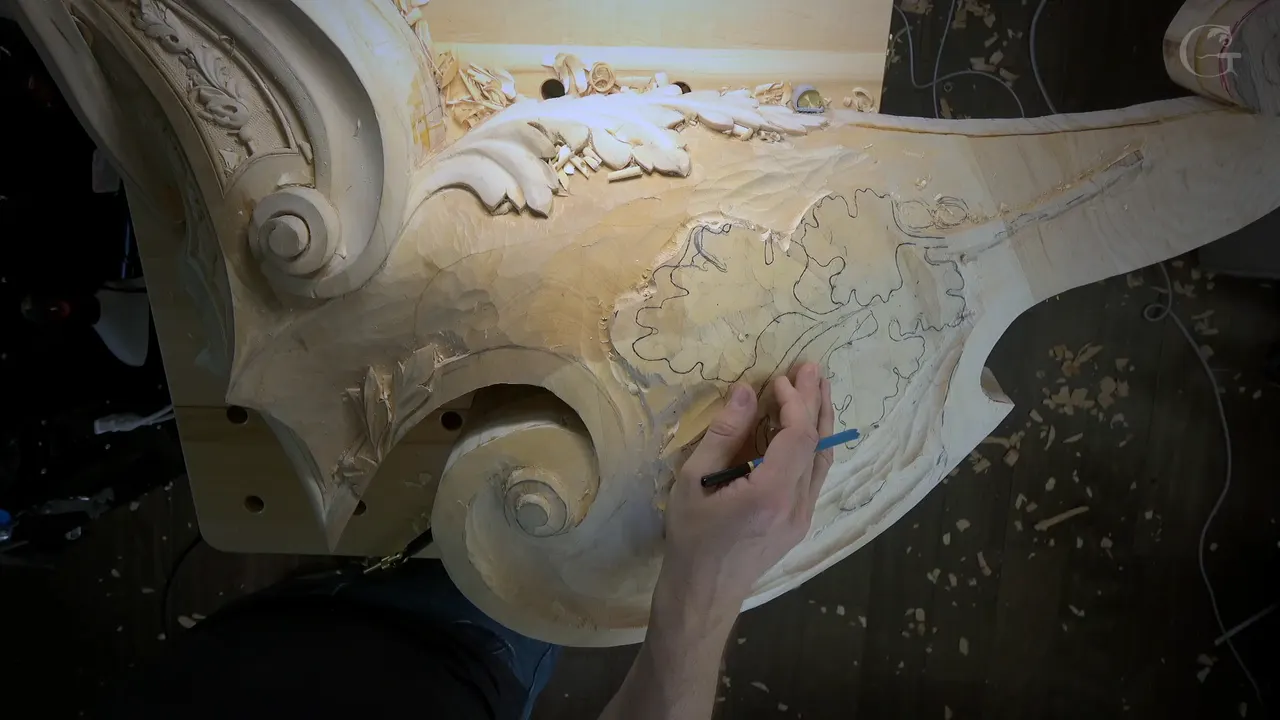

Research, for a wood carver, is looking at what the old makers carved before drawing a line on the wood. My line in part 11 of workshop 96 is "I decided to just research a little bit what they carved back then." The subject is an oak leaf, and the research explains why that leaf has three parts.
Ever copied a leaf and wondered where its shape came from? Or stood over a drawing and asked if the old carvers did it that way? Then my short video and a dozen of my other lessons are for you. This one is brief, so I searched my other courses for each place where I use the word, and every lesson has a link.
What do my research lines add up to?
- Workshop 96 follows the old Venetian leaf in three parts, and that is where this page starts.
- The same kind of leaf is called stylized in workshop 97.
- Workshop 9 and 41 give hollows and curls.
- Workshop 102 adds ribs on a corbel, and workshop 103 adds the caps of an acorn. Both came from looking.
- Two acroterion lessons give one thing I found and one I could not.
- A Roman acanthus lesson and a lily box lesson send you further.
- Where to look is the subject of workshops 1 and 28 and of a livestream, which close the list.
What did I look at before drawing the oak leaf?
The part opens with a plan, "I'm going to carve this section." Two limits follow right away. The leaves are "specific oak leaves," and "there's different types of oak, and you should know that."
At 00:43 the design gets its label, Venetian style. The study itself comes next: "And I spent a little time studying a little bit what they carved, how they imagined the oak leaves and so on."

Three places I have lived come into it. "I used to live in Russia" is the cue at 00:54. In Michigan the trees were another matter, since "they look a little different from what the oak leaf looked in Russia." And in Florida, "the Floridian southern oak is absolutely different."
Those three oaks "gave me an idea or pushed me to study pretty much what it's supposed to look like." Then comes a limit on the whole effort, said plainly at 01:37. "It's mostly like a stone carving. It's not like wood carving, but still, I've got an idea, preliminary idea, how they looked at the leaf, at the oak leaf." Most of the old work was stone, by my words, and I have only a first idea of it so far.

Why does the oak leaf follow the acanthus?
The leaf in the frame is the proof. "there's three main parts of the leaf" is the cue at 01:57, and the next one adds "that's Venetian style, I should say." A limit comes with it, "It's not applicable to all other oaks."
The link to acanthus arrives at 02:13. "So it's pretty much the same idea as acanthus." An honest doubt sits right after it, "And I don't know if there's any oak leaves in life divided in three like this."

On the acanthus side my words are "the people, they used to carve acanthus" and "the main divisions of acanthus, three main divisions." The count can grow: "Sometimes it's five, sometimes it's eight." On the oak, at 02:37, "they divided each leaf in three main parts."
I say it flat out at 05:31. "I guess they carved too much of acanthus." What follows is the choice that research makes, "But I want to be authentic to what they did." That one sentence is the point of looking first.
What happens on the board once the looking is done?
Out comes a marker. "Let me actually get a little bigger marker for you to see it," I say at 02:44, and then I count on the wood: "So one, two, and three part." Next a short check, "Look right here in this section. The same idea." Then, "I've got one, I've got two, I've got three."

A marker is no carving tool. Its trouble shows at 03:33, "Looks like this marker's penetrating too deep. But you should get an idea." The plan is spelled out after that: "So again, I've got the three main divisions, and that's what I'm going to follow. And then I'll fix whatever I don't like."
A stem has to be dealt with too. "And I do have a main stem, which logically is supposed to go somewhere to this stem, and it's supposed to be hidden somewhere underneath." The cue at 04:27 says only "But let me start, and we'll see how it's going to look." A plan is all it is, and no result is claimed.

One spot gets rejected at 04:43, "Because I kind of don't like how it looks." At 05:08 it gets a name, "And I should call it Venetian style oak." At 05:24 an eye is planned between those movements.
For finer work the marker changes. "Maybe I'll just use a tiny marker, and maybe I'll just refine it with a tiny marker." A bigger marker shows the idea, and a tiny one refines it.

Where does the middle line sit?
At 06:09 the middle line is the subject: "Logically, if you see the middle line, which is going to be somewhere right here." My rule for it has an if in front. "if you like the idea of Fibonacci sequence, if you take this side and if you take this side," and then "this line's supposed to be at the 60/40 rule or 38 versus 62 rule, if you wish to do that."
The golden ratio is the name for that 38 and 62. On this leaf the line did not land there at first. "looks like I'm slightly off," I say at 06:39, and at 06:50, "actually, you know what? I don't know." Then a try, "Let me see if I can be able to move it somewhere."

It ends on a decision. "Here you go. That is going to be my middle line right here." Three parts came from the research, and the middle line gets its place on the drawing.
What do the next two parts of workshop 96 add?
Part 12 repeats the research once more. Its first minute holds "Wherever you have the main separations, this is the main separation, that is the main separation, you're supposed to have some kind of eye." The oak breaks that rule, and I say so: "Not on oak leaves, but they did it." My choice follows, "So they did it," and a pipe is part of the plan.

One difference between the two leaves gets a name at 00:30, "The only difference between the oak leaf and acanthus leaf, in this case, it would be roundness of the movement and outside." At 05:11 the leaf is called "not typical oak leaf," with a reason attached, "I guess they took that idea from acanthus, the main divisions and so on."
My lines on the golden ratio are careful ones. "Again, it has to be with the golden ratio. Doesn't really have to, but that looks like they did a lot of that stuff." The Fibonacci numbers at 08:08 get the same hedge, "It doesn't have to be that way."

A tool is named in the same part, "number 11, and it would be 12 millimeters, like half an inch. And mallet." The mallet and a gouge of that size make the pair, and the distance from the line is "approximately eighth of an inch away from the line, about three millimeters or so."
By the end the drawing has a name, "So we've got actually a Venetian style oak leaf." One doubt stays on it, "But I would probably get little deeper eyes for it would be looking much better."

Part 10, the one before, has no research word in it. Its work is plain. The shell outline at 06:35 is "approximately the shell of movement that I'm after. I'm not sure if I like it or not." A small fix is planned, "Maybe I'll fix it." Soon the tool is named, "let me use just the number seven and start removing some of that stuff," and the depth is "maybe about half an inch deep." About 13 mm, in metric.

Which finds came from my other workshops?
Workshop 97, part 12, asks if the leaf in front of me is real. "That leaf is not true like a leaf you see in life" is the cue at 03:36, then "It's more or less stylized, I should say." Another follows: "So I never saw anything like that."
The research is the answer. "But like I said, I researched, and that's what they did." After it comes "And that actually blends nicely with acanthus," and then the reason the leaf stays, "So it doesn't make sense in a sense of nature, but it does make sense in a sense of design and that style."

A found detail sits in Venice Room 9, part 4. "I found when I researched, they created really small micro concaves on inside." They matter because "They're not distracting ones from the main form, I would say." The tool is "Maybe number five and 1/8 of an inch," and soon after, "So I'm using just number five and 3 millimeters, 1/8 of an inch."
The small hollows work on light. "but they break the light and create small shadow," is the cue at 03:23. One more look, this time at the wrong way, comes after: "And I looked at a lot of different acanthus designs, and there's different approaches." Then "And I saw some of the people, they put a lots of those lines, and they create them really deep, okay, on inside of the acanthus. And it just doesn't look right." His fix, at 04:21, is "But see, just subtle. Okay? Just really subtle, and that's already giving some interest."

Venice Room 41, part 3, opens with another find, this time about curls. The first words are about giving a detail some curliness. The source of the curls is in the cue at 00:21, "That was probably one of the things I found while researching. They really love those curls. Everything was curly." The verdict is short, "And yes, honestly, it looks rich."

Ribs are the subject in Venice Room 102, part 8. I expect a question from some of you at 06:21, "why would I do that movement, those ribs right in the middle of that corbel." The answer is the research: "And I mentioned before, I really want to be authentic to Venetian times, and that's what they've done on some of the corbels, and I researched what they've done." The choice stays open. "And yes, I could probably do without them, without those ribs, but I think it's a good detail. Why not use it? It gives extra dimension."

Acorns bring the word back in Venice Room 103, part 4. The first half is "I studied a little bit, well, I shouldn't say studied. I researched a little bit the different caps of different species of oak," The second half is the decision for "Mediterranean oak." It is one of the oak species on the map, and the choice came from the looking.

Which questions did research leave open?
Greek Acroterion 5, part 6, starts with a first picture. "that's how I imagined that at first." The check follows: "when I looked and researched a little bit about acroterions, they also didn't make those roofs really deep." The use of it, "Just to determine to make it look outlined."
Greek Acroterion 2, part 1, is the opposite case. The question at 02:54 is "If you would ask me why this acroterion, they chose as a symbol of victory." My answer is short: "I tried to research it, have no idea. Absolutely no idea why is it." One soft guess follows, "Maybe they had some reasons."

Roman Acanthus 16, part 5, sends you out. "So there is a different ideas, different designs, in the history people used." My own pick was "I decided to do some simple way to finish it, because I want to concentrate more on inside movements versus just on a small part." And to you: "But you can research, there is a different ways you could finish it."

Lily Box 13, part 3, gives research a limit. "And ask me how I know that, I really don't know. I just read that in the books. That's it." Then "But there was some researches done, and I trust those guys who wrote those books." The subject is a small leg on a piece, and "that's the idea behind those legs."

Where do I look for what the old carvers did?
Books are the subject of Venice Room 28, part 8. It starts at 04:32 with "I studied a lot, not studied, but I should say, researched a lot about those acanthus leaves," A warning follows, "But even in the books, sometimes you just don't get the completely right idea."
The reason comes at 05:06. "Even in old ones, in old books, you still see just a certain type of acanthus, which is related to the time when the book was written." My advice is "You should look at the old European books, which is not even in English, most of them." Their subject is ornaments.

A client asked for it in Venice Room 1, part 1, and the client is not named. At 03:38 the cue is "they asked specifically for research and to match the design, match the details," and the place is "in Italy in Venice in 15th century." The list of work comes at 04:03: "So I had to research, I had to design, I had to draw, I had to model, even 3D model on my computer until we agreed, yes, it looks authentic". And the checking, "People checked and rechecked everything and that would be really accurate."

A livestream in April 2020 has a question and answer on the same subject. "Yes, you are able to skip design nowadays because we can download on Pinterest, just research and so on." Then at 20:49 a look backward, "But back then, 15th, 16th century, people stayed home, okay? Not too many people traveled."
Venice had a trade body. "And in Venice, they also had some type of guild, okay?" There were shops: "So they had a woodworking shop, maybe not one, maybe multiple." And "They had a stone shop, stone carvers also." The teaching, in the cue at 22:10, was "And the masters who knew how to carve stone or wood, they actually give that skill away to younger generations by just showing the techniques they do."
Where does each of my research lines sit?
| Topic and part | What the research gave me at that spot | Quote |
|---|---|---|
| Oak leaf, 96-11 | A Venetian oak leaf divided into three parts | Specific oak leaves |
| Stylized leaf, 97-12 | A stylized leaf that still fits the whole design | Blends nicely |
| Eye, 96-12 | An eye with a pipe between the main divisions | Some kind of eye |
| Hollows, 9-4 | Tiny hollows on the inside of an acanthus leaf | Micro concaves |
| Curls, 41-3 | Curls everywhere in the work of the Venetians | Everything was curly |
| Ribs, 102-8 | Ribs in the middle of a corbel, as they did | Researched it |
| Acorns, 103-4 | Caps for the acorns, from the oak species I chose | Mediterranean oak |
| Roofs, Greek 5-6 | Roofs that were not made really deep on an acroterion | Looked and researched |
| Symbol, Greek 2-1 | No answer on why this one was chosen as a symbol | Tried to research it |
| Finish, Roman 16-5 | More than one way to finish the end of a leaf | You can research |
| Legs, Lily Box 13-3 | Small legs on a piece, known from the books | Researches done |
| Books, 28-8 | Books from old Europe over what is sold today | Researched a lot |
| Client, 1-1 | A client who asked for a match to old Venice | I had to research |
The finds are shapes, hollows, curls, ribs and caps. What research did not find is the reason behind one acroterion. The books come with a warning, so the old work is the better teacher.
Ever sat with a drawing and a doubt about it? Then take one leaf and look at how the old carvers shaped it, the way part 11 does, and then see the rest of the course.
How it's done
- Study the old work first. My first move in part 11 is a short study of Venetian carving.
- Count the main parts. A bigger marker helps me count one, two and three on the leaf, because the old leaf is divided that way.
- Follow it, then fix what you dislike. My plan is to follow the old division first and then fix what I do not like.
- Mark the middle line. The middle line follows the 60/40 rule, and I try to move it when it looks slightly off.
- Refine with a tiny marker. A tiny marker refines the lines after the bigger one has shown the idea.
Frequently asked questions
What did I research for the oak leaf of workshop 96?
I studied what the Venetians carved and how they pictured the oak leaves. Oaks from Russia, Michigan and Florida look different from each other, and that pushed the study. The result in part 11 is a three part leaf, which I follow on the drawing.
Is the Venetian leaf a real oak leaf?
My answer in workshop 97 is that the leaf is "not true like a leaf you see in life." The design still holds it, because it "blends nicely with acanthus." The research explains why the leaf stays, doubt and all.
Did research settle every question?
Some questions stay open. On why an acroterion was a symbol of victory, my answer was "have no idea," followed by "Absolutely no idea why is it." Another lesson, about a small leg on a piece, rests on books I trust.
What to carve next