

Alexander Grabovetskiy, woodcarver, School of Woodcarving · Published 2020
What does a wood carver mean by "a pipe going to the center"?
Quick answer: A pipe is a ridge that stays raised and starts at an eye, then heads for the middle of a leaf. I use the word in Venice Room workshop 96, and my Roman, Hashemi and rosette lessons use it with a tool and a size beside it.
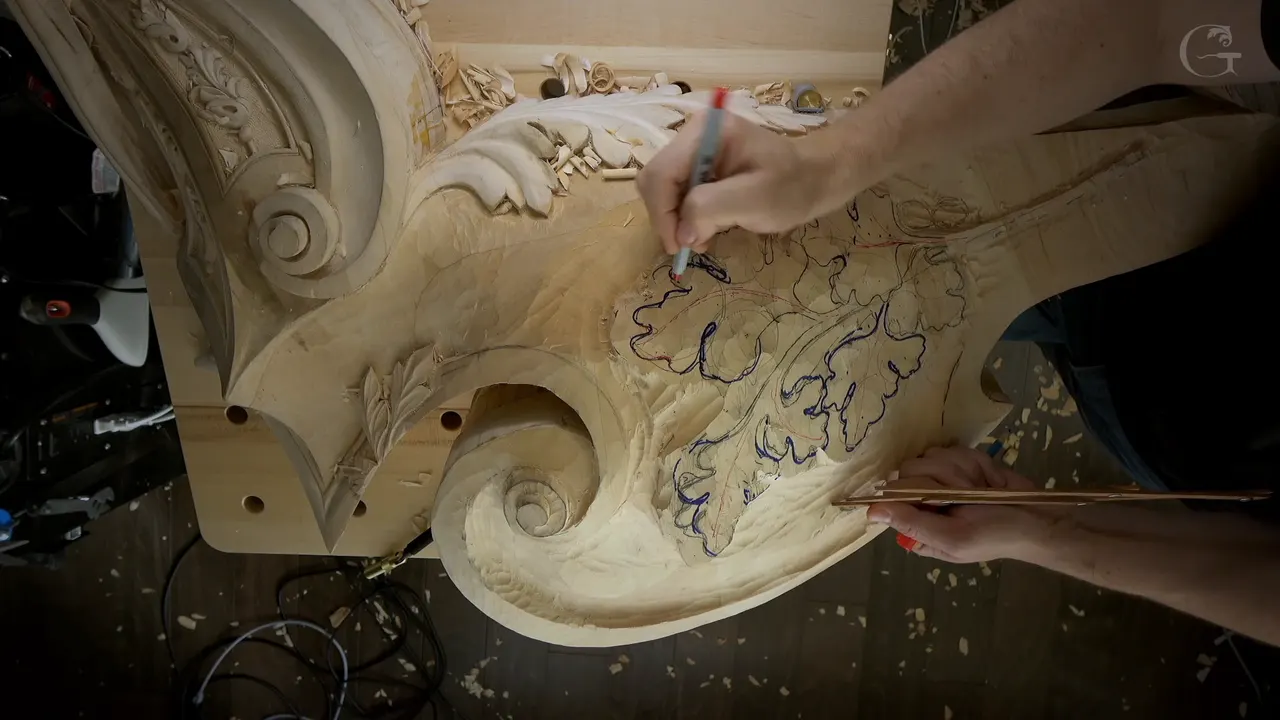

A pipe, in my carving, is a raised ridge that runs out of an eye, and in part 12 of workshop 96 I plan one for an oak leaf. Other lessons of mine plan the same ridge, each with its own tool and size, and this page walks through them one by one.
Ever drawn a leaf and not known which way a ridge should run? Did a line look fine on paper and wrong once a gouge touched it? Then these lessons are for you. Every one has a link, so you can watch the passage yourself.
What is a pipe on this leaf?
The eye comes first in this video. Between the divisions of the leaf I plan to "create an eye just like that", and next I say the line this page is named for: "there's going to be a pipe going to the center." Right after it comes my label for the plan, "So that is the main idea." It stays a plan on this page, because that is how I say it on camera.

Where do the eyes go? "Wherever you have the main separations" is how I start, and I end on "you're supposed to have some kind of eye." About oak leaves I add "Not on oak leaves, but they did it." My reason is short, and it follows right away. "That's what I'm going to do."

How is an oak leaf different from acanthus here?
I put the two leaves in one sentence, "The only difference between the oak leaf and acanthus leaf", and the difference I name is "roundness of the movement". On where the idea comes from I say "I guess they took that idea from acanthus."
Each lobe gets a ridge. In my words, "it's supposed to have some kind of pipe." Next comes the lean. In my words, "the movement's supposed to be toward the middle line."

The wrong lean gets a name as well, "that would be mistake if I would do something like this", and I add "It would be wrong."
Part 11 of this workshop explains where the Venetian oak leaf comes from. I spent "a little time studying" what the old carvers did, and about their work I say "It's mostly like a stone carving."
How do I find the direction of a pipe with a tool?
Part 12 gives a short tip. "If you just place the right tool and imagine the pipe going up, which direction it's supposed to be, it's easy to create pretty much the right movement." That tip belongs to the little eyes sections, and I call them that.

The order matters. Tool first. Then picture the ridge rising.
For the outlining I plan a number 11, "12 millimeters, like half an inch". The mallet will help, and I say so: "Of course, mallet will help me." A margin is part of the plan, "approximately eighth of an inch away from the line, about three millimeters or so."
Put in both systems, that is 12 mm (about 1/2 in) for the tool and about 3 mm (1/8 in) for the margin. None of it is the ridge itself yet. "That is just the outlining", I say.
One spot gets a remark of its own while I outline: "this one is raised up, actually a lot from the future shell." The shell is only a plan for later, and I keep it one.

What does an eye have to do with the pipe?
An eye is where one part goes under another, and the ridge is what runs from it. I did not make that pair up for this video. Workshop 49, part 8, defines the eye as "the place where one part going underneath of another", and a few words later I plan a pipe for "every eye" that runs straight to the middle part of the leaf.

Its look comes next. "Raised", I say, and "if it's raised like that, it's a convex." Part 7 of the same workshop puts the idea on a bigger drawing, "divisions divided by the eyes and the pipes", and gives me the rule I use: "Every division has an eye."
The vase course makes the same link in its first lesson. The line there is "wherever I have an eye", and a pipe follows. For a viewer who is lost I add "I'm teaching about pipes in my acanthus design."

What are the short answers on the pipe?
- In the video for this page, a pipe is planned right after the eye is.
- Workshop 49 gives the eye and its raised ridge a definition.
- Workshop 52 and workshop 62 tie each ridge to the one middle line they share.
- Workshops 81, 83 and 144 hand the ridge to a number 11.
- Workshop 155 and the Roman lesson give the ridge a size and a direction.
Which way does a pipe run, and where does it end?
The middle line is my answer in a few lessons. Workshop 52, part 8, has me mark my own pipe, "my pipe, which is going to go this way", and then name what everything follows: "Everything's supposed to go to the middle line." My reason is "Otherwise, it's not going to make sense."

Part 3 has more than one ridge, and I plan to raise one, "it has to be raised up a little bit." Concaves beside it follow, in my words "a concave cut like this, and I also have to create concave cut on that side also." My pick is "just probably number eight", with "number nine will work also". The word "probably" is mine, so the pick stays open.
In workshop 62, part 5, the ridges are big, "those pipes right now big". The side of one needs a concave, and I put it as a need: "on the side of that pipe, I also need to create a concave in this section." I plan "just 3 millimeters" (about 1/8 in) on a number 11. Direction bothers me there: "I'm doing the wrong way", since "I really don't like to carve toward myself." Then I settle it: "I'm able to do that, but it's not really convenient."

A Roman lesson uses the same plan. In part 4 of Roman lesson 5 I redraw my design, and I say "The pipe movement going all the way to the center." Two more ridges in that part get their own lines, and I give the style as Romanesque.
How do I give the eye room for its ridge?
I place an eye on purpose in workshop 65, part 9: "I have to place an eye", and the payoff I want is "a really nice pipe going all the way". I add "invisibly, so you can probably continue this line." All of that is still a plan.

Workshop 19, part 6, is about where an eye could sit. "this eye could be located either right here", I say, and then I weigh a second spot, since I could take the whole section and put the eye elsewhere.
Workshop 26, part 7, puts one eye "right there" and a second "somewhere right here". Another option is on the table: "I could go opposite direction. Nothing wrong with that." My choice is "10 millimeters number 11", about 3/8 in.
Workshop 34, part 4, has a leaf that is too narrow for me. "I need to widen it", I say, and I plan an eye with its ridge running toward the back. What I would love to see is "a much wider area."

Which tool do I pick for a pipe?
Several lessons name an eleven. In workshop 83, part 7, I count concaves aloud, "Again, two concaves. Well, actually three concaves." A choice comes next: "I need to make the decision". Next is the ridge itself, "which I think I'm going to keep it like this." I start with "the smaller tool, with the three millimeters number 11."
Workshop 81 goes smaller still. In part 11 a smaller tool is the plan, and I say "I need to use a smaller number 11 veiner if I want to create a really beautiful pipe." The reason is the next ridge. "I kind of have to be mindful what space I'm using."

Part 2 of workshop 47 tells you what I am after. It is not a pile of acanthus movements: "I'm not looking for just creating a bunch of acanthus movements. I'm trying to tie everything together." My plan for the ridge is that "it's going to blend", with "a slight concave" beside it. "Not really pronounced concave, but slight", I add.
The rosette course ties a concave to shadow: "every time when you create concave cut, you create extra shadow." There I use "Number seven and 6 millimeters" (about 1/4 in). My result is "I got an extra pipe going that direction", and "I'll take care of it little later" covers the cleaning.
A Hashemi lesson makes a similar plan in part 5 of lesson 11. "I think I could actually place another pipe right there", I say, and afterwards I check the wood: "I do have plenty of the material".

How big is a pipe in my lessons?
There is no single size. A Venetian ridge gets a plain name in workshop 155, part 2. The words "we are doing Italian one, Venetian" lead to the size, "huge." In the same breath I add "those pipes, they all have to go to the same middle line."

The small one is "micro". Workshop 144, part 1, has me say "I really want to see like a micro pipe going from this eye." A pair, "numbers 11 and 7 millimeters" (7 mm is about 9/32 in), is what I take. I begin "from almost nothing, just using side of it", and then "little by little, create deeper concave."
Part 2 of the same lesson has a simpler spot. I comment "So this is a much more simple movement, I would say." It is a number 11 at 3 millimeters, "of course."

Workshop 147, part 2, wants a long one. It starts "from almost nothing", and what I say I need is "just a long pipe." Over in workshop 117, part 2, I speak to the camera: "if you don't understand on the camera, so I'm working in this area right here." Next I point out the direction the ridge takes.

Where does each lesson put the pipe?
Here is the table. It lists the lesson, what I plan or say about the ridge, and the tool I name. Each row is a lesson you can watch.
| Lesson and part | What I plan or say about the pipe | My tool |
|---|---|---|
| Workshop 49, part 8 | Every eye gets a pipe, and the ridge is raised | No tool |
| Workshop 52, part 3 | Two pipes run to the middle, with concaves beside them | Probably eight |
| Workshop 62, part 5 | Everything heads for one middle line, plus a concave by a pipe | Eleven, 3 mm |
| Workshop 81, part 11 | A smaller veiner for one pipe, since another is planned on this side | Eleven veiner |
| Workshop 83, part 7 | A decision on how a pipe goes, and a ridge I plan to keep | Smaller eleven |
| Workshop 144, part 2 | An eye, then a pipe that runs the whole way along | Number eleven |
| Workshop 155, part 2 | A Venetian pipe that is huge, and all of them on one line | None named |
| Roman 5, part 4 | The movement of a pipe toward the middle of the piece | Not named |
| Hashemi 11, part 5 | Another pipe placed next to an eye on the piece | Number eleven |
| Rosette 4, part 3 | An extra pipe that a concave gives me, plus extra shadow | Seven, 6 mm |
How many pipes go inside one circle?
Inside each circle the count is five. That is the plan, "it's going to be divided in five". I count out loud, "one, two, three, four, five." Where room is short, I tell you, "I am limited with the space, but I can do my fives a little differently."

The word "pipe" lands four times in a row, and then "So we've got five." The arithmetic stays as I say it. My number is five.
A reason for the count comes from the Fibonacci sequence. "It has to do again now with the Fibonacci sequence", I say, and my own note is "It doesn't have to be that way, but that's what they did."

The part ends on a wish. "I would probably get little deeper eyes for it would be looking much better." It stays a wish, because "probably" is the word I use.
Where can you watch every lesson?
The video for this page belongs to Venice Room 96, and the twelve workshops 86 through 97 live together in the Part 8 course. Earlier lessons with the pipe line are workshop 19, 26, 34, 47, 49, 52, 62 and 65. Later ones are 81, 83, 117, 144, 147 and 155.
Other courses have their own lessons: the vase with leaves, Roman acanthus 5, Hashemi 11 and the Venetian rosette. For a word that is new, a plain page is one click away: gouge, mallet, chisel, wood carving, oak, bench, inch, millimeter, volute, circle, basswood and stone carving.
Want to hear all of this in my own voice? Start here.
How it's done
- Set the eye. The video plans an eye "just like that."
- Name the ridge. Next I plan the ridge itself, a pipe.
- Pick the direction. My tip is to "imagine the pipe going up."
- Choose the tool. The plan is a number 11, "12 millimeters, like half an inch."
- Keep a margin. My margin is "about three millimeters or so."
Frequently asked questions
What is a pipe in wood carving?
Workshop 49 has me call a pipe raised, in "if it's raised like that, it's a convex." Each ridge starts at an eye, and workshop 96, part 12, plans one on an oak leaf.
Does every eye have a pipe?
On my pieces, a pipe follows each eye I plan. Workshop 49 plans one for every eye. The vase course adds "I'm teaching about pipes in my acanthus design."
Which tool makes a pipe?
Workshops 62, 81 and 83 name an eleven. Workshop 62 says "just 3 millimeters", and workshop 81 asks for a smaller veiner. Workshop 52 names "just probably number eight."
What to carve next