

Alexander Grabovetskiy, woodcarver, School of Woodcarving · Published 2020
What does a wood carver mean by "measuring device"?
Quick answer: Workshop 96, part 6, uses the gouge itself as the measuring device, a number 11 of 10 mm (0.39 in) set in the wood. Other lessons give that job to scrap paper, a square and a pair of calipers. Each lesson has a link below.
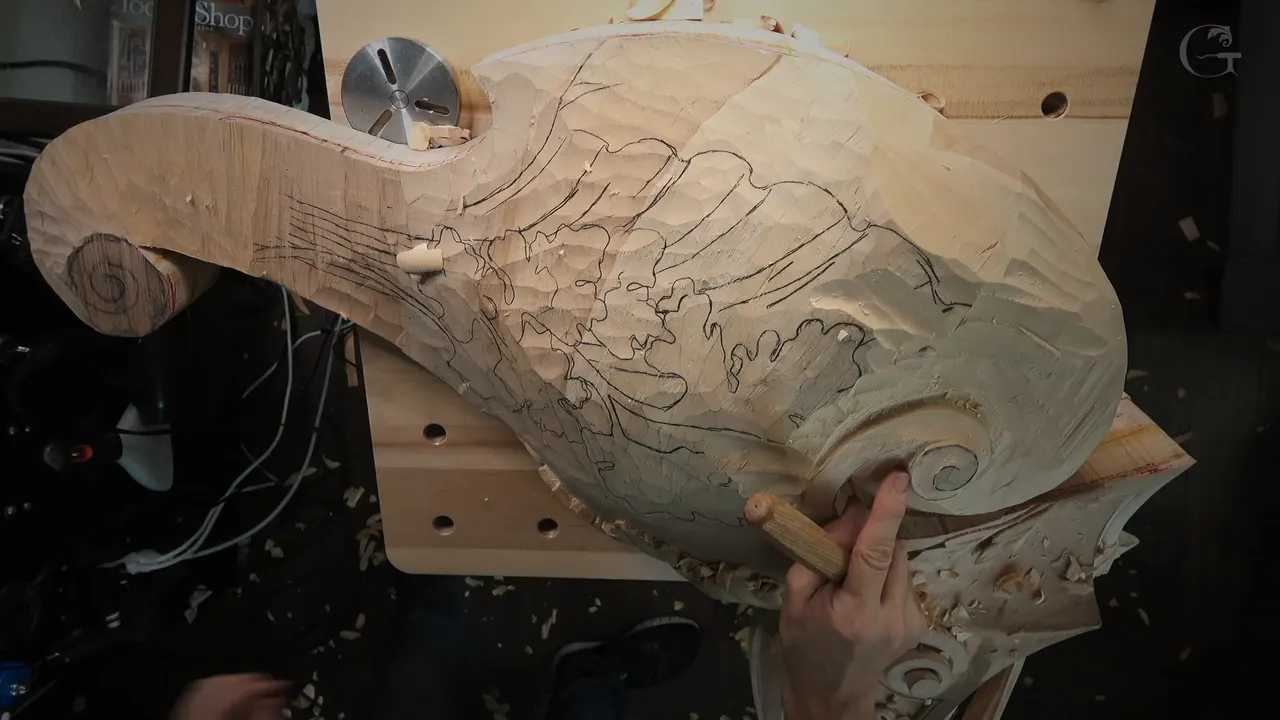

In part 6 of workshop 96 I set a number 11 in the wood to check a depth, and my line was "So my tool is my measuring device very much." Other lessons of mine give the same title to a scrap of paper, a square and calipers.
Ever reached for a ruler and found the gouge already in your hand? Did you wonder whether it could do the checking too? Then these words are for you. My video is short, so this page looks through my other lessons for the places where I name something as a measure. Each one has a link, so you can watch it yourself.
Where else I name a measure
- The gouge itself, a number 11, is the device in workshop 96.
- The furniture course and Hazelnuts 2 use paper.
- Workshop 159 puts paper among the best.
- Workshop 161 reaches for a square to test a corner, and the check is 90 degrees.
- Workshop 79 names a measuring point at a finish line.
- The floral panel lesson picks calipers.
- Workshop 36 and the lily box lesson both use a finger.
- Workshop 55 gives the number 11 two jobs.
- Chamomile 1 uses the needle of a pointing machine.

Why a depth of 10 mm?
The part opens in the middle of a thought. "otherwise, it is not going to look nice and not going to look consistent." The line before it holds the number: "so there's got to be 10mm". Call it 10 mm (0.39 in). At 00:23 I add a second way to say it, "Three-eighths of an inch." In millimeters it is 9.5, so the two figures sit side by side.
Then comes a need, not a finished job: "I need to lower down a little bit, this section right here," and the reason is a view from underneath: it will be "visible from below." The stakes are movement: "not really nice movement."
How does a number 11 tell you the depth?

At 01:56 the line is "And by the way, 10mm number 11 helps me." Then two short lines. "I can place my tool." Also "I can see if that is the depth I'm after so that this actually serves me in double purpose so I can actually check the depth overall depth if I'm there."
Double purpose is my phrase, and the purpose named in the same breath is the depth check. At 02:20 I ask, "Hope it makes sense." At 02:28 the plan is "And I guess I can do it exactly the same all around." Then, at 02:36, "until I'm happy."
What was the same idea for the wing?
At 03:12 the wording is "And the same idea, same exact idea." The tool goes in "straight down," and the wing "is supposed to be with the same level." Next comes a note about work still left: "which means in this section, I still have to cut a little deeper" and then "slightly deeper".

At 03:43 the sentence that names this page arrives, the one at the top.
What did flush and "on the money" mean?
At 04:28 I say, "OK, so I'm right here, so get flush on the bottom, I've got pretty much flush" and the cue after it is one word, "now." A figure follows: "I know it's exactly Three-quarters of an inch from the upper point down here". Metric, it is 19 mm (0.75 in), measured from the upper point down.

The check goes on: "and I can check all around." Then the verdict at 04:54: "And again, I've got flush, so I know that I'm right on the money." After a pause, "Ok, wonderful." And a second time, with a catch: "Wonderful, wonderful, except I still have to fix the outline."
Why look at the outline again after going lower?
At 05:55 the words are "because right now it does not look good" and then "because we lower that down and we lost distance, Ok." The distance is a space between two lines: "from this line to that line, so it also has to be really nice and smooth."

Lowering one spot cost distance, in my words, and the distance between two lines needed its own care. At 06:35 the cue is "Beautiful." Soon after, four seconds later, comes "I think it's a beautiful".
Why place only one corner of a number 7?
The end of the part is a plan, so I keep it a plan. At 06:42: "Now I'm going to take number 7 and number 7 and start working around here." At 06:51: "14mm #7 little bigger than half an inch." Fourteen millimeters is 0.55 in. Half an inch is 12.7 mm. Then "That's what I am going to use," and "usually works really good".

The placement comes next: "I'm placing just the one corner of the tool, which is the right hand side right now." Then: "I'm not trying to catch the true curvature of the tool." My last cue ends with "So if I'm placing just one corner, I can actually control where my tool goes".

What did the parts next to it add?
Part 5 of the same workshop opens with the tool: "I will switch to number 11 and I'll use 10mm," the same size again, about 0.4 in. At 02:58 the depth returns: "like a Three-eighths of an inch 10mm to the lower spot at least for the beginning". Later the warning is short. "Have to be careful, not to undercut," then "that would be a big mistake." On pace: "Again, it's got to be gradual."
Part 7 tests a tool against a shape, not a number. "I will use #7 Let's see if it's going to fit the profile." The test passes. "And yes, it does" and "And it fits actually perfectly." Later, "I have to check how it looks in 3-D", which is a need, not a result.
Which job does paper do in Furniture Panel 7?

The Furniture Panel course, lesson 7, has almost the same words as mine in workshop 96. The first line is "Let me get my piece of paper again." Then "This one is my measuring device." Right after it, a size you can read in metric as about 16 mm (0.63 in): "exactly the same space. It's about 5/8 of an inch."
The move continues with "And I'll mark it," and later in the same stretch: "It just helps me a lot to speed up the process, okay?" Paper is a measuring device here. Back in the Venice Room, the same word belongs to a gouge, so the word device does not change.

How did paper help with a lot of wood to remove?
In Hazelnuts, lesson 2, the scene is a big removal. "I know you got so much material and now we are taking a lot of it away." Right after comes "Use my paper as a measuring device," with "I'm almost there. Just slightly more."

A little later: "Again, what I'm after, I am after a full 3D." Then "Like I said, equal, equal, equal, equal." That is all one cue. A few cues later, "So now it does look like it's pretty equal."
When is paper one of the best measuring devices?
Venice Room 159 puts the options first. "For me, I could use just a ruler or even just calipers." Also "I can measure whatever the distance is." Then "Small calipers." After that: "You don't really have to use a calipers."

The line that matches this page is "Piece of paper is one of the best measuring devices," and the how-to follows: "and you can translate right on the side the height of it, okay?" Last in that stretch: "And maybe it's actually even easier."
How do you test a corner for 90 degrees?
In workshop 161, part 1, a size comes first, and the angle check comes after it. "So now I need to get a little deeper on this side," then "like another two millimeters." Two millimeters is 0.08 in. Later: "Two millimeters, that's what I'm using, but I can use actually one millimeter." The 1 mm figure is 0.04 in.

Then the angle. "But I also need to check if that is truly 90 degrees." Next: "How do I check that? There is multiple ways I can check that." The answer goes on: "I really have to just pretty much eyeball it. But what I could do, I could just place my measuring tool, even just a square." At 07:10 comes "And yes, I am actually now truly 90 degrees."
What was the measuring point in workshop 79?
Venice Room 79 holds a plan. The words are "So now I need to get some flatter gouge," with "maybe a number three," and then "and get right to the finish line." Next: "So that is going to be my measuring point."

The reason is a second piece. "I'm talking about perfect when I'm going to work on the second one, I'll know exactly because that's going to be the same since I'm getting the same line on both of them." It is a plan, so it stays a plan: a flatter gouge, a finish line, and one line matched twice.
Why do I like calipers for a molding?
Floral lesson 2 is about a molding. "I have to establish how wide" Then my choice: "but what I like to use, I'll use calipers."
"Calipers is always probably one of my favorite measuring tools." Then "Probably the most accurate, I'd say." After that: "And yes, I'll just take pretty much this piece," with "the old piece, and let me measure it." And "And line to line." The last cue in that stretch is "Let me transfer to my new piece."
Where does a finger fit in?

From workshop 55: the tool is the same size as in workshop 96. "Number 11," then "take 10 millimeters," a little under 0.4 in. My reason: "And why I like number 11, it actually like a two tools in one. Okay?" Further: "I can just place my tool straight down and use it as a gouge, or I can actually create different type of cut."

Back in workshop 36, the measure was 5 mm (0.2 in), "5 millimeters, about 3/16 of an inch" for a border. The preference: "And yes, there are tools to do that, but I kind of like to use just butt my finger against that and use as a reference point." The other option is "Or I could just do very much just a draw and eyeball it."

Lily Box, lesson 5 has a finger on the piece for another reason. "Try not to press the edge because right now it just becomes fragile." Then "That's why I'm placing my middle finger, if you can see, as a reference point or cranking point or leverage point, if you wish to call that way."
When did a needle do the measuring?
In Chamomile, lesson 1, the pick is "one of my favorite tools, pointing machine." Then "in this case, because I can measure." The how: "I can measure and just the needle of this machine going to go and touch, and I can reference the height."

A few cues later: "It's not like a must-have tool, but it's a good idea to invest in that tool." So the device can be a gouge, paper, calipers, a square, a finger or a needle.
Which lessons say it, and what did each one measure?
Here is the table. It lists the lesson, what was measured and a few of my words. Each row is a lesson you can watch.
| Lesson and part | What got measured, and how | His words |
|---|---|---|
| Workshop 96, part 6 | A number 11 placed straight down in the wood | Double purpose |
| Furniture Panel 7, part 4 | Paper, for a space of about 5/8 in (16 mm) | Speed up |
| Hazelnuts 2, part 2 | Paper, used as a measuring device while taking wood away | Almost there |
| Workshop 159, part 1 | Paper, named beside a ruler and calipers | Even easier |
| Workshop 161, part 1 | A square, to test the corner at 90 degrees | Multiple ways |
| Workshop 79, part 9 | A flatter gouge at the finish line | Same line |
| Floral and Molding 2, part 2 | Calipers, taken line to line from the old piece | Most accurate |
| Workshop 36, part 6 | A finger against a 5 mm (0.2 in) border | Reference point |
| Workshop 55, part 2 | A number 11 placed straight down, used as a gouge | Two tools |
| Lily Box 5, part 5 | A middle finger resting on the piece, edge left untouched | Leverage point |
| Chamomile 1, part 1 | The needle of a pointing machine, reading a height | Measure |
Where can you watch each of these lessons?
The video for this page belongs to Venice Room 96, and workshops 86 to 97 live together in the Part 8 course. The workshops on both sides of it are workshop 95 and workshop 97.
From other Venice Room courses: workshop 79 in Part 7, workshop 55 in Part 5, workshop 36 in Part 3, and workshop 159 with workshop 161 in Part 14.
The other courses are the furniture lesson 7, Hazelnuts 2, Floral and Molding 2, Lily Box 5 and Chamomile 1.
If a word here is new, the plain definitions are one click away: gouge, calipers, square, ruler, paper, pencil, chisel, hand tool, wood carving, bench, inch, millimeter, measurement, right angle, depth gauge and molding.
Want to hear all of this in my own voice? Start here.
How it's done
- Pick one depth. Workshop 96 gives two ways to say it, 10mm and a fraction of an inch.
- Use a number 11. Workshop 96 says the 10mm number 11 "helps me."
- Go around the side. At 04:46 the check goes all around.
- Look for flush. At 04:54 the verdict starts with "I've got flush."
- Check the outline. At 05:24 the catch is the outline beside it.
Frequently asked questions
When a wood carver says "measuring device," what is it?
On this page it is whatever answers a size question at the bench. Workshop 96 uses the number 11 in the wood. In other lessons the same two words go with paper, and a square is named a measuring tool.
Can a gouge tell you how deep you are?
In part 6 of workshop 96, a number 11, 10mm, "helps me" and lets me "actually check the depth overall depth if I'm there." At 04:39 the figure is "Three-quarters of an inch".
Do you need calipers to measure a carving?
That depends on the job. Workshop 159 lists a ruler, calipers or paper. Floral lesson 2 has the line "Probably the most accurate, I'd say."
What to carve next