

Alexander Grabovetskiy, woodcarver, School of Woodcarving · Published 2020
What does a wood carver mean by "in my case"?
Quick answer: "In my case" is what I said in part 3 of workshop 96, right after a warning about one way to carve the grain. My reason was how much wood had to go. Other lessons put the same words beside a tool size, a cookie and a missed undercut.
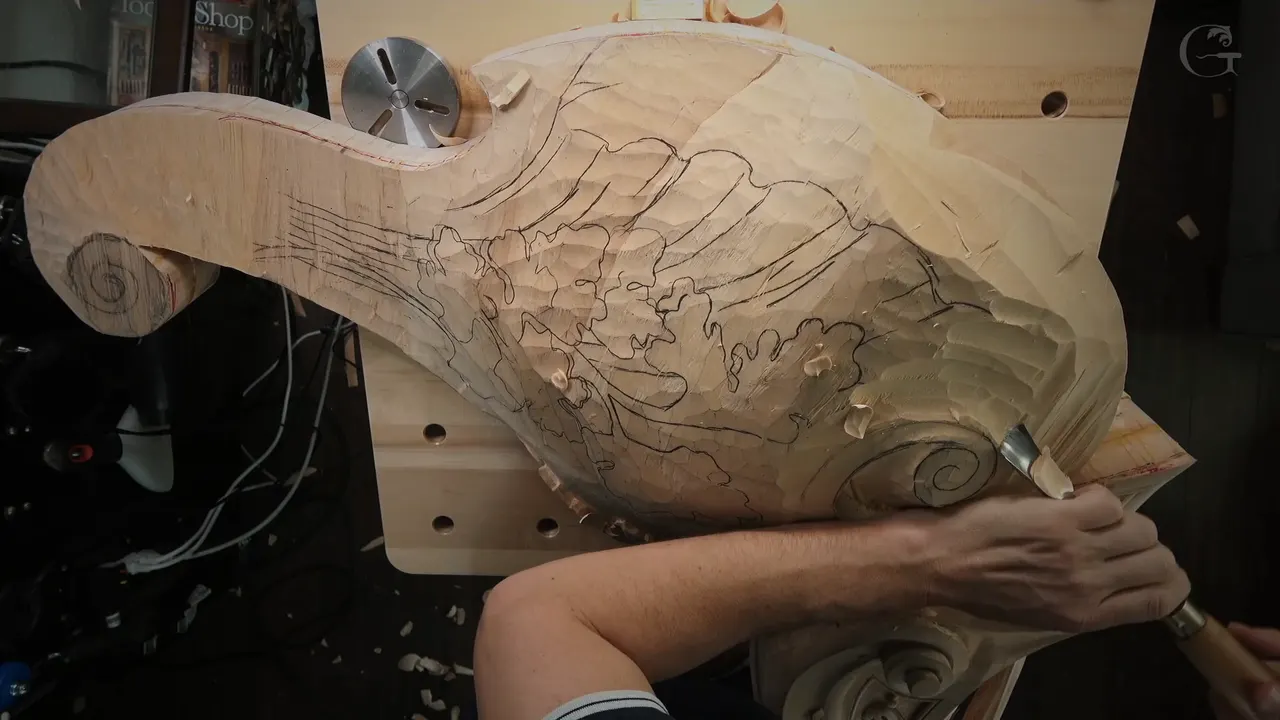

"In my case" is what I said in part 3 of workshop 96, after "that is not the safest way," and my reason followed: "because there's a lot of material that needs to be removed." Other lessons put the same words beside a tool size and a missed undercut.
Ever had a rule explained at a bench, and then wondered if it still holds for the piece in front of you? Did you look at your own board before you copied the move? Then you already know what these three words are for. My video is short, so I looked through my other lessons for the places where I say them. Every one has a link, so you can watch the real thing.
Nine places where "in my case" shows up
- Workshop 96 pairs a warning about the grain with wood to take off.
- Workshop 85 adds a grain direction and an angle.
- A small tool in workshop 73, then a spot that shows only from the ceiling.
- A middle point for a pipe in workshop 65, and a direction for it.
- A cookie will not work for me in workshop 66.
- A back bend gets its reason from a bench I already have.
- Chamomile gives a missed undercut, plus a size.
- Furniture 1 asks which end of a board is the top, and I pick.
- Hashemi gives a volute profile, a wavy edge and small gouges.

What did I say about the grain in this video?
The video opens with a plan: "that's preliminary because I still have to lower down a little bit later, this section." Right after it comes "I can start at least."
At 00:39 the warning arrives: "So, by the way, that is not the safest way." Around it sit "the grain runs in this direction," then "when it runs in that direction," and "you can always split and remove too much what you don't want to remove."

Then the three words, at 00:59: "in my case, it's OK." One cue later, at 01:01, my reason: "because there's a lot of material that needs to be removed." After that, "So I can do that."
At 01:11: "The best way is actually just to go across the grain, just in that direction." Then one more: "OK, so it's always, always better to run in that direction."
Why is that direction the safer one?
At 02:31: "See what I'm talking about in this case, it's Ok." Next, "it catches and you remove sometimes," and the stretch ends at 02:52 with "is always safer."

What did I say about the outline in this video?
The plan at 03:10 was "I am going to need to outline approximately, the position of leaves I am going to have," and the line after it adds "not the final leaves outline yet,". Then: "approximately I do have an idea what is going to happen later on. I'll refine it." At 03:31, "So I want to make sure I'm not hitting that outline."
Part 2 of this workshop holds a question on the same topic: "And if you would ask me if I'm afraid of losing outlines." "Absolutely not." is the very next cue. Also in part 2: "I do have to keep an eye how deep I'm going." And: "logically, when you look at this piece, it looks like it's supposed to go this way right here," then "but that's not the case."
Part 4 has a line about measuring: "Wasting time to just measure everything and so on, just eyeballing."

Depth shows at 05:11: "that is about Three-quarters of an inch deeper right now, this section," so about 19 mm. At 05:47, "I want to make sure I like what I see." At 05:52, "I need to lower it down."
At 05:59 the plan is "Let me just check if I like the slope." Later, at 06:22: "I don't want to lose overall feel."

The movement is named at 06:35: "this is going to be the secondary movement." Then "just kind of a nice transition this way." And at 06:48, "And I really like the slope, how it looks."
The last cues are plans. Seven minutes in: "maybe it is safe right now to outline that line right here." Then "I think it is a good idea to get a number three," and "number three and maybe Three-quarters of an inch," about 19 mm. The final cue is "And start outlining it."

Which way did the grain send me in workshop 85?
Part 5 has a warning of its own: "the direction of my grain runs this direction, and if I'm going to put straight down, I can always split." At 03:55, "So I always try if the grain runs that direction, I'll just go across the grain." My phrase follows, "In my case," and a number: "I have to just angle it about 45 degrees or so."

Which tool size did the words pick in workshop 73?
Video 5 plans a tool. Then "in my case," then "I'm going to take 3 millimeters number 11," which is 3 mm (0.12 in). A few cues on: "Maybe it's a little too big."

It returns at 05:04: "In my case," and the rest: "I really don't need to go this way because it's not going to be visible." More follows: "visible only from the ceiling," and "So just deep enough, but not to the extreme. I don't need to."

What could you do with a leaf, and why not in my case?
Workshop 77, video 1, has a leaf: "But yes, I do have a rib, but it's just a leaf which is folding like that." Next, "Almost like a boat." And "You could do actually acanthus leaf like that, if you wish."
Here it is, "In my case," plus "I don't have to because it's a different design." Two plans follow, "Let me see if I'll be able to open up wide enough," and "Maybe I could actually clamp it even like this."

Which gouge did I name in workshop 74?
Workshop 74, video 2, has "just matching whatever matches the curvature gouge." The pick: "In my case," followed by "it was number five right now, about 12 millimeters or so, about half an inch, and I was able to fit this curvature." The half inch converts to 12.7 mm.
A verdict on that section follows: "But I'm not really too happy with that section, okay?" And a plan: "maybe I should use different tool to blend it nicer."

Where should a pipe end?
Workshop 65, video 10, has a pipe with a middle point. Then comes "which, in my case, I think I should bring that all the way this direction." A little further: "visible from the side position, too."

Why does a left side count as the right side?
Workshop 82, video 3: "It would not look good if I would just create the S curvature this way. It would just throw away overall movement." Then "So it has to be on the right side." Then: "I mean, on the right side, which is in my case, it's the left side."
One more line sits right there: "If you would jump on another side, I cannot put S curvature right here."
Workshop 64, video 10, has a pipe too: "Got to stop around this side first of this pipe," and then "which in my case would be right, and now I have to attack left."

What about a cookie?
Video 10 of workshop 66 has "protect with the other piece of wood if you do have it," and "like a cookie,". And: "In my case, cookie is not going to work, but it's a good idea." Then an option: "Or otherwise, you can just use your finger as a leverage point." Wikipedia has a page on leverage, if the word is new.
How sharp was my tool in workshop 71?
At 04:44, "And that's against the grain." Then "It's still possible." At 04:59, "If the tool is sharp, I shouldn't have any problem." And at 05:10: "And in my case, the tool is really sharp."

Why does a back bend work for me?
Video 10 of workshop 73 says "any back bend will work." The line goes on: "In my case, back bend, that is the only solution because I do have a bench already." Then "So that's the only way I can probably get it. Otherwise, it would be just impossible for me to use a normal tool."

Which advice did the Chamomile course add?
Lesson 4, video 3, has the advice: "it's actually a good idea to check everything before you take it out from the background, from the paper, and if you miss something." Then "In my case," with "I missed to undercut underneath the flower."
Next: "And it took me a couple seconds, and it's easier when it's attached to the background."

Lesson 2, first video, has a size. "I'm using number three, like I said," and "and in my case, it would be about 10 millimeters," or 0.39 in.
Why did two cathedrals not matter on a board?
In the first furniture lesson, the rule comes first: "if there's a single cathedral going up, but there is no second one, so that means the cathedral always goes up."
Then the exception: "In my case," next to "it doesn't matter because I've got two cathedrals facing each other." After that I pick a top and a bottom myself.
Which way did the diagonals send me?
Furniture Panel 7, video 2, starts at once: "And in my case, the easiest way would be, just because I do have diagonals all the way, this diagonal and that diagonal,". In Furniture Panel 6, video 3, a movement could go "that direction. Or it could be this direction." Then: "It's going to work also, but in my case, I would love to get this curl going like that and going this way."

Which edge needed a wave?
Hashemi Flowers 30, video 2, has the words in the middle of a sentence: "kind of wavy, in my case, okay, because I want to do a complicated flower."

When did a profile match my picture?
Over in Hashemi Flowers 14, video 4, I pick a tool: "I'll take number seven, 10 millimeters, and start working my way in." Just over 3/8 in. Then "Again, really important shortcut."
The shortcut: "If you're working on a volute, it's easier to find a matching profile which is matching your picture." And the line: "In my case, it matches, looks like it's 5/8 of an inch," or about 16 mm.
What size did I hold for the small gouges?
Last, Hashemi Flowers 49, video 1, lists "number 11 and one millimeter," then "a half a millimeter." Next: "in my case right now, I'm holding about five millimeters." That is 5 mm (0.2 in).

Which lessons say it, and what came right after?
Here is the table. It lists the lesson, the topic and a few of my words, and each row is a lesson you can watch.
| Lesson | Topic | Words |
|---|---|---|
| Workshop 96, part 3 | The grain, with a lot to remove | It's OK |
| Workshop 85, part 5 | The grain, then a 45 degree tilt | Just angle |
| Workshop 73, part 5 | A number 11 of 3 mm (0.12 in) | Number 11 |
| Workshop 77, part 1 | A leaf folded like a boat, or another design | Different design |
| Workshop 74, part 2 | A number five, about 12 mm (1/2 in) | This curvature |
| Workshop 82, part 3 | Which side of the S curve gets what | Left side |
| Workshop 66, part 10 | A cookie for leverage, or a finger | Good idea |
| Workshop 71, part 1 | A tool going against the grain, and sharp | Really sharp |
| Workshop 65, part 10 | The middle point where a pipe ends | This direction |
| Workshop 73, part 10 | A back bend, with a bench already there | Only solution |
| Chamomile 4, part 3 | An undercut I missed under a flower | I missed |
| Chamomile 2, video 1 | A size of about 10 mm (0.39 in) | Rush it |
| Furniture 1, part 3 | A board with two cathedrals facing each other | Doesn't matter |
| Hashemi 30, part 2 | A wavy edge on a complicated flower | Number nine |
| Hashemi 14, part 4 | A volute profile of 5/8 in (about 16 mm) | It matches |
| Hashemi 49, video 1 | Small gouges, about 5 mm (0.2 in) in hand | Right now |
Where can you watch each of these lessons?
The video for this page belongs to Venice Room 96, and workshops 86 to 97 live together in the Part 8 course. The workshops on both sides of it are workshop 95 and workshop 97.
From other Venice Room courses: workshop 85, workshop 82, workshop 77, workshop 74, workshop 73, workshop 71, workshop 66, workshop 65 and workshop 64. Their courses are the Part 7 course and the Part 6 course.
The other courses are Chamomile 4, Chamomile 2, Furniture Panel 1, Furniture Panel 6, Furniture Panel 7, Hashemi Flowers 30, Hashemi Flowers 14 and Hashemi Flowers 49.
If a word here is new, the plain definitions are one click away: gouge, chisel, hand tool, wood carving, bench, clamp, ceiling, curve, inch, millimeters, chamomile and angle.
Want to hear all of this in my own voice? Start here.
How it's done
- Read the grain. Workshop 96 has the grain running in one direction, and a risk of removing too much wood.
- Look at your own piece. My reason was how much material needed removing, and then "So I can do that."
- Pick a direction. The best way I named is going across, in that direction.
- Watch the outline. At 03:31 my line was about not hitting it.
- Check the slope. At 05:59 the plan was a check on the slope, and an opinion of it came at 06:48.
Frequently asked questions
What does "in my case" mean when a wood carver says it?
On this page it sits right before a fact about my own piece. Workshop 96 had material to remove. Workshop 73 gave a tool size, and Chamomile 4 an undercut I missed. The words fit each piece on my bench.
Is the grain a risk when you carve?
My warning in workshop 96 was that a split can remove too much wood. The best way in that video is going across. The exception I gave for my own piece was the amount of wood to take off. At 02:52 the line ends with "is always safer."
How do you angle a tool when the grain runs one way?
My line in workshop 85 was "I have to just angle it about 45 degrees or so." The cue before it names the direction of my grain, and the cues before that warn about a split. The angle belonged to that piece.
What to carve next