

Alexander Grabovetskiy, woodcarver, School of Woodcarving · Published 2020
What does a wood carver mean by "careful not to"?
Quick answer: Workshop 96, part 5, holds the warning, right before "that would be a big mistake." My lines after it say gradual, somewhat careful and conservative. In other lessons I end the same warning on walls, borders, edges and depths, and each one has a link.
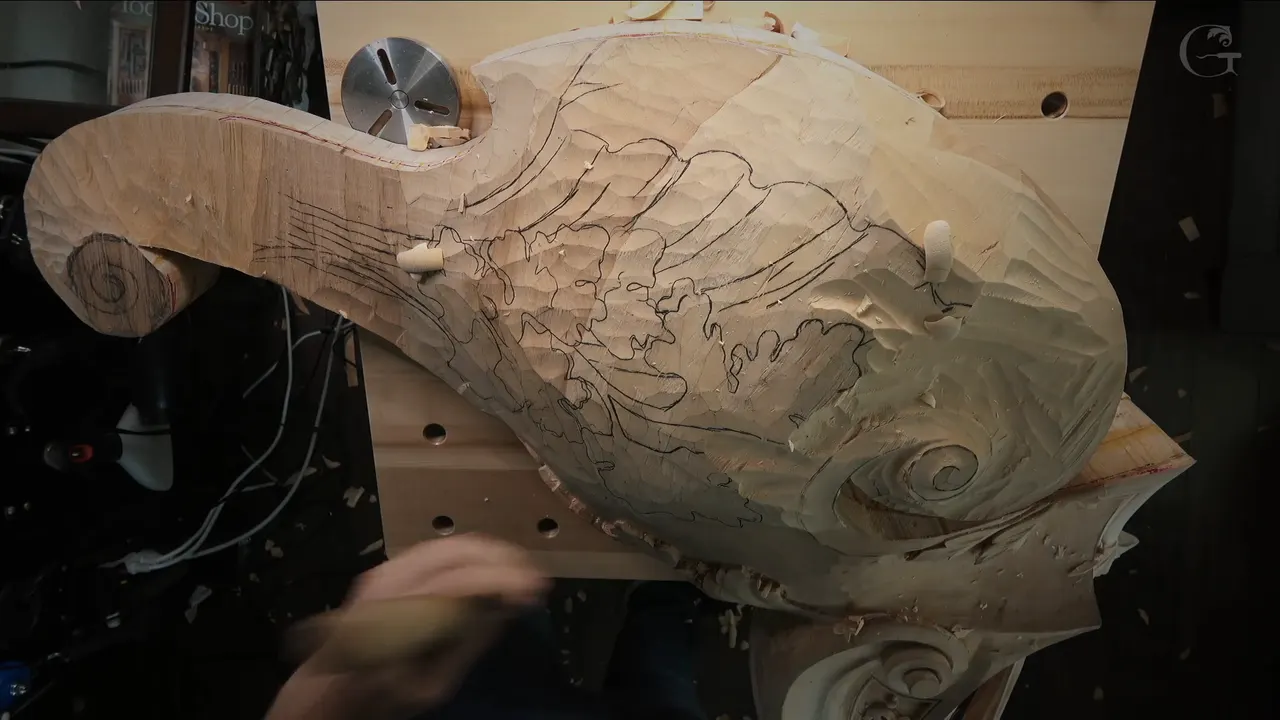

"Have to be careful, not to undercut" is what I said in part 5 of workshop 96, and the next cue is "that would be a big mistake." My other lessons carry this warning too, beside walls, borders, edges and depths.
Ever stood over a line you cannot afford to lose, with a gouge in your hand? Did you slow down before the next pass? Then you already know what this warning is for. Every lesson below has a link, so you can watch the real thing.
Where this warning shows up
- Workshop 96 pairs an undercut with a big mistake.
- Workshops 53, 1 and 2 meet an undercut as well, each in its own part.
- A floral lesson holds a pass that almost went wrong.
- Furniture 15 and 16 reach the background.
- Hashemi 49, Hazelnuts 5 and the grape vase are about taking too much wood, or going through it.
- Chamomile 3, Roman 15 and Venice 62 guard a border, an edge and a wall.
What did I say in part 5 of workshop 96?
The part is short, so I put it first and whole. My plan at 00:05 was "I will switch to number 11 and I'll use 10mm, number 11 and just work around this section." The size is 10 mm (3/8 in). At 01:21 the plan was "And let me use again number three and recreate that outline."

A depth shows at 02:58: "Three-eighths of an inch 10mm to the lower spot at least for the beginning." Both of my figures sit in that line, 3/8 in and 10 mm.
The warning from the top arrives at 03:32. After "That's good." at 04:07, I say at 04:09 "Again, it's got to be gradual. So that's why I am somewhat careful. And really conservative with my cuts."

At 04:40: "number three and clean up a little bit overall section." A size follows at 04:53, "20mm so three-quarters of an inch," or 20 mm (about 3/4 in).
At 05:25 my plan was "I could actually lower that down a little bit, lower this section." Then "You know, it's going to give me a really nice movement." The same stretch holds "attacking that from the right position."

The part closes with these lines. At 06:47, "I need to use a spoon-gouge." At 06:57, "I will use number 5, but it is like against the grain." At 07:06, "I have to be really mindful of what I'm doing," and the last words are "clean up right away."
What do parts 4 and 6 add to the warning?
Part 4 starts with "Start outlining it" and the next cue holds "much easier for me not to lose the line." At 00:46 I say "careful, right in those spots." At 00:58 comes "OK, that's enough, like I said, I don't wanna overdo it."

At 01:16 comes "safer to use that number eight." Sizes start at 02:49 with a number three. The cue ends "about 19mm," which is 19 mm (3/4 in). Later, at 03:11: "Ok, again, that is just the starting point, and now I need to start lowering down this section."
At 04:59: "and I'm constantly checking around how it looks." Depth shows at 05:27 as "And that has to be consistent, like 10mm from this point down," and 10 mm is about 0.39 in. Then "depth of here and looks like I need to go a little deeper right here." After that I say "I really don't want to make a mistake."
The last cues of part 4 hold my view on measuring: "And I'm just eyeballing it," and "Wasting time to just measure everything and so on, just eyeballing."

Part 6 starts with "Expose full 10mm and this site makes sense, so there's got to be 10mm otherwise, it is not going to look nice and not going to look consistent." My reason at 01:36 is "Especially it's important because" and the next cues hold "visible from below" and "really noticeable if there is not really nice movement."
A check on depth follows. At 01:56 I say "And by the way, 10mm number 11 helps me. I can place my tool. I can see if that is the depth I'm after". At 02:28: "And I guess I can do it exactly the same all around." At 03:43 comes "So my tool is my measuring device very much." At 04:39 the cue is "I know it's exactly Three-quarters of an inch from the upper point down here and I can check all around," about 19 mm (0.75 in). At 04:54: "And again, I've got flush, so I know that I'm right on the money."
The tool at 06:51 is "14mm #7 little bigger than half an inch." That is 14 mm (0.55 in). At 07:08: "I'm not trying to catch the true curvature of the tool."
Which lessons put the warning beside an undercut?

Back in workshop 53, part 6, a line at 04:08 ends on "undercut too much because I still have to create convexes and concaves." At 04:15: "So if I'm going to undercut in this area too much," and then "it can give me a big problem." At 05:04: "actually giving me a beautiful shape." At 05:12 I add "really careful how much I roll."

Workshop 1, part 13, gives it at 03:35, ending on "undercut under here, and I'm going to lose the detail." The next cue is "And that's no bueno." At 04:06, "Some carvers would call this stage setting in."
That workshop gives a depth too. At 04:26: "Like I said, I want to see really deep excavation right here." At 04:44: "But at least right now, I'm about one-inch deep, 25 millimeters deep," which is 1 in (25 mm).

Workshop 2, part 2, starts this stretch at 02:57 with "number nine," then "20 millimeters," then "and remove that waste I just produced," and "and I can actually go deeper." That is 20 mm (0.79 in). At 03:15 my reason is "I think that is a focal point of overall design,".
The line at 03:26 ends on "undercut it underneath." At 03:31: "Okay, so important for me not to undercut." My plan at 03:38 was "Let me use again big number seven and maybe just to chop down a little bit." The wall at 03:53 is "Okay. Now I've got about 25 millimeters wall, which is very good, I'd say," or 25 mm (1 in).

Floral and Molding 1, part 3, reaches it at 16:12 with "create a undercut." Then come "And I was pretty close. Almost. Almost made a mistake," and then "Almost made a mistake by the shadow it's already casting." At 16:49 comes "And obviously, it's a good idea for me to use a small tool."
Where does a depth enter the warning?
Over in Furniture Panel 16, part 8, at 00:51: "jump closer to the edge and get my way inside little by little, okay?" At 01:01 I say "approaching background," and the sentence runs through "really careful" into "not to overdo it, but still make sure you control how deep your tool goes."

At 01:32: "And now I'll just get from the side and carefully start removing those chips." Later in that part, at 12:04, a sentence runs on to "inside of that wall. Inside of the wall of detail. It's better to take your time and make rotation movements just like that." At 12:38: "And don't dig too deep, because we really need to get the same level later on."
Furniture Panel 15, part 12, has "careful, careful, careful," at 09:53, and the sentence ends on "to do too much." Next come "Because it's easy." and "It is easy." At 10:31, a bit later in the same part, I say "Okay, I'm pretty close."

Hashemi Flowers 49, part 3, reaches it at 05:09 and ends on "remove too much." Next is "I don't want to lose overall look, overall shape."

Hazelnuts 5, part 1, puts it at 03:36 and ends on "to take too much." A measure follows at 04:13: "approximately one inch, about 25 millimeters," which is 1 in (25 mm).

Grape Vase 3, part 5, has it at 05:03, ending on "pierce it through because it's much deeper right now." At 05:26: "It's all the way through." And later: "I don't really want to excavate too deep, just to clean up".

What guards an edge or a wall?
Chamomile 3, part 3, closes at 17:56 on "break the border." Roman Acanthus 15, part 1, has "really careful on escape." at 06:17 and then "What I mean by escape, when I'm moving out." The warning there ends on "break my edge," and the cue after it is "So I barely remove any of my material, but still creating that spoon effect,". At 06:42: "there is a reason why this tool is called veiner, even if it's a spoon, but it's still veiner spoon." And "And it just creates beautiful shadow."

Venice Room 62, part 11, says it at 04:13, ending on "press too hard because" and "damage the wall." Before it, at 03:59: "Okay? Because I need to expose this barrel also, or this part, this wall." Then comes "push too hard and create the tool marks." Then "a problem for me to clean up." At 04:32, "mindful of it." At 04:55: "I need number seven probably."

Venice Room 32, part 11, has "make this part lower." at 00:29. At 00:34 the line ends on "lower that too much." Before it, at 00:05: "And I can probably go right now a little deeper with the same tool." Later: "a space for undercutting. Okay." At 01:12: "I need to knock down little more this side because as of now, it is in my way."

Greek Acroterion 2.2 says it at 01:43, ending on "split my wood." Earlier, at 01:13: "probably one of the number ones, and establish my line."

What reasons does the warning carry?
A few lessons give the reason right beside it. In Byzantine Acanthus 9, part 2, at 05:07, the cue is "because right now it becomes fragile." At 05:13: "We really, after that effect, just make it airy and light."
Grape Onlay 14, part 1, has a reason at 04:42: "all of those parts are fragile." Then "already broke some of them just by misplacing it." Earlier, at 04:12, I say "I just have to feel the tool itself."
In the Tray of Blessing 1, part 1, the edge gets "but still you don't wanna destroy it." In Furniture Panel 23, part 9, at 02:47: "Carefully, carefully go in" and the sentence ends on "damage my background. It has to be flat."
Venetian Flowers Rosette 5, part 1, gives a background too. At 07:50: "chop first straight down because I want to see somewhat final boundary." At 08:16 comes "damage my background." Then "But it gives me a really good idea, the boundary where I should stay."
What did I say about it in each lesson?
Here is the table. A number like 53.6 means workshop 53, part 6. Each row lists the lesson, what the pass could ruin and a few of my words.
| Lesson | Topic | Words |
|---|---|---|
| Workshop 96.5 | An undercut, then a big mistake, then going gradual | Really conservative |
| Workshop 53.6 | Too much undercut, with convexes and concaves still ahead | Big problem |
| Workshop 1.13 | A forced undercut under here that loses detail | No bueno |
| Workshop 2.2 | An undercut under the point that draws attention | Very good |
| Floral Molding 1.3 | Almost a mistake, by the shadow it is casting | Pretty close |
| Furniture 16.8 | Overdoing it near the background, then the wall | You control |
| Furniture 15.12 | Doing too much, with the line getting closer | Overdo it |
| Hashemi 49.3 | Removing too much and losing the overall look | Overall shape |
| Hazelnuts 5.1 | Taking too much, with an estimate from the center | One inch |
| Grape 3.5 | Piercing through a spot that is much deeper | Way through |
| Chamomile 3.3 | Breaking the border during a pass toward it | My border |
| Roman 15.1 | Breaking my edge at the escape of the pass | Spoon effect |
| Venice 62.11 | Pressing too hard against the wall and leaving marks | Tool marks |
| Venice 32.11 | Lowering one part too much, above a space | Maybe partially |
| Greek 2.2 | Splitting my wood, in the Greek Acroterion course | Really careful |
Where can you watch each of these lessons?
The video for this page belongs to Venice Room 96, and workshops 86 to 97 live together in the Part 8 course. The workshops on both sides of it are workshop 95 and workshop 97.
From other Venice Room courses: workshop 53, workshop 1, workshop 2, workshop 32 and workshop 62.
The other courses are Floral and Molding 1, Furniture Panel 15, Furniture Panel 16, Hashemi Flowers 49, Hazelnuts 5, Grape Vase 3, Chamomile 3, Roman Acanthus 15 and Greek Acroterion 2. The reasons above come from Byzantine Acanthus 9, Grape Onlay 14, Tray of Blessing 1, Furniture Panel 23 and Venetian Flowers Rosette 5.
If a word here is new, the plain definitions are one click away: gouge, chisel, hand tool, wood carving, bench, grain, mallet, relief, spiral, volute, corbel, inch and millimeters.
Want to hear all of this in my own voice? Start here.
How it's done
- Name the depth. My depth in part 5 was "Three-eighths of an inch 10mm to the lower spot at least for the beginning," which is 10 mm (0.39 in).
- Name the loss. In workshop 1, the undercut warning is followed by "And that's no bueno."
- Stay careful. At 04:11 I say "So that's why I am somewhat careful."
- Use the tool to check. Part 6 has "So my tool is my measuring device very much."
- Check around the piece. At 04:46 the cue is "and I can check all around."
Frequently asked questions
What came after the warning in workshop 96, part 5?
At 04:07 the cue is "That's good." Next, at 04:17, I say "And really conservative with my cuts." The cues between them carry my words about being gradual and somewhat careful.
Which sizes does part 5 name?
My cues name "10mm" with a number 11 at 00:07, and "20mm" at 04:53, which are about 0.4 in and 0.8 in.
Can you go deep and still avoid an undercut?
In workshop 2, part 2, I say "and I can actually go deeper." The reason at 03:15 is "I think that is a focal point of overall design,". The undercut line follows at 03:26.
What to carve next