
August 30, 2024 · Updated August 26, 2026
By Alexander Grabovetskiy — Master Woodcarver · Founder, School of Wood Carving · 18 min read
What is the densest wood ever?
The densest wood ever weighed is black ironwood, Krugiodendron ferreum, at 84 pounds per cubic foot on The Wood Database. I have to add the honest part right away. Different sources crown different species, because that figure shifts with moisture and with the one board you happened to put on the scale.
You went looking for one name and got three. Quebracho on one page, Australian buloke on the next, lignum vitae on a third, and each page sounded certain. The woods at the top sit within a few pounds of each other, so whoever weighed a board last gets to be right for a while.
No slogan from me. Below are real figures with the source printed beside each one, plus the part nobody writes down. What they feel like when the gouge goes in. I carved white oak for weeks at a stretch, then basswood for weeks at a stretch, and my shoulder learned the difference long before I read a chart.
Measuring comes first. Then the woods that deserve room on your bench.

Seen from the side, where the full thickness of the board shows. That is the part you lift.
- Heaviest on The Wood Database is black ironwood, at 84 lbs/ft3 or 1,355 kg per cubic meter.
- Fresh water weighs 62.43 lbs/ft3, so anything heavier than that sinks.
- Cell wall material runs about 1.54 specific gravity in every species, says the USDA Wood Handbook.
- So a heavy board is really just a board holding very little air.
- Any single figure you read still carries roughly ten percent of swing between two boards of one species.
Which wood holds the record for the densest wood ever?
Black ironwood carries the highest species average I can find, 84.5 lbs/ft3 or 1,355 kg per cubic meter, on The Wood Database list of the heaviest woods. Krugiodendron ferreum grows in southern Florida, so the heaviest wood in America is a native, and USDA plant records put it across the southern tip of the state.
Itin comes next at 79.6, African blackwood at 79.3, lignum vitae at 78.5. Then I opened the species page for that same wood and it says 84, not 84.5.

Nine and five sixteenths inches across. Weigh two panels this wide in two species and your wrists learn the argument.
Half a pound. One small detail, and the whole business is inside it. That site says the honest thing right on the list, and I would rather quote it than soften it. Density can vary "by an average of plus or minus 10% between samples." So a sample of the tenth-ranked wood could outweigh a sample of the first, and "certainly no conclusive ranking should be inferred from the list." Two paragraphs down, the same page calls lignum vitae the wood "widely accepted as the heaviest wood in the world," four places below whatever sits on top.
Hunt for one heaviest piece and the target moves again. A specimen of South African black ironwood, Olea capensis, was reported at 93 lbs/ft3, and that lone piece is where the old world record came from. Somebody has since documented a piece of waddywood at 95. One board is not a species.
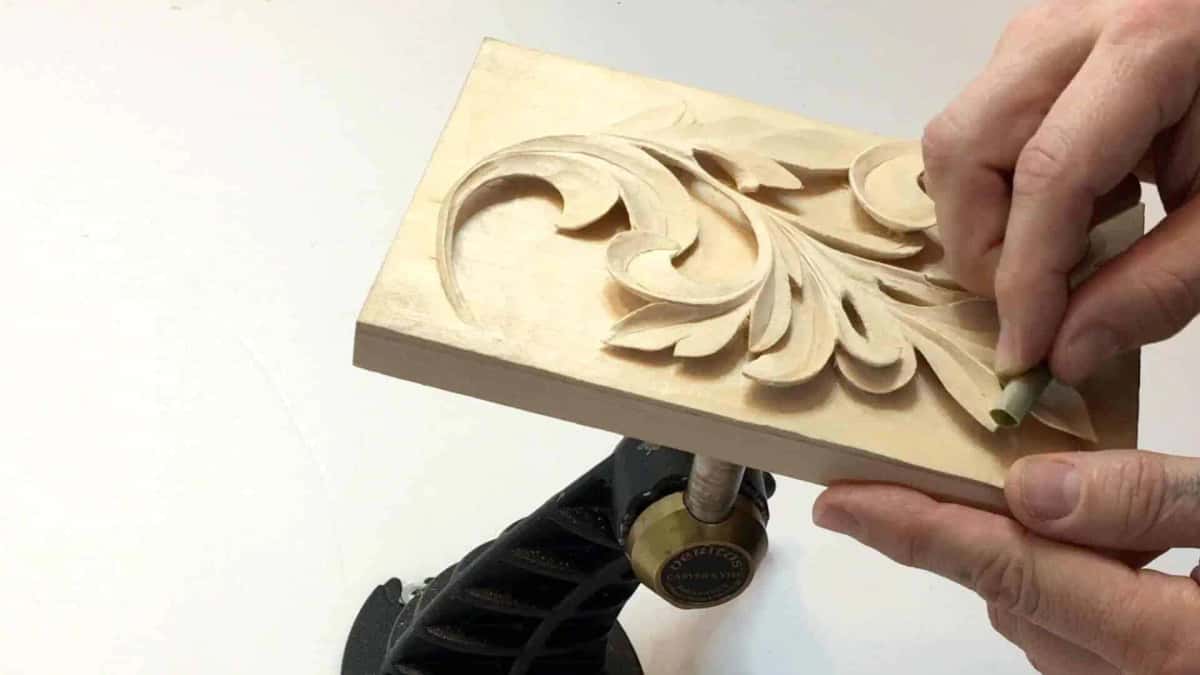
Pick up a finished leaf and your hands guess the species before your eyes do.
Hardness carries the same trouble. Quebracho wore the crown at 4,570 lbf for years, until the author traced his old source to decanewtons, recalculated, and dropped the wood to 3,530. Its Spanish name, quebrar hacha, means axe breaker. Meanwhile Australian buloke, which the whole internet calls hardest, carries this note on its own page: the claim "is based upon a single data source," and with every reading counted the wood lands 21st. For that fuller mess, read what Janka hardness of wood means for a hand carver.
How do you measure how dense a wood is?
Density is mass divided by volume, and every argument above hides in the moment you choose to weigh the board. The USDA Forest Service Wood Handbook defines specific gravity as the density of a substance over the density of water, and puts water at 62.43 lb/ft3.
Basswood at 0.42 holds under half of that. ASTM D2395 is the standard method for weighing it properly.

Spalting lines on a bowl, proof that one piece of wood is not one uniform material.
Now the sentence that changed how I look at a board. Cell walls hold a constant specific gravity across species, the handbook says, and it uses 1.54 for every species. Read that twice. Balsa fibre weighs what ironwood fibre weighs, gram for gram, and only the hollow space between cells differs. Balsa is mostly air. Ironwood has almost none. So wood density and high density wood turn out to be questions about empty room.

Two species in one piece, and the pale carving does not weigh what the dark ground weighs.
Ranges come from the same chapter. Most species dry to between 20 and 45 lb/ft3, and the full span runs from about 10 for balsa up past 65 for some imported woods. Ovendry density inside one ordinary species swings about ten percent. Ten percent. I meet it every week, because the density or softness of wood changes inside a single species, and even with the same limewood the color shifts and the darker patch goes softer under my hand.
Here are the figures I trust, side by side, with what each one means at the bench.
| Wood and species | Average weight once dried to 12% MC | Janka lbf | What a hand gouge finds there |
|---|---|---|---|
| Black ironwood, Krugiodendron | 84 lbs/ft3, easily the heaviest figure listed | 3,660 lbf | Turning stock, too small for panels |
| Lignum vitae, Guaiacum | 78.5 lbs/ft3, endangered, now listed under CITES | 4,390 lbf | Hardest number here, and legally awkward |
| Gaboon ebony, Diospyros | 60 lbs/ft3, well under the ironwood figure | 3,080 lbf | Possible by hand, barely worth it |
| White oak, Quercus | 47 lbs/ft3, heavy but honestly still workable | 1,350 lbf | Crunchy, grainy, and wants a mallet |
| Black walnut, Juglans | 38 lbs/ft3 per the Purdue extension figures | 1,010 lbf | My favorite, holds fine detail beautifully |
| Basswood, Tilia americana | 26 lbs/ft3, which beginners should start on | 410 lbf | Slices clean under a light mallet |
Why does a heavy board sink instead of float?
Fresh water weighs 62.43 lb/ft3, and any wood heavier than that goes under. At 84 pounds a cubic foot the ironwood has no chance. Every wood on that top ten list beats water, and the lightest of the ten still reads 74.4 lbs/ft3.
A formula in that same chapter gives the moisture level at which a piece of wood sinks, which tells you something people miss. Floating is not a fixed trait of a species. A dry piece of a middling wood floats. Soak it a month and it can go straight to the bottom. Longer version in does dense wood float, next to the lowest density wood for the other end of the scale.

Hollowing a flower center in walnut. Every stroke takes weight out and leaves air.
Somebody drops a scrap in the sink about once a year to test it. Fine party trick. It says nothing about whether that board holds the tip of an acanthus leaf, and a heavier board is not automatically a stronger board either.
What does a dense wood do to a sharp gouge?
Density turns a slice into a chop, and it takes good steel apart faster than any beginner expects. I spent a whole course carving a lily box out of olive wood. Partway through I said this out loud.
Really dense. It feels like you're working with the stone, and even with the stone, if you're using limestone, it's going to be much easier, because limestone doesn't have a grain you have to deal with.
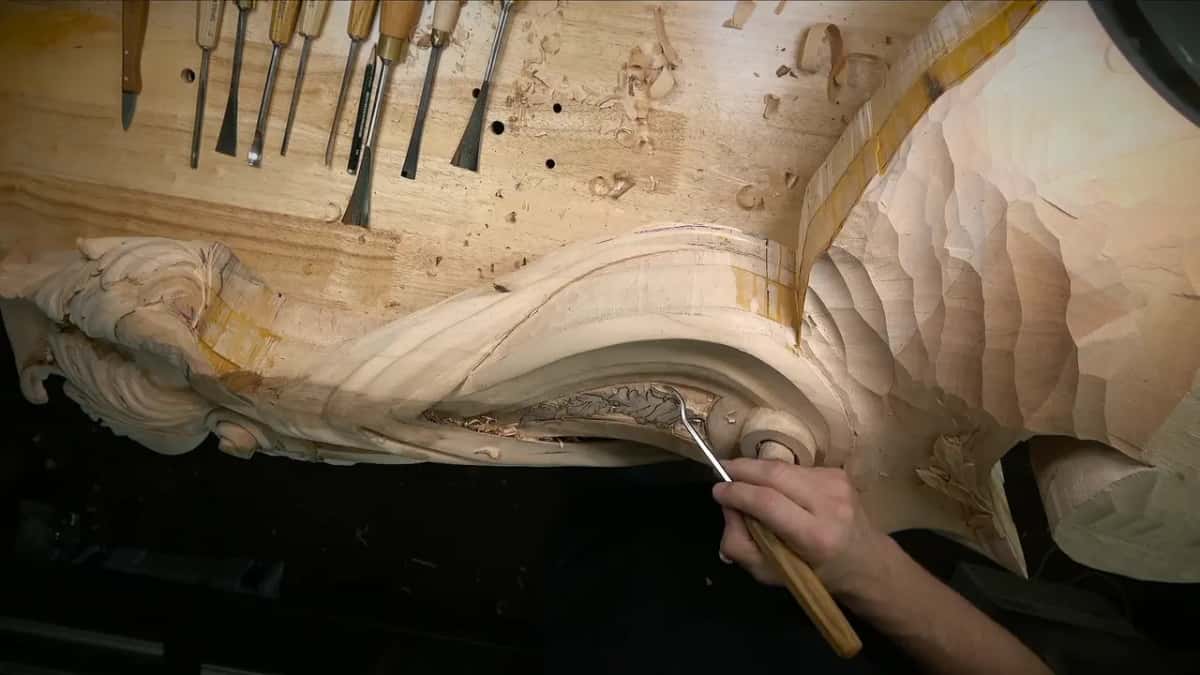
A scroll bracket coming up out of the block, tape marking the line I will not cross.
My own word for what a heavy board does under the tool, and I am not sure I am supposed to say it that way. Crunchy. I never got any splinter from basswood, but from crunchy wood, and also oak, white oak, you can get splinters sometimes. It is a crunchiness of wood. Oak makes a crunchy sound and limewood does not, and the sound tells me which board I am over before I look down.
Olive wood beat oak on that. I couldn't even carve sometimes, just really really dense. I don't like when I break my tools, and that usually happens with the harder woods. Still better than the hard pine I had to work one day a few years ago. That was a really interesting material. I broke quite a few gouges on it, and you can't even drive a nail into the stuff. So dry, and harvested in the 19th century.
The other end of the scale, and why a chart is not a board on a bench.
Now the part that ruins the tidy story. My tools get dull a lot quicker on basswood than on oak. That is kind of a paradox, I guess. Basswood does not look abrasive, it is really nice and smooth, and my teacher tried to explain it to me and I still didn't get it. Some woods carry grit inside the fibers, and in basswood it's not the case. Heaviest on the chart does not mean fastest to eat an edge, at least not mine.
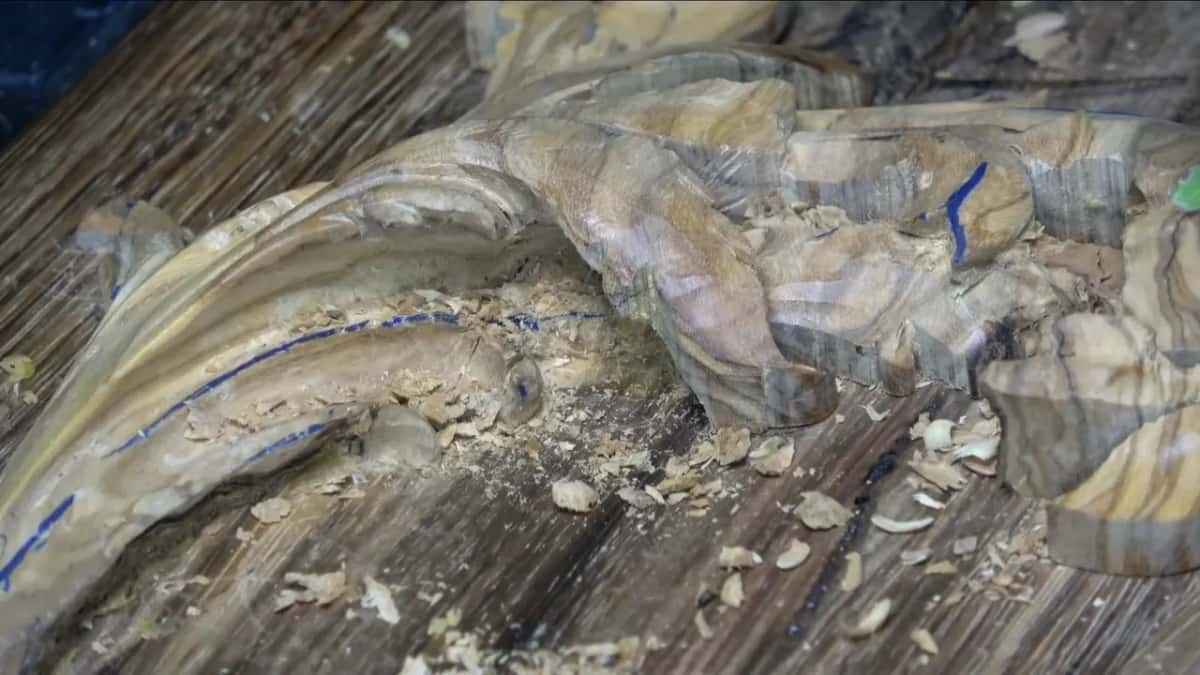
Dark and light grain in one scroll. Those bands do not carve at the same speed.
Years back I posted a video of myself working a really dense area, and a smart guy on Instagram left a comment. "Have you ever tried sharpening your tools? It would make a lot easier to carve." Right. I know. Let me try it. My tools are sharp, really sharp, and you wouldn't be able even to carve a wood like this with dull tools. It's impossible.
My teacher had one answer whenever I complained about a board.
There is no such a thing as a bad wood. Only dull, not sharp tools. That's the only thing is the problem.
He was right, at least about the carvable species, and I have never found a way around that rule. Some are almost impossible, like ebony, and even ebony is still possible, just dense. But if you are complaining about walnut or cherry or basswood, the problem is not the wood, the problem is the tool. Which is why a whole course goes into sharpening before anybody touches a heavy board.
Is carving a dense wood slower than basswood?
Olive reads 61.2 lbs/ft3, with 2,710 lbf on the Janka scale, and the first thing it changes is how you hold the tool. On the lily box I tried a cut by hand, then said it out loud. Nope. I still need to use a mallet.
That was a number 11 at one and a half millimeters, a tool small enough to look harmless. Olive outweighs white oak and takes nearly seven times basswood's 410 lbf to dent. So the mallet comes out for cuts I would push through limewood with a thumb, and even then I am barely just hitting my mallet, because force is what breaks olive. A whole course covers the tools.

Figured olive wood, held in a clamp, chips already round it.
The second cost is patience, and that is not a soft word here. It takes a lot of patience. Just try it if you don't believe me. It takes a lot of patience to work the micro details, because you have to support all the time with your fingers, and you're always constantly thinking about not to break it.

Nobody in the frame. Only what came off the wood, and not one long shaving in it.
Carefully, carefully, carefully, I'm going to approach. I keep an eye on what is happening below, because I don't want to hit the next one right there. Maybe I should slow down. On a board like this I go slowly, just taking the shaving, and I switch down to a 1.5 mm gouge when the tool starts to feel too big for the space.
Please feel what the grain of the wood does. If it's catching, if you're creating too much pressure, you'll break it. Always better to be on a safer side than rush it and push it too hard. And ask me how do I know that. Yep, I made that many times, that mistake.

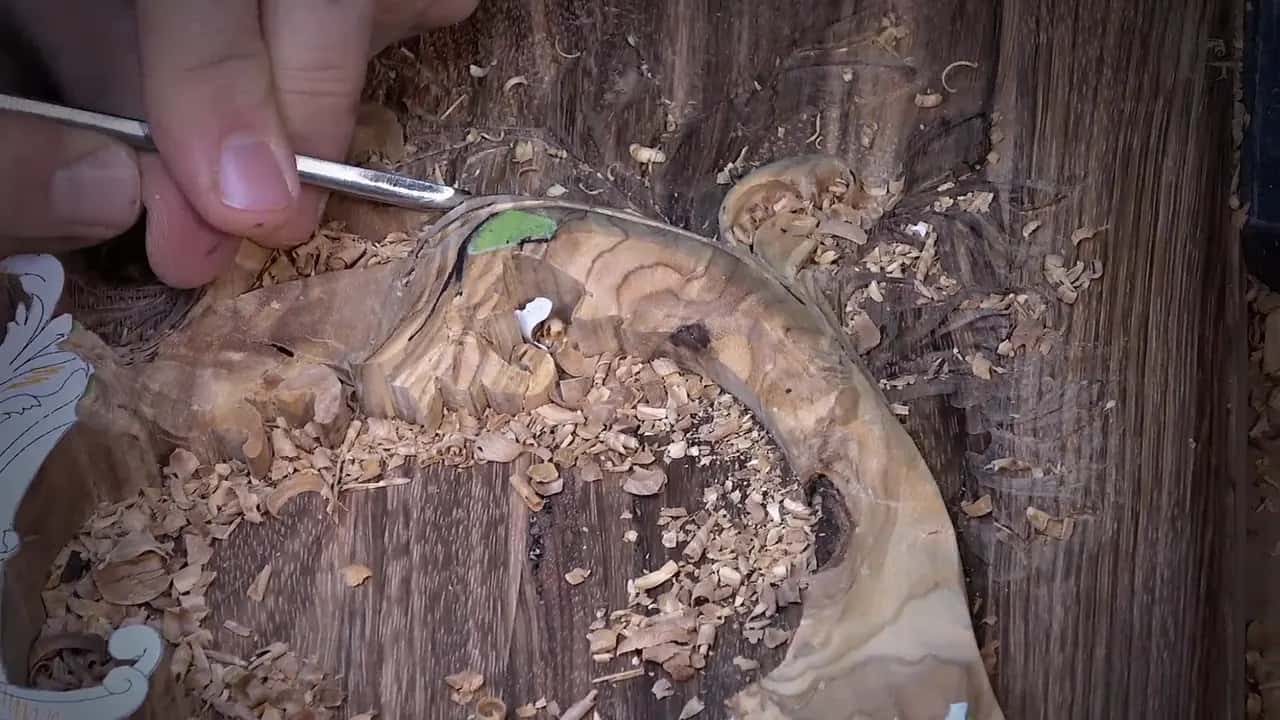
Purple and brown running through pale olive, with a blade laid in.
Can you carve the densest woods by hand?
Hand tools handle a heavy board fine, once you shorten the bevel, pick up a heavier mallet and redraw the design for that wood. Four steps, none exotic. The fourth is the one people skip.
Step 1, set up and mark out
Draw the design on the board itself, never on paper you then trace over. I change a drawing for a heavy wood, because I have to understand the property of the wood I'm carving. A thin petal that survives in olive wood snaps in limewood, so on olive I leave a spot one sixteenth of an inch thick and feel safe.

Two hollows and a ridge between them. On a crunchy board, that ridge is where detail breaks.

Paper first. The ruled lines under the scrolls are the real design.

Paper on the left, the board on the right, and the row of gouges I will actually reach for.
Step 2, shorten the bevel before you start
A long bevel leaves metal weak right at the point, and on hard woods like oak or cherry that gets dangerous. For those hardwoods I use a really short bevel most of the time. A secondary micro bevel on the inside then makes the point strong while the angle stays low enough to carve with.
Step 3, pick up the heavy mallet
On hardwoods you usually use really heavy mallets. Mine weighs two pounds, 32 ounces, and sometimes I switch to a brass one that is heavier and smaller in the hand. Handy for micro moves. A mallet buys control, not just force. Never held one? Start with whether you need a mallet at all.

A drawn plate, not a carving. This is the stage where I change a design for a heavy board.

The mallet stands where I can reach it without looking.
Step 4, open the relief grooves first
Relief grooves are a must, especially with a crunchy wood. Working basswood, they are not as critical. Working a harder wood, this is the step you should not avoid. Really important step. Some people take a V tool and dig right on the line, which works on softer woods, and will not work on a crunchy one.

An altarpiece. Every spire is a bet on how much weight the wood can carry.

That groove around the scroll went in before any shaping did.
One kindness about heavy boards that nobody mentions. Because walnut is a little harder than basswood, my knife is not digging too deep, so it is actually an advantage for me. I know I'm not going to go too deep. The wood pushes back and does half my thinking. For the species that fight worst, see which woods are hard to carve.
Does a heavy wood hold fine detail better?
Weight and detail turn out to be close to unrelated. Cherry reads 35 lbs/ft3, walnut 38, both lighter than white oak at 47, and both hold a fine ornament better than oak manages.
Cherry and walnut, they hold the detail really nicely. Cherry takes 950 lbf and mahogany only 900, under oak's 1,350, and still nobody carving furniture reaches for oak on a small flower. Even basswood at 410 holds detail, as long as you don't press it too much, which is why it heads every list of softwoods to practice on.

Every fresh cut comes up pale. The dark is the surface that has been standing.
Nothing about that is a weight problem. It is a support problem, and on a dense board the wood at least holds still while you work it.
What decides it is how the fibres part, not what the board weighs. Working micro details takes me down to a number 11 at one and a half millimeters, sometimes one, and at that size we are almost like jewelry. The key there is not to create any force at all.

The paper pattern is still on. Underneath it, sawn olive edges.
Which dense woods are worth putting on your bench?
Walnut and cherry sit in the good spot, heavy enough to hold fine detail and still kind to a hand tool all day. Cherry and walnut, they hold the detail really nicely.
Purdue Extension puts walnut at about 38 pounds per cubic foot at 12 percent moisture and calls it an intermediate weight species, which is just how it feels. A longer answer sits in whether walnut can be used for carving.
Oak is heavier again at 47 and it carves, and it carves crunchy, with a lot of grain. Mahogany is really nice for carving also. Poplar I avoid, which sounds backwards, since poplar weighs less than any of these. It doesn't feel good when you carve that. Much better to use cherry, or even oak, and even oak beats poplar in my opinion.

A power sander earning its keep, teaching your hands nothing about density.
For your first year, none of the woods above. Basswood weighs 26 pounds a cubic foot and takes 410 lbf on the Janka scale. Soft enough, and it still holds the detail. Almost no visible grain sits in it, and that, rather than softness, is the real reason it beats everything else for learning. Some people call it a queen of the woods. In old European culture limewood did not even count as a soft wood, it counted as a hardwood, and a soft wood would be pine.

Rosettes over a bead border, drawn rather than carved. Basswood will hold detail this fine, and it will not fight you for it.
Which numbers actually predict how a wood carves?
Every one of these numbers fails on its own, and poplar is the proof. Poplar reads 29 lbs/ft3, Janka 540, both above basswood at 26 and 410, so on paper it ought to carve about the same. It does not.
It doesn't feel good when you carve that. Poplar beats basswood on the chart and loses under the tool, so I send people to cherry or even oak instead. Meanwhile eastern white pine reads 25 lbs/ft3 at 380 lbf, lighter and softer than basswood, and old European practice still counted lime a hardwood and pine the soft one. Worth knowing what low density wood really means.

A line drawn straight onto the petal, not onto paper.
European lime reads 33 lbs/ft3, Janka 700, well above American basswood, and carvers treat the two as one wood anyway. A chart tells you what a steel ball does to a flat face. It says nothing about grain catching on a curve, a fibre that tears rather than parts, or the abrasive some species carry and others do not.

A slim gouge, down where a wide one will not reach.
Read the numbers, then read the board in front of you. Grain direction and crushing strength both tell you more about a ruined afternoon than the weight ever will.

Chips still sitting where they fell, inside the hollows.
Frequently asked questions
Is the densest wood also the hardest wood?
Those two rankings disagree. Lignum vitae tops The Wood Database Janka list at 4,390 lbf while sitting only fourth by weight. On weight the leader reads 3,660 lbf. Weight counts how much material fills a given space, and Janka counts how far a steel ball presses in before it stops.
Will the densest wood sink in water?
Every wood on that heaviest list goes under. The Wood Database puts fresh water at 62.3 lbs/ft3 at room temperature, and the lightest of its ten still weighs 74.4. Soaking changes the answer for lighter species, though, so a float test tells you about one board on one particular day.
Why do different websites name different champions?
Four reasons, all of them real. A single sample of one board beats a species average every time. Green weight and 12 percent moisture give two different answers. Several definitions of specific gravity circulate at once, and a plus or minus ten percent spread swamps the tiny gap between the leaders.
Can a beginner start on a heavy wood?
I would not. A basswood board at 26 lbs/ft3 lets you learn the tool instead of fighting the board, and you can come back to walnut once your gouge stops wandering off the line. Olive wood taught me plenty, and it broke tools, and a broken gouge teaches nobody anything in week one.
Where does the weight in a heavy board come from?
Missing air. Cell walls hold 1.54 specific gravity in every species, the USDA Wood Handbook says, so balsa fibre weighs exactly what a piece of ironwood fibre weighs. What differs between them is the volume of hollow space those cell walls surround. Nothing else does.
Filed under
- basswood for carving
- benefits of heavy wood
- best wood for carving projects
- carving blanks for woodworking
- carving wood options
- characteristics of dense wood
- densest wood ever
- effects of dense wood on environment
- expensive woods for carving
- hardest type of wood
- most durable wood for carving
- reasons for using dense wood
- similar wood types to densest wood
- types of wood for carving
- Understanding Wood for Carving
- uses of hardwood
- where does dense wood come from
- wood carving blocks
- wood density comparison
- wood density measurement
- wood for carving