
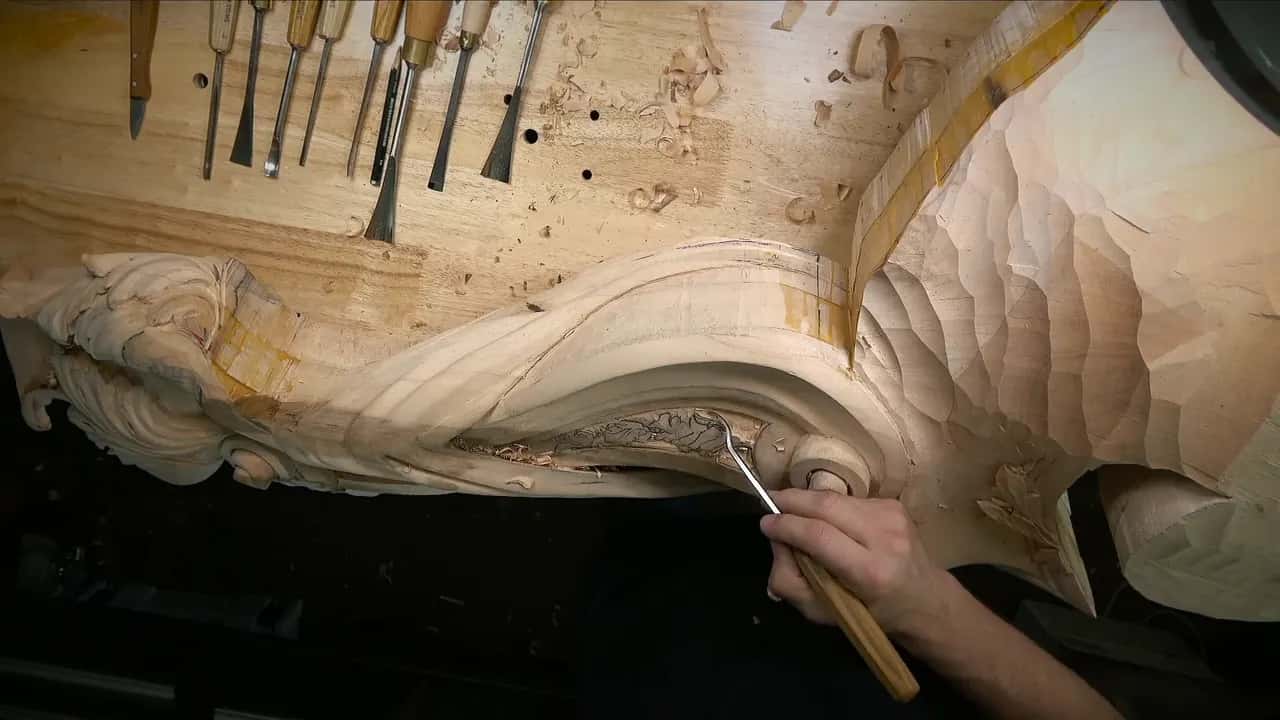
August 28, 2024 · Updated August 26, 2026
By Alexander Grabovetskiy — Master Woodcarver · Founder, School of Wood Carving · 18 min read
What does the modulus of rupture of wood mean?
Modulus of rupture is the biggest bending load a small clear stick of wood carries before it breaks, written in pounds per square inch at 12 percent moisture. The federal tables put American basswood at 8,700. I have snapped more leaf tips than I can count, and the book number was never the thing that decided it.

Every thin part like this is a small beam, and it has no idea what species it is.
A leaf tip came off in your hand. Barely a sound.
Most carvers go shopping for a stronger wood the next day. Wrong shelf. What let go was short grain, where the fibers ran across your tendril rather than along its length, and no species on the rack repairs that. Over forty years I have lost more small parts to grain direction than to any board I ever paid for.
Once I carved furniture in a prison cell with a knife I made myself, 10 millimeters wide, plus a small gouge ground out of a nail. When walking out to buy another board is impossible, you look very hard at the grain first.
Below are the real numbers, the one line of grain that throws away more strength than any species buys back, and the checks I run before carving a fragile part free.
- A piece gives out when the bending stress reaches its MOR.
- Basswood snaps around 8,700 while hickory takes 20,200 before letting go, more than double that.
- Stiffness, denting and breaking each come off their own separate test.
- Grain that wanders one part in five costs you almost half the strength you paid for.
- Thick parts survive. Fiber direction matters more than which tree it came from.
What does MOR really measure?
MOR is the stress inside the wood at the second a bending test finally breaks the stick. Nothing else. It reports how much load, and nothing at all about how far the piece traveled getting there.
The Wood Database writes it out as bending strength, a measure of what a specimen holds before rupture. Ohio State University Extension keeps it even shorter in its wood strength factsheet: bending strength based on the maximum load applied. One idea, two ways of saying it.

Nothing here is fragile yet.
Never once at my bench have I said modulus of rupture. Short grain, that is what comes out of my mouth. Supported grain and not supported grain too, because that is the terminology I was taught, and those words describe exactly what a laboratory writes down with a load cell.
Here is how the test runs. A small clear stick, sawn straight and free of knots, rests on two supports. A press comes down in the middle and keeps coming until the wood lets go. Read the fine print in the federal mechanical properties chapter and you find the result is not a true stress, since the formula behind it only holds up to the elastic limit. Worth reading twice, that sentence.

My pencil is on the flaw, and no laboratory stick ever has one.
Every one of those sticks comes from a standard method for small clear specimens of timber. Small. Clear. Sawn on purpose out of perfect wood, which your blank is not, and the gap between the two is most of this page.
Is breaking the same thing as bending?
Bending and breaking are two different numbers off the same machine, and a third number covers denting. Carvers mix all three up. Then they buy the wrong board and blame the tree.
Stiffness measures how far a piece moves under load and springs back afterward. Wood science calls that the modulus of elasticity, and we keep a page on what elastic modulus means for a carver. Basswood measures 1.46 million psi there. That same wood reads 8,700 psi when the load bends it instead. Two questions, two machines, two answers.
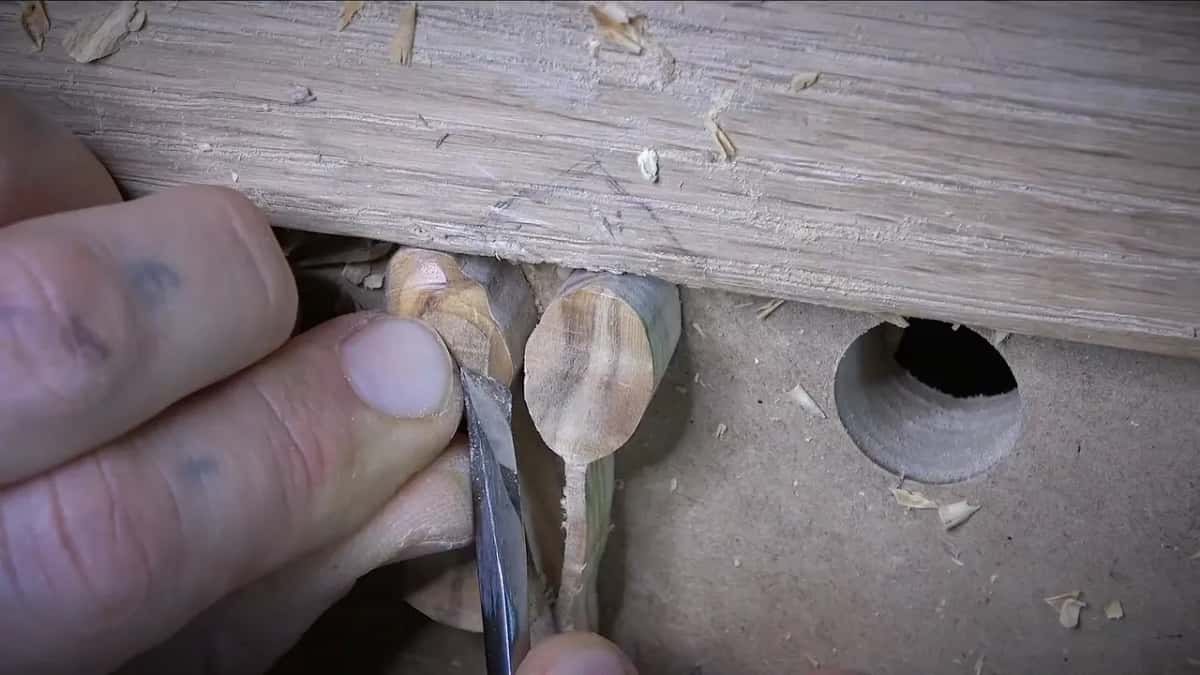
Down at this size the tool asks one question and the wood answers it.
Then comes the third one. Crushing strength is fibers folding up under a push that runs parallel to the grain, and it shows as a soft fuzzy rim days later rather than as a snap. Our page on crushing strength in wood covers that failure on its own, and a reader question there is what sent you here.
So here is the plain answer to that question. Crushing squashes fibers that run lengthwise. A bending load travels across the piece and finishes with a snap. A carved acanthus tip almost never crushes, and it breaks all the time.
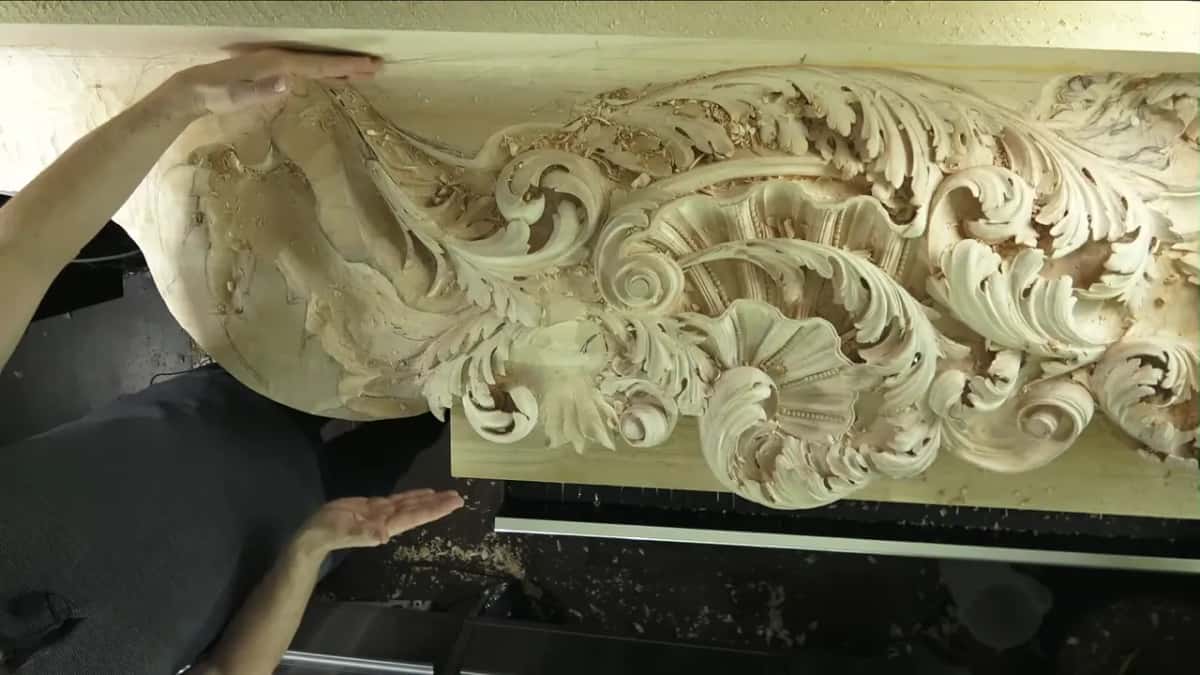
Every lobe stands on its own little stalk.
Hardness is a fourth thing again. The Janka hardness test presses a steel ball 11.28 millimeters across into the side of a board until half of it disappears, and the 2021 chapter defines it exactly that way. Good for floors. Useless for tendrils. Ohio State keeps a plain glossary of wood strength terms, which is a fast way to see these are four separate measurements.

Hardness tells me how the tool feels going in. It decides nothing about what snaps off later.
Which carving woods break first?
Northern white cedar gives up at 6,500 psi and gaboon ebony holds until 22,930, so the whole shelf spans about three and a half to one. Every figure sits at a board dried to 12 percent. Each row names its source, since two respected books disagree sometimes.
| Whatever wood is in your hand. | Strength in bending, given in pounds per square inch. | Which book I read it in. | What the figure means once you carve something really thin. |
|---|---|---|---|
| Northern white cedar. | Down at 6,500, the weakest row on this whole list. | Read off the Wood Database. | Light and easy, and slender parts let go early. |
| American basswood, the wood I carve most days. | 8,700, or 60 megapascals. | Both books print that same figure. | My own reference point, and the number I carry around. |
| True Honduran mahogany. | Around 11,710 psi by one count. | The Wood Database, whose 80.8 megapascals sits close to the federal 79.3. | Holds an undercut better. |
| Northern red oak. | Listed at 14,300 psi, which is 98.6 megapascals. | From a Wood Database species page. | Strong on paper, and it snaps on me constantly. |
| Hard maple, from bowling alleys. | A solid 15,800. | Agreed again, and by both of them. | Eighty two percent stronger than basswood, and much more work per hour. |
| Hickory, the wood in mallet heads. | Way up at 20,200. | Another entry out of that same species database. | Handles, not tendrils. |
| Gaboon ebony, the heaviest thing on this whole page. | Sitting right at the top, 22,930. | One source only here, since the federal tables skip it altogether. | Dense, dark, hard on edges. |
One row needs a footnote. White oak comes in at 14,830 on the Wood Database bending strength article and 15,200 in the federal chapter itself. Neither is wrong. Different sticks, different people, and the 370 psi between them is smaller than the gap between two boards off one tree. The heavy end of the rack gets its own page on high density wood, beside one asking whether denser wood is stronger.
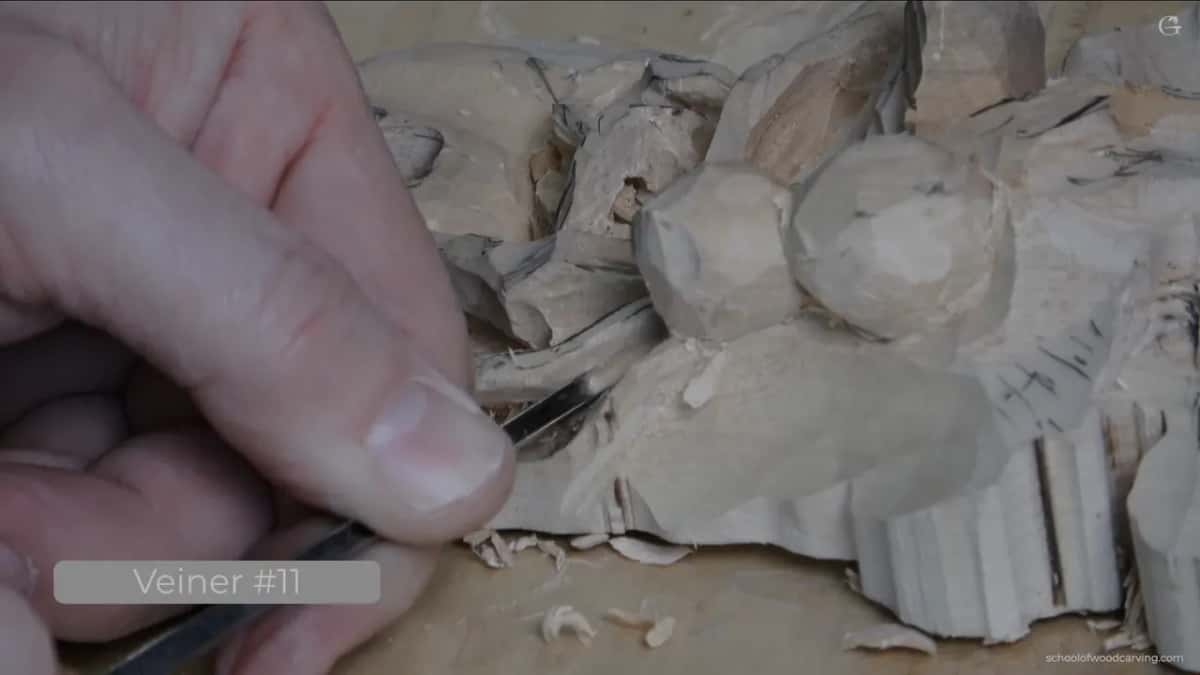
One row of that table is supposed to cover every bead under this gouge.
Red oak is the interesting row. It sits high on that table and still breaks on me more than anything else I carve, which tells you how little a table is worth. Over in a dining table apron workshop you can hear me repeat it again and again and again, especially with oak. You do not want to snap it. We keep a species page on red oak for carving.
Why does a tendril snap far below the book number?
Grain runout turns a long part into short grain, and a fiber slope of one in five leaves 55 percent of the strength. That single line of the federal handbook is the most useful thing on this page.
Table 5-12 of the same chapter on mechanical properties prints what happens to bending strength as fibers wander off straight. A slope of 1 in 25 keeps 96 percent. 1 in 20 keeps 93. 1 in 15 holds 89, 1 in 10 drops to 81, and 1 in 5 collapses to 55.
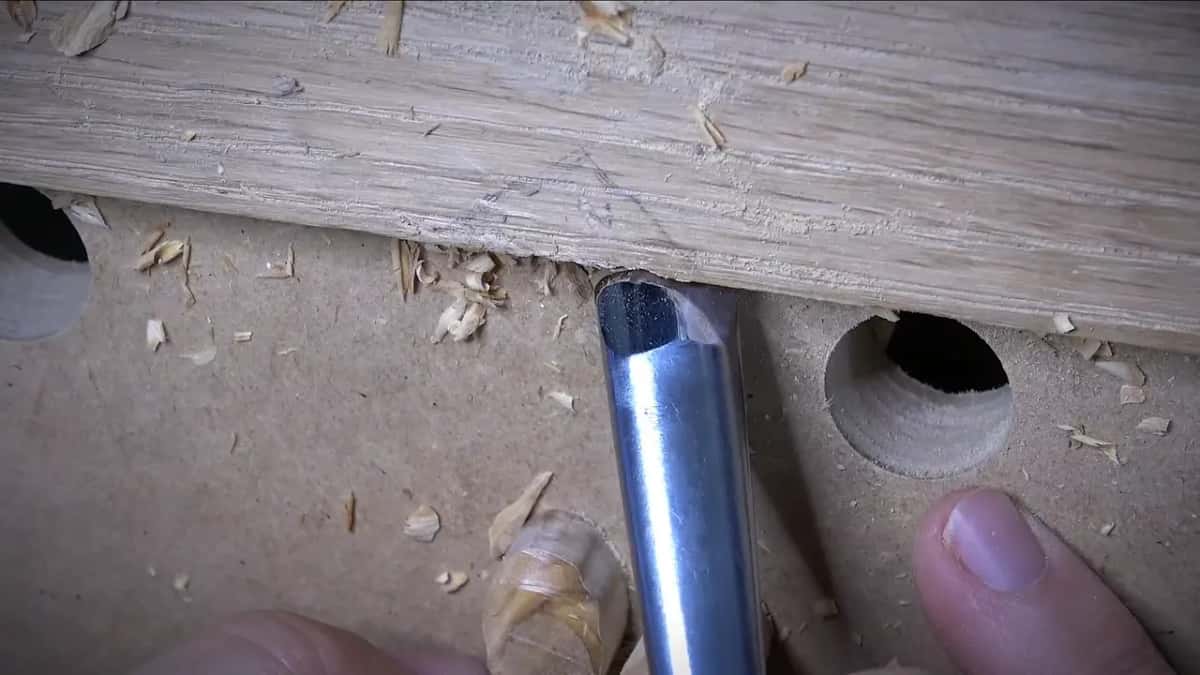
Watch where those lines leave the edge, because that angle is the whole story.
Set the two facts beside each other. Trading basswood for hard maple buys 82 percent more bending strength, and it costs you sharper tools, a mallet, and much more time. A careless runout at one in five throws away 45 percent before you make a single mark. Choosing the grain beats choosing the species, and it costs nothing at all.
A study in the journal Materials put the same idea in degrees. A 15 degree deviation cost ash and hickory 56 and 60 percent of their strength, and the work absorbed before maximum load fell by more than half in every species tested.
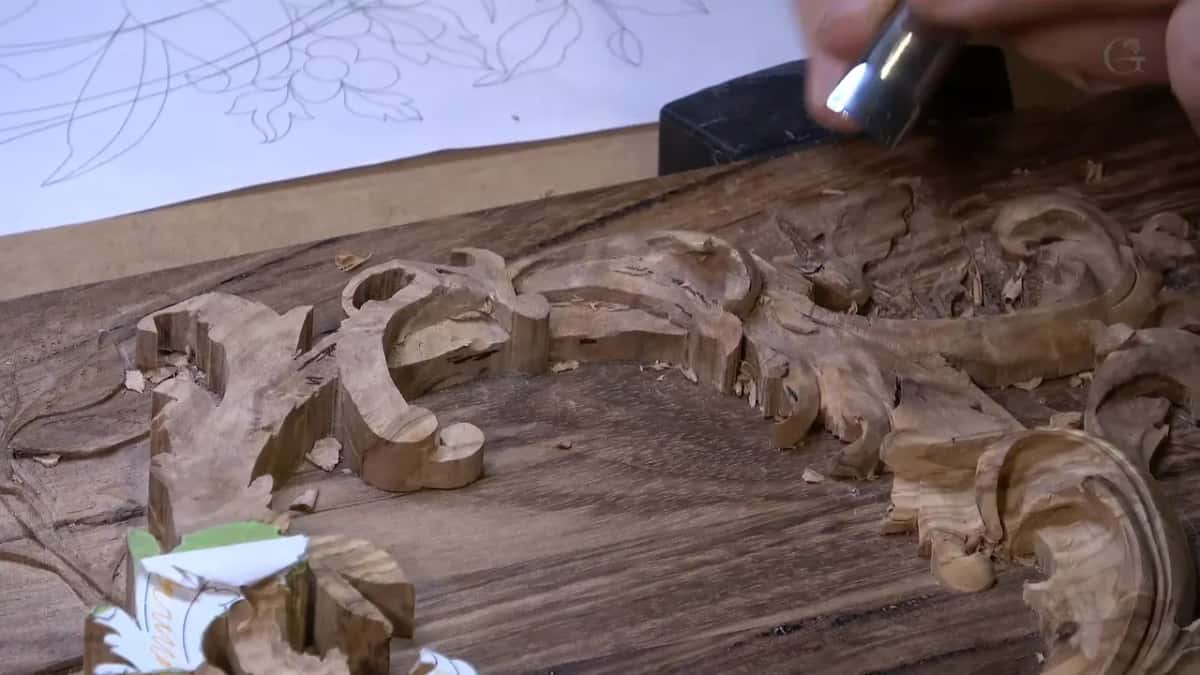
Following the fiber around a curve is half of what I teach.
Over in a grape onlay workshop I stop and say this part is somewhat weak because of the grain direction. Still strong enough. Weak because it already twists slightly to the left, and that makes the grain too short. So you have to be careful. We have a fuller page on carving in the direction of the grain, plus another on handling grain that changes direction halfway across a panel.

I mark the fiber direction in blue first, and this leaf needed plenty of marks.
Undercutting does most of my own damage. Carve too deep behind a leaf and some of the grain is no longer supported, and unsupported grain will not hold. A little undercut is fine. Not much. The support has to stay in there, and I say so out loud in the Venice Room workshops.
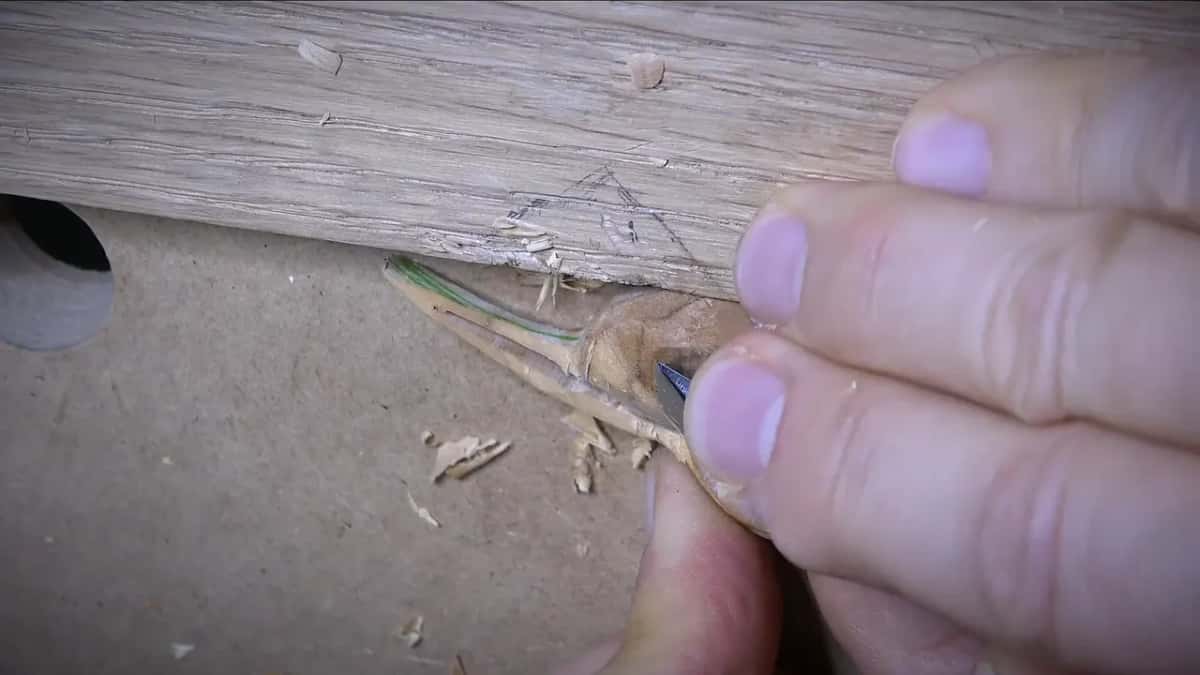
Nothing holds that little tab from underneath. Unsupported is the word I was taught, and it fits.
Thickness is the other half of it. During a tray workshop somebody asked whether the piece was strong, and I answered that you can break anything if you set out to break it, but this one is solid, because I kept the thickness. Sometimes my carving goes paper thin. Paper thin is more fragile, everybody knows that, and everybody does it anyway. Read what we have on whether a thicker board carves better before you plane the next panel down.
This one covers holding a fragile part together while you work on it.

Not much wood left in there at all.
Does the handbook figure describe the board on my bench?
Those figures are species averages, and one real board scatters around them by roughly threefold. The average is honest. Your plank is a lottery ticket drawn out of it.
A 2020 paper in BioResources tested 182 white oak specimens and 179 red oak specimens. White oak averaged 113 megapascals in bending, with a low of 59 and a high of 157. The red oak set averaged 120, running between 65 and 170. You can read the clear wood study on red oak and white oak, which carries a permanent digital object identifier.
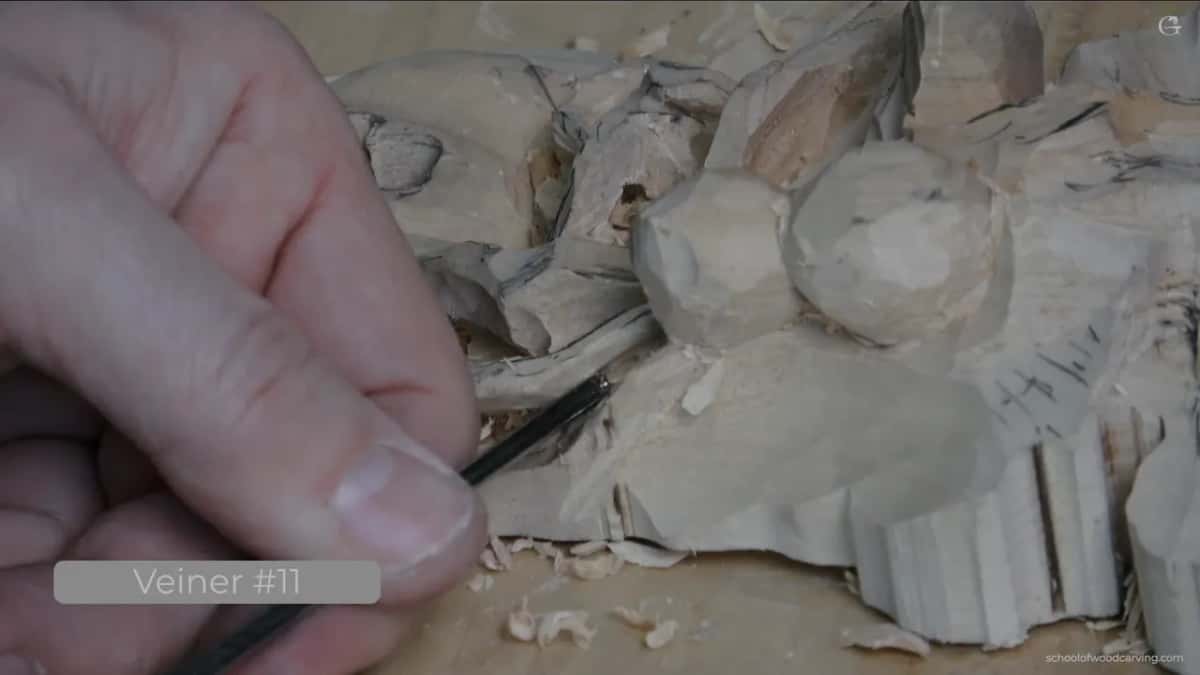
These beads all came out of one board. The next board will not hand me the same day.
Sit with that spread. The weakest white oak stick held 59 megapascals, the strongest held 157, and both were clear, straight and legally the same wood. One was worth two and a half of the other. Those same authors concluded the historic figures still sit close to what people published over the past 100 years, so the handbook is a good average and a bad promise.
The edition matters, and the 2021 Wood Handbook runs 543 pages. Its current chapter on mechanical properties still carries the basswood row as 12 percent moisture, specific gravity 0.37, 8,700 in bending. Nobody re-measured it. That says how settled the number is, and how old.

Scraps of the pattern still stuck on, the way an old number stays put in a book.
Knots do their own damage. Fibers detour around a knot, so the slope near one is steep even when the face looks quiet, and the table above is the price list. Water shifts the figure too, which is why every number here names a moisture content. The page on how wood shrinks covers what happens after the carving is finished, and the page on wood density covers the number they all hang off.
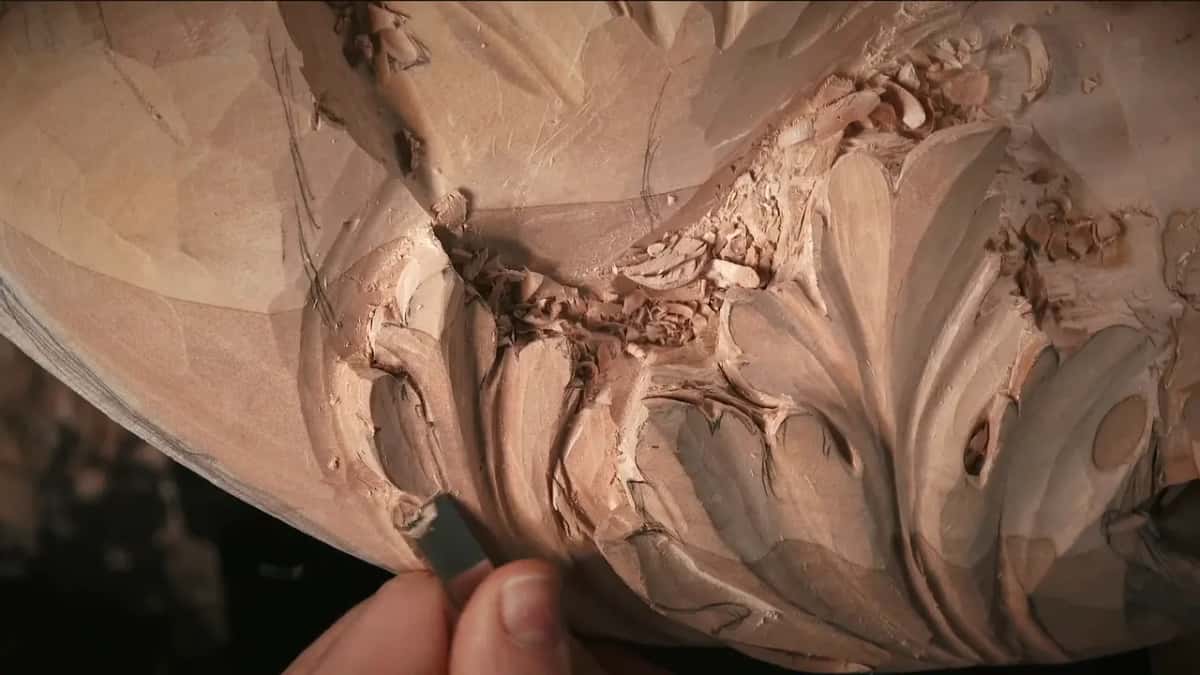
Grooves this fine go where the fibers let them go.
Does a heavier wood pay you back for the extra work?
Bending strength climbs about 2.2 times when density doubles, while hardness climbs about 4.3 times. Wood gets much harder to carve faster than it gets stronger. The whole trade sits right there, written as arithmetic.
Both properties get fitted to specific gravity as power curves in the federal table of exponents. Hardwood strength in bending runs at 24,850 times G to the power 1.13. Side hardness in those same hardwoods runs at 3,440 times G to the 2.09. Near one, a property tracks density. Above two it runs away from you, and by the time a board is twice as dense your shoulder already knows.
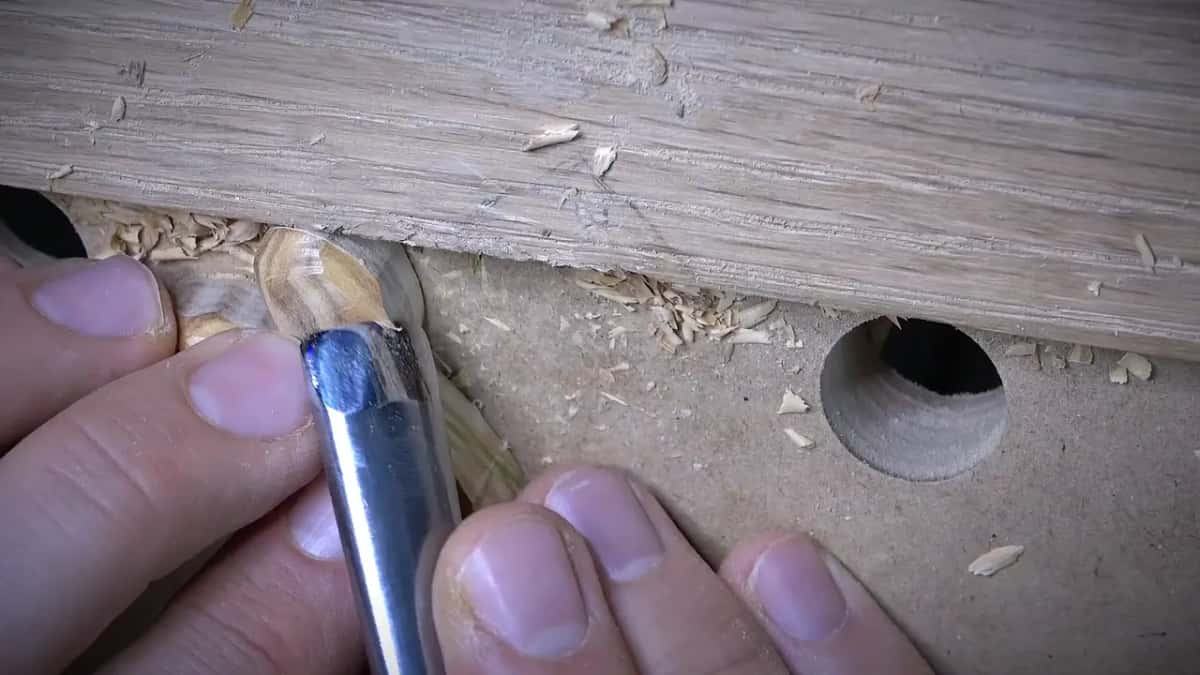
Fingers, a gouge, and one small shaving. The heavier the board, the more of my shoulder each one costs.
Carvers already feel all of this and call it something else. On a walnut panel I say walnut is a little forgiving to me, then that some species are really crunchy, and that on those a single greedy pass takes the whole detail off. Crunchy is my word for fibers that break instead of carving. From the handle end of a gouge, a high hardness exponent feels just like that.
The honest ranking of levers goes fiber direction first, thickness second, species a distant third. Neither the woods that are hard to carve nor the strongest wood for a project will save a tendril you laid out wrong.
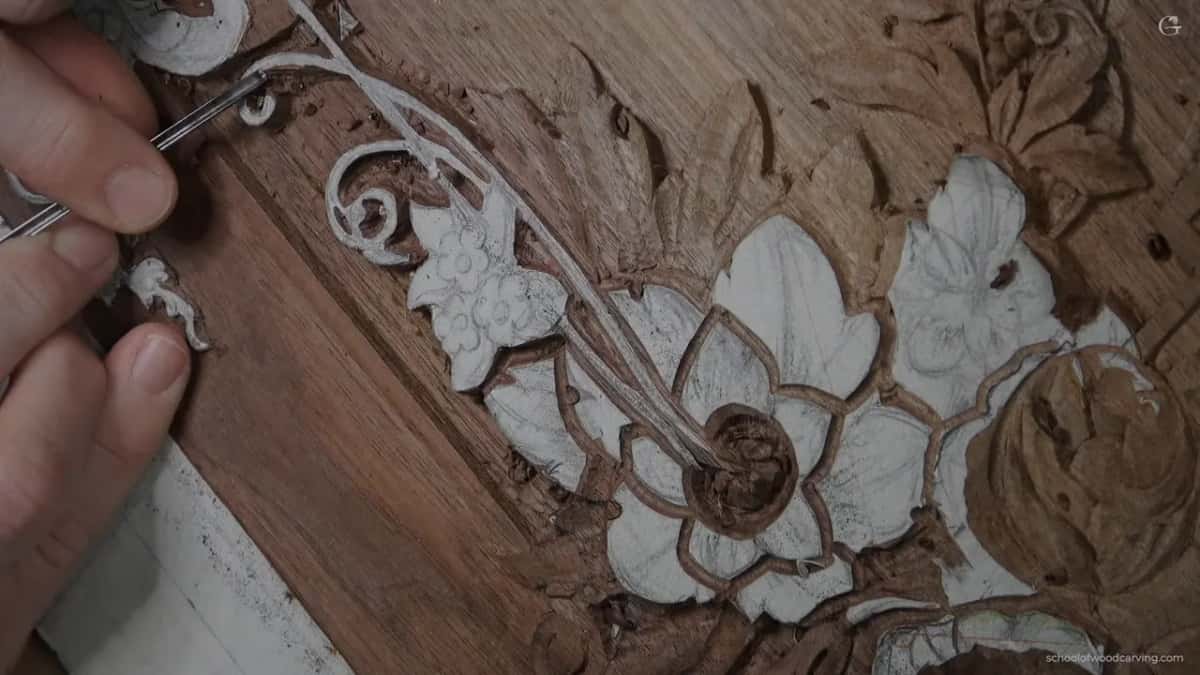
Chalk on the petal edges, and a sharp edge doing the rest. Leaning harder never once helped me here.
Pressure breaks more parts than density does anyway. A lily box workshop has me warning that the wood there is a little more crunchy, so be careful how you carve and do not press too much, especially in the weak spots. Sharp steel does the work. Sharpening sits second of the three things I teach, between design and carving, and we run a course on the tools themselves if your edges are the problem.
One thing never resolved for me. I tell students a hardwood wants a shorter bevel, and then in my own spoon gouge sharpening lesson you can hear me say I am staying on the longer bevel even for the hardwood. Both of those are me, on camera, years apart.
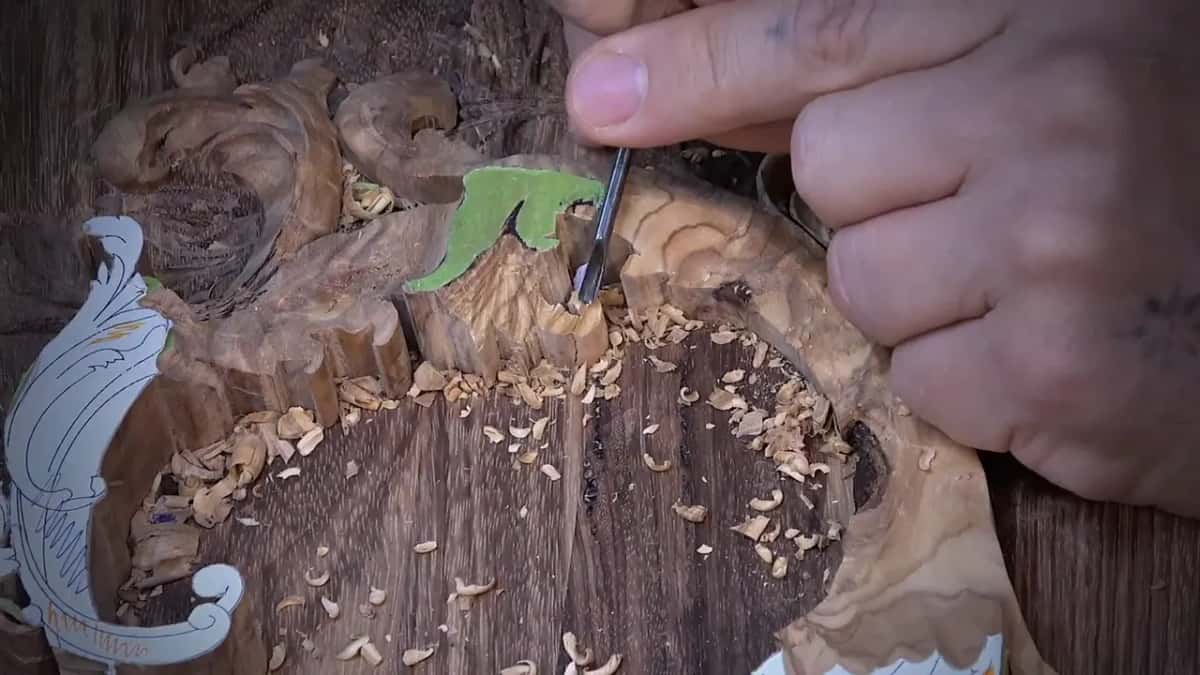
Dark in patches, pale in others, and this piece fought me the whole way.
Color does the same thing to me. Working olive wood I say the darker areas are harder to carve. On a limewood panel I say the darker color right there is a little softer. Different trees, opposite readings, and both statements are mine.
How do I read the grain before I carve a fragile part free?
Six checks, and the first four happen before a single chip comes off. Nothing here needs a laboratory or a moisture meter. About four minutes and one scrap of the same board.
Step 1, look at the face and find which way the fibers run
The handbook method for spiral grain is plain enough. Note how pores, rays and resin ducts line up on a flatsawn face, and that alignment is your fiber direction. Basswood makes you hold the board to a window before it shows. On oak it jumps at you across the room.
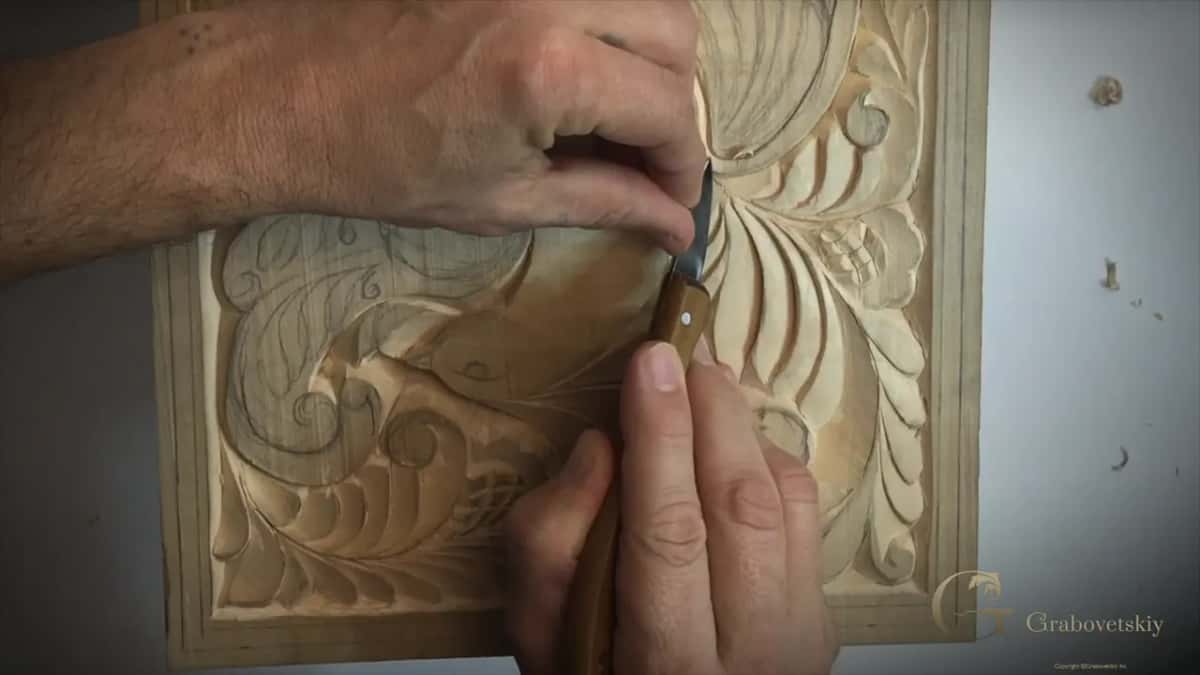
Before the knife ever came near it I stood there and read this face.
Step 2, read the small drying cracks along the surface
Those little splits follow the fibers, so they hand you the slope for nothing. Federal wording calls them drying checks and says they indicate the slope of the fiber on a flatsawn surface. I call them cracks, because that is what a person sees, and I read them on every board that comes into my shop.
Step 3, split an offcut when the part really matters
Take a piece off the end and split it radially. Splitting is named the best test for spiral grain, and it earns that, because a split has to follow the fibers whether or not you like the answer. Split the offcut. Never the blank.

The scrap tells on the board.
Step 4, write the slope as a ratio and price it against the table
One inch of sideways wander over however many inches of length it took. That is your whole measurement, and the same standard test turned it into a price list. 1 in 25 costs 4 percent of bending strength. 1 in 10 costs 19. At 1 in 5 I redraw the ornament rather than argue with the wood.
Step 5, turn the fragile element so its long axis follows the fibers
Rotate the drawing until the longest thin thing in it lines up with the fibers, end to end. Sometimes the design has to move two inches left. Do it anyway. Layout is free and a broken tendril is not, which is most of what the design course teaches.

Both hands hold the paper down while I decide which way it should sit.
Step 6, throw out reaction wood and juvenile wood for thin parts
Wood off a leaning trunk and wood near the pith move in ways ordinary timber never does. Both can shrink 2 percent lengthwise while drying, the handbook records, against 0.1 to 0.2 percent for normal stock. A part built out of either one is fighting itself before you pick up a gouge.
Near the pith the wood behaves differently, and never in your favor.
What happens when it snaps anyway?
Glue it back and keep carving. That line has come out of my mouth in workshops for years, and I meant every word of it. A break is almost never the end of a piece.
David Esterly spent a year replacing a lost Grinling Gibbons carving in limewood, and he put it in his book: "As a matter of fact I was getting used to breaking things." A man at the top of this craft, admitting exactly what I am telling you.
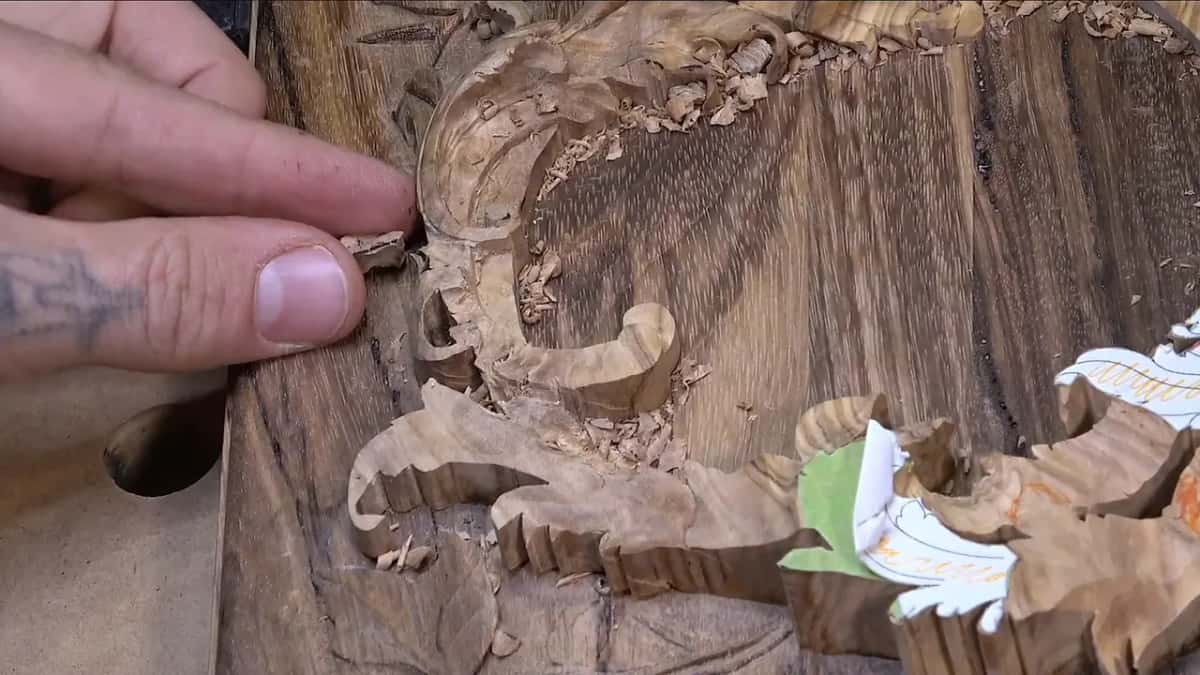
Small parts come off. Then they go back on.
The habit that saves the most parts is slower than gluing. On end grain I take more than one pass, never all at once, because fibers there snap and break and the surface never looks right afterward. A rosette workshop has me saying I would rather make two cuts, three cuts, than make a mistake and snap it. The section under my gouge that day was an eighth of an inch. Help with holding thin carvings together sits one page over, if you are already in trouble.
Knowing why grain matters in carving before you even start helps more than any of it.

Done, on the bench, and nobody can say what it cost.
Have you ever felt a leaf tip go under your thumb with no warning? Do you want to know which way the fibers run before the design goes onto a board? Would you rather redraw an ornament than glue one back together? Then start with the grain, get someone to walk you through a full acanthus leaf, and carve the whole path from a flat blank through a finished panel inside the course library. All of it is covered by one tuition, and you can read about who is teaching it first.
Frequently asked questions
How is crushing strength different from MOR?
Crushing strength squashes fibers lengthwise until they fold, leaving a soft rim rather than a break. A bending load runs across the piece and ends in a snap. Carved tendrils fail the second way almost every time, and the two figures come off two different tests on two different machines.
What counts as a strong bending number for carving wood?
Anything above roughly 14,000 psi counts as strong for our kind of work. Red oak sits at 14,300. Hard maple reads 15,800. Basswood at 8,700 is weak by that measure and I carve it constantly, because thickness and fiber direction decide far more than a species figure ever does.
Does a high strength wood carve harder?
Almost always, and worse than the strength gain justifies. Doubling density multiplies bending strength by about 2.2 and side hardness by about 4.3. You pay roughly twice as much in edge wear and shoulder work as you collect in strength, which is why heavy woods belong in handles rather than leaf tips.
Why did my part break when the grain looked straight?
Runout hides on a flatsawn face. Fibers can wander a full inch over five inches of length and still look tame under shop light, and that slope alone costs you 45 percent. Split a scrap off the end radially, and the split shows you what two eyes missed.
How thin can a carved part go before it gets fragile?
My own working floor is about an eighth of an inch on a small element, and I say so out loud in the rosette workshops. Below that I am carving on borrowed time. Paper thin parts look wonderful and they break, and I still carve them, so take that advice with a grain of salt.
Can I make a broken carving strong again?
Glue it back. A clean break in wood glues stronger than the wood around it when the two faces still fit, and the repair disappears under a finish. Save the piece, keep the fibers lined up, clamp gently, because crushing the joint does more harm than the break did.
Filed under
- best type of wood for carving
- choosing wood for carving based on strength
- comparison of wood species in strength
- factors affecting wood strength
- high modulus of rupture explained
- how moisture affects wood strength
- how to test modulus of rupture
- impact of wood density on carving
- influence of moisture on wood strength
- measuring wood modulus of rupture
- moduli of rupture across wood types
- modulus of rupture in hardwood
- properties of wood for carving projects
- significance of modulus of rupture for wood
- typical modulus of rupture values
- understanding modulus of rupture in wood
- Understanding Wood for Carving
- using basswood for carving blocks
- wood species and modulus of rupture
- wood strength testing methods
- wood testing equipment for modulus