

Alexander Grabovetskiy, woodcarver, School of Woodcarving · Published 2020
What does "excellent" mean when a wood carver says it?
Quick answer: Excellent is my word for a pipe, a tool or a spot that does the job right there. In workshop 43, part 2, a pipe got good from me first. After a bigger 11 went over it again with hardly any pressure, I said excellent pipe.
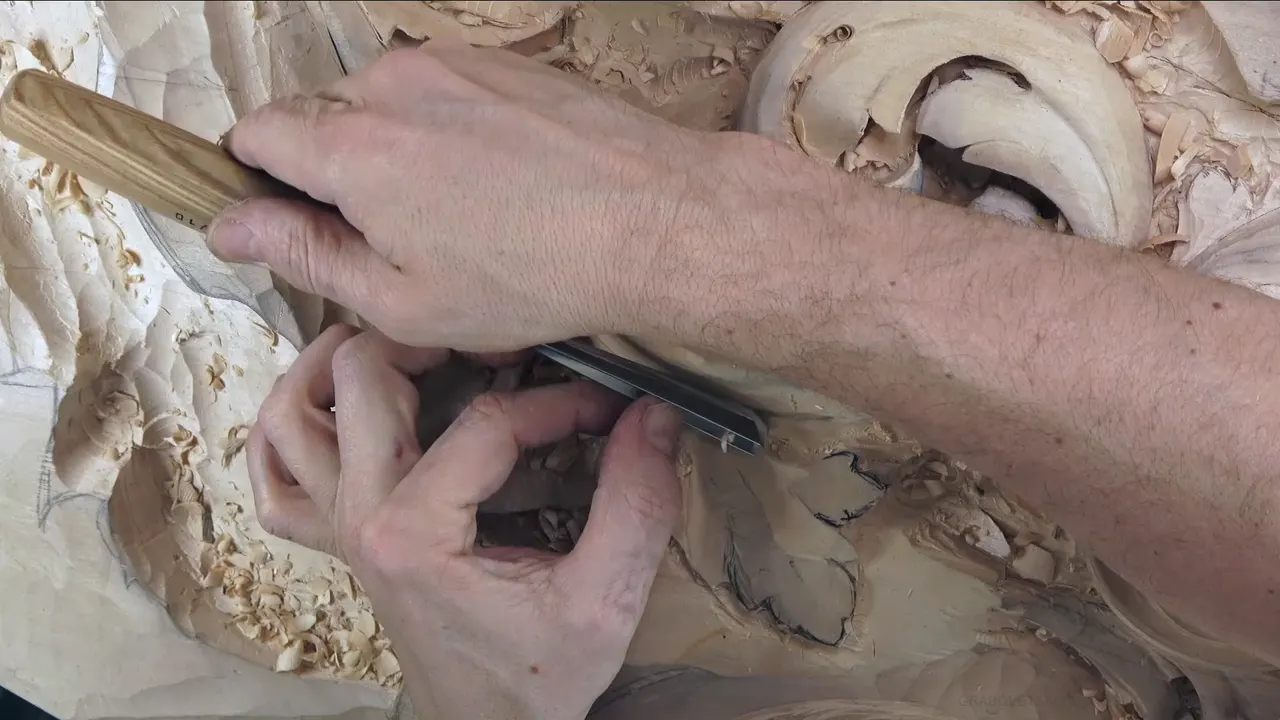

Excellent, at my bench, is the word for a pipe, a tool or a spot that does what the job needs right there. In part 2 of Venice Room workshop 43, one pipe got good from me first. Then a bigger number 11 went over it, with almost no pressure, and after that I called it excellent.
Have you looked at a pass you just carved and felt it was close, but not quite there? That gap is what the word is about here. This part is short, so I went through my other wood carving courses for the same word, and I name the course each time.
Six things excellent meant at my bench
- A pipe in 43.2 was good first and excellent later.
- The word did not mean finished, since right after it I still had a pipe to blend in workshop 44 and a whole side to develop in 43.2.
- Tools earned it for the job right in front of me.
- A try came before the word, as in a quarter inch number six, tested on the wood first.
- Even excellent tools got a second verdict from me, on how the wood looked.
- Okay is not excellent, and that gap was enough to change a design in workshop 75.
What turned a good pipe into an excellent one in 43.2?
One more pass, with a very light hand. Early in part 2 my plan was to develop this pipe, and soon the board showed another layer of wood at the glue. That's okay, I said.
That is a good pipe. I really like it, I said, although I need to give a nicer shape. That's not a big deal, and I can do that pretty much right away.

A line in the wood puzzled me next. I don't know what, I began, and then, oh, I know what that is, it's just the glue line, two pieces glued together right here, and I had a little void. It all blends, I said, and that's looking good.

A bigger number 11 came next, to redo that pass, and I need to go from this side, I said. Almost no pressure whatsoever, just shaving, little by little.

So that is excellent. I should say excellent pipe, I love it, I really love it, nice movement, beautiful movement.
Look at the order. Good came first, with a catch about the shape, and the second word followed a bigger 11 and hardly any pressure on the steel.
Does excellent mean the carving is finished?
Not on these boards. Right after the excellent pipe in part 2, I said so now I have to develop this side, and the eyes came next.
Workshop 44 has the same order with another pipe. A really excellent pipe, I said, I love it, but now I need to blend that, because I don't want to see any ridges as of now. Pretty much just shaving is what I'm doing. Then my edge touched my beautiful concave, and I said I can always clean it, though it's better not to do that.
Workshop 82 shows it too. I was really happy about a detail there. So, let me lower that down a little bit, I said, and you'll see it much better. Yep, that is excellent, I said, twice over, and I can now create the concave, because I really need the middle part somewhat convex. And I'm really limited with the space.

Over in workshop 55, the word went on a section still waiting for the excavation. It's going to look good, I said. Excellent, I should say. Gorgeous.
Both times the words I should say sit right beside excellent.
What makes a carving tool excellent?
The spot it has to reach, in several of the places where I used the word. On lesson 10 of the Greek acanthus leaf, the grain ran one direction, so care was needed there. I could use just a knife right here, I said, but the back bent is an excellent tool, and you can see why. This piece is in my way, and with the back bent I can still use just the edge of my tool and still get really deep.

Back bents earned it again in workshop 59. I was almost parallel to the ceiling and still able to make my pass. An excellent tool to have, I said, and if you're really serious about wood carving, you should at least consider buying it, and I meant back bents.
To clean inside on the Roman acanthus leaf, lesson 12, I could use a small spoon gouge, I said. Then I tried a number nine, 2 mm (about 5/64 in). Excellent right now, right here, I said, and dig this out, and don't force it, because I'm working some areas against the grain.
Hashemi lesson 24 put a knife on the list. The spot was challenging because of the end grain, and a knife would work in this case, I said. Knife is an excellent tool for any type of carving, and with the knife I can make it quicker. Much quicker. Right after that I said I would probably take just a number seven.

One excellent tool comes with a warning. In my V tool lesson I said the parting tool wasn't common until, let's say, the 19th century in Europe, and some carvers never use it even nowadays because of the problems. It's an excellent tool, don't get me wrong. But it wasn't an everyday tool.
How do you find out a gouge is excellent for the job?
I try it on the wood first. Over in workshop 74 I had to think which one I should use, and then, that one doesn't work. Next came number six in the quarter inch. Let me try, I said, and see if it's going to work out or not.

And yes, number six is excellent, I said, number six quarter inch, about six millimeters or so. It gave me beautiful movement, and I was happy with that one.
My first rosette lesson went the same way. All I have to do is find the right sweep, I said, and the sweep is the gouge profile. My guess was number six first, just to check if it works. And number six was working excellent, a fishtail straight gouge about half an inch (about 13 mm) wide.

My own part 2 had a try too, without the word. I think I could do with the 4 millimeters (about 5/32 in) with no problem, I said. Then I went around, one, and the second one, two.

Can an excellent tool still give a look you don't like?
Yes. Lesson 11 of the Greek leaf needed something smaller, and I said I'll take a number six, 6 mm (just under 1/4 in). Really excellent tools, I said. Beautiful tools. But I'm still not too happy about what I see. My next words were that I would just use my back bent, 6 mm.
Back on lesson 10, an idea was the excellent thing. Maybe I can use my V tool to get underneath, I said. And it's a really excellent idea to use that V tool right here, because I can get even deeper. Then came, although, I don't like how this looks.
In both spots the praise went to the tool or the idea, and the look of the wood got its own verdict right after.

Is a spot ever excellent, or only a tool?
A spot can be, too. On the Greek leaf, in lesson 1, I said there is a pipe and an eye, if you remember from a Corinthian acanthus leaf. So let me place one of the eyes, I said, and I think that is an excellent spot for the eye right here. Another eye would follow.
Hashemi lesson 11 had the same pair. Every acanthus leaf has to have an eye and has to have a pipe, I said, and I believe right here is an excellent spot to put an eye and just get that pipe.
For workshop 61, the spot was for you. I believe this section is an excellent section for you to try, I said, because I'm not going to do a lot of complicated forms in this area, since a flower is going there.

Part 2 of workshop 43 had two eyes as well, and I talked it through before the 4 mm went around them. Let me think, I said. There's going to be an eye, and there is going to be an eye. This one will be on top of that one, and that one on top of this one. But let me again think about the position of those eyes.
What is the difference between okay and excellent?
Enough to make me change a design. Back in workshop 75 something didn't make too much sense when I looked at it, so I changed the design, though not the overall movement, I said, just minor details. Once in a while I have to do that, because on paper sometimes it looks one thing, but in real life it just doesn't look too good.
It looks okay, I would say, but it's not excellent, and I really want to aim for excellency.

The furniture panel design went the other way, with my curly side for all the flowers and movements and my straight side, and that hits right at the golden ratio of the inner panel. So I think it's excellent what I see right now, I said, and it's still on the line.
Even a bevel can earn it. Sharpening a back bent gouge, I checked it and said I think my bevel is excellent right now, so you can see where it takes the metal out. On lesson 3 of the Greek leaf, results earned it. That side became really clean because we had that bevel, and it protects the inside, I said, so the results are excellent even in this stage.
Where I said excellent, and what came next
Six of the places, side by side, with the course each one comes from.
| Where | Excellent | Next |
|---|---|---|
| Venice Room 43 | Pipe, after a bigger eleven, barely pressing | Eyes came next |
| Venice Room 75 | Design that looked okay but not excellent | Details were changed |
| Greek Acanthus 10 | Back bent, where a piece blocked me | Still gets deep |
| Greek Acanthus 11 | Number six, though I wasn't too happy | Back bent planned |
| Roman Acanthus 12 | Number nine, 2 mm, right here, now | Don't force it |
| Flower Rosette 1 | Fishtail number six after a quick check | Half inch wide |
Do you need excellent tools to start carving?
Not the micro tools, by what I said on my rosette. On rosette lesson 4, a cheap carving knife would do, I said, but this micro tool makes life much easier, and they are excellent tools to have. Although I survived without them for a long time. It's a good thing to have, but not necessarily something you really have to have, and if you can afford it, I would suggest buying.
During workshop 56 a spot for teaching got it. I have to be careful how I attack it, I said, and that was an excellent area to show you how I create the deep undercuts on really complicated work, just removing plugs and taking my time. There's not a big secret, I said, you just practice your patience. That's the biggest secret.

What came after the excellent pipe in part 2?
More work, and plainer words. With the two eyes in, I said that one is going to go underneath, which I can plan right away, before the confusion.
This one has to go underneath too, but in this case I could probably use a number seven, because I really want to see maybe a concave right here. Again, let's go deeper, I said, a little deeper down inside.

That just gave me really good detail. This is raised up, and I think it's beautiful. And yes, I could go with the smaller number 11 and excavate deeper even, and this is a 1.5 mm, I said, one and a half millimeters, 1/16 of an inch.
I believe I've got a really beautiful movement right here. Until I make my divisions, I know it doesn't look too nice, but I can probably give some division right away, so it's not too confusing.
The part ends on plans. I think I'll be able to use number seven and give better shape to it, I said. Number 11 again, excavate around, I can go from this side, and that is good. Get that deeper. My last words in part 2 were that I can probably just give a better shape to this.
Excellent did not come back in the rest of part 2. Good, nice and beautiful did.

Have you ever called a piece of your own work good and still wanted more from it? Would you like to see the light pass that changed my word for one pipe? The part sits in the Venice Room Part 4 course with the rest of workshop 43, and tuition opens every part, so you can watch that pass on your own screen. All my courses are one click away if you start here.
How it's done
- Look for the catch on the first pass. My pipe was good, yet it still wanted a nicer shape.
- Pick up a wider eleven. A larger number 11 went back over the same line.
- Pick the side to come from. For that pass I named the side I needed to go from.
- Barely press. Hardly any weight on the tool, just shaving.
- Judge it again. This time the pipe got excellent from me, and the movement got beautiful.
- Move to the eyes. Two eyes followed, and the 4 mm went around them.
Frequently asked questions
Is excellent the same as finished on a wood carving?
Not in my lessons. After I called one pipe excellent in Venice Room 43.2, the next thing I said was that I now had to develop this side. In workshop 44 a really excellent pipe still needed blending, because I did not want any ridges showing yet.
How do you test whether a gouge will work before you carve with it?
I put it on the wood and look. During workshop 74 of the Venice Room one tool did not work, so I tried a number six in the quarter inch, and it was excellent and gave me beautiful movement. On a flower rosette a number six passed the same quick check.
Can a cheap knife do the job of an excellent micro tool?
On my flower rosette I said a cheap carving knife was an option, but a micro tool makes life much easier. I survived without those for a long time. Good to have, not a must, and if you can afford them, I would suggest buying.
What to carve next