

Alexander Grabovetskiy, woodcarver, School of Woodcarving · Published 2020
What does recreate mean when a wood carver says it?
Quick answer: Recreate is my word for bringing a line, eye, notch or idea back in the wood, after the first try was lost or came out wrong. In Venice Room 43.12 the carving is not too good yet, and I say I can recreate the idea. Other lessons show it for lines, eyes and notches.
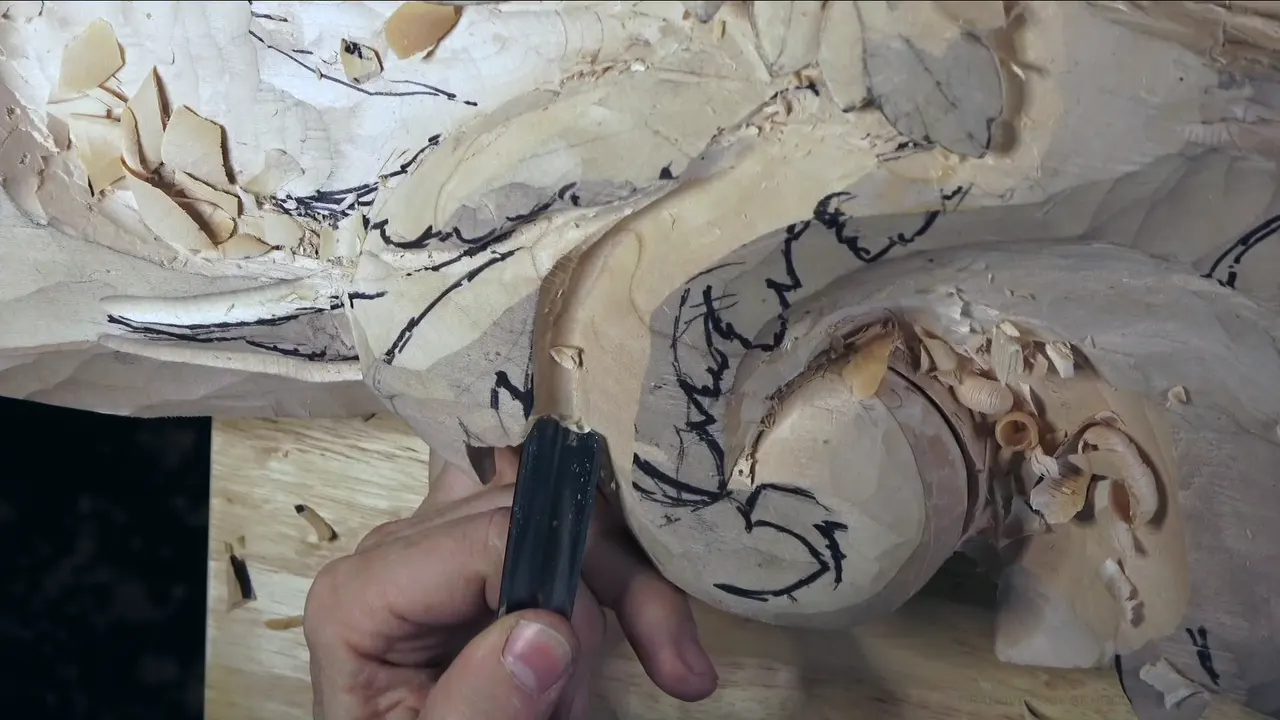

Recreate is my word for carving a line, eye, notch or idea again, after the first try was lost or came out wrong. My verdict on the carving opens Venice Room workshop 43, part 12. Then comes "and I can recreate the idea what I have."
Ever carved a line you liked, lost it on the next pass, and wondered if the whole shape was gone with it? This part runs 462 words, so the rest of this page comes from my other lessons. In each one, something different comes back.
What does recreate mean in Venice Room 43.12?
Here the word goes with an idea, not with a tool. The word arrives at 00:31 and returns at 00:46, shorter: "And recreate that idea."
Before that, at 00:16: "That is not bad, but it is not too good yet." Next, "Let me clean it," which is a plan. A second plan follows at 01:03. Number three, maybe, will help me establish nicer movement.

"Okay. That is good." The time is 01:29, and a few seconds later I give myself a job: "let me fix what I see and I don't like." Earlier work comes up too: "for this head, I used pretty much the same, what I used before."
Then the phrase "another same plastic piece." Of course, it's moved little different directions, I tell you, "but the idea is still the same." That piece is not explained in this part, though one frame shows a clear plastic sheet with a drawing on it. The Byzantine Acanthus lesson, further down, explains plastic pieces in my words.

Where do the eyes go when the idea comes back?
An eye goes "somewhere right here." Four seconds on, I fix it: "Oh, actually right there is going to be an eye." Another follows at 03:01, "another eye," and a separation at 03:09.
At 03:24 comes a verdict: it is good, I think, "except I still have to figure out what I'm going to do right here without losing the idea." And a question to myself, "So what am I going to do right there?"

A plan comes next, in my words. This leaf could go like that, and maybe, which is also a common thing, "just to get leaf above the leaf." That goes below this one, and I think it will work out really good. Gradual blending is the plan, I add at 04:19.
Another line, at 04:29: "And I do not want to lose this movement, which is going to go all the way right there." Another idea turns up at 04:38: "I could actually create huge eye. Big eye."
What did I plan to dig next?
Excavate underneath, probably, "before I forget the idea what I have in mind." The plan gets plainer: "So let me just excavate underneath to the eye." At 05:07, just three words: "Excavate to the eye."

Another plan, at 05:43: with the bigger one, movements that are "more pronounced." After 00:46 the word recreate does not come back in this part. What follows is excavating, outlining and one big separation, and the word does not return.
Next comes a plan for the part I just added: "let me also outline this little division." That, I say, is probably going to give me a beautiful look. An eye is planned right here, and I can outline this way, and "that way," though "this outline could be done with the bigger tool."

Next: "It's a big separation. Nothing stops me from chopping out." The last words say I could get this part much deeper, "which going to make sense."
What if the waste will not come out?
Other lessons speak to it. On a butterfly in the Plate with Butterflies course, lesson 3, part 2, something is "gonna be straight down 90 degrees." My plan: "Let me remove that waste as much as I can." Then: "And like I said if it does not fly out. Recreate the cut and that should fly out."

Part 2 of Modern Acanthus 4 has the same advice. "Again, do not remove too much. And don't force it if it does not fly out go back." I'll use the right-hand corner of my tool to recreate it "without pushing too hard."
Cleaning comes after, "until I'm happy." One warning for that stage. When you clean, please do not push too hard against that rolling motion, because you can damage the side. Work your way in.

A row of little triangles is the setting in Venice Room 57, part 11. By 05:00 I tell you it is better not to carve too deep "than do too deep and create too weak of a spot." Whatever is not popping out, I can go back to, "recreate the cut, and then it just pops."
Then the triangles go: "See? They all flying out, those triangles." Later, at 05:49, comes "right here I have to recreate." At 06:25 the row is already giving me "those beads feel."

Lesson 10 of the Plate with Butterflies course adds one more piece of advice, in part 3, which is "if you need to recreate that cut multiple times, take your time." Earlier I tell you, "I don't need to rush anything." After I attack from the other side, you can just clean it slightly, and I'm happy how it looks.
How do I recreate a line I lost?
Start with a blower. "Let me use a blower," I say in Venice Room 38, part 1, and I plan to blow everything and continue. After that comes "I think I can probably right now recreate the line." Moments later, "I can recreate that line," and I say where it is: "somewhere right there."
The lines that follow are a check. "But this one doesn't look too good to me." Double check, I tell myself. It probably needs to move a little bit this way, because it looks a little too straight. At this point, I would say, I have to work with just the smaller tools "to figure out the right movements."
Eyeballing is the method in Greek Acroterion 4, part 3. I say "I took it gradually down." Then my line has to come back, "which is right here, and I'll just eyeball it." It's an eighth of an inch (3.2 mm). The other side gets eyeballed too, and the result is "exactly eighth of an inch."

Part 4 of Venice Room 39 is about an outline. I need to excavate a little deeper, I think, around here, "just for myself not to lose it." Then: "It's okay for me to lose it, I could recreate with no problem, but all it's going to take, couple cuts." Then: "I can save this outline no problem."

Part 1 of Roman Acanthus 5 starts with a lost line. I lowered the right and the left side. On the left I can clearly see where my pipe will go, "But I completely lost this pipe on that side, and I need to recreate that."
There are different approaches. You can eyeball it, or print two drawings, lay one beside the carving, and glue the other on top of the wood, work, and remove the paper. I call that a wonderful idea. "Always you can reference those lines and recreate them even in three-dimensional world approximately." The surface is going downhill, which is kind of hard. You have to be really creative and imagine where the line will land.

The goal is to recreate the eyes and the pipe movement. Since I have this side, I'll take my small gouge, the same one I used, and dig that deeper. Then I need to take this eye and recreate it on that opposite side. If you have a difficulty, you can take a flexible ruler, place it, and "approximately recreate the lines."
The Furniture Panel course, lesson 35, part 1, has me checking my own design. I gotta find out what I did during the design. "I got multiple eyes," so I have to recreate them. I want to make sure I'm not "lost in the space," and I need something darker, so I'll use marker. There's one eye, there's another eye. It looks like I tried to do a micro eye right here.

Next, "I don't know what is going on right here because it doesn't make too much sense." The line after it is a plan: "Let me actually rethink what I can do."
How does an idea return in a new shape?
Lesson 7, part 7, of the Hashemi Flowers course shows it, and the first problem is plain: the overall shape of a leaf just doesn't flow together. I'll take number eight, and number nine could work: "I think I should. Maybe not. We'll see." Then: "Take a number eight and kind of recreate the same idea, the same flow."
A correction follows: "Same movement, I should say." I barely create any pressure, and I have to check if I have enough thickness. It looks like I do. The choice at 02:16 is "Number nine at one inch" (about 25 mm), and next I'll attack that from this side.
Lesson 31, part 2, has another. After a V-tool and an undercut: "Now carefully, with the number five, I'll recreate the waviness." Next comes "Clean it." Number nine, it seems, can make it curl inside.

Now back to the plastic piece. Byzantine Acanthus 1, part 1, has the plan: draw right on the board, take one of the plastic pieces, and use "the magic tool, which I call marker." Then you take it to your piece, and I've got some carbon paper.
That approach pays off if you want to recreate multiple movements: go that direction, then another, then another. "All you do, flip it, flip it, flip it." Then: "It's what they did but without the plastic." In 43.12 I say "another same plastic piece" and nothing more, so I only give you its words here.

When do I correct the word as I say it?
In these three lessons I catch myself in the middle of the word. In Venice Room 40, part 4, I say "let me use number 11" and then "recreate, not recreate, but get a little more pronounced pipe cut. Not pipe, but the eye cut." For that I will need 2 millimeters (0.08 in). Then: "Get underneath."
Blending an area first is the plan in Venice Room 48, part 12, because I need the right surface for a pipe. After "let me recreate this eye" I take it back with "make it nicer." A pipe goes right there, so this part needs to be concaved, and the opposite side too.

Part 3 of Venice Room 63 has the same turn. I'm still not too happy about this concave, so "I'm going to recreate that concave," and then, "Not recreate, but now just create a little better version of it." The reason comes right after: "it was just preliminary anyway."
The word comes twice in 43.12, and the lines around it do not correct it either time.
How deep can I recreate a concave?
One figure comes from Roman Acanthus 16, part 4, where I would probably take 1 millimeter (0.04 in), number 11. There is a deep concave right there, "and I can recreate and make it little deeper until the end of it."

Extra shadow, I tell you. Light is going to travel on that side, and "It's going to look beautiful." I do the same on the other side. A smaller one, 5 millimeters (0.2 in) by length, could make an even deeper concave.
Chamomile and Bow Rosette 4, part 2, has it too, and it starts with a plan: "First of all, let me recreate that cut again." It goes all around, "Just get little deeper." I want a small notch where I blend it, for extra shadow at that point. A number 11 at one millimeter (0.04 in), maybe, will make that pass toward the center. Of that plan: "I think that is probably a better way. I'm after the shadow."
Now a nut. In Hazelnuts 3, part 1, I'll try saving it first. If I see there's absolutely no way I can save it, "then I'll just recreate the thing." Number seven comes next, as a plan, about 14 millimeters (0.55 in), a little bigger than half an inch and a little smaller than 5/8.
That tool is going to create the nut inside. I'm carving into the grain, I add, and it's kind of dangerous.

How do the lines add up?
Eight moments sit side by side in the table. Each names what came back, and what I said about it.
| Source | What came back | What I said about doing it |
|---|---|---|
| 43.12, Venice Room | The idea I have for this carving | Plan: number three |
| Butterflies 3.2 | A pass that should make the waste fly out | Remove that waste as much as I can |
| Modern Acanthus 4.2 | The same pass, with a corner of the tool | Do not push too hard |
| Venice 57.11 | A pass where a triangle stayed put | Go back, and then it just pops |
| Hazelnuts 3.1 | The nut, if I cannot save it | Number seven, said as a plan |
| Greek Acroterion 4.3 | My line, which is right here | Eyeball it, 1/8 in (3.2 mm) |
| Roman Acanthus 5.1 | The lost pipe, the eyes and the pipe movement | A small gouge, or a flexible ruler |
| Roman Acanthus 16.4 | A deep concave, a little deeper | Number 11, probably |
In 43.12 the number three is a plan, and so is the hazelnut's number seven. The Roman row's number 11 is hedged too. Nothing in the table says how long any of it took.
What do I take from all of this?
Across these clips the word fits lines, eyes, notches and ideas. The tool changes. Part 12 returns the idea, named at 00:31, well before the number three comes up.
Which did you lose on your last carving, a line or an idea? Mine are on camera in part 12, and the lesson 43 page covers the whole workshop. For all my lessons in one place, start here.
The Venice Room course for workshops 38 to 49 holds the rest of this acanthus carving. These clips come from my wood carving courses, and every figure in millimeters and inches on this page is mine, with the conversion beside it when I did not give one.
How it's done
- Clean it first. In 43.12 my plan was to clean it, said at 00:25, before the idea came back.
- Decide what must stay. At 04:29 I said the movement must not go, and I planned to excavate underneath before I forgot the idea.
- Go back for stubborn waste. In the Modern Acanthus course I said not to force it, and to go back when the waste stays put.
- Allow many tries. In Butterflies lesson 10 I said that when a spot needs many tries, you take your time.
- Use a flexible ruler. In Roman Acanthus lesson 5 I said a flexible ruler on the wood helps with the lines.
Frequently asked questions
Which tools came up in this part?
A maybe at 01:03: number three, to help establish nicer movement. After that, only a bigger one, twice: for more pronounced movements at 05:43, and for the outline at 06:30. No other number comes up in this part.
Is recreate a repeat of the first try?
Venice Room 40, 48 and 63 each carry a correction after the word, for a more pronounced eye, for a nicer eye, and for a little better version of a concave. Part 12 of workshop 43 has no correction near either use.
What did I do when I could not tell where my eyes were?
On a furniture panel I said I had to find out what I did during the design, and that I would use a marker. I found one eye, another eye, and what looked like a micro eye. At one spot I said it did not make too much sense, and I asked to rethink what I can do.
What to carve next