

Alexander Grabovetskiy, woodcarver, School of Woodcarving · Published 2020
What does "nothing special" mean when a wood carver says it?
Quick answer: "Nothing special" is how I mark routine work on a carving, the same idea I have done before. In part 3 of workshop 43 I gave that name to a whole everyday acanthus leaf, and still kept two limits on depth underneath, so it would not get too weak and I could get inside to finish it.
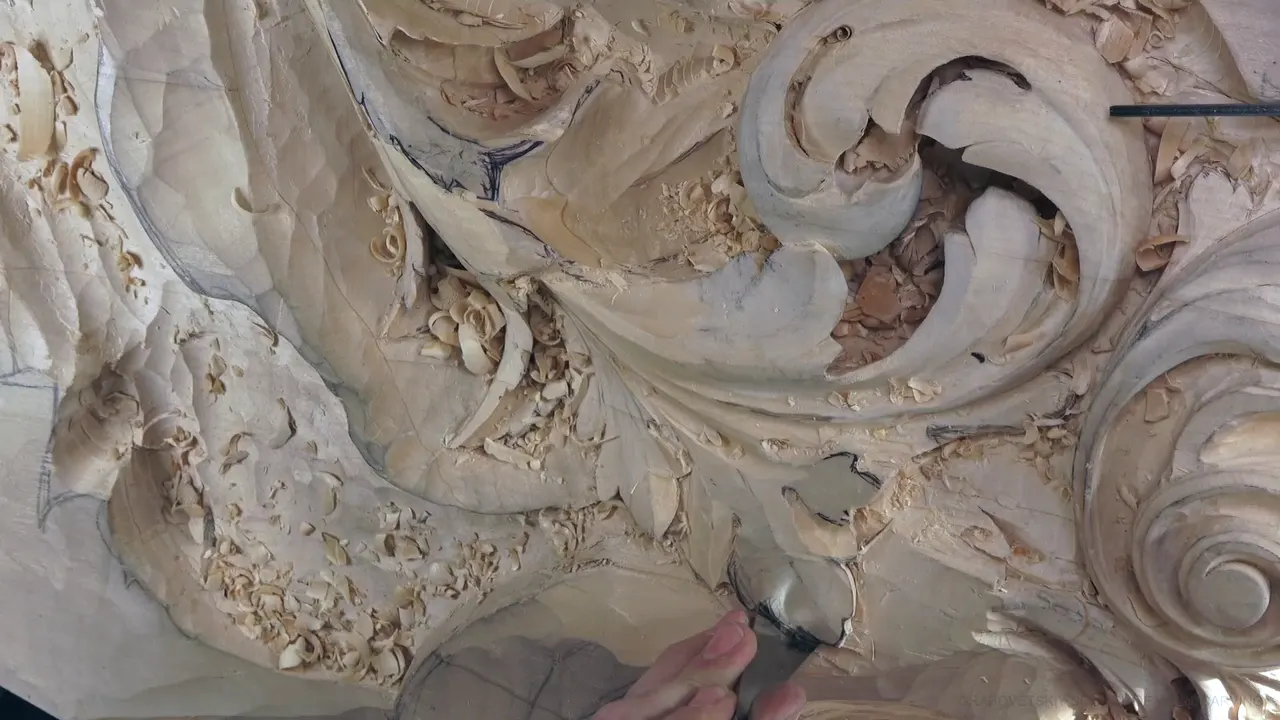

"Nothing special" is my plain way of saying a job on the board is everyday work, the same idea as before, with nothing new to learn in it. In part 3 of Venice Room 43, a lesson in acanthus leaf carving, I said it about a whole leaf. Everyday acanthus, I called it. Daily acanthus, I should say. Later in that same part I still had to watch how deep I went underneath.
Have you ever watched a carver go quiet and just keep working? Did you think the secret was hiding in that quiet stretch? On my boards, when I call a stretch nothing special, it is plain work, and I tell you so out loud. Below is what the word covers in this part and in my other carving courses, with what I did or planned next.
Six lines on the word
- A whole leaf got the word in workshop 43, part 3, an everyday acanthus I said goes quick.
- Its undercut was saved for later.
- Depth underneath still had two limits, and I named them.
- On other boards it covers cleaning, a plain number seven, or eyes carved the same way as before.
- Some of that work goes off camera, and once I came back and explained it.
- I corrected myself on the word, about an acroterion and about acanthus being everyday at all.

What made the leaf in part 3 an everyday acanthus?
Plain work, with nothing going on in it that I would call special. Those were close to my words at the start, and here they are. There's nothing special going on on this acanthus, just everyday acanthus, an everyday acanthus leaf, if there is anything like that. After that I changed my word to daily acanthus. And twice, before any of it, I told you this one goes quick.
Undercutting it was a plan for later. Maybe not now, but later on, I said, I'm going to undercut it and create a shadow all around. At that point I really didn't need to. What I needed was to refine those divisions and get the somewhat final shape.
Next I was giving one side a little letter S element. Maybe this tool is a little too big for that, I said, but it's okay. And I was right on the glue line, and showed it to you. Here you go. That is a layer of glue.

Why can digging underneath go too deep?
For a couple of reasons, and I counted them out while I worked. I have to be careful how deep I go underneath, because at a certain point it's almost too deep. Reason number one, I can make it too weak, and the second, again, I have to finish it. I have to get inside somehow. And finish it.
That was on an everyday leaf. Right after, out came I love it, four times over. Of course I love it, because I did it, and I have to love it, otherwise I'm doing the wrong thing.

Inside the eyes I could excavate with a small number eight, two millimeters approximately (about 5/64 in). First I wanted to see whether it would be a bit too big or not. That right there, I said. I've got one more right here.

In those spots I could go as deep as I wish. I love to give them some depth, as long as no junk is flying back. The depth gives extra shadow, and I think it's nice. I don't have to do it everywhere, but sometimes I could.

What happens when an everyday leaf turns choppy?
On this leaf I stopped and fixed it. I was about to bring out the middle line, the one that runs to this point. Halfway into telling you how, I broke off. Well, actually, you know what? I had just found one of the areas a little too choppy. It's no good, I said. So I took care of it, just like that, and then said now it's better.

I didn't want to forget one more spot either, which goes like that too. That is the middle point right here, I would say, and it's going to make more sense. And that is going to be the main movement of it.
Next I needed the number 11 again. This one is a little too big, I said, and I need a smaller one, to make that separation right away and outline it the same way. Once it was in I said I think it is good, though I could go a little deeper on this side, which I will later on. As of now it gave me the right shape already.

The part ends on a plan. Let me see if this is the right tool for the job, I said. Need to give that a convex feel. One millimeter is what I need, if I can find it, a number 11 of course (about 0.04 in), to go underneath right here.

Was the acanthus leaf ever everyday work?
Back then it was, and I said so one workshop later. Part 10 of Venice Room 44 has me calling a leaf a really interesting acanthus. It's not like everyday, I began, and then fixed it. It is everyday acanthus for those times, but not today. Today, I said, you're not going to be able to see too many people doing it.

The same kind of turn came at the very start of my Greek acroterion course. Meaning of it, it's actually nothing special, were my words. Then at once, well, first of all, yes, it is special, and the meaning of it is a victory. The design there is a stylized palm placed on a flat base, the part we would probably call a plinth today. One of my clients wanted it as a prototype. They were going to make a form from my carving, cast it in bronze, and place it on the top of a building.

Which jobs do I call nothing special?
Cleaning, for one. During Venice Room 31 I said I would spend a little more time later, maybe off camera, cleaning everything to make it more perfect. Cleaning has nothing special in it, but it takes time. Essentially there is nothing new to learn. It's the same way all the time, just to get a lot cleaner cuts.
On the Chamomile and Bow rosette I had a number 7 in my hand and said any flatter tool will work there. You don't have to watch me clean the outside. There's no reason. Again, nothing special about cleaning. All I'm going to do, I said, is take a small flatter gouge, or even a chisel, and get in and remove the excess chips. After that, really small, tiny gouges and chisels would clean the rough spots until it's perfect. That piece was for paint, so I was not afraid of sandpaper on it. I recommended 180 grit, or 240, not lower than that. Use 100 or 120 and you get a really, really rough look.

Then there is Venice Room 59. I called one stretch just a cleanup job, and I did not want to move the camera. It's going to slow me down, I said. Right after it I said I was going to excavate underneath, now that I was able to, and because of the grain I had to be careful how I attack it. Preliminary cuts with a number nine came first, a bunch of them around, to relieve it. After those I said I should probably take a number 11, 5 millimeters, 3/16 of an inch, to remove all the mess the nine made.
Why is some of this work done off camera?
I don't want to take your time showing it. That was my reason in Venice Room 86, where I said let me clean this off camera, because it's kind of nothing special.
One process in Venice Room 85 I called kind of boring, nothing special, and I said I'd do it just off camera, all to get rid of the voids. A section in workshop 81 I said I'd probably do off camera, because really there's nothing special about it. Part of it would be gone completely, just a chunk. On Venice Room 64 one chunk sat on the side, invisible to the camera, and the work there was just a stem coming from that detail.

Back in Venice Room 66, after work like that, I explained what I had done, because it's actually nothing special. I added extra separations. I excavated that eye, and the inside right there. You saw the main idea, how I developed it, and now it was all about the detailing and the extra divisions. The logic is three main divisions, and then I divide each of those into another three.
Does nothing special mean the same idea again?
On several boards I said so in the same breath. Workshop 65 brought me to the eyes of an acanthus, and I called them nothing special. Same idea, exactly the same as I'd done hundreds of times in that project. The plan was a number 11 at 3 millimeters (about 1/8 in), then a switch to a smaller one.
For Venice Room 115 I said I'd just go around with the same operation, smaller and smaller tools, then undercut it and clean it. I like the idea of three main divisions, but it doesn't have to be three necessarily.

On the Venetian Flowers rosette, in lesson 2, I finished all four of those and called them nothing special, the same as the one I had already done. In the next breath I said there's no repetition, absolutely no repetition. Concave, convex, concave, another convex and another concave on one section, and the next one has the very same idea without repeating it. Just different variations.
The floral panel went the same way. Lesson 9 had leaves I called nothing complicated, nothing special, the same movements, and I said I have more freedom on those leaves. Two lessons earlier, in lesson 7, a part I called nothing special got short advice from me. Just work your way in. Make it wavy, and don't make it look straight. Use your creativity, but don't overwhelm. For a small concave, a convex and a concave again, I said I could probably use a smaller number eight there, one and a half millimeters (about 1/16 in).

The undercut waited in Venice Room 92 too. I called those leaves nothing special, just pretty much really simple ones. A number 11 leaned a little away made one cut along the line where one part overlaps the other. I planned to undercut with pretty much the same tool, but at the end, not right away.
Can a plain tool be nothing special too?
My number seven was the plain one in Venice Room 63, when I named the tool in my hand. Again, that is just number seven, by the way, nothing special. A short bend, actually a medium bend, I would say, about 14 millimeters, about half an inch. With a skew push it was already slicing, and the cut came out absolutely beautiful and clean. There are limits, though. At some point I can't go deeper with this tool, because it's number seven.
Chopping around future leaves was nothing special too, I said in Venice Room 130. Straight down cuts, plug cuts and edge cuts. By an edge cut I mean a number nine that removes some material close to the edge, straight down, 90 degrees. I could even go bigger, maybe three-quarters of an inch (about 19 mm), and hit that a little harder.

Punching a background earned the same word in Venice Room 93. Just punch it, I said. A normal hammer, please, not a mallet. While I punch I make a rotation movement, so my pattern goes in different directions.
What can still go wrong in a plain step?
The grain can catch, for one. On Venice Room 9 I was carefully shaving back in a little tough area because of the grain. Still doable, I said, nothing special. But see, it's catching right there. I had to change the direction, and change it again.
Things break, too, and Venice Room 8 has my answer to your question. What do you do if something's broken? You just glue it back, nothing special. I won't save on the glue, I said, then a small clamp held it, not too tight, to leave overnight.
Even the word can slip. In Venice Room 10 I called what I was taking out inside nothing special, just lots of waste. Then I took it back. I shouldn't say that. I'm not wasting material at all, I told you.

Where the word came up, and what came next
| Where | What I called nothing special | What came after, done or only planned |
|---|---|---|
| Workshop 43, part 3 | A whole leaf, everyday acanthus to me | Careful depth underneath |
| Venice Room 9 | A tough spot with the grain, still doable | Changing direction twice |
| Room 59, part 11 | A cleanup job, and I didn't want to move the camera | Preliminary relief cuts first |
| Room 65, the eyes | The same idea I had done hundreds of times | A 3 mm plan |
| In workshop 92 | Leaves I called pretty much really simple ones | Undercut saved for later |
| Greek acroterion | What the design meant, at first | Yes, it is special |
Part 3 is a short one, and it goes quick, like I told you at the start. The workshop 43 page lists all twelve parts, with workshop 42 before it and workshop 44 after, and Part 4 of the room holds workshops 38 to 49. Tuition opens every part. Every course of mine is one click away if you start here.
How it's done
- Refine the divisions first. On this leaf the undercut waited for later. The divisions and a somewhat final shape came before it.
- Mind the depth underneath. Too deep and it gets too weak. You also have to get inside somehow to finish it.
- Try a small eight in the eyes. Mine was two millimeters approximately, about 5/64 in, and I checked first whether it was a bit big.
- Fix a choppy area on the spot. One area was a little too choppy, no good, so I took care of it right then and called it better.
- Outline the separation. A number 11 made that separation right away, outlined the same way, and it gave me the right shape already.
Frequently asked questions
Did the everyday acanthus in part 3 get its undercut?
Not yet. I told you on camera that it would come later, maybe not now, with a shadow all around it. In that part I really didn't need it. Refining the divisions came first, along with a shape I called somewhat final, and a little letter S on one side.
What size gouge went into the eyes of that leaf?
A small number eight, about two millimeters, or 5/64 of an inch, after a quick look at whether it was a bit big. In those eyes I could go as deep as I wish if no junk flies back. The depth gives extra shadow, which I think is nice.
Is cleaning a carving really nothing special?
To me, yes, though it takes time. It is the same way all the time, just for a lot cleaner cuts. On my rosette for paint I said a small flatter gouge or even a chisel would get in and take out the excess chips, and that you can skip watching it.
What to carve next