

Alexander Grabovetskiy, woodcarver, School of Woodcarving · Published 2020
What does "I promise" mean when a wood carver says it?
Quick answer: "I promise" is my word to you when the wood does not show yet the shape I see. In part 9 of Venice Room workshop 43, I said it would make sense and you would see it, and I meant the development. Elsewhere it covers real-time teaching, the next step, or a warning.
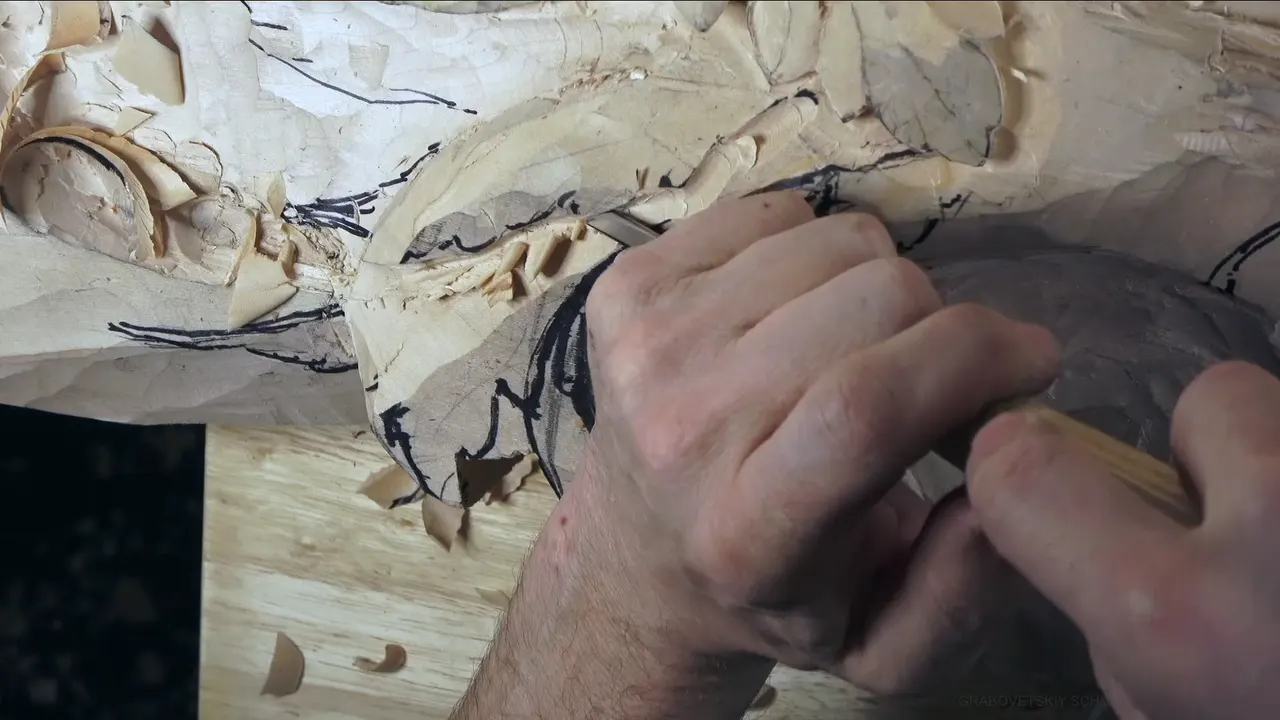

A promise, at my bench, is what I say when the wood does not show yet the shape in my head. In Venice Room workshop 43, part 9, I was cleaning one spot again with the same number 11, and I named three places where the movement had to be reestablished. Then came the promise. "It will make sense," I said, "you'll see it, I promise," and right after I said it a second time, the other way round, I promise you will see it.
Have you looked at a half-carved piece and seen mostly chips and lines? Did you wonder how that turns into a leaf? The part is short, so I went through my other wood carving courses for the same word, and I name the course each time.
Five kinds of promise I make while carving
- One kind is about the result, a shape that will make sense once the development shows.
- A few are about teaching, like real time, no speeding up and no cut corners, with my mistakes left in.
- Some promise the next step, which then came, even once when the recordings went bad.
- One is a warning about breaking tools during extreme undercutting.
- Some things I won't promise at all, if I can't be sure I'll deliver.
What did I promise in Venice Room 43, part 9?
Part 9 opens on a clean-up. Clean it again, I said, just clean it with the same number 11. Number 11s are pretty much what I'm using most of the time on this job.

A warning came next. If I excavate too deep underneath, I won't be able to blend it nicely, so I have to be more careful and move it more gradually downhill.
Then the three spots, one right after another, each waiting to be reestablished, and a quick "Go like that." That is where the promise sits. What I meant by that, I said, was the development, what I have in mind.
One more area had to be outlined also. Just like that.

The frames from this part show what you were looking at when I said it. Black lines run all over the round head, chips lie on the bench, and by my own words at the very end, much deeper digging was still to come.

Why carve it downhill?
The view decided it. Let me think, I said, and then: "I really have to make this cut downhill all the way. Reason why, because again, that looks good from above, but it's going to be also looking good from down below."

Next I said this point is not the point I want to see, unless I take this piece and let it go underneath, to get this one somewhat high. I could do that too, probably. My plan for the wood was still to probably lower it a little bit, not much, because rolling it too much is not what I want. A little bit won't hurt.
Yes, I think it is good, I said, and then came a small trouble with the ball pen, which just didn't work.

Next came what I'm probably going to do with one line. It will be below and run on underneath, and that's the way to go, I think.
Use number 11, I said, and knock some of it below. The next frame shows a gouge reaching up under the head, and a little later I said I thought it would still look good.

Not every piece was meant to go down. This particular piece I didn't want to take the whole way down, I said. This one will go more down, yes. But not that one. To do that, I need to make sure I start excavating right here.
A little later, in the same stretch, I said, "And I do not want to lose overall picture."

What was still a plan when part 9 ended?
Quite a lot. So let me reestablish the movements, I said. Although I could get this movement from down below upward, like that, and that would look good. But I still need to make it more lower in this area.

And go this direction. Maybe I could actually make some roundness right below, which you don't see. But essentially what I'm doing is just rounding it.

The part closes on a need. Just giving the main shape, I said, although I need to excavate much deeper in this area, because I really want to see development of the head and the main end of it. That will be somewhere right there, so I need to excavate deeper around.
Development. Same word as in the promise. By the end of part 9 the head was still a plan, with the deeper digging I had just named.

One part later, in part 10, I said about the head, "This head is going to be a beautiful head." And then, "I hope." There are twelve parts in the workshop 43 lesson.
On the Tray of Blessing, the Cabernet Sauvignon tray, a promise and an I hope came out together. Yeah, I know it's a simple ball, I said, but it's gonna be gorgeous. I hope so. At least I always promise, you know, every project I do, I say it's gonna look gorgeous.
What does a half-carved shape promise?

It promises a look you cannot see yet. The Hashemi flowers course had one flower that did not look complicated so far. Once we get all the undercuts and all the movements on this flower, I said, it will be complicated, and you'll see it, I promise you, really complicated. Then I took the word back. Well, I shouldn't say complicated, I said, it will be beautiful, complicated in a good way.
In workshop 62 of the Venice Room I was going carefully around a shape on the acanthus relief, just going around, and in the middle of it I said, "I promise it's going to look really good," and then that it would look awesome.

The furniture panel background lesson has one section I showed you. Here you go, I said, that is the look. One side still needed work, and the area around it, but we were getting pretty close. I know it's not as detailed yet. But I promise you it will look awesome.

On the butterfly plate the promise came at the very end of a video, after I showed the plate. That is how it looks as of now, I said, how it looks without the details. Once we do all the details and stuff like this, I promise you it will look absolutely gorgeous. I'll see you next time.
Back in the very first Venice Room lesson the promise went the other way. I know the shell looks a little complicated, I said, but I promise it won't be complicated.
Which promises are about the way I teach?
A good number of them. In that same first workshop I put it plainly. As I promised, I will do it in real time, the way I do it.
During workshop 15 of the furniture panel I could have sped up the process and shown you just the result. I promised at the beginning, though, when I started my school, that I won't speed up. Maybe I should. I'm not sure. That way you get the real life speed. When you watch some other people carving, you wonder how in the world they do it that quick, and they don't.
In the furniture panel design I told you to be patient and see what the end result will be. And I won't cut my corners, I promised. I called it more a virtual apprenticeship than a school, with me working and you watching, picking up what you like and developing your own style.

My vise in the Roman acanthus course sits on a small workbench, and sometimes it's shaking. When I started this school, I promised to teach you the way I do it, and most of my carvings I do just like that. Maybe sometimes it's hard to watch, I know. There I brought up Russia and a movie I saw about a school of spies, where they learned to write with a pen on a floating, shaking table.
Mistakes fall under the same word. Like I promised, I said in Hashemi workshop 11, I won't hide it if I made a mistake, and on the final piece nobody will know it was one. How many do I make? I didn't count, and I know I should do less.
The Lily Box course had a bigger one. I promised you would watch more than instructional videos, that you would watch me work on a daily basis, just like being in my shop with me. I didn't want to cut out the parts and pretend I don't make any mistakes. I do make a lot of them. What counts, I said, is solutions, how to fix whatever doesn't look good.

Even my mumbling is covered. I'm sorry if I'm just mumbling, I said in lesson 2 of the Venice Room, and as promised, that is real work for me. Yes, it is a lesson. And in design lesson 12 I said please be patient with me, and promised to show you the process, how I work and what I do in my shop every day, and sometimes I have to jump project to project.
Did I keep the promise to show the next thing?
Sometimes within seconds. Over on the floral and molding panel the transition had to go uphill really smoothly, and I said I would show you. I will promise, I said. Right there. You could see it had some kind of curvature.
Sometimes the film let me down. In Lily Box workshop 3 I had promised to jump to another area. I did, and I filmed everything, but my recordings were really bad, so I had to destroy them. Only a small section was left to do, and as of that video the first layer was absolutely done. Like I promised, the plan for that day was a punching pattern with my background punches.
The Greek acanthus leaf opens on one kept from before. We'll go "deeper on this acanthus leaf versus the previous one, versus a Corinthian acanthus leaf," I said. My block was about one inch and an eighth (about 29 mm), and my plan was to go about five-eighths down (about 16 mm).
The curly cutting board had a finish as its promise from before. My words there were that I'll show you how to finish it so it is absolutely food safe, with no chemicals involved, in two ancient ways.
Lesson 148 of the Venice Room carried two. As I promised before, I'll do some stuff off camera because of the time, I said, because I really want to make sure I'm not repeating myself on the same details. Later in that lesson I said I had promised to show you some architectural movements. One shell will go right down, a counterpart to the one going uphill, and I called one a hero and the other its antagonist.
With the hazelnut panel I said I can probably start on the second bunch now, as promised, with a number 11, 10 millimeters, about three-eighths of an inch. Over the acanthus over a molding, I was ready, as promised, to work on the last two petals.
When do I hold back a promise?
When I can't be sure of keeping it. For the hazelnuts I had two blocks of the same species from two sides of the United States, one pinkish and one yellowish. We're going to cook, I said, or maybe, I'm not sure. I don't want to promise and not deliver it. Then the plan, I think I want to cook some kind of natural stain and create a beautiful look. And again, I don't want to overpromise it, because I'm staying really busy.
In that same course I said I might take a picture and refine all those lines like in a line drawing. "I'm not promise that," I said, "because it's just possibility."
In cutting board workshop 14 I said to write me emails, and to call if you have to. Although I'm not promising that I'll answer right away. Carving-related questions only.
During a livestream about strops I made a promise to anyone on my email list. I won't solicit, won't push anything on you, and won't sell you anything unless you want me to.
One promise is a warning. Just be careful, I said in Hashemi workshop 46, don't break your tools. And I promise you, with extreme undercutting like this, you can break them easily. A number three came next, and a small gouge again.
And a small one from lesson 75 of the Venice Room, while I was marking convex and concave in color. I won't use marker right now, I promise. I'll use just a blue pencil, teal or teal-ish, and blue would be concave.
Where each promise was said
Eight of them side by side, with what came after each one.
| Where | Promise | After |
|---|---|---|
| Venice Room 43 | You will see the development I meant | Deeper digging needed |
| Hashemi Flowers 43 | Plain now, complicated in a good way | Word taken back |
| Furniture Panel 18 | Not detailed yet, but awesome later on | Getting pretty close |
| Butterfly plate 12 | Gorgeous once all the details go in | Video ends there |
| Panel workshop 15 | Real life speed, with no speeding up | Unsure about it |
| Lily Box 3 | Moving to another area, everything filmed too | Recordings were destroyed |
| Hashemi Flowers 46 | Your tools break easily in extreme undercutting | Be careful there |
| Carving Hazelnuts 1 | A natural stain, if I cook it | Promise held back |
Is there a half-carved piece on your bench right now? Does it look like chips and lines? Part 9 sits inside the Venice Room Part 4 course, and tuition opens every part, so you can watch the development I promised on your own screen. All my courses are one click away if you start here.
How it's done
- Clean the spot again with the number 11. On this board it is the gouge I use most of the time.
- Stay shallow underneath. Dig too deep under there and it won't blend nicely, so I move it more gradually downhill.
- Outline the area that needs it. One more area needed an outline in that part, and it got one.
- Take the slope downhill. It has to look good from above, and from below too.
- Knock some wood below and look again. My words were use number 11 and knock some of it below, and a little later came my verdict that it would still look good.
- Round it and give the main shape. When the part ended, the head still needed deeper digging.
Frequently asked questions
Why would a carving teacher promise you will see it later?
The development I mean is not on the board for you to see yet. During part 9 of workshop 43 I told you it would make sense, and at the end of that part I still needed to excavate much deeper there to see it myself.
What happens when a promised video goes wrong?
My Lily Box promise was that we would jump on another area. I did, and filmed all of it, but the recordings were really bad, so I had to destroy them. Only a small section was left, and as of that video the first layer was done.
Do you speed up your carving videos?
At the beginning of my school I promised I would not. Once, on the furniture panel, I said maybe I should, though I wasn't sure. When you watch some other people carving you wonder how they do it that quick, but they don't.
What to carve next