

Alexander Grabovetskiy, woodcarver, School of Woodcarving · Published 2020
When is a wood carving a piece of art and not just an ornament?
Quick answer: In part 8 of Venice Room 43, I called a carving art and said it was not an ornament only. Other lessons of mine put those words beside more time, extreme undercutting, authentic techniques, and a customer who asks for less detail.
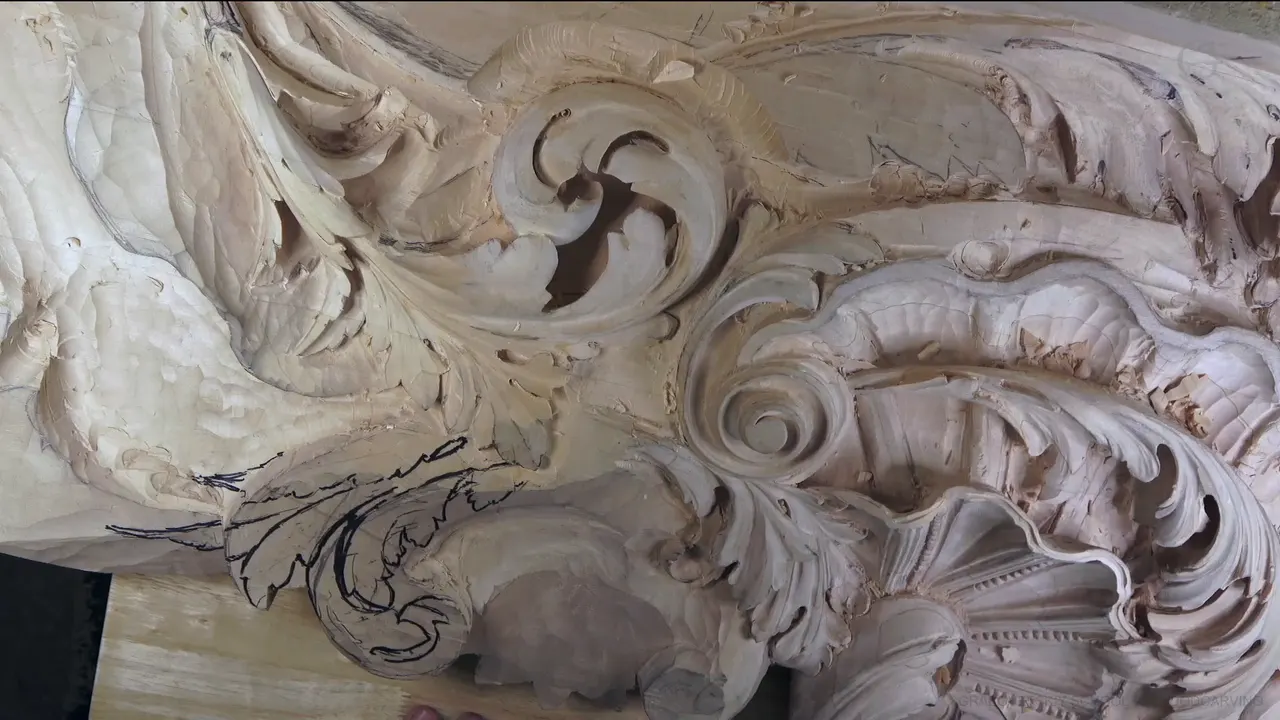

In part 8 of Venice Room 43, I stopped to think and told you what you were seeing: the birth of art. The same word turns up in my other wood carving courses, beside a list of things a carving is not and a list of things I do for it.
Where does an ornament stop and art begin, and do you carve the two the same way?
What was I carving when I said it?
Part 8 opens in the middle of a big carving. "Let's jump to this area." Probably off-camera, I said, because for me it is a big piece, and it is hard to get at without sticking my head in the camera view. Just this section, probably, and it would not be really complicated: "This section is going to repeat pretty much that one."
A cluster of flowers would sit right there, and some of the petals would stick down. Maybe I would add petals somewhere else, but it would be covered. "But I would love to develop this movement."

I had actually sketched an idea for it, based on my original movements, and I wanted to change something a little bit. One part would go downhill and continue on this side, and that one would go that way. "And maybe later, I'm going to develop something on inside also. We'll see. Which is probably I will."
My first tool, I said, would be my skew chisel, "big one, one inch" (about 25 mm), for a preliminary shape. I took care because this head would be "a somewhat big head" that goes all around and is visible from the bottom. "So for me, really important not to mess it up."

"Just preliminary cuts is what I'm doing." Maybe I would hide part of it with the leaf, or something like that right there. A couple of elements I had just added, I said, would tie all together the rest of the movement. "And that is actually good."
Next I wanted to establish the movement. "It's going to go like that, and that is going to be my focal point element." Maybe it needed to be a little wider. One spot did not look right to me: "This one doesn't look too good. We have to add some of the movement this way." Of another: "that one looks okay."

Outline cuts came after that. "Let me create a couple separation cuts, outline cuts," I said, using probably 15 millimeters (0.59 in), number 11, "just to separate my idea." The shape would roll down, and I have to excavate on the inside to create that rolling effect. "Maybe. Maybe yes, maybe no. Maybe I'm going to do something else." Another thought: "Flatten it a little bit. Let me think."

And the line came: "Oh, yes. Obviously, I do have to think. And you're experiencing the birth of a piece of art. I consider that as going to be a piece of an art." It was, I added, "not just an ornament."

Back to work. "Just outline it a little better." Then: "Obviously, that is going to flip above, and I don't want to lose that movement. But this, I could roll this way a little bit." The part ends on a plan: "Make my preliminary cut just like that."

What do I say a carving is not?
The furniture panel design course names a goal in lesson 1. My aim was art that is "not just a practice piece, not just a next carving piece", but a real one. That one, I said, would be in a furniture style.

The Roman acanthus course says it a second way. I was rushing a little and making mistakes, and underdoing it was no option either. Even a simple form of acanthus leaf, I said, I still wanted to see it as art, and no mere furniture detail, "although you could use that on furniture." My goal was a leaf that looks more unique, more ornamental. That is why I spent time on small details, "because I really want to see a beautiful end result." My gouges kept changing, from 1/8 of an inch (3.2 mm) to 3/32 of an inch (2.4 mm), and right then it was 1/16 of an inch (1.6 mm).

About the panel on my bench in lesson 15 of the furniture panel carving stage: "for me, it's not production panel." I wanted to create art there, "preservation of techniques they used back then." A warning came with it: "don't dig too deep, because we still want to maintain the same depth."

Does art ask for more of my time?
In lesson 22 of that course I looked at one line that was supposed to kind of continue somewhere else. "Otherwise, it just doesn't look right." I needed that section out, and my plan was to take a 1 millimeter (0.04 in) number 11 again and fix it.
Someone could ask why I spend so much time on details some people call insignificant. My answer: "I think it's going to bug me, and it's better for me to fix right now than it would bug me for many years." We are trying to create real art, I said.
The people who look at that panel, I said, are furniture makers, and some furniture makers are perfectionists. I did not mean production furniture makers. I meant the real craftsmen who can spend a lot of months creating just one piece of furniture, and who pay attention to every detail. "And people are not stupid, they will see all imperfections, especially if we're trying to be authentic to the techniques."

The Lily Box course shows the other side. Work done for history, I said, the kind of art I really wish "shows really good", would get a lot more of my time. I did that on some of them, and that looks much, much better. "But when I'm doing that for a client, sometimes I'm limited with the time, and I have to compromise and just stop at some point."

Do I take art to the extreme?
Yes, and I told you where I hold back. For furniture, I said in lesson 5 of the Corinthian acanthus course, if it gets heavy use, or people will touch it all the time, or it sits against some other pieces, "then I would not suggest extreme undercutting." The other case is art: "I go to the extreme. So I really like to do the extreme undercutting." On some of my work, I said, it is so much undercut that it can easily break.

Hashemi flowers 15 makes the same turn. A detail like that, I said, would in most cases be left alone, the way you can see it in a church carving. We are making art here, and "we're going to take it to extreme." The wall was not good, so I would excavate it, and I would undercut that side too. Further on: "That way you can see it has a true flipping movement. It's how I call it. It just flips."

In lesson 23 of that course my hand had almost no place to rest on top of the carving, so I said you kind of have to be creative. "There is such a thing as air carving." It is like painting with an airbrush, with your hands in the air, and you just create something beautiful. "Right now, it's the same thing, actually, but with chisels versus the airbrush." My only point of contact, I said, was just my finger, right there.

Does art follow rules?
Back at lesson 1 of the design course, my goal was to create beautiful art. The best pieces in art, I said, throughout history all followed the golden ratio rule, and different people named that rule differently. My goal for that day was to find all the golden points, golden centers and golden lines.
Lesson 5 of that design course puts it harder. "Unfortunately, since 1950s, since 1960s, the true art was minimized to just some kind of soul therapy. Like it makes you feel good. But in reality, the true art is the real math, the real geometry, okay? And that's a true craft and that takes some knowledge" when you develop it, not just "strokes of different colors and random composition."
My youngest daughter wanted to be an artist, and we found a teacher here in the United States. We thought the teacher would teach all the composition rules and all the color palettes, "but no, it didn't happen." The teacher said, "If it feels good, so that's good, and you don't have to know anything, just draw whatever you feel like." It just doesn't work like that, I said. "So that's why you can't find too many pieces of art in the second part of 20th century and the beginning of 21st century." You still can find them, I said, but not as many of the true ones as it used to be.
On that piece I said: "I'm trying to develop beautification. I'm trying to develop the true artistic approach." Lesson 4 gives another: make it art and still be "authentic to the original designs of 18th century. Or should I say end of 18th century." Please be patient with me, I said, because I do understand it takes time.
Where can art hang or sit?
That part is yours to decide, I said at the start of the panel course. I had a panel of about 10 millimeters (0.39 in), three-eighths of an inch, and I thought it was beautiful wood that I wanted for the furniture panel. Then: "It can be used in the furniture." It could also stand on its own as art. "It's up to you to decide."
In Venetian flowers rosette 5 I said of a piece, "You can just hang that on the wall." It began as a two inches (about 51 mm) block of wood, and I corrected myself: it's actually an inch and seven-eighths (about 48 mm), an eight-quarter stock. A single solid piece. I could have scrolled it, carved it and applied it on a background, but I thought it a good idea to do solid, so you see exactly what is going on.
The Schaaf tools video has a small one. The wood was kind of small, and I wanted no complicated carving. I wanted it done really quickly, but still nice. I could do the grapes as an onlay. This time I wanted a small art piece "that you can frame later. Or I can frame it and use it as wall art or something."

Grapes come up again in Grape onlay 3. You can use that technique on mantels, on the kitchen hood, around doors, even art "just on the wall. It's still gonna look nice." And in Venice Room 76, before I glue a section, I called it a project on its own and said I would show how you can use it. It could stand as art, "like I said, on its own."

What does art cost?
People ask me for something nice, and then I tell them a price. Some tell me it is a lot for just wood. In a livestream in October 2020 I answered that it is a piece of wood, of course, and asked how much time I invested in it. I told them it is art. "Wood is just a media I'm using, all right?"
The April 2020 livestream has the worst thing an artist can hear: "Can you make it less detailed?" My answer: "Yeah, just to get the block of wood. That's less details. Just harvest yourself the tree, and here you go. That is" art. "It's a firewood, by the way."
For me, I said, "I would not do that. It's actually really offensive to wood carvers." I don't want to make it less detailed just because the buyer is unwilling to pay. "Yes, you can always find somebody's cheaper. There's a lot of people who would willing to do that probably for a much cheaper, but just expect what you're going to get."
Who sees the art in the wood?
In Venice Room 55 I talked about Michelangelo, a sculptor probably known all over the world. He would take a piece of marble, a big chunk of stone, and he already saw the form in it, and he would create it. There is another approach too: you draw on a piece of paper, place it on a piece of media, wood or stone, and carve it. "I don't see anything wrong with both of those approaches." Even Michelangelo, I said, "would see inside of the stone" certain art, "certain movements, and so on."
What did I say about it, and where?
Six of those places sit side by side in the table.
| Lesson | What I called it when the words came up | What went with it |
|---|---|---|
| Workshop 43, part 8, my own lesson | The line about an ornament | A head I did not want to mess up, and a rolling effect I was still thinking about |
| Furniture panel design 1 | Art in a furniture style | Not a practice piece and not the next carving piece |
| Roman acanthus 13 | A simple form of acanthus leaf | Small details, and a beautiful end result |
| Furniture panel 15 | "Not production panel" | The techniques they used back then |
| Corinthian acanthus 5 | Where I hold back and where I go to the extreme | Furniture that gets touched all the time |
| Livestream, October 2020 | What the carving costs when someone says it is just wood | Wood is just a media I'm using |
Where can you see these lessons?
Each one sits inside a course of mine, and Venice Room Part 4 holds workshops 38 to 49. Every course is one click away if you start here.
How it's done
- Start with the skew chisel. It was the first tool I planned to take, a big one.
- Look after the visible side. The head would be seen from underneath, and I did not want to spoil it.
- Set the movement. The movement could just be established, and it was to be my focal point element.
- Outline before you dig. Separation cuts and outline cuts come before the deep work.
- Stop and think. Flatten it a little bit, I said, and let me think.
Frequently asked questions
Which tool did I plan to take first on that head?
A big skew chisel, an inch wide (about 25 mm). A preliminary shape was the job, because the head would show from underneath.
How did I plan to separate my idea?
With outline cuts, using probably 15 millimeters (0.59 in), number 11.
Why did the head matter so much?
It would be visible from the bottom, and for me it was really important not to mess it up.
Do client jobs get as much of my time as art?
What to carve next