

Alexander Grabovetskiy, woodcarver, School of Woodcarving · Published 2020
What does it mean when a wood carver says "I love it" in the middle of a carving?
Quick answer: Saying I love it mid-carve is how I name a shape that is going where I want, and it does not mean the carving is finished. In Venice Room 43.6 I named a small concave I could give that area, then said the edge of that movement had to make sense.
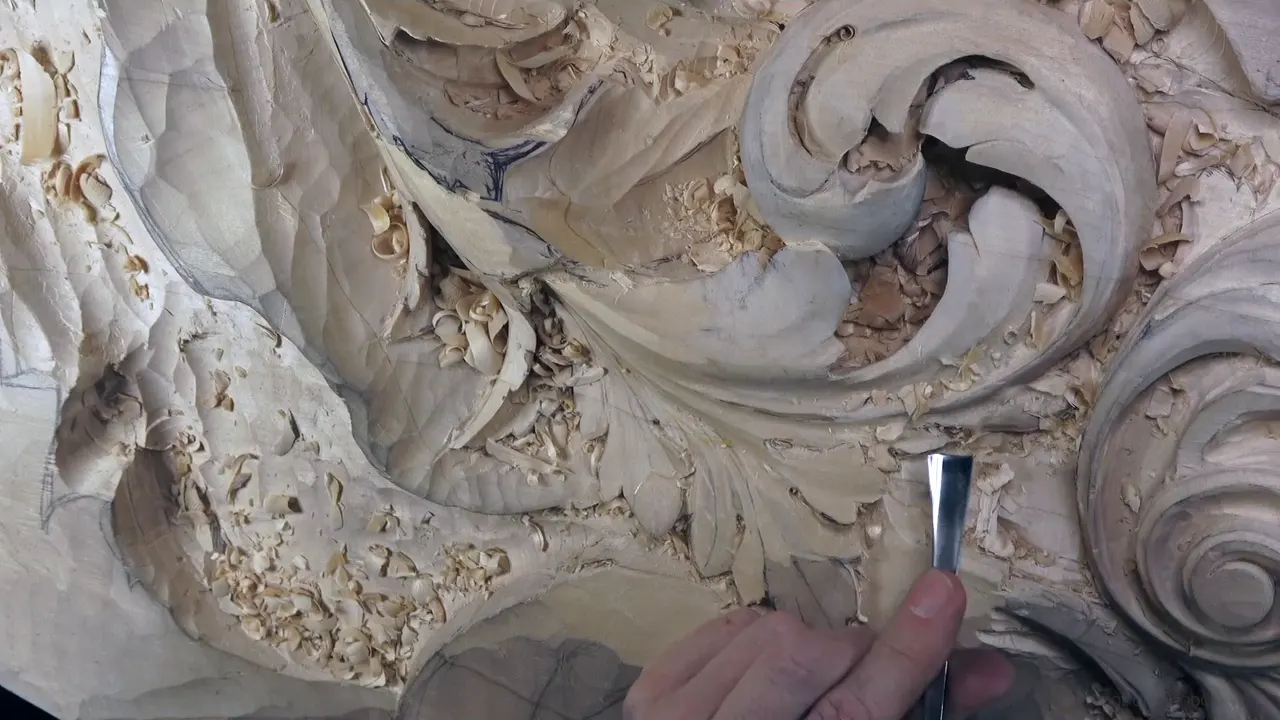
When I say I love it halfway through a carving, I am not calling the carving finished. I am saying the shape is going where I want, and the next job follows. A small concave comes right behind it in Venice Room 43.6.
Think about the last time a rough spot on your board looked good to you. You may have felt you had to clean the whole piece before you could say so. I did not wait. Below you will see where I said it, what I did next, and why one short word turns up in so many of my videos.

What came before the word in part 43.6?
The part opens on a mess. I wanted some of it gone right then, and I told you why it would not matter for the final look. Most of it, I said, would be covered with "the leafage, with the flowers." Even so, rough was not an option. "I'm not going to leave it rough," I said, with the cleaning still to come.
Tool choice came next: a straight tool, I said, "is not the best tool for the job," so a spoon was the one I needed. The cleaning I could get done off camera "with no problem," which spared you the watching. Back on camera, I paused, and then came the line, "Okay, let me think, and there is nothing to think, I love it."

What came right after "I love it, but"?
A "but" followed the second time. "I love it, but an area like that, I could give a small concave." The word closed nothing. It opened a job. That concave, I said, "will look really good in an area like that."
Then a check. "Okay, that is good. Of course, I need to make sure the edge of this movement is right and makes sense, otherwise, it's just not good." Liking a shape and testing it happened in one breath.
The clean-up went back on the shelf for a while. "And again, I'm going to clean it a little later, but now I'm going to jump somewhere else."

Which development did I like?
About a minute and a half later, I stood at the next spot. "It's already dry," I said, so I should be able to "carve around with no problem." Then came the line I chose for the title of this page, "I love the development, the idea I've got right here, I really like it."
The word landed on no finished leaf, but on an idea that had started to grow. "So that is going to be the movement." A list of what was coming followed: "nice divisions, beautiful movement," a line going "this way also," and one going "underneath the division."
The pipe still sat ahead of me, "and I still have to develop the pipe, but let me kind of outline that." The division was probably where I would start, and my liking was a green light.

The plan got deeper. "Well, actually, I got to get a little deeper right away." Next to it sat "somewhat deep excavation on inside," so that it would feel "like this is really growing from underneath." I also wanted to see if it was "dry enough or not."
Then the tool, "a smaller, number 11." Then I told you it was really good, "at that stage, okay?" The same words came again, "It is good at that stage." The stage belongs to the praise, and that is the part I want you to hear.

The part ends on the next job, "but now I will need to work around the pipe, I need to create that pipe right here." Good first, then what is still needed.

Does a pipe get the same treatment?
A pipe in workshop 43, part 2, got "a good pipe" from me, and I told you I loved it, adding "I really like it." Right behind that came a catch: "Although I need to give a nicer shape, that's not a big deal, I can do that pretty much right away."
That part has a mark in the wood, too. "Oh, I know what that is. It's just the glue line. Two pieces glued together right here, and I had a little void, but there, it all blends it." I could like the pipe and know a little void was in it. Later in the same part came a plainer line, "I should say excellent pipe," and then "I really love it."

Back in workshop 44, part 8, the same two beats show up. "A really excellent pipe," I called it, and I loved it. Then the job: "But now I need to blend that," so that no ridges showed "as of now." Shaving was what I was doing, and then I touched my concave. "But I can always clean it. It's better not to do that, but that is what it is."

Next came a shape in part 7 that is not final, "but it's a shape that I'm after." I told you I liked it so far, "a lot, actually." My next move was a small clean-up around it, with a warning to myself that it was "important not to dig too deep."

Why did I say I have to love it?
Digging eyes in workshop 43, part 3, I was careful about depth. "There is a certain point when it's going to be almost too deep," I said, for a couple of reasons. "I can make it too weak" was one, and the other was that I still had to finish it.
Four times in a row I said it, and the reason came right behind. "Of course I love it because I did it, and I have to love it, otherwise I'm doing the wrong thing."
Inside those eyes, I said, I could excavate "with a small number eight," and I stopped to see whether it would be "a little too big or not." A size came up, "this one is two millimeters approximately," about 5/64 in.

Part 5 of that workshop brings a detail I called "really, really nice," and I added "I think I love it," followed by "Nice and gradual." The next job was already waiting: "A separation or division, whatever is the best to call it," I said, and "I need to clean it."
Is liking a shape a reason to stop?
Workshop 42, part 6, begins with "But I love what I see." More detail was possible. Careful, though: "I can make it too weak, and that would be big mistake."
A smaller tool came into play. 1/8 of an inch, about 3 mm, was "a little too big," and I wanted "smaller, maybe two millimeters," about 5/64 in. My plan was "two millimeters or 1.5, but let me try two millimeters first, number 11."
Venice Room 41, part 6, gave me another one. Earlier I had shown how to turn the tool and shave "because of the grain." Here is the line: "I really love how this one looks, but I also don't want to see it too thick." Another part could follow, "maybe like that," and it would give me a more detailed look.

When do I leave a shape alone?
Take 42.9. A point on the carving in Venice Room 42, part 9, left me unsure whether I should do it. "I kind of love it," I said, then planned to leave it like that. Seconds later came "I'm glad I went with this detail."
My reason was "it's something different." A plain acanthus, I said, "probably would fly, but it wouldn't give me the feel of satisfaction." A "final, final" cut was not coming again, I said, because a future shell around that semi-final form still needed work.

The wish to keep a part shows up in Venice Room 35, part 5. I was after "concave, convex, concave," and gradual. Here is the line: "I really love the idea that this part is raised up, and I really don't want to lose it, that's what I'm trying to communicate."
My next words were, "Well, maybe even straight gouge, just like number five, let me do that." The liking and the wish to keep that part came together.

What do I keep liking in the movement?
"That is all junk, so don't pay attention to it," I told you in workshop 44, part 9. I loved the movement so far, I told you, and a wish followed. "I want to get this part below that part."
In workshop 45, part 2, a pipe needed a direction. "Beautiful movement." Then a direction: the pipe was "supposed to go from the eye." And, honestly, I loved "that development I just created, overall development, okay?" Go all the way, I said, "maybe with the smaller tool," and, "Let's do a concave on another side of the pipe."

In workshop 48, part 12, "Beautiful movement" came twice. I wanted more, "a much nicer movement, I should say." A concave right there had its reason, "because I want to raise a little bit this ridge." Before that, I wanted the ridges "gradual and nice."
A shadow got the full treatment in workshop 47, part 5. "And create even more shadow." Four loves came in a row, and then, "Okay, I've got really nice movement." Right after that: "Yes, I still have to clean it and so on, but it's okay, cleaning is a part of a job."

Does the word show up when a step is not needed?
The next one comes from Venice Room 66, part 11. Some of the stuff, I said, is "really not necessary, but I love it." Then I added, "sometimes I'm asking myself why don't I do it, yeah, there is no answer, why don't I do it, so I still would do it." Next, a small number five, "quarter inch, about 6 millimeters," and a caution about working "against the grain."

Another preliminary outline sits in Venice Room 71, part 11, "here you go." I planned to "give better shape to it" later. Extra "separations right there" were planned, and maybe more on the side, "because I love it, and that's going to give me a really nice curl in this round."

What about a whole piece?
There I invite you to judge. In Carving Furniture Panel 21, part 4, I said, "I'm not sure if you like it or not," and then, "I love how it looks." Next, "of course, I need to undercut underneath." Number 11 could undercut it right away, I said, and no more movements were wanted on that one.

The furniture panel design course has it in part 14.3 too. Next I showed you how it looks together, and I left the judging to you, though I thought it "looks really good," with "just a small section right here" still to develop.
Over in Venice Room 53, part 12, it was "Beautiful development." I asked you to look at the overall picture, "how it just flows nicely." That piece was going on the ceiling, and I asked you to comment, because it was "really important for me to know your opinion." Next I took a number 11 and a 4 millimeter veiner, about 5/32 in, to outline a little deeper.
What does the word hold, video by video?
| Where | What I liked in that spot, as I said it | Next job |
|---|---|---|
| 43.6 | The development, and the idea I had right there | Small concave, then a check that the edge of the movement made sense |
| 43.2 | A good pipe | A nicer shape, which I could give pretty much right away because it was not a big deal |
| 44.8 | An excellent pipe | Blend it so no ridges show |
| 43.3 | The eyes I was digging | Excavate inside them with a small number eight |
| 42.9 | A detail that was different from a plain acanthus | Leave it like that |
| 35.5 | A part that was raised up | Keep that idea, and carve around it, maybe with a straight gouge like a number five |
| 41.6 | How one part of the piece looked to me | Not too thick, and another part could follow |
| 44.9 | The movement so far | Get this part below that part, which is what I wanted to do |
| 48.12 | Beautiful movement | A much nicer movement right beside it, and gradual ridges |
| 47.5 | A shadow and really nice movement | Clean it, which is a part of the job |
| 21.4 | How the whole piece looked | Undercut underneath |
Each row is a different video of mine. The middle column is what I liked, and the right one is what came next. Nothing in the right column is "done" (every cell is work that came after).
The first row is the spine of this page: in 43.6 I said the word, then "but," then a concave, followed by one more check of that edge. So the word did not mean "finished."
How does it play out at the bench?
Take the spot in front of you on your bench right now, whichever shape is working for you. In these videos I name what works for me, and then I name the next job. For wood carving work like mine, the jobs I named were cleaning and blending, a concave and an undercut, plus one more look at the edge.
Reasons differ. In 35.5 the part was raised up, in 42.9 the detail was something different, and in 41.6 I liked the way it looked, yet I did not want it too thick.
In these acanthus videos a pipe got shaved and blended, while a movement got a nicer one beside it.
This page belongs to Venice Room, workshops 38 to 49. You will find 43.6 in workshop 43, along with 43.2, 43.3 and 43.5. Access opens every part, and I tell you the truth about what each one shows.
How it's done
- Name what is good. In 43.6 it was the development and the idea right there, before the wood was clean.
- Name the next job. Next, a small concave for that area, and the pipe not yet developed.
- Check the edge. That edge had to be right and make sense, otherwise, as I put it, it was just not good.
- Keep what you want. In 42.9 I left a detail I liked for being different as it was. In 35.5 a part raised up was one I did not want to lose.
- Watch for weak spots. In 42.6 a piece could become too weak, which is why a smaller number 11 was my plan right then.
Frequently asked questions
Does I love it mean the carving is finished?
No. This video gives a small concave as the next job, a check on the movement's edge, and a clean-up planned for a little later.
What did I like in 43.6?
A development, the idea I had right there, with divisions to come, a pipe still to develop, and deep excavation planned on the inside.
Why did I tell you I loved my own work in 43.3?
My reason was that I did it, and I tied it to doing the wrong thing otherwise. Digging the eyes had me watching how deep I went.
Can a carver like a shape and still change it?
What to carve next