
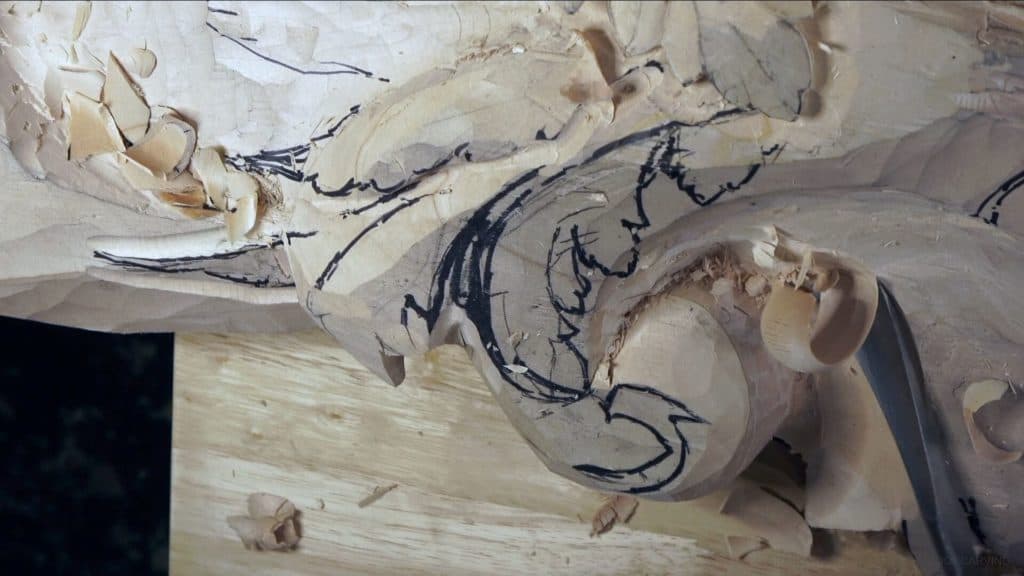
Alexander Grabovetskiy, woodcarver, School of Woodcarving · Published 2020
What does meat mean when a wood carver talks about a carving?
Quick answer: Meat is the wood I leave standing so a spot can be carved later. In the part this page grew from, I said I would need it for an undercut, then fixed it to material. Across other courses the same word covered handles, weak joints, curls and deeper shadows.
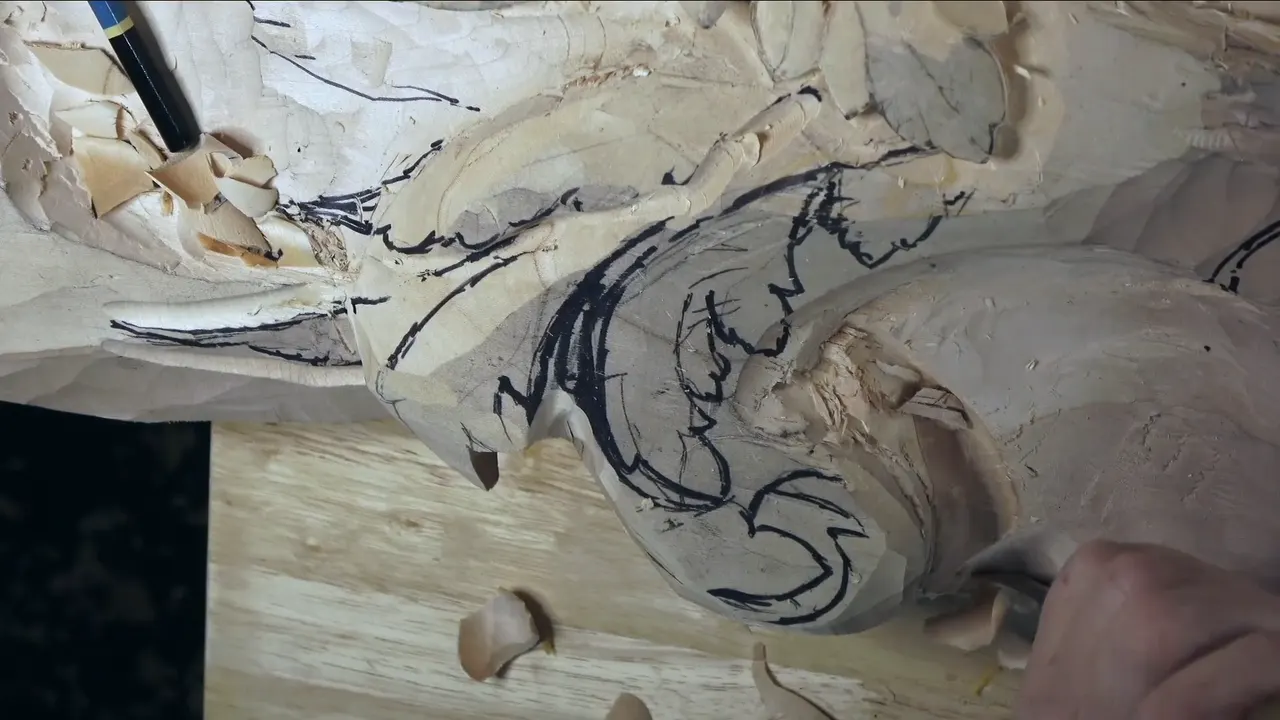

Meat is my word for the wood I leave standing on a spot so I can carve it later. In Venice Room 43.10 I say I still need meat for an undercut, then I fix myself: not meat, material. You will hear the same word in many other courses of mine.
Ever pushed a gouge down a leaf, then wished you had kept more wood under it? This part runs 396 words, so I put it beside my own lines from other lessons. Each line says why the wood stayed.
What did I say about meat in Venice Room 43.10?
The part starts low. Leaves could go lower, I say, and I take a number seven, one inch (25 mm), to one of them. At least this leaf could go much lower, almost all the way down, because I really have to expose the thickness at that spot.
Next I take 15 millimeters, 5/8 of an inch, number 11, and go around and around. That has to be gone also, and I don't need that part. I say I'm taking too much at once, and I think I know what I'm doing.

When I draw, I draw how it will look from the top. A flat drawing can't show where the real point will land, and here it lands near the spot I point to. About an inch and a quarter (32 mm) lower than the other point.
My plan was to rotate a little more on the inside, if it was a good idea, and I said I thought it was. The tool in that plan was a number five, one inch (25 mm) wide, to send the movement inward. Soon after, I wonder out loud if just a number seven is the better idea at this head.

Then comes the careful part. I'm right next to the opposite side, I say, and I don't want to make a mistake. For the undercut this way I still need some meat. Not meat, I say, but you know what I mean. Material. Just call it that way sometimes.
A little later it flips. At one spot I've got too much material, I say, and it is no good, so take it out. One part of the video holds wood I keep and wood I don't want.
The last lines are about the inside of the head. I don't worry about what's going on there, because flowers are going in, and I left that space for them on purpose.

Is it meat or is it material?
I catch myself on this more than once. Part 8 of Venice Room 23 has a section I will not take too deep, because I might do some movement inside it and need meat. Then "Not meat, but material," and then "Sometimes I call it like I need meat." Venice Room 3 gives the plain version, in its part 6,, after I say there is plenty. "When I'm saying meat, it's not really meat. I'm talking about just wood."
The sixth part of Venice Room 2 has the same habit. I stop short as of now, because that side still wants meat, "if you wish to call that way." Some material.
The nicest one sits in part 10 of Venice Room 46. I did not take too much out, I say, so I can create whatever I want. Just so much meat, and then my fix again, you know what I mean. So much material to work with.

The Furniture Panel does it on the background. The background can go down to the right depth, one-eighth of an inch (3 mm), and there is plenty of space for that, or plenty of meat, "plenty of material, I should say."
A slip in Lily Box 3 gets the same treatment. Some is left, I call it meat. Some wood. And while I work around an outline in Roman Acanthus 3, there is a lot of wood and material, "and I call it a lot of meat yet."
One more sits in the Antique Style Rosette lesson. The line there says meat, and in the next breath, wood. So the word means wood, and in the Venice Room I say so out loud.
What was the wood kept for?
Across the passages below, the wood waits for the next pass. The rest of this page gives each reason I said on camera, one passage at a time.

Room for the next movement
A smaller line sits in part 7 of Venice Room 26. I could dig a little deeper there because I need meat, I call it, for this movement. A little deeper, I say again, and maybe here too. Then one more word turns up, preliminary.
Then a plan for later. In part 9 of Venice Room 19 I don't want to lose a separation that will become an eye. Before that, I say, I want to make sure I do have some meat in those areas for the future separations also.

A bigger version comes from the Byzantine Acanthus class. The middle will still become a dish, a bowl inside, so I say not too deep. "Don't go all the way because we need the meat." The upper part will want it, since concaves and convexes come above.

In another lesson of that course I say don't scoop in, like a spooning, but go downhill. "We still need meat for the future development." A second word follows. We need that meat, that material, for the later development, because the concaves and convexes are still ahead.
Acanthus over Moldings has it on leaves that grow from underneath. Carefully, I work around them and keep some material, because I'll develop those leaves later on.
And in the Hashemi Flowers course I take an inch-wide number seven (25 mm) and clear a lot of waste. The pass stays small, I say, since detail goes on the inside later, and "I'm going to need some meat."
Wood for an undercut
The undercut is the reason in my own part, and I say it plainly there. The Byzantine class comes at it from the other side. See how much meat we have, I say, a lot of material on one side. So we can start undercutting there, and the final form gets a lot easier to establish.

The line before that gives a size. Undercut and undercut with the same tool, but leave approximately quarter inch (6 mm) for now between the ridge and the hole. Then go in from all the sides of that hole.
Strength for a thin part
Floral and Molding for the Panel, lesson 14, puts a weak point into words. I make sure I have enough meat at the end, because the connecting point to my shell has to have some, "otherwise, it's going to be too weak." The grain runs that direction, and that makes a really weak point, so I make sure it's not too low.
A joint of another kind comes up in part 1 of Venice Room 53. A corbel is going to connect at one point, which means I have to leave some meat where I connect it. I plan to use probably really large Festool dominoes to join the corbels on the side.

The same case comes up in the olive lesson of Lily Box 13. I shouldn't finish it yet, since I still have to work the backside, and the parts are fragile even now. Take a lot more material and they become even more fragile, which would be a big mistake.

The rosette lesson shows a knife version. I leave one section on purpose, because I need meat, I need wood there. Otherwise it's easy to chip. Later in the same lesson my knife goes about a 16th of an inch (1.6 mm) deep, no more than that, because this section is only an eighth of an inch (3 mm). I'd rather make two cuts, three cuts, than snap it.
One keeper is a handle. In the Tray of Blessing course I point to one side and say it's going to be your handle, so you don't cut more. Keep that meat about 10 millimeters or three eighths of an inch, enough to grab with the hand, because it becomes your handle later on.

Curls, flips and smaller leaves
Venetian Flowers Rosette 2 has curls coming, I say, and two spots need extra meat. My plan is half an inch (13 mm) of distance at the ends. I also say a different gouge would be better: a number nine, about 20 millimeters, three-quarters of an inch, will work probably the best on that area.

Lesson 9 of the Lily Box course has a flip. Maybe, I say, I do have some real estate or some meat, and I can give a flip. I plan to use a number 7 and try to curl it a little. I also say I'm going to make it a little round, because the void continues on this side.
A wall bothers me in Hashemi Flowers 39, and I don't like it. But I have extra meat on one side, so I could create an even smaller leaf under the leaf. A knife goes first, and I say you can do a lot with just a knife.
In Carving Hazelnuts 4 two pieces are going to lay pretty much right on the floor, so one will sit higher than the other. So some meat has to stay for that.
Going deeper for shadow
The wood becomes a choice in Furniture Panel 29. I can probably go a little deeper, I say, because meat is there. So let's use it and create some deeper shadow. Why not? Furniture Panel 26 says it about a flute concave: not too deep, but it looks like I'm able to dig deeper because some meat is left.

Another Byzantine lesson pushes the other way. Don't be afraid, I say. We have a lots of meat and thickness, which is why the first layer did not go through. And don't be afraid to be too deep, because we are after all the shadow we can get.
Rescuing a slip
A section popped in the same course, lesson 16. I lost a little detail, I say, though I'm not sure I lost it. I'll try to save it, because it still has some meat. That was my mistake, and it's okay.
A slip came in Lily Box 3 right after a half a millimeter (0.02 in) pass. I can just blend it downhill, I say, since one of them will end up lower.

Sometimes the wood runs short instead. Under a flower in the Grinling Gibbons class in Maine, lesson 12, I look and find almost no material left at the center. Some meat is on the sides. So I'll probably change the style of that flower. I like that about wood carving in general, I say: you can change stuff and nobody's going to know, and it still looks nice.

Does the word show up at the sharpening bench?
Twice, in one lesson. The Sharpening Straight Gouge lesson has me talking about a really low bevel angle. You can still use it on oak, I say, but the probability of breaking it is much higher, because you don't have too much meat left right here. The grinding part of that lesson uses it again. I got too close to the edge, I say, but some meat stays in the center, so I don't have to reach the edge right now and can concentrate on the middle section to make a uniform bevel.
Which moments line up in one table?
Eight of them are lined up here, with the job and my words.
| Where I said it | Why that wood stayed behind on the piece | My words |
|---|---|---|
| Workshop 43.10 | Wood kept on the far side for the undercut | Not meat, material |
| Workshop 23.8 | A section left shallow for a movement inside | Sometimes I call it that |
| Floral Molding 14.1 | The joint to the shell, or it gets too weak | Not too low |
| Lily Box 13.3 | Fragile wood still to be worked on the backside | The reason why I need that meat |
| Tray of Blessing 6.2 | A handle to grab with the hand | Keep that meat |
| Byzantine Acanthus 9.2 | A big mass on one side to undercut | See how much meat we have |
| Roman Acanthus 3.2 | A thick piece of wood, outline still rough | A lot of meat yet |
| Furniture Panel 29.3 | Room to go deeper for a shadow | So let's use it |
Each row is a place where I said it out loud. The first row keeps the word with the undercut, and the second shows me taking it back again.
What do I take from all of this?
The word moves from one job to the next. On one board it was an undercut, and on another it was a handle. On a third it was a weak joint. On the sharpening bench it came up twice, once beside a tool that can break. My part here is small, with one undercut, one correction and one spot where I had extra.
Which spot on your own piece still needs some wood left? My choices are on camera in 43.10, and the lesson 43 page covers the whole workshop. For every lesson in one place, start here.
The Venice Room course for workshops 38 to 49 holds the rest of this wood carving. Every figure in millimeters and inches on this page is mine, with the conversion beside it when I did not give one.
How it's done
- Mark the wood the next pass needs. In my part that was wood near the opposite side, for the undercut.
- Keep a weak joint thick. On the shell joint in Floral and Molding 14 I said it has to have some, or it is too weak.
- Leave a handle's worth. A handle in that tray lesson took 10 mm (3/8 in) of wood you can hold.
- Look for extra wood before a new idea. In Hashemi Flowers 39 extra wood on one side meant I could try a smaller leaf under the leaf.
- Name the wood you can remove. In my part I called one spot too much and told myself to remove it.
Frequently asked questions
Does meat mean wood or something else?
Wood. In Venice Room 3.6 I said it's not really meat, I'm talking about just wood. Later, in my own part, I said not meat, but material, and that I just name it that way sometimes.
What did I want wood for in this part?
The work was near the opposite side, and a mistake was the worry. For the undercut this way, I said I was still going to need some.
Did I ever give a size for it?
Twice. The tray lesson says to keep about 10 millimeters or three eighths of an inch, enough for a grip. Approximately quarter inch (6 mm) between the ridge and the hole comes from the Byzantine class.
What to carve next