

Alexander Grabovetskiy, woodcarver, School of Woodcarving · Published 2020
What does it mean to reestablish a movement in wood carving?
Quick answer: Reestablish is my word for putting a movement back on the wood after carving has taken its lines away. In Venice Room 43.11 a number seven rounds a shape, and my next words are about reestablishing my movements. Other courses show a pencil, a knife and a small gouge doing it.
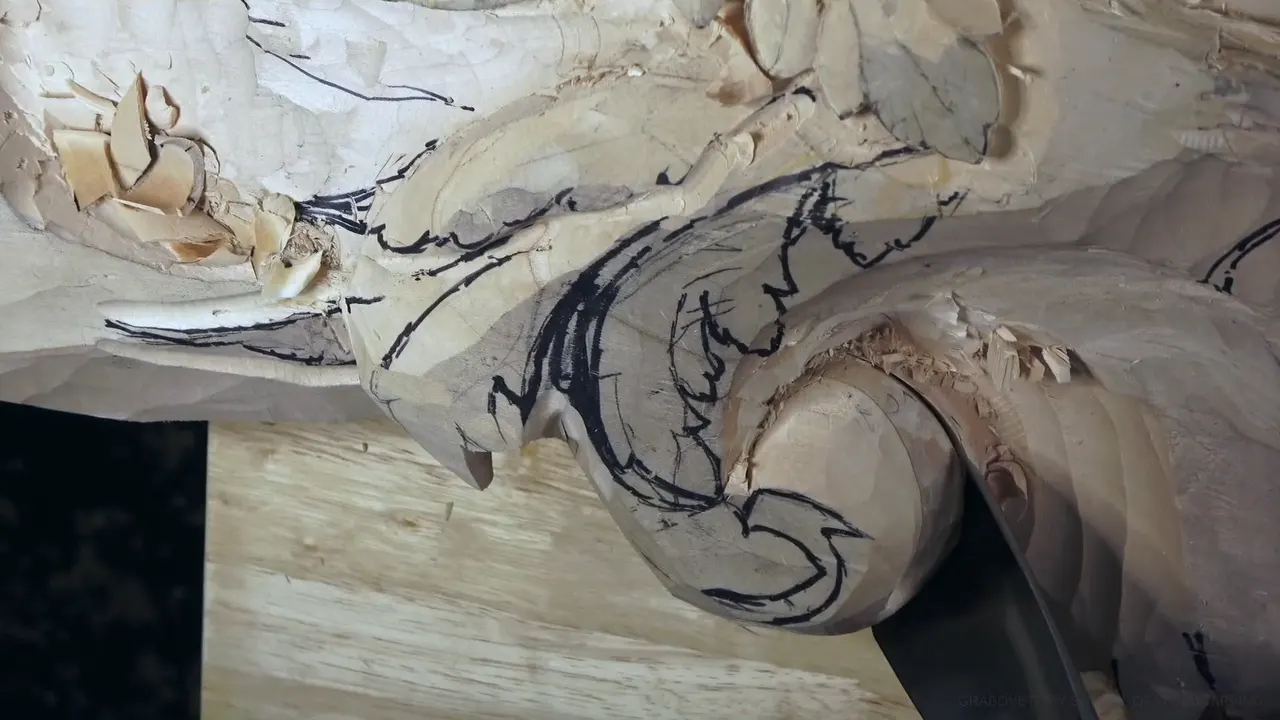

To reestablish is my way of drawing or carving a lost line, eye or movement back where I want it. In part 11 of Venice Room workshop 43 a number seven finishes rounding a shape. Just after that I say, "now it's time to reestablish my movements." You will hear the word in my other courses too.
Ever drawn a line on a board, carved past it, and then stood at your workbench staring at the spot? This part runs 377 words. Twenty-five more of my video parts sit next to it here, some from this workshop and some from other courses. Each one tells what came back.
What does reestablish mean in Venice Room 43.11?
The word lands at 04:32, near the end of the part. Four seconds earlier I say, "So let me put this tool away." The number seven has just rounded the shape. Next I ask which division will be there.
Two things stay: "this one still remains in the same spot, and that one remains in the same spot." Other parts change. A shape downhill like that is needed, and this needs to be rounded also this way. One line says what I want to keep: "But I do not want to lose this movement."

One more idea comes up. This movement can grow from underneath of that one. The step I have to do is take big, probably just number 11, like 15 millimeters (0.59 in), and create my preliminary cut.
How I want to do it is still open at 05:51. By 06:32 the plan is "probably just a skew" to start shaping this way. The last lines of the part describe the shape, not the tool: it has to be gradual movement, "so gradual and beautiful."
Why did a number seven round the shape first?
It fit. I reach for it at 00:23: "Let me use big number seven." A few lines later comes "see? It just fits perfectly." Moving inside comes next, I say, and that will give me perfect roundness.

A line about design follows. When I designed that movement, I had to keep in mind the tools I own, "what I have to fit." My words are "followed, followed, followed, followed": all I did was go along the radius or sweep of this seven, and that gave me perfect movement.
The look matters from every side. The movement is going to look really good from the bottom and from the sides, I say. In this case I have to make it really nice, because it's going like a bowl.

Around 02:45 a flat spot shows, or it looks that way. But when you place a tool like that, I say, it's not much that needs to be taken out. By 03:29 I call it "clean and nice."
Then, at 04:08, I call the result almost a perfect sphere. Almost, because it's not perfect and I don't need it to be: part of it is going to go, and more development will go on there. After that comes the line about my movements.

What do parts 9 and 12 show?
In a few seconds, part 9 says it three times. I say let me reestablish the movement, and then I name two more things that need the same. Then comes a promise: "It will make sense. You'll see it, I promise."
A warning sits earlier, at 00:26. If I excavate too deep underneath, I won't be able to blend it nicely, so I need more care and a more gradual move downhill. At 01:21 I add that you will see the development I have in mind.

It returns at 05:17. I could get this movement from down below upward, I say, and that would look good, but I still need to make it lower in this area. A little before it, at 04:48, comes the worry again: "I do not want to lose overall picture."
Reestablish never shows up in part 12, yet the same work is there. Maybe number three, I say at 01:03, will help me establish nicer movement. The worry is the same at 04:29: losing this movement, which goes all the way right there. Later, at 05:43, I plan to make my movements more pronounced with the bigger one.

Which tool puts a line back?
Start with the plain case. In Flower Rosette 3, part 4, I check one thing against another and say it does look the same, and I'm happy with that result. "Now I need to reestablish my center. That's easy." I take my pencil to draw a straight line and reestablish my petals. A V-tool for the groove comes next.
Next comes a knife. In Flower Rosette 6, part 2, I bring the middle line back with the same knife. If you don't have many tools, I say, you can still do low relief carving with just a knife.

A gouge works too. The Greek Acanthus Leaf course, lesson 4: before I lose this detail, I say I'll place my pencil mark, and maybe I'll use a different tool. I'll use number eight, 7 millimeters (0.28 inch), and reestablish my line. I'm talking about my pencil mark line.
The Roman Acanthus course, lesson 4, has me losing an eye. Looks like I lost another one, I say, and I will reestablish it. I'm just eyeballing my grid. I'm trying to find those lines and make parallel. Before too late, I say, let me take my small gouge, number eight, an eighth of an inch (about 3 mm), and reestablish my eye.

Calipers can hold the line too. The Venetian Flowers Rosette course has me keeping those calipers with the measurement, so I can reestablish the line quickly. Later I say it's time to reestablish my line for the future molding, and I remind you that I used calipers to measure exactly where the line will be. It doesn't have to be perfect, I'm pretty close.
In a few spots I'll put my marking, I say, then place my finger against that ridge and use it as a guide. That's going to give me a pretty accurate line, and "obviously, I have to check." Next is number 11 at 7 millimeters (0.28 inch). That's a little bigger than a quarter inch. Just the right-hand side of my tool will shave the side.

What if you lose a line?
I've said it's okay more than once. On Venice Room 3, part 6, it goes: "Now I lost my lines, but it's okay, I can always reestablish them." I'm not afraid of it, I say, as long as I'm not losing overall movement, which is supposed to be underneath.
Venice Room 59, part 3, sorts the lines by what matters. Before I would lose it, I say I'll reestablish the middle line right here, and this part is going to go below. Enough depth has to be there to create that movement. I don't worry about losing a boundary line. All I need right now is just the main movement, which is what I worry about.

The Floral and Molding course has an exception. In lesson 1, part 2, a point is at risk, and I can bring it back a little later, no big deal. "But sometimes, to keep that point, it's a good idea." In this case I know the part will be much lower, and I'll take a number 11, maybe about 18 millimeters, about three-quarters of an inch, and let me make an outline cut.
Lesson 6 of the Hashemi Flowers course shows me almost losing my original design, "although I'm not that worried, I can always reestablish it." I'll take a V tool, I say, and make my separation cut again. The Furniture Panel course, lesson 20, has the same ease: I don't worry about losing the detail, so I will reestablish it. I know exactly what it's supposed to look like.

Where do you look for what to put back?
Stepping away is one way. Looking from different positions helps me visualize better what's going on, I say in Venice Room 69, part 12. It looks good from one point of view and not from another, and I need to reestablish. Good practice, I say. Step away for a couple seconds: if it makes sense, it's good, and if it doesn't, change.
Reading the list is another. Floral and Molding, lesson 10, has "Let me actually look what I have to reestablish." A part comes from here all the way through, goes underneath and becomes part of that acanthus, I say. That part has to come lower, not that much, but still lower. I name a small number nine next, a quarter inch (about 6 mm).

A photo helps. In lesson 5 of the same course I made a picture again on my phone and flipped that image. That's going to be a lot easier for me to reestablish whatever I need as far as the drawing, I say, so I can place it right beside that. It's a matter of copying: "It doesn't have to be perfect."
Leaving the drawing alone is a third. Venice Room 150, part 1: I could chop right away, but I don't really want to redraw everything. So I outline that part, and it's a lot easier to reestablish the original drawing by chopping around. I need something flatter, maybe number two, and I'll take five-eighths of an inch (about 16 mm) and go down right on the line.

Which lines came back in other Venice Room workshops?
Measured work comes in Venice Room 79, part 9. There is no room for error, I say, absolutely none, so I'll reestablish those flutes and this movement. "Now I know it's going to be there." Maybe I have to double-check where my middle is. I can safely outline everything once that is done: about 10 millimeters (0.39 in), which I call three-eighths of an inch, and I'm safe.
The same workshop's part 8 postpones it. I have to roll a part down, so I'll reestablish my movement right on the bottom and knock some of this material. "Although I really don't have to, I can do it a little later, too."

Two pipes are exaggerated in Venice Room 62, part 5. I can reestablish my middle line with no problem, I say, or middle spine, and then I wonder which word is best. Lowering my middle lines is absolutely okay too.
Next, Venice Room 71, part 11, moves on to a shell. I'll reestablish my convexes and the concaves, I say, and I name them: a convex, another convex, and the rest concaves. I plan to do it little by little, because I need to be really careful in this area and it is better for me not to rush.

By part 9 of Venice Room 49 the main shape is in, and you can see how it moves. Time to create better divisions, I say. The middle line comes back, I say. That will be a pipe, and that is the eye.
Does the word ever mean something else?
One lesson separates a form from a movement. The Lily Box course, lesson 3, has me saying I'll use one millimeter (0.04 in) and try to reestablish my form. I correct myself: my movement, not the form. Just reestablish the movement. I think it looks much better.
The Kitchen Cutting Board workshop, lesson 14, calls it a flow line. Let's reestablish this flow line, I say. I call it flow, F-L-O-W, because it's flowing all together, and everything has to go to the same line.

On the sharpening bench it is a bevel. The Sharpening Large Gouge lesson has me saying I'm not going to reestablish my bevel, because I really like to maintain the original bevel. I use my mallet a lot with this tool, so I can't do a really low angle on it. The Stropping and Compound lesson names stage number one as: grind and reestablish your bevel.
How do eight of the moments line up?
Eight of the moments are lined up here, with what I put back and what I named.
| Source | What came back | The tool or measuring aid I named |
|---|---|---|
| 43.11, Venice Room | The movements, after the seven rounded the shape | A plan: number 11, then a skew |
| 3.4 in Flower Rosette | The center and the petals | A pencil to draw the line, then a V-tool |
| 6.2 in Flower Rosette | The middle line on a rosette | The same knife |
| Greek Acanthus 4.3 | The pencil mark line, before I lose the detail | Number eight, 7 mm (0.28 in) |
| Roman Acanthus 4.3 | An eye I had lost | A small number eight, 1/8 in (about 3 mm) |
| Venetian Flowers Rosette 1.3 | The line for a future molding | Calipers, number 11 at 7 mm (0.28 in), a finger |
| Floral Molding 10.2 | The part that had to go underneath | A quarter inch number nine (about 6 mm) |
| Lily Box 3.6 | The movement, not the form | The 1 millimeter tool (0.04 in) I said I'd try |
Each row names a tool or a measuring aid. In 43.11 and in the Roman and Greek rows, the tool is a plan.
What do I take from all of this?
One job runs through these lessons: bringing back a lost movement, eye, middle line or bevel. The tool changes in every row, and in part 11 the round came first, with a number seven.
Which line on your own board went missing last? My choices are on camera in part 11, and the lesson 43 page covers the whole workshop. For all my lessons in one place, start here.
The Venice Room course for workshops 38 to 49 holds the rest of this acanthus carving. These videos come from my wood carving courses, and every figure in millimeters and inches on this page is mine, with the conversion beside it when I did not give one.
How it's done
- Put the tool away. At 04:28 the sphere is almost perfect, and I say the tool goes away.
- Say what stays. One spot remains where it is, I said, and the other one does too. What has to change is a shape downhill and a rounding this way.
- Mark the line you lost. For the rosette center in Flower Rosette 3.4, I said a pencil line comes first, then a V-tool for the groove.
- Pick a tool for the size of the line. For an eye in the Roman acanthus lesson I said I'd reach for a number eight.
- Step away and look. At Venice Room 69.12 I looked from different positions and said if it makes sense, it's good. If it doesn't, change.
Frequently asked questions
What came right before the word reestablish in this part?
The number seven rounded a shape, and I said it just fits perfectly. I called the shape almost a perfect sphere. Next I said let me put this tool away, and my words turned to my movements.
What tool did I name for the preliminary cut?
Big, probably just number 11, like 15 millimeters (0.59 in), to create my preliminary cut. A plan, said at 05:19. By 06:32 it was probably a skew for the shaping, a plan too.
Do I mind losing a line while I carve?
In Venice Room 3 and again in 59 I said I can reestablish a lost line. What matters is the overall movement. In 59.3 I put it this way: all I need right now is the main movement.
What to carve next