

Alexander Grabovetskiy, woodcarver, School of Woodcarving · Published 2020
Why does a wood carving look boring when every part is the same?
Quick answer: A boring wood carving is one where every part is the same and there is not enough movement. In Venice Room workshop 45, part 2, I went for the eye of an acanthus leaf, called the movement not bad at all, and said at least something was different. Otherwise, it's just a little too boring.
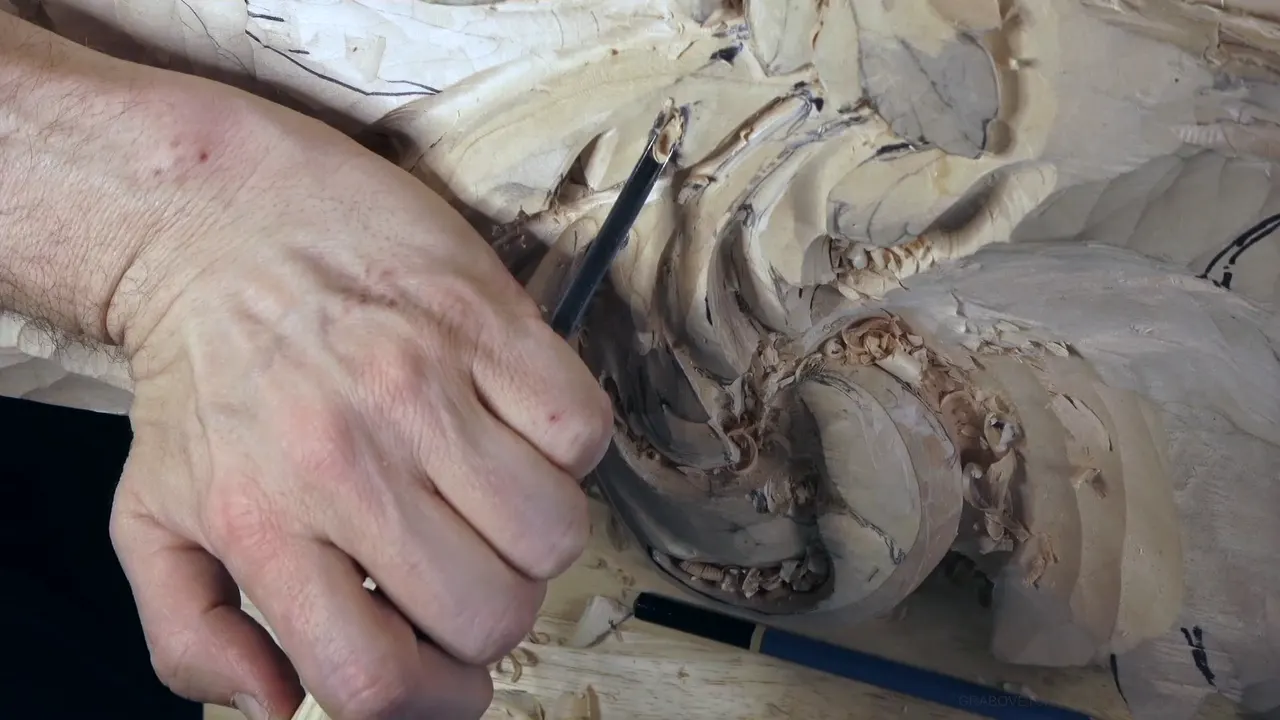

Boring is my word for a carving where everything is the same and nothing moves much. Workshop 45 of the Venice Room has it in part 2. Right after carving an eye on an acanthus leaf, I judged the movement a decent one. Micro-separations were still to come.
Have you ever walked past a fence where every post is the same? Did your eye move on almost at once? A carving does that too. I have one plain word for it, and it comes up in many of my lessons. This part is short, so beside it I set the other wood carving lessons where the word came up, and what I did about it each time.
Where the word comes up in my lessons
- The eye in workshop 45, where a new movement gave the leaf something different.
- A Furniture Panel leaf, where I said what the word means to me.
- Small flowers whose petals point two ways.
- A plain line and a plain barrel, and the waves and concaves I planned for them.
- My own bench, where changing tools keeps me from getting bored on the same task.
- Clean-up I leave off camera, and why.
What happened in part 2 of workshop 45?
The part opens on dividing. I can divide this wood properly, I say, with no problem. Then comes "Well, I don't know." My next thought is a maybe: maybe I should give a bigger opening, which you sometimes see actually in original work.
That question had been open since the end of part 1. There I thought I should repeat what I had done in one spot, then said "Maybe yes, maybe no," because it doesn't have to repeat everywhere, or it will look too much alike. A much bigger opening came up then too, with a catch. If I make the opening, I have to take care of the piece underneath, and I'd rather not spend a long time cleaning up a spot for no need.

In part 2, "Get the eye," I say at 01:03. For about half a minute after that the video shows my hands working and I say nothing. At 01:42 comes the verdict. Not a bad movement at all, I think, and of course micro-separations will come a little later. But at least something different, not everything is the same. "Otherwise, it's just a little too boring."

Then "let me take out that corner," and half a minute later I say it gives me opportunities for a nicer movement. That pipe is not in the right direction. It's supposed to go that way, I say. I probably need to blend a little better and just take out the whole thing right here, because it just doesn't make sense. Number three is the tool. Twice I say the same plain thing: carefully removing what I don't need.

Working inside like this, I have to be really careful not to dig too deep. My tools are super sharp. See how long a bevel I have? Like a doctor's tools, like a surgeon's, so it is really easy to dig inside the fibers. You can actually shave yourself with it.

Beautiful movement, I say at 04:15. Now I can give that pipe the right direction, since it's supposed to go from the eye. And I love the development I just created. Overall development, I repeat, overall. Maybe a smaller tool will take it all the way.
Let's do a concave on another side of the pipe, I say next. I need a smaller one again to get underneath, and even deeper, because that part has to overhang. Hang over, I should say, I add a moment later.

I could blend pretty much this pipe, I say, and this side. Hard area. But it's not like it's impossible, and too strong a ridge right there is what I want to avoid, while the ridge that runs to one point has to stay. So the plan is the same number three and a really careful pass right on the side, and at 07:05 I say I'm going to leave it like that.

Last comes a wall. It could be gone by now, I say, and I could give it a much cleaner look, especially since not too many divisions are going to happen there. Then I ask you to see what a beautiful shadow it casts. Gorgeous area. I like that, I say, and it comes three times in a row before one more, I like this. Of course, it's not done yet, but I like it.

What do I mean when I call a carving boring?
Furniture Panel lesson 31, part 3, spells the word out, starting at 03:59, when one spot on a leaf there looked too boring for me. Let me excavate a concave right here, I said, and then came the meaning of the word, not enough movement. Then more excavating, I said, this way and this way. The whole leaf didn't look organic enough for me, so I wanted something more interesting, starting with a big separation cut.

A half-done stage can look that way too. In class 10 of my Grinling Gibbons course in Maine I took a small skew, about six millimeters, a quarter inch, held it upside down, and began preliminary separations. It doesn't look too appealing yet, I said. Just too boring.
The word "yet" is doing the work there.

Why would identical petals look boring?
The rosette in Chamomile and Bow Rosette lesson 1 has several chamomile flowers, each small, just about an inch or so (about 25 mm). The first one got three petals going uphill and curling back, a middle part that is kind of interesting, and two going downhill. That part is optional, but I think it's a good idea. Doing exactly the same on all of those would be boring. That's why I did some up and some down, and it gives me a beautiful shadow too.

Venetian Flowers Rosette lesson 3 says it about the petals of one flower. Every petal is supposed to be a little different. No need for them to match, and if you want, you can be as creative as you wish. Then I wanted another concave on one side of a petal, since otherwise it just looks too boring, and my next words were to get number 11 again.

What did I do with a line that looked too plain?
I planned waves.
Venice Room 110, part 2, had a section pretty much done, and I kind of didn't like one line on it. Too boring, I said. Why don't I make some waviness, like real-life waves, right on the edge? Slight concaves and convexes could go that way too. I hoped it would give a more beautiful look, and my plan was just a knife on that edge.
Class 17 of the Gibbons course has the same fix on a petal. One petal was just a simple arch. The bigger petals had some waviness, and I wanted to see exactly that here. If there's not going to be a wave, I said, it's going to be boring. Its end would bulge out, with a short pass at each concave, and the same number eight I used before could do it.

In Floral and Molding for the Panel lesson 12, part 3, the next target was what I call the barrel of a volute, because I don't know how else to call that thing. The plan was a small concave and a convex in the middle, convex, concave and concave, all going around. That way it won't be so boring. Next on my list was a number nine spoon gouge, really small, a tiny one, to attack it with.

Is a straight line always the dull choice?
On a molding it is one choice of many. Venetian Flowers Rosette lesson 6 looks at one from above, and there are a lot of different ways to develop it, even when the idea stays the same. Straight passes are one, with everything wrapping on its own inside. I didn't want that. Too boring. I wanted some movement, a little different, so with the calipers I found a spot approximately in the middle between two earlier lines and planned to carry that line all the way to the intersection point.

In Modern Acanthus lesson 6, part 3, I asked you to look from different angles. If a line is a little too straight and not flowing, fix it. Rotate, kneel down, look from other points of view. Then the pipe I was on was going to go uphill to the eye, otherwise it's too boring, and it would cast a little different shadow. A number seven held at about 45 degrees, just its left side, was my plan to knock that down, nothing too crazy, a slight rise.

Does the carver get bored too?
I do, and I said it in Venice Room 76, part 1, about a spot that could stay like the original I designed at the beginning. Something different gives a little more movement, though, and it won't be as boring. Sometimes you get bored with the same elements. I'm not joking, I said, carving all day long, just the same movements all over, you really want to do something else. That spot became a really deep excavation, maybe about a quarter inch in (about 6 mm), and a little later I had about one millimeter (about 1/25 in) thick left.

Changing tools does the same job for me.
In Greek Acanthus Leaf lesson 13, part 2, I picked a small, really short number one with a double bevel. They used to call those ladies tools, I said, but they are not ladies tools. When I change tools, the work stops feeling so dull, because you can get bored using the same tools all the time. First, you train yourself on different tools, and second, you just eliminate the boredom.

Roman Acanthus lesson 7 has the long version. I've got lots of tools, and I'm using most of them. Even for the same task I sometimes reach for different tools. You get bored with the same tools, and sometimes you want to challenge yourself.

In class 12 of the Gibbons course, let me grab number 16 again, I said, and you could use a number 11. But sometimes you have to change tools. The same one over and over becomes boring after a while. The acroterion in Greek Acroterion lesson 4 had a different sweep in my hand, a number five of about five-eighths (about 16 mm). A knife could go there too, I said, but it's all right. I need something different too, for not being bored.
Then there is the extra detail. Venice Room 16, part 9, has me wanting one side down more, underneath, to bring out a separation, an extra detail I said I didn't really need to do. Ask me why. I have no answer, I just think it's going to look much better, and something extra like that makes me happy. It's not boring every day, the same thing.
The big version sits in class 6 of the Gibbons course, where I said simple projects are just boring for me. There's no reason to travel up to Maine from Florida for that. It's ambitious. It's hard, and I said so at the beginning.
Which parts of a lesson go off camera?
Clean-up, mostly.
In Venice Room 7, part 8, I said all that stuff I can do off camera, because it's kind of boring. The plain version is in workshop 63. It's a boring process, so all of that is for off camera. Some of it could be done with the number seven still in my hand, I said, and the skew helps a lot there.

Workshop 85 had me leaving about six millimeters (about 1/4 in) to the line, because it felt safer to clean up to it later. That process was kind of boring, I said, nothing special about it, so getting rid of the voids could happen off-camera. Same in workshop 87. I really didn't want to make it a boring process, so softening and cleaning were for off-camera too. In workshop 145 all the cleanup could happen off-camera, I said, since it doesn't have to be boring, and that day I planned to cheat with rasps, though I don't know if it's cheating or not.
Even the music has a reason. Back in Venice Room 2, part 10, I asked if music in the background helps or not. I try to keep it low. But when it's too quiet back there, I said, it's just boring, so let me know if it distracts you.
Where did I call it boring, and what came next?
Eight of those moments sit in one place here.
| Lesson | What looked too plain to me | What I did or planned there |
|---|---|---|
| Venice 45.2 | A new movement at the eye of the leaf | Micro-separations, later on |
| Panel 31 | A spot inside one leaf with too little movement | A concave right there |
| Chamomile 1 | Small flowers that could all come out alike | Some petals up, some down |
| Flowers 3 | One side of a petal left plain | Another concave, with number 11 |
| Flowers 6 | Straight passes that wrap inside on their own | A line to the intersection point |
| Molding 12 | A volute barrel that was still plain | Convex and concave in the middle |
| Venice 110 | One line in a section pretty much done | Waves along the edge |
| Gibbons 17 | One petal shaped like a simple arch | Waviness like the bigger petals |
Most of the last column is what I said I would do. A plan.
How can you use it at your own bench?
Three things I said straight to you. Look from different angles and kneel down, and if a line is too straight and not flowing, fix it. Let every petal be a little different, as creative as you wish. And change tools now and then, since that trains you and takes the boredom away.
The lesson 45 page holds all twelve parts of this workshop, and the course page holds the rest of this Venice ceiling board. Repeating one idea across a design is a different question, and workshop 41 has it. Got a leaf on your bench where every lobe is the same? Then you know the word I mean. My lessons sit in one place, and you can start here. Part 2 itself ends on a wall I could still take out.
How it's done
- Get the eye. I wondered about a bigger opening, the kind you sometimes see in original work, and then went for the eye.
- Judge the movement. Looking at it, I judged it a decent movement. Micro-separations were still to come, but one thing, at least, was different.
- Turn the pipe. That pipe ran the wrong way, so with a number three I carefully took out what I didn't need. After that I could give it the right direction, from the eye.
- Plan the other side. A concave was the plan for the other side of the pipe, with a smaller tool again to get underneath, because that part has to hang over.
- Keep one ridge. No strong ridge there, yet the one running to the point had to stay. The plan was the same number three and a careful pass on the side, and then I said I'd leave it like that.
Frequently asked questions
Does a boring carving mean a badly carved one?
In this part I called the movement not bad at all, and what I liked was that one thing, at least, was different. The Furniture Panel is where I explained the word as a lack of movement, and the fix I went for there was a concave on one spot of the leaf.
Can switching tools stop a carver from getting bored?
For me it helps. Changing tools on the same task makes the work less dull, I said in my Greek acanthus lessons, and you train yourself on different tools too. In the Roman acanthus course I said the same tools get boring, and sometimes you want to challenge yourself.
Why do I clean up off camera?
I said several Venice Room clean-up jobs could go off camera, because the process is boring, with nothing special about it. Workshop 63 has it plainly, and in workshop 145 I added that cleanup need not be boring, planning rasps that day to move it along.
What to carve next