

Alexander Grabovetskiy, woodcarver, School of Woodcarving · Published 2020
What does "the wrong way" mean when a wood carver says it?
Quick answer: The wrong way is a phrase I say beside a cut across the grain, a pass toward myself, boards glued with rings running alike, and tools laid out on a bench. Workshop 45 of the Venice Room, part four, had me calling one area more dangerous if I did it the wrong way.
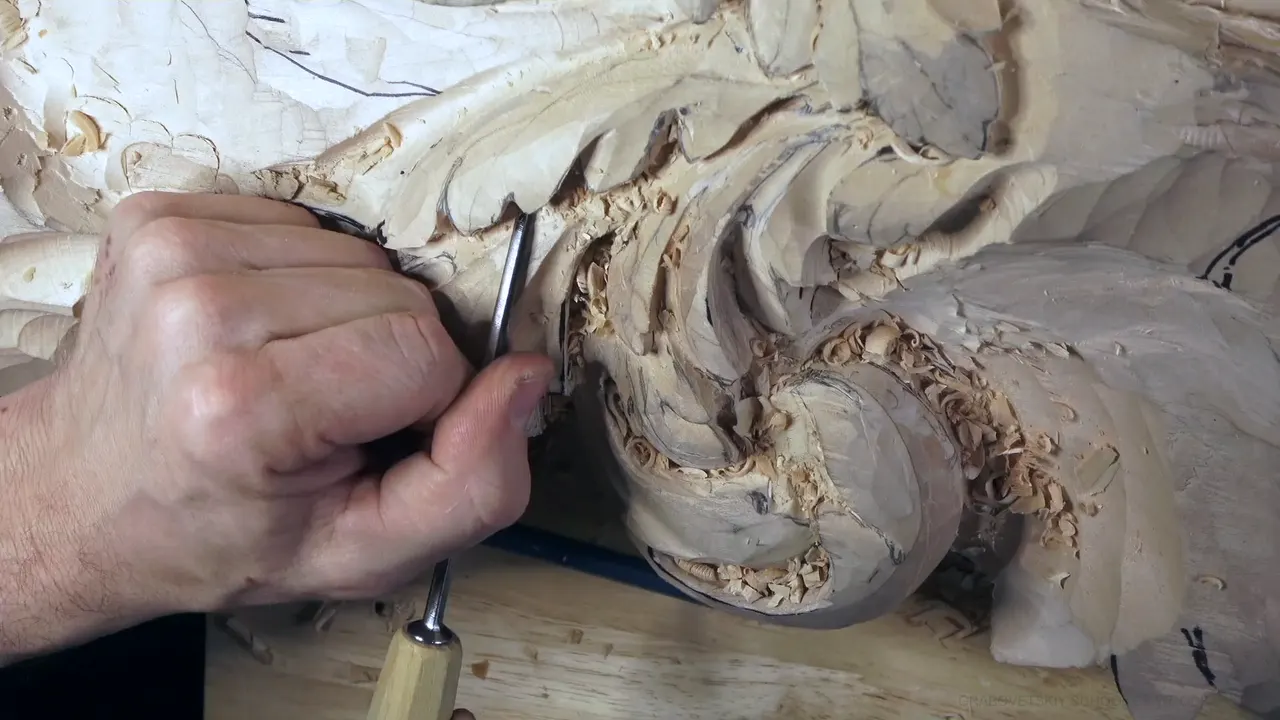

I am pointing at something I can name when I say the wrong way. Venice Room workshop 45, video four, has it beside an area where I had to be careful. Other lessons put it next to grain direction, carving toward myself, boards glued together, and a piece placed upside down.
Have you ever started a cut and felt the wood push back, then wondered if you came at it from the wrong side? Did you push harder? Come along with me. I'll give you the words I used at my bench in each of those moments, and what I did after it.
What did I say in workshop 45, fourth video?
The part is a long run of undercutting and cleaning, and the words come in the middle of it.
It opens with a reason to be careful. That mess is becoming a little too weak, I said. I don't want to break it. I do not want to break it.
The tool size came next, a smaller one, and again a smaller one. Go deep with a smaller one. Since I do have a movement like that, I could... first I'd think about it. Maybe this way, and I think it's logically okay to give that shape right there, and this one could go a little bit underneath.

Now that is the end of it, I said, but let me think what I want to do. This end is supposed to roll down that way, which you will do later. It will be the main subdivision, and I can shape it nicely all the way like that.
Undercutting was open to me pretty much right away. Like I said, I won't change this detail, and I think it looks really good. Clean it, I said, right at two millimeters (about 5/64 in). And undercut this way.

Here is the sentence. And this area, I have to be careful. It's kind of not tricky, but more dangerous, I'd say, if I'm going to do it the wrong way.
My next words were, just like that. Okay? I clean that with the number 11, I said, and I'm going to do it that way. And from that side, and from this side.
The size came next. Two millimeters (about 5/64 in) is what I'm using, I said. If I want to go too extreme, I could use one millimeter (about 1/25 in), and some spots do get one. But if I don't have to, I'm not doing it. That's all junk, of course.
And let me do the last division right here, I said. Later I told you this was probably what I want to see, except I can see this side is a little too rough. A bit of cleaning would take care of it, and a skew could do that.

It looks clean now, I said. I'm pretty much very much at the end. I still kept that ridge of this movement, a good thing, and it continues. Then a plan: let me use a hair dryer. Got a lot of junk inside.
I think I've got a really good result, I said, except this part needs to be cleaned, of course. Not a big deal at all. All it takes is a number nine, taken down like that. And it's just excavation underneath.
And maybe it's a good idea to use a spoon. I'd see if a big one would work. No, that is too big. A smaller one, going this way, like 13 millimeters (about 1/2 in), was my plan.

I could take care of it with a seven or a six, I said, and it doesn't really matter. Most of it will be hidden, but still I'll give a little cleaner look. It looks not bad at all, in my opinion.
In that video I did not say which way was the wrong one. Other lessons say more, and I'll walk through them.
Does the wrong way mean against the grain?
Over in workshop 97 I took a number seven at 14 millimeters (about 0.55 in), and I'd blend that in. Yes, I'm doing a wrong way across the grain, I said. A little later I said, so that's the right way.

That part also gives the depth. Approximately maybe about 3/16 of an inch deep (near 4.8 mm), I said, and I think it will be plenty.

The furniture panel is another place. I could go right on the line with the same number 11. I am doing a somewhat wrong way, but with the walnut it's all right. With some other woods it would be a really big mistake. Walnut's grain direction would forgive a little more in this case, I said.

The butterfly plate course has it, too. Now I can see if I continue my cut, I said. The wrong way this way, I said, so I have to attack it from the opposite side. Keep an eye on the grain of the wood, what it does.

What happens when I start the wrong way?
The Tray of Blessing course gives the longest answer I have. My plan was a number 11 at three millimeters (roughly 0.12 in), if I could find one, set with exactly the angle of my previous cut. After that I would start undercutting on the inside.
Because I've got two together, it should be fine, I said, even airborne. It shouldn't break because the grain direction runs that way.
Make sure you maintain the right angle, I said, so the side of the tool must be exactly the same angle as the previous cut. It's not as critical, but if you start the wrong way, you have to change everything else right here, which we probably do anyway, but we'll see.

At some point, I said, I can feel the limitation. I'll stop and grab my number two, and position the tool the right direction. Catching the grain meant I couldn't force it. The position has to change, and I attack that from opposite side. Just continuing that cut would make a big mistake.
Can a wrong way still turn out all right?
In walnut I said it was. Over in Venice Room workshop 62 I said I need to lower down the middle section. Otherwise, it's not going to look as nice. An 11 at seven millimeters (near 0.28 in), I said, and let's start. See? That's kind of wrong way of doing it. This is going to be the right way.

I'm not afraid that my middle line is going to be a little lower. That is absolutely okay.
Later in that part came a number 11 at three millimeters (close to 0.12 in), and again, I'm doing the wrong way. I really don't like to carve toward myself, although it's okay. I'm able to do that, but it's not really convenient.

The next lesson had a slope. Careful again, I said. A big skew, one inch (about 25 mm), and I'd start sloping from all the way here. That would be mistake, I said, if I would just do it wrong way. Okay, that is good. Even if it doesn't look too good yet, it will be good.
And in workshop 50 I said it has to be gradual movement, beautifully moving in three dimensions. Maybe, well, that is the wrong way, I said. It doesn't give me a really nice finish, and this way gives me a much better finish.

Do other woods change the wrong way?
Walnut was the forgiving one on the panel, I said, and other woods were the risk.
In workshop 82 the words were about the letter S. Letter S curvature is common to the acanthus movements, I said, but you can always do it the wrong way. It's supposed to face out and move on whatever the outside movement is doing.

Just in this case, I said, it's left side. It would not look good if I would just create the S curvature this way. Overall movement would just get thrown away, and it doesn't make any sense. It has to follow the movement. That's the logic, and I hope you understand. If you don't, ask me and I'll try to explain again.
Is carving the only place I say it?
My lessons use it for gluing, too, in a paper method that I show in the Byzantine acanthus course. Take that piece you're going to work on, I said, and make sure you're working on the back side. Don't glue it the wrong way.

Two surfaces get sprayed, that surface and one of the sides of the paper. Wait a minute, I said. Don't stick it right away. It has to be dry enough that when you put your finger on it, it's not sticking. If it's sticking or too wet, it's not the time yet.
And that's going to hold, I said. The lions I carved were heavy, about 48 inches (about 122 cm), 47 3/16 to be exact (about 120 cm), and I was holding them by paper. I used a piece of plywood and exactly the same paper, and huge blocks of wood, and I was able to carve the whole thing.
The wood itself can be glued the wrong way. My livestream on wood movement showed the edge of a board and its rings. If the rings run alike in two glued boards, it's even worse, I said. It's going to move a lot.

You have to alter the direction of the grain, I said, and the next board gets glued in the opposite direction somehow. Were I to glue it wrong way again, just the same, it's going to move right in the middle. So I flip it and check what the rings are doing, and I created a wave.
A Grinling Gibbons class had a smaller case. I was marking pieces with two colors, blue for the lower level and red for the upper. I wrote the word as well as the color on the piece, because I saw sometimes people make a mistake. They place it upside down, and now when you place it upside down, it's the wrong way.

Even the workbench has one. Another April 2020 livestream says there is such a thing as the right and the wrong way to position your tools on a workbench. Some people place tools so they hide behind the handles and behind the cutting part, I said, and you don't even know what tool is lying right there. That is not really convenient.
Is every wrong way a mistake?
By my words, a wrong way was a mistake in the Tray lesson, a big one if I continued. It was fine in walnut on the furniture panel. In workshop 62 it was inconvenient.
The furniture panel lesson 19 says it in another way. A couple of ways are possible there, I said. There's no right or wrong way. Both of them are actually right.

The depth I gave there was approximately 1/16 of an inch (about 1.6 mm), a little deeper at 3/32 of an inch for now (about 2.4 mm), and I would lower the moldings about 1/32 of an inch (about 0.8 mm). You could take number 11 again at 1 millimeter (about 1/25 in), I said, and just outline, but not as deep. Don't go really, really deep. That would be a big, big mistake.
For the lowering itself I said I'd take a flatter gouge, maybe even just number one. When I'm saying gradually, I usually like to work with a 45 degrees angle, gradually, gradually, until you reach 1/32 inch (about 0.8 mm), without touching the middle part.
Do I say my own way is the right way?
The video where I introduce myself has it, too. Here is what I said: I'm not saying the way I carve is the right way or wrong way, but I know how to carve. You can watch it in the introduction lesson.
Where else did I say it?
Each row has my own words from that moment at the bench.
| Where | What I was doing at that moment | My words about it |
|---|---|---|
| Cleanup 45.4 | Cleaning around an undercut using a number 11 | Called more dangerous, I'd say |
| Finish 50 | Shaping a gradual movement beautifully through three dimensions | Not a really nice finish |
| Pipes 62 | Carving toward myself with my number 11 gouge | Fine to do, but inconvenient |
| Slope 63 | Sloping the wood with a one inch (25 mm) skew | A mistake if I did |
| Blend 97 | Blending with the 7 at 14 mm (0.55 in) | A wrong way, then right |
| Panel line | Going right on the line with the walnut | Somewhat wrong, fine in walnut |
| Butterfly plate | Checking whether I could continue my cut here | Switch to the other side |
| Tray lesson | Planning an undercut inside using an 11 gouge | Stop, then change the position |
| Byzantine paper | Gluing the back of a piece to paper | Don't glue it that way |
| Wood movement | Gluing two boards together with rings running alike | Moves a lot, even worse |
Where can you watch this part?
The video sits inside the Venice Room 45 lesson, in the Venice Room Part 4 course. The lesson before it is workshop 44, and workshop 46 comes next. Is there a spot on your board right now where you can feel the wrong way? Could a second look, from the other side, be your next move? Then take your gouge and carve along with me on any wood carving piece you have going. The tuition opens the whole room, and you can start here.
How it's done
- Notice the catch. The tool starts to grab the grain, and a cut like that has a limit.
- Stop forcing. I can't force it, I said.
- Turn the tool. Grab a different tool, as I grabbed my number two, and position it the right direction.
- Attack from the other side. Switch sides, as I did on the butterfly plate.
- Match the earlier angle. Match the previous cut, and the tool's side takes exactly its angle.
Frequently asked questions
Which way did you mean in workshop 45?
That area made me careful, and I added the danger of doing it the wrong way. No direction followed. Next came a number 11 for cleaning, from that side and from this side.
What do you do when a tool catches the grain?
In the Tray of Blessing lesson I said I could feel a limit and would stop right there. Number two would come next, aimed in the right direction. A catch in the grain meant forcing was out, so I'd change position and come in from opposite side.
Is gluing the wrong way a problem for carvers?
Two boards whose rings point the same way move a lot, I said in my wood movement livestream, and that is even worse. My Byzantine course put a piece on paper by its back side, and I warned not to glue it the wrong way.
What to carve next