

Alexander Grabovetskiy, woodcarver, School of Woodcarving · Published 2020
What does "stupid" mean when a wood carver says a carving looks stupid?
Quick answer: In Venice Room 45, part 8, I said it while deciding where my volute goes and how it will look. In other lessons, the word sits next to an eye that looked too chunky, a point I had to turn, a straight line and a run of veins.
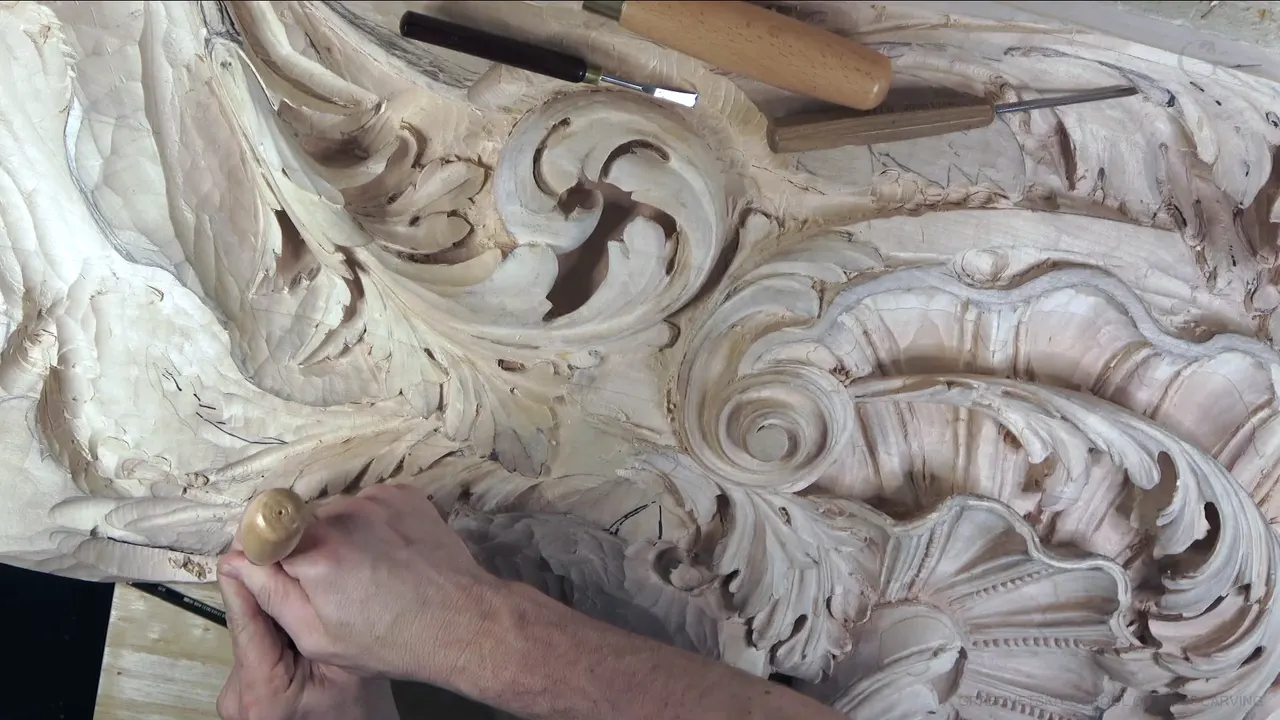

In part 8 of Venice Room 45, I stopped to ask where my volute goes and what I wanted it to look like, and I used the word "stupid" for the look I was avoiding. That word turns up in my other lessons right beside a decision. This page follows each place, with what I said around it.
Ever stood over a wood carving with a tool in your hand and wondered what the next pass will do to the whole shape? Or looked at a leaf edge on and felt one line was off? Both happen at my bench.
Where I said it, at a glance
- A volute on the Venice Room panel, where the end was still open.
- An eye that looked too chunky.
- A form checked from below, and a line that bothered me.
- The point of a leaf, plus one spot where I had to decide what to do next.
- Straight lines. Veins.
What was I doing in part 8 before I said it?
The part opens with a plan: "I'm going to chop a little bit of this side." Soon the shape made more sense to me, and I said I have to "probably also create some kind of concave-convex movement around."

Number four was the tool. There is going to be a point, I said, and I would go to the point. It can work on another side "if I have to." A concave on both sides was one option, and a convex on the opposite side was the other, which would give me nice movement too.
My plan was to turn the piece upside down and go with the convex. "This needs to be cleaned now." The side needs a nicer blend, too. Then I said: "But see, it creates actually a really nice movement. Not bad at all."

Leave it or add more was the next choice. I could "actually leave it like that, or I could give little notches like this, create more interesting look." I called it "probably the end of this development." The next move was open: go this way, or "jump on another side." I was probably going to work on the opposite side of this movement a little later.

Then the question that matters here: "how I want to see this one." The surface could stay flat, or I could bevel it. With a big chunk of material at that spot, a bevel made more sense to me, and my barrel would sit sideways, going "all the way up."
My word barrel stands for the volute and nothing more, and that volute goes "around, around, down, and up."

Its top needed an idea of where it ends up. Because of the big chunk, I could start "somewhere right there" and work on the side. I know it is kind of hard to understand, I said. Some of that material was too thick. It had to go, and if I don't like what comes out, "I'll just take it down." Still, "I believe it should look good."
A heavier tool would be much quicker. But with a mallet and big tools, I warned, stay short of the end, because that end is weak. The grain runs one way, and it is better "to approach from the end itself." Otherwise, you can break it easily.

Those leaves will be exposed and visible from underneath the flowers I'm going to create, and they have to go "almost all the way down to the point." My plan was to chop one right away and keep some thickness for now, since a piece too thin breaks easily. "I don't want to break it."

Near the end of the part I came back to the volute and where it goes. Then came the word "stupid." I finished with a motion of my hand that "makes sense pretty much," going around.

Where else did the same worry come up?
The same worry sits in Venice Room 65, part 8, where extra separations were still ahead of me. "But I don't want to make it look stupid, if you know what I mean." One area was "too chunky." Bigger eyes were what I wanted there, and the chunky look was "just not what I would like to see."
Two eyes would sit above the main end of the acanthus. Sometimes I do not know what word to use for that spot, I said, so I make one up. My tool was a 2 millimeter (0.08 in) number 11, and a number nine could give the same result. I like the number 11 because carvers used a lot of those on acanthus. The tool is called a veiner because they used it for the veins in eyes.

On depth, I could go deeper but did not need to. What the leaf needed was two darker spots, "to give that pop." I would start with the same tool, and a 1 millimeter (0.04 in) tool would give "even better shadow." An undercut was possible, but flowers will cover that spot.
A reminder came next: "I have to be wise." In an area I don't need to, I could spend too much time.
Do I look at a carving from below?
In Venice Room 37, part 5, I planned a deeper cut that stayed short of extreme: "deeper, but not too deep." A secondary bevel could stay too, to give the same idea as what I have right here on this volute. "I think I should do that." A little more carving around it came next: "So we are developing a really beautiful detail." A secondary concave would add "really nice movement." That meant going underneath with the acanthus, and the next question was how deep.
Not really deep, I said: "That's deep enough." I wanted a double-check from below, because "it's important not to lose the overall feel."

It looked like I should take out a little bit this way, a little of that, then blend. "And that is looking good, actually." Then I checked from below once more, to avoid a stupid look. The eye could be done over: "It's not a big deal at all," and I still had the position for it. The next plan was a bigger tool on the inside.
Which way does the point of a leaf go?
Venice Room 143, part 3, puts a leaf in front of me. A couple of ways to approach it, I said. One part a little higher than the other would look "a little lighter," and "I think it's going to look much better." The plan: a number 11 in 3 millimeters (0.12 in), and start excavating.
There may be an eye somewhere, I said, "but I'm not sure." The decision was about the point of that spot, and I asked: "How do I want to see it?" The word "stupid" follows right after.

One way would move the point somewhat downhill. The other would add a little more twisting, with the point landing "right there." That is probably what I will do, I said. Some separations would follow. I thought it would look good, which made it safe to take the wood away with the same tool.
Next came a rough outline of what I was after, and I would not go too deep. "That's still deep enough." A number three would blend that ridge in. After it, the number 11 again, at 2 millimeters (0.08 in), to take out all that mess and make an even deeper excavation, for "really, really, really deep shadow."
Another head in that part called for a choice too. Going downhill is possible and makes it more three-dimensional. But from that point of view the point would be lost, and you would not detect that it is a canvas. "I think I should keep it high," I said.
A spot I am not sure about
Venice Room 82, part 11, had one spot that needed a decision. The word "stupid" came with it. Right after, I said: "on the other hand, it has to look good." A movement uphill might do it. I'll leave it for now, I said, and start attacking this area.

One section was a little too high yet. It had to be lowered "to the quarter inch, even this section," which I then put as "about six millimeters above the surface." A quarter inch is 6.35 millimeters, so the two figures agree. Here was my separation, and a somewhat deep cut and a deep shadow were going to follow.
My next tool was the number 11 at 3 millimeters (0.12 in). Deep, yes, but not too deep. I still have to keep in mind how I will finish it and paint it, I said, and I still wanted some shadow.
The same part has a flat spot. That area had to lie flat with the surface, and "probably the best tool for it would be number one," a double bevel. I can lay it right on the surface, I said, and make a rotating cut. That way it lies at the same level.
A line I do not like: can I fix it?
There is a spot in part 11 of Venice Room 19 that bothered me. "I need to fix it somehow." It would most likely be covered by the upper layer, "but still." The plan was a subdivision, with a little better outline right there.

There was a line I did not want to lose, and I did not want it to look stupid either. I said what the leaf should look like: acanthus. We were still developing it, I added, and I put another movement in because some material was left. Then a number three: "We'll do the trick right now."
The overall movement still bothered me. The fix: flip it from that way, so this line becomes that part right there.
A preliminary cut was the plan, done carefully. This line is going to become that line, I said, by flipping from the opposite side: "If it makes sense, which it should." The inside was a little too messy, and "most of it is just junk."
Straight lines on a leaf
The Byzantine acanthus course, leaf 6, takes the word to the side view: "make sure, wonderful people, it's supposed to be 3D right now." Seen from the side, "don't create the stupid movement." It should be a really nice transition downhill, a beautiful arc, and no straight lines.
That ties to the arabesque idea: a really smooth transition to downhill. For now, the shape just gets round. We are creating roundness, I said, and it will look like a claw.

Leaf 7 of the same course has the line again. Create that arc and make it really flowing. "Otherwise, it's going to look stupid if it's a straight line." The overall movement has to be like an arc, and it is still visible from the side.
The steps came next. Take out the whole thing, and then "round it or fillet it." After that a roundness: "a bowl upside down, if you wish," for the overall shape.
A curve that has to connect
In Design principles for wood carving 4, I asked people to look at my flowers. Can you find any straight line right there? "Absolutely not. None." Everything connects everything, and every movement has a swirl.

That means I have to decide about my curvature. A curve that goes the other way is "not going to connect," and I called it weird, stupid and not logical. A good line circles back and meets the others: "It's Arabesque." Another one I call "a letter S," which still supports the overall idea.
Too many veins
In furniture panel 19, part 6, I said I would use the true veiner. I wanted "even deeper exaggerated veins," all really smooth and nice. Then the warning: "Don't do them a lot." Please do not overdo them, because too many will not look nice. They would look "kind of stupid even, I would say."

"But somewhere, not everywhere." Upside down number seven was next, to create some convex shapes, and I would exaggerate my cut right there.
How the six places sit next to each other
| Where | What I weighed in the lesson | My next words |
|---|---|---|
| The volute, workshop 45, part 8 | Where it goes | A motion that goes around, and makes sense pretty much |
| Chunky area, workshop 65 | Eyes | Bigger eyes, and a number 11 to darken two spots |
| Lower eye, workshop 37, part 5 | Below | No big deal |
| Leaf point, workshop 143, part 3 | Direction | Somewhat downhill, or with a little more twisting |
| Part 11 of workshop 82 | A spot to decide | Come down to a quarter inch (6.35 mm), with some shadow kept |
| Veins, furniture panel 19 | Count | Somewhere, not everywhere |
Where these lessons live in my courses
Each one sits inside a course of mine, and Venice Room Part 4 holds workshops 38 to 49. Every course is one click away if you start here.

How it's done
- Decide the view. Before the next pass, I decide how the shape will read, as in the volute question of part 8.
- Weigh two ways. In workshop 143 one way sent a leaf point somewhat downhill, and the other added some twisting.
- Check from below. Workshop 37 had me double-checking from underneath.
- Leave wood on a weak end. Part 8 left some thickness for now, since a thin spot can break easily.
- Make the arc flow. In the Byzantine course I asked for an arc that is really flowing, with no straight line.
Frequently asked questions
Where did I plan to go after the convex in part 8?
I called that probably the end of this development. The opposite side of the movement was where I was probably going to work, a little later.
Why a heavier tool in part 8?
It would be much quicker, I said. I added a warning for a mallet and big tools: that end is weak.
Why leave wood on a thin part?
A piece too thin can break easily, and I want it whole. Some thickness stays for now.
Deep or shallow in Venice Room 82?
What to carve next