

Alexander Grabovetskiy, woodcarver, School of Woodcarving · Published 2020
What does "soaping the eye" mean in wood carving?
Quick answer: "Soaping" is a saying in the Russian language that I gave in video six of Venice Room workshop 45: it's like applying a soap to your eyes. After a while on one detail, my eye gets used to it, and I don't really see if I'm making something wrong.
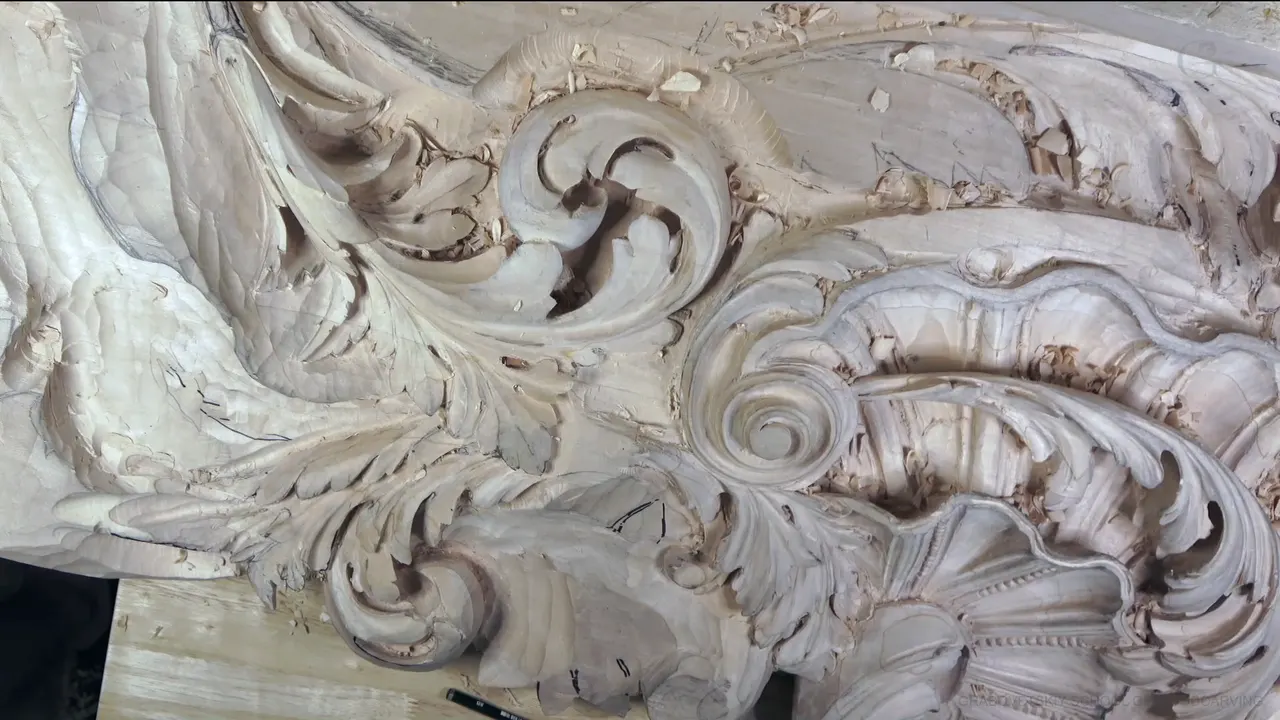

Soaping is a saying in the Russian language, and I gave it in the sixth video of workshop 45 of the Venice Room, about what working on one detail for a while does to my eye. The eye gets used to the spot, and a mistake can sit there unseen. My fix in that video was a jump to a different area of the piece, and then back to work.
Have you ever stared at one leaf of a carving until you could not tell if it was right? Did a mistake jump out at you when you came back a few days later? You already know what the saying is about. I have more of my own words on it than that one video.
The saying and its fix
- Workshop 45, video six, is its home.
- The eye adjusts to one detail, and a mistake can go unseen.
- The fix I named there was a move to a different area of the piece.
- In other lessons I talk about fresh eyes and about days away from the piece.
- In my wood carving lessons I also give the whole shape first, and the fresh eye is part of my reason.
What was I doing in video six before I said it?
Video six opens on "I need to make the decision how pronounced it's going to be." I really did not need to do too much, I said, and by too much I meant movement. "But on another hand, I could raise, actually, this side a little."

A slip came early, and I named it. "I just made a mistake. It's not a big mistake, but still, that's what I wish I didn't do." My next words were "Using number seven. Number seven and four millimeters" (about 5/32 in), and then "Yes, carefully. Going to create that concave."
My next line was about the convex. "Maybe I have to take this convex all the way here." It will make more sense, I said. A little later I added "Just give a little better shape."

An option came next: take that part and bring it a little bit inward. My reason was "That way, I can actually create the feel" that this part is growing from underneath of the other. Then a quick "Oh, okay," and "That was unfortunate, but it's okay."
I was not sure it would even be possible, I said, since that happened. "We'll see." Get the number 11, I said, and get a little bit inside.
"That is not what I was planning, okay?" A moment later: "So I was just probably too fast. See, I just used number seven, and that's not always the best idea to get really close to detail like that."

Here is what that tool did. "It just doesn't cut the upper part." What it does is hit with the corner and break away, and "that's why it is better to use proper tools."
Then: "But that's okay. It's not like the end of the world." It "created a beautiful movement and insight," I said, and "I'm okay with that."
A division was the next job. "Now, I'm going to make a little division right here because logically, it doesn't look too appealing." Then "And division like that," and later "Now relieve it."

My plan was a much smaller tool, probably, to finish up those divisions. Then, "That's one, and that would be the second one. I'm using just a micro tool." Cleaning and blending were still on my list, and sharp tools got a line of their own.
If you have really sharp and nice tools, I said, you really don't need to sand anything, pretty much. Then came "Get rid of this mark also."

The next tool was a number four, "and a quarter inch, about six millimeters." That tool gave "a beautiful concave, almost not concave, but still, at least you can see the ridge."
Blending was what I needed after it, with the same tool, and I said I would try to do it upside down. "Just blend nicely." After it came "I kind of like it, what I see."
Then a plan for later. Every edge and every point would get a hit, so that I create much better, much cleaner work. Everything gets inspected, I said, and whatever I don't like gets redone, which is "a normal routine, I would say."
What did the part say about the eye?
The reason came right behind it. In a detail, I said, you do see the final picture, "but not 100%." Walking away and working on something else is "one of the reasons I'm jumping around from one area to another area."

And now the saying: "It's like, we call it, there is a saying, actually, in the Russian language, it's calling soaping the eye. Okay? So it's like applying a soap to your eyes."
It ends on the eye. "So after a while, when you work in one detail, your eye used to it, and you don't really see if you're making something wrong. So it's better to jump to another area and continue your work."
A reader who wants the lab word for an eye that adjusts to a steady sight can look up sensory adaptation.
What does the eye do in my kitchen cutting board lesson?
Workshop 15 of my kitchen cutting board course has the idea too, and a mirror comes into it. You can check your carving, I said, and you usually catch something like that later. Sometimes it is while you carve. A lot of times it is days later, "because your eye is adjusting."

I put a picture beside it, a broken mirror at home, just a shattered one with a crack. After days you stop paying attention to that crack, I said, "Just because you're adjusting."
Carving works the same way. Your eye adjusts to what you see, and I said it sometimes helps to leave the work alone for a couple of days, even longer, even a week or so, carve a different type of piece, and come back. Come back and you see all the mistakes you made.
That is why I do not fix everything right away. I knew some of you probably had a question: "Why in the world he leaves some spots rough?" I still find some imperfections, I said, "but I'll find them much quicker after a few days when I'm looking back."
Of what was left I said, "I'm not cleaning right away because I know I still going to come back and work on that a little bit more." I would spend maybe half an hour cleaning everything, "just to find whatever I find."
One spot had "a little bubbly area" that was not really flowing. I planned to recut it, and "you'll see yourself it looks much better. But it takes fresh eyes. Fresh look."
Why do I carve the overall shape before the details?
In lesson 3 of my Modern Acanthus course I said I'm not taking it to the final stage, and I'm working on the overall project first. My reason: "Because who knows when you look at it with the fresh eye," I said, "you want to change something."

Spend so much time cleaning one area, and you get really frustrated when you want to change it. Real carving shows you the piece from every side and from different angles, and you realize it is better to change a little bit.
I gave the order too. Overall shape is the first stage. Only then do I check it from all the points of view, and the bigger details come after that. "And the final stage of course is going to be clean up."
Lesson 6 of my Acanthus over Moldings course agrees. I like to look again after a few days. When I work all day long on the same piece, I tend not to see mistakes, and I fixed my own "you" into "I" right there.
Coming back next day, I said, you start fixing those mistakes. Spend too much time at the start, decide to make the form perfect right then, and then see the mistake, and "that's just like a depression." Not what I'd like to experience, I said.
What do fresh eyes do in my Lily Box and Furniture Panel lessons?
In Lily Box workshop 5 I left a spot alone. "I'm going to leave it for now, at least for now." I can always look back, I said, "with the fresh eyes and work on it."

Workshop 6 of that box has another. I liked the overall development of one side, I said. I would go back for a few more looks. "It's actually a really good practice to go back and look with fresh eyes." Next I wanted to concentrate on this area and flip the piece.
Workshop 8 has a short one. It looks exactly like I wanted, I said, and "I think I'm ready to move on to the next section." I planned a look with fresh eyes to see if there was anything else I could do.

The design half of the Furniture Panel course has it too, in lesson 8. It was not 100% how I wanted to see it, I said, and later I would check it with a fresh eye and see if I really liked it. Maybe I would add something.

Later in that video: "So let's look at from a little distance. And I think it's not bad at all." I also told you a drawing and the carving look a little different, "because when you carve, you're going to see all the chisel marks."
Lesson 9 of that course puts it another way. "It's a really good idea to step back and look at it and stare for a few moments and check if you like it, if you don't like it." That time the area was not looking too good, I said. I thought I should develop a little different movement. The movement itself was really good, but I thought it was too crowded for that area.
Lesson 6 opens on it. "Step away and look at your composition from just a little distance and see how overall development develops." I added that I like the arch, and that it feels organic to me.
How long do I leave a spot alone?
It depends on the lesson. Workshop 69 has the short version. Stopping and taking a moment helps me visualize better what is going on, I said. I step away, then look from different positions. It sometimes looks good from one angle and not from another. Step back for a couple seconds, I said, and "if it makes sense, it's good. If it doesn't, change." I called that good practice.
A little later in that video I looked from a different point of view again. "It doesn't make too much sense in this area," I said, and then "Don't get me wrong, it does make sense, but I'm not 100% happy."
In workshop 28 I said, "Sometimes it's better to walk away from a certain area when you're not sure if it looks good or not, and nothing else you can think of. So come back in a day or so, and you usually have a solution or an idea."

Workshop 89 stretches it. At that point, I said, the part bugs me and I don't really like it. The more material I take out, I said, the more chance I will make a mistake. So I need to be away from that area a couple of days or so, I said, and then come back.

Workshop 64 has my reason for not cleaning at first. I know I'll change some stuff. I could do much better and didn't, I said, so I would leave that spot, walk away, and return to that area later.

The Tray of Blessing course has a night in it. Looking at the piece all day long, I said, it makes sense. You walk away and look again. "I did that late, like 11 o'clock yesterday," I said. I looked at that part of the leaf, and "It doesn't really show that curl well."

Being tired of a side was my reason in workshop 124. I wanted to see the overall picture, and sometimes it's a good idea to leave one area and jump on another. On the other side I planned to remove the majority of the material, and I said "Don't look how it looks right now, because you don't see the levels." Workshop 4 put it as "you get tired when you're working on big details all the time."

Time away in my lessons
Each row is my own wording from the lesson in the last column, so you can open that lesson and check it.
| Words | Time away | Lesson |
|---|---|---|
| Just step away for a couple seconds | Some seconds | Venice Room 69, video 12 |
| So come back in a day or so | About a day | Workshop 28 of the Venice Room, video 8 |
| I really like to look again | A few days | Acanthus over Moldings 6, video 1 |
| I need to walk away from that area | Days | Venice Room 89, video 5 |
| Even longer sometimes, even for a week or so | About a week | Cutting board, workshop 15 |
Where did video six end, and what was left on my list?
Video six closed on that jump, and my pass along every edge was still ahead. I had made the divisions, I had a ridge, and I said I kind of like it.
If you want to see the micro tool and the number four at work, the tuition opens the whole Venice Room, workshop by workshop.
How it's done
- Work the overall shape first. In the Modern Acanthus course I said I work on the overall project first and do not take it to the final stage.
- Say what went wrong. In video six I said I was probably too fast, and that the number seven just hit with its corner.
- Reach for a proper tool. Following that slip, I said proper tools are better. The tools I named next were a micro tool and a number four.
- Move to another area. I said it is better to work a different area once your eye is used to a detail.
- Look again later. In the Lily Box I called going back to look a really good practice.
Frequently asked questions
How long should I stay away from a spot?
The times differ by lesson. Workshop 69 gave me some seconds, workshop 28 about a day, and workshop 89 days, more than one. The kitchen board lesson reached about a week of time away from the piece.
What do I do while I am away?
The sixth video says to go work another part of the carving. The board lesson says to carve a different type of piece and come back, which is how I see the mistakes my eye got used to.
Where does a cracked mirror come in?
A crack in a mirror at home stops catching your attention after days, I said in workshop 15 of my beginner course. The reason I gave was that you are adjusting, and your eye does the same on a carving.
What to carve next