

Alexander Grabovetskiy, woodcarver, School of Woodcarving · Published 2020
What does "we'll see" mean when a wood carver says it?
Quick answer: "We'll see" is my line right after I name a doubt about the carving. In workshop 45 the doubt is a chunk that must come down, and maybe it is a little too big. Lesson 68 tests number three, then five.
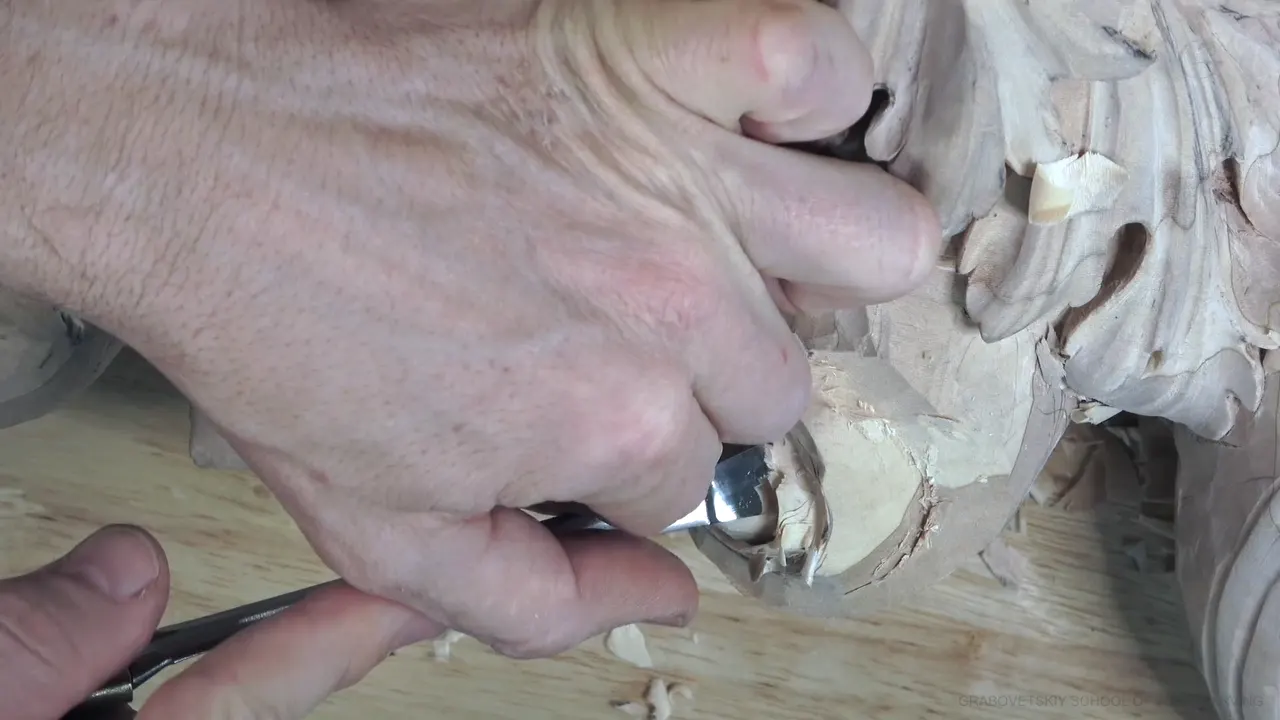

"We'll see" is what I say right after I name a doubt about the carving and before I know the answer. In part 11 of Venice Room workshop 45 I say it twice, a few lines apart, about a chunk of wood that may be too big. The same two words turn up in my other courses too.
Ever stood at your workbench with a gouge in your hand, unsure how much to take off? This part is short, 382 words. Seventeen more of my video parts sit beside it on this page, some from this workshop and some from other courses.
What does "we'll see" mean in part 11?
It comes at 02:09. First I say I need to take the chunk down quite a bit, and that the goal is to go really low in this moment. Then: "So I really need to lower that down. So we'll see." A beat later I say, "Maybe I have to change. Maybe that chunk is a little too big, so we'll see."
Nothing is settled in those lines. A need comes first, then a doubt, then the two words. Those lines give no answer. What I say next is about a tool: "Number 11, that's what I'm using." In this case it's three-quarter of an inch, about 20 millimeters.

What was I carving while I said it?
The barrel of a volute. Part 10 has me saying "create better barrel or the upper part of volute," and the eleventh video says I need to excavate around that barrel. It opens with the slope. We still keep the same slope, I say, just making it more round, and then just making it more logical.
The tool in my hand is number three, and I say a better tool would probably be number seven. I don't know why I'm not using it. "Got to use it."
Further in, the shape of the work comes through. I want it "really pronounced." I need to get this side a little lower, too. I did not want it too low at the beginning, I say, because it's becoming weaker and weaker, and at 04:09 the line is "Let me chop this out."

A decision sits right in the middle of it all. At 04:21 I say I need to make the decision how I want to see this chunk. I really want to keep some of it. I'm also going to develop some movements right there. So I need to make sure I'm not taking what I don't want to take out.
Later, maybe a smaller one now so I don't crush it, I say, though I also need to excavate around that barrel. At 07:08 I say, "Just go around and excavate, and take the time."

Did the jigsaw cut cause trouble?
At 06:11 I see the problem. I got with my jigsaw a little too close to the final line, I say, "but it's okay." It is a problem, "but not too big of a problem."
The twelfth video comes back to it. There I say it makes me worry a little that you don't probably see that too much. "But I got with my jigsaw too close. Sometimes, I guess it happens." The tool is number three at one inch (25 mm), and I roll it.

What do parts 10 and 12 add?
Taking my time gets said out loud in part 10. I say I don't need that big of a chunk of material, because logically I have this going all the way. "Let me remove a little bit." Then comes the line I'd hang over my bench: "The idea is to take your time." The next words are "not rush anything."
A bit further in, I say it's not the final look yet, "but we are on the right path." Near the end of that video it goes, "Hope it makes sense," and then, "I know it will." A little later I admit it's looking a little confusing at the beginning.
That's a different thing from "we'll see." Here I know it will make sense. Part 11 is where I don't yet know whether the chunk is too big, and that's the open question.
One more case sits in part 12, at 02:43. I don't want to take too deep right there at this point. "Or maybe I want to, I don't know." I have to excavate right there anyway, I say. That leaves the depth open.
I kind of like that slope better, I say at 04:32, so this one also needs to repeat that slope and go in more.
Part 12 also brings up the other sides: I did not want to repeat the same like I did on other sides. I still would like to get those movements, I say, but make them a little different. The details will pretty much be the same design, and the movements a little different, "okay?" Then: "So that's what I'm after." Near the end the tool gets a word: it looks like I need to sharpen a little bit, "not sharpen, but buff my tool."

Which tools get these two words?
In Venice Room 76, part 5, I'm trying to create a rolling motion. Number seven or number six will work, I say, "Let me think first." I say, "Let me try number seven," and "we'll see." Maybe it won't work. Number five will do.
The clearest case is Venice Room 68, part 3. For the opposite side I need a shallower tool, like a number six or number five. Maybe even number three, I say, "we'll see." After it comes "Let me check." A few seconds on is "No, that is not going to be good." I check number five next, and it's actually good, I say, then really good.

Workshop 76, part 3, has a quieter case. What I need is a gradual transition between the convex and the concave, and maybe I can actually get a little deeper, "we'll see if I'll be able to." Later in the part this number 11 is a little too small, I say. I should use a bigger one, like 10 millimeters (0.39 in), which gives me much better transition.

How deep should the cut go?
One place is part 7 of Venice Room 14. Maybe I'll need to go a little deeper right there, "we'll see," and then maybe not, "because it's going to be from the bottom." Then: "Let me use a 1-millimeter" (0.04 in). Further on, I say I don't have to excavate really deep right there.
Part 10 of Venice Room 50 has a deeper excavation coming. On the other hand, I do not want to lose the height, which is almost impossible not to lose. Somehow I still have to keep it, "we'll see." A few seconds later the same two words come again. Earlier in the part it should make sense, I say, though I know it doesn't make sense sometimes. After it comes "you'll see."

The question in Venice Room 67, part 4, is whether to get deeper underneath a leaf or leave the two sticking together. It doesn't matter, I say, "we'll see just in a moment how it develops naturally." Maybe I can use a skew a little bit to clean up and create my canvas, a clean canvas to see much better what's going on.
The Byzantine acanthus course brings the same thought into a bowl. Lesson 6, part 2, poses the question whether the bowl should go deeper on the second layer. The answer given there is "I wouldn't. We're still just after a shadow." Go deeper and there's a chance you're going to get through. "But we'll see. We can probably deepen it later on if we need to."

Can a shape or a design get them too?
Hashemi lesson 46, part 2, has me unsure how extremely I should go on inside. Maybe just leave it like that, I say, because not every petal is supposed to be curling that crazy, "we'll see," I add. In part 4 of the same lesson, it's a good idea to make one grow from underneath another. Whether I should, I can't say yet, but it would give me even more depth. The line is "Try that first, make that separation cut, maybe yes, maybe no, we'll see, maybe not."

Design work gets the same words. In the Furniture Panel design lesson 14, part 6, I say maybe we'll add some stuff while we carve it, and maybe we'll remove some stuff, "we'll see." Figuring out everything right now, versus too late, is probably a good idea.

Part 1 of Venice Room 124 is about where a first cut goes. The first cut will go really close to the line, or right on it, I say. What the highest spot on the future shell will be, I don't know, and I ask if I even want to be too high. Maybe everything will sit a little lower, "we'll see," but here I've got to be careful.

Two more use it about a plan. In Carving Hazelnuts lesson 6, part 1, the outline for the husk is about an inch, one inch, about 25 millimeters or so, and "it could change slightly," "we'll see." Next, I say, I'll lower this section with a number 11 veiner. It is 20 millimeters, about three-quarters of an inch. I'll attack again perpendicular to the grain. And in the Dining Table Apron course, I plan to concentrate just on one side, "Then we're going to flip it, and we'll see where we're going to end up."
A gel glue gets the words in Lily Box lesson 11, part 1: "Now, I used different glue, and I think it should hold it, and we'll see how it's going to work."
How do the places fit side by side?
Here are ten of the moments, with what was open and what came next in each.
| Source | What was still undecided in that moment | Next step |
|---|---|---|
| 45.11, Venice Room | How low to take a chunk, and whether it is the right size | Number 11, 3/4 in (about 20 mm) |
| Part 6 of workshop 45 | A growth from underneath, maybe not possible after something unfortunate | Get number 11, a little inside |
| 76.3, Venice Room | Going a little deeper for a gradual transition between convex and concave | Bigger, a 10 mm number 11 |
| Part 5 of workshop 76 | A rolling motion, with number seven or number six first | The answer: number five will do |
| 68.3 in Venice Room | Maybe number three on the opposite side | Really good, I said of number five |
| 67.4 (Venice Room) | Deeper under a leaf, or leave the two sticking together | Maybe a skew to clean up and make a canvas |
| 14.7 (Venice Room) | Deeper by a little, on a side that shows from the bottom | The plan: a 1-millimeter (0.04 in) |
| Hashemi 46.2 | How far to curl a petal on the inside | Maybe just leave it like that |
| Hashemi 46.4 | One part growing from underneath another | Try that first: the separation cut |
| Carving Hazelnuts 6.1 | An outline for the husk that could change slightly | Number 11 veiner, 20 mm, about three-quarters of an inch |
In every row the two words follow a doubt I said out loud. In 68.3 a check follows them, and in part 6 they follow something unfortunate.
What happened in part 6 before the words?
An unfortunate thing happens first, and I say, "Oh, okay. That was unfortunate, but it's okay." After that I explain what I'm trying to do: I can actually create the feel that this one is growing from underneath of that. "But now, since that happened," I say, I'm not sure it will be even possible, "we'll see."
Next I say, "Get the number 11. Get a little bit inside." And then: "That is not what I was planning." I was just probably too fast, I say. I used number seven, and that's not always the best idea to get really close to detail like that. It hits with the corner and breaks away, so it is better to use proper tools.

What do I take from all of this?
In three of these videos a doubt is followed by a tool or a check. The chunk in part 11 is followed by number 11. In lesson 68, number three is followed by a no. And in workshop 50 the doubt is the height: "Somehow I still have to keep it."
Now look at your own workbench and find one half-decided cut. My choices are on camera in part 11, and the lesson 45 page covers the whole workshop. For all my lessons in one place, start here.
The Venice Room course for workshops 38 to 49 holds the rest of this acanthus carving. These videos come from my Venice room carving and other courses of mine, and every figure in millimeters and inches on this page is mine, with the conversion beside it when I did not give one.
How it's done
- Name the need. Part 11 starts with a need. The chunk needs to go down quite a bit, I say, and the goal is to go really low.
- Name the doubt. Then comes the doubt. Maybe I have to change, I say, and that chunk may be too large.
- Pick the tool and say its size. A number 11, and I say its size on camera. Workshop 76, part 3, has a bigger one at 10 mm (0.39 in).
- Check what you said you would check. In Venice Room 68, part 3, I said let me check number three. Number three was a no, so I checked number five.
- Leave the rushing out. The part 10 line is about time. Take it, and leave the rushing out.
Frequently asked questions
What came twice in the eleventh video of workshop 45?
Two doubts about a chunk, each followed by the two words. I said the chunk needs lowering. Maybe it is too large, I said. Right after the second one, I named number 11 as my tool.
Which tool did I test after "we'll see" in lesson 68?
The first test was number three, as a maybe, and it was a no. Then number five, which I called actually good, then really good.
How did I describe the jigsaw cut?
The eleventh video says the jigsaw had come a little too near the final line. A problem, I said, though a small one, and part 12 says it happens sometimes.
What to carve next