

Alexander Grabovetskiy, woodcarver, School of Woodcarving · Published 2020
What does a wood carver mean by "I don't want to bore you"?
Quick answer: Venice Room 63 has me saying it right after a plan to let one tool do the cleaning. Next in my plan came a skew. Other lessons put the line beside cleaning, a repeated operation, a camera that could not go under the piece, or music in a live stream.
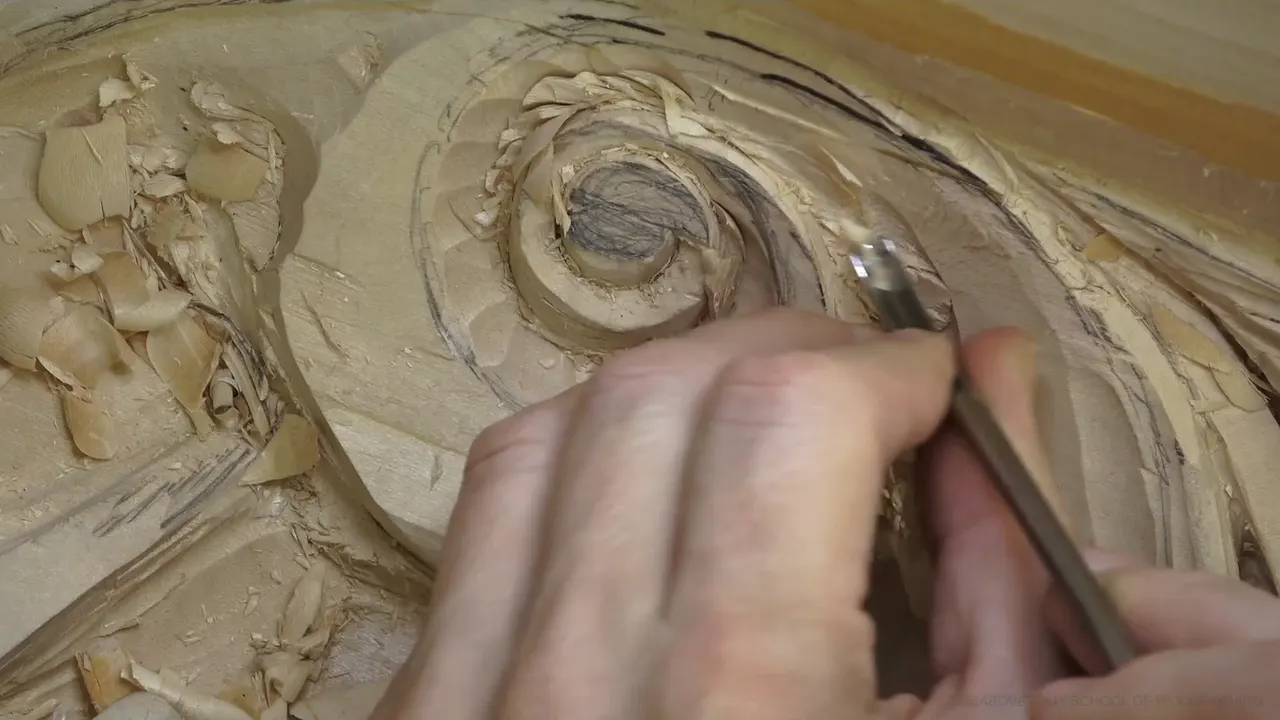

In part 1 of Venice Room 63 I said I would clean around with a number 11, and that I would clean "that stuff" using the same tool. Right after that came a line about boring you, the one this page is named for. Close lines sit in other lessons of mine, beside cleaning, a step I had already shown, and a spot the camera could not reach.
First comes the line in its own place. After it come the lessons where I said something close, with what sat beside each one.
What did I say just before the line in part 1?
The part opens with tools. "So I've got to place my tools in the right way," I said, and then, "So now I need to take number 11 and clean around." A thought followed: "Clean around, and maybe a spoon, and 5 millimeters, about 3/16 of an inch." The size was 5 millimeters (about 3/16 in). A spoon is a kind of gouge.
My pace came next: "I'm going to clean it little by little." Again: "Little by little, and go around." Then a side plan, "And then maybe attack that from this side." And one more: "And I also going to clean that stuff with the same tool." Then came the words this page is named for: "But I don't want to bore you. So here you go."

What came after the line in part 1?
A skew came up. "So let me use just the skew and little bit give a better shape to this," I said, and I added, "And maybe I could just shape a little bit that side also." Of the spot: "I took out some of the mess, but it still doesn't look too appealing."
"And couple ways I could do." One was a tool I love: "It's pretty much knife, okay, or chisel," I said, and I corrected myself: "It is chisel, actually. I'm sorry." I said it "has all of the skew chisels in it. It has a 45 degree, it has 22 degrees, and it's actually excellent tool to have." One word followed: "Multi-use." For a general look at the tool, see this page on the chisel.
A light pass came next: "Maybe just a slight cleanup again." Blowing was next in my plan, and a short verdict followed: "I like the development so far."

Which jobs did part 1 show after that?
Sloping came next, and a slope is what I was after, starting "from all the way here," with a note to myself: "Again, got to be careful how I do it." Probably "just a skew," I said, and "Big one, okay? One inch." That makes it a skew of one inch (25 mm). A warning followed: "That would be mistake if I would just do it wrong way."
Later came a verdict: "Okay, that is good. That is good. Even if it doesn't look too good yet, it will be good." And it was not clean yet, I added.

A new job came up. "So next, what I have to do, I need to create the concave movement." My distance would be "approximately one-eighth of an inch, about 3 millimeters away from this line," and then I would concave it "all the way."
About the shadow, I said, "I really need to see a shadow of this concave." And: "I could use probably number 11 concave." Maybe even 7 millimeters (0.28 in), "or maybe actually even bigger than that." I wondered about 10 millimeters or even bigger, and I would try 10 millimeters (0.39 in) first.

For my hand, I would "place the tool and move it little bit to the left," and "stay a little bit away from this line I just created." Higher up, it would taper. "A lot less concave," I said, but "deeper concave right there." I was staying away about one-eighth of an inch (3 mm) or so "from the line because it's just preliminary concave." By the end I was still weighing sizes: "Maybe I should use even bigger. Or actually right here, I could use smaller. I could use even just a 5 millimeters and go up." The smaller size is 0.20 in.

Where else do lessons of mine carry something close, and what came next?
The same words, and close ones, sit in other courses. Each lesson is linked where I name it, and each line comes with the work around it.
How did I handle the cleaning in Venice Room 72?
Workshop 72, part 8, has a look at the piece first: "I think it looks good, except you probably don't really see how it looks in real life." Cleaning came next. "As far as the cleaning all that and so on, I'll take care of it off camera." I did not wish to bore you, I said.

A word on safety: "But now, it's safe for me now just to create the undercut." And: "with the smaller tool, I can go in and create my undercut." On the view: "just because it's right on the slope, I'll be able to see it." On what I could see and you could not: "I am able to see what I'm cutting, but not you."
Which jobs did I leave off camera in Venice Room 70?
Over in workshop 70, part 4, a back bend came first, the same one as before: "I'll just remove the main chunk." Then: "It is revealing itself." The eyes were next: "now I need to clean those eyes, excavate them, and clean on inside," which I would do probably just off-camera. I said, "I don't need to bore you."

Of the tools I said, "the same tools what I used previously, like a big, big number 11." Then: "Huge ones." I would "go dig in and in and in." Then I said to you, "But this you don't need to watch."
What did I leave for off camera in Venice Room 58?
In part 6 of workshop 58, I said something would go "underneath of this acanthus movement." The mess came next: "I can probably take care of it off camera. I don't really need to bore you with this." All I wanted to show right then was this: "just to get that idea, just around that and around this side."

"Now, next cut would be super important," I said. A cleanup was first: "Let me clean a little bit nicer," though "it's not the final cut." The cut I had to create after that would be "like a small number 11. It's like a groove."
What came after the cleaning in Venice Room 66?
Part 9 of workshop 66 has this about a detail: "Maybe even a little deeper because shadow." Then: "It's not a big detail, but I think it's beautiful detail." I called it "Just something different," and "Not the same all the time." Next would come "just cleaning and cleaning and cleaning, and that part will be pretty much done." I wanted to avoid boring you with just cleaning stuff up.

"Two millimeters, that's what I'm using right now," I said, which is 0.08 in, and the tool was "number 11, of course."
Which operations did I skip in the Chamomile and Bow Rosette course?
Lesson 3 of the Chamomile and Bow Rosette course carries "So far, I love what I see." Simple operations like cleanups and so on were not something I wanted you to sit through. "But you can see, obviously, how it looks already like a bow."

A job followed: "Yes, I need to make my separation cut between that detail and the bow itself." Its size was "the one millimeter," and I added, "Of course, one millimeter, number 11," which is 0.04 in.
Which operation repeated in the Grape Leaves vase course?
In the Carving Vase with Grape Leaves course, lesson 3, I wanted a deep one: "Really extreme undercut, like maybe three millimeters deep." A check followed: "Let me see how deep I got. Oops, I'm sorry. So I've got more than three millimeters. I've got about five millimeters deep undercut on inside." In inches, three millimeters is about 0.12 and five is about 0.2.

"But I really want to undercut," I said, after saying to make sure I would not pierce it. And: "that operation is going to be done on all of those leaves." My line about boring you came with showing the same operation over and over. "At least not on this project," I said.
A flaw came up afterward: "Looks like I wasn't too careful and I've got two weak fibers, but it's okay." Then: "Once we're going to finish it, so we're going to make sure it's going to stay there."
Where could the camera not go in Venice Room 84?
The reason I gave in workshop 84, part 4, was the camera. "Some of it probably for me makes sense just to do off-camera because there is no way I can place a camera right underneath." I also wished to avoid boring you with what I was doing, I said. "My camera's all above." I was staying on my knees, carving "upside down, looking up."

Further on came a plain line: "So I can see now the boundary."
What stayed the same in Acanthus over Moldings?
Lesson 10 of the Acanthus over Moldings course has me working on a convex. The job matched one I had done before: "just create my convex." It was exactly the same, I said, and so I would not bore you to death. One more part did not need showing. It matched what you saw on another side. One step was still ahead: "except we still have to take it off the board and work from the back side, which is gonna be easy."

Which step did I not take time on in Venice Room 41?
In workshop 41, part 1, I said, "I believe I can do really nice detail, and maybe I need to grab a marker or something." Then: "Or I can do it with the pencil with no problem. Or let me actually work on a paper. I'll do it on a paper, and then I'll just get that maybe on a plastic and apply it right here."

What I said there was "Okay. Yes, I didn't want to take time and just bore you with the development." My next words: "I think I found the solution I want to see right here." And I added, "I really would love to develop something like that," with a note on viewing: "I know you have to look kind of from all the positions to understand exactly what is going on."
Did the live stream use the line for something else?
My April 2020 live stream days carry the line too, with other work beside it. On April 8 I said, "Just establishing 3D form. That's what I'm doing, okay?" Music came next: "Let me put some music on the background," because I did not wish to bore you. I planned to finish my stream soon and to continue to carve only for the school.

My goal: "For me, the goal is to make a really tangent or really continuous movement even in 3D." Come April 13 I asked, "just give me thumbs up again, okay?" I wished to avoid boring anybody, and "if you want me to continue those live streams, I need encouragement."
Which lines use the word boring itself?
Other lines use the word. Part 5 of workshop 63 has me saying, "just to clean up, clean up, clean up, and clean up right here." The tool would be the one from before, "just number sevens." Then: "But it's a boring process," and I would clean all of that off camera.

Some of it could be done with the tool I had in my hands: "Number seven, and this is a skew. And skew, in this case, helps a lot, actually. See? Just gives me a beautiful, beautiful clean cut."
Workshop 85, part 4, has a margin: "I'm leaving about six millimeters" (0.24 in). Then: "as of now, I feel it's more safer just about a quarter inch away" (6.35 mm). Finally: "And that process is kind of boring. Nothing special about this process. I think I can do it just off-camera."

Over in workshop 87, part 4, I would clean everything off-camera, since I really did not want to make it a boring process. I would "soften everything and clean everything this side," and then jump on that side, in "exactly the same procedure."
And in workshop 7, part 8: "I think it looks good." Then: "That I can do off camera, all that stuff, because it's kind of boring." One area did not make me happy, and I would tell you later what I meant.
Does cleaning explain every line?
A different case sits in workshop 76, part 1. "I could leave it like original. I designed at the beginning. But I think it's going to give me a little more movement. It's not going to be as boring." And: "And yes, sometimes you get bored with the same elements. I'm not joking."
I went on: "So when you're carving all day long, just the same movements, same movements all over, all over, and so on. So you really want to do something else."
Which lessons give a figure or a tool?
One table holds the places, and the first row is this lesson. The middle column holds what sat beside the line.
| Lesson | What the line sat beside, in my words | Next |
|---|---|---|
| Workshop 63, part 1 | Cleaning plans: number 11, a spoon, one tool | A skew, then "So here you go" |
| Workshop 72 | The cleaning, to take off camera | With a smaller tool, an undercut |
| Workshop 70 | Cleaning the eyes, to do off camera | Number 11, a big, big one |
| Workshop 58 | A mess for off camera | A groove, planned with a small number 11 |
| Workshop 66 | Just more cleaning, and that part done | 2 mm (0.08 in), number 11 |
| Rosette course | Simple operations like cleanups | A separation cut, planned at 1 mm (0.04 in) |
| Grape Leaves | One operation on every leaf | An undercut about 5 mm (0.2 in) deep |
| Workshop 84 | No way to put a camera right underneath | "I can see now the boundary" |
| Acanthus Moldings | A convex, the same as before | The back side, which I said would be easy |
| Workshop 41 | A detail I was working out | A paper, then maybe a plastic to apply right here |
| Live stream, April 8 | Establishing 3D form | Music in the background, and a plan to finish my stream soon |
Where can you watch the full video of each lesson?
This lesson holds all of workshop 63, and workshops 62 to 73 are in Venice Room Part 6. The other ones I named are linked where I named them, including a vase course and a rosette course, and each one shows wood carving in real wood. The live stream days are in the April 2020 live stream lesson. To watch the full videos, start here.
How it's done
- Clean around with a number 11. Number 11 was the tool I named, maybe a spoon, at 5 mm (0.20 in).
- Shape with a skew. Just the skew, and a little better shape for the spot, was my plan.
- Slope with a big skew. Probably a big one, 1 in (25 mm), and a note to be careful how I do it.
- Keep a distance for the concave. About 3 mm (0.12 in) away from the line, and a concave along it.
- Try a size first. To see a shadow, a first try of 10 mm (0.39 in).
- Stay off the line. A preliminary concave was the reason I gave for staying away.
Frequently asked questions
Which sizes did I name for the concave in part 1?
On a number 11, maybe 7 millimeters (0.28 in) or bigger, and my first try would be 10 millimeters (about 0.4 in). Later I named 5 millimeters (0.197 in) as a smaller option.
Is the line only about cleaning?
Not in my lessons. In workshop 84 the camera could not go right underneath, and in workshop 41 I was working out a detail. On April 8, 2020 it was music in the background, and on April 13 it was a thumbs up.
Which words did workshop 63 use for a boring process?
Part 5 has "But it's a boring process." I named number sevens, and for part of it I had a skew in my hands.
What to carve next
- Workshop 63 lesson
- Workshop 62 to 73 course
- Workshop 72 lesson
- Workshop 70 lesson
- Workshop 58 lesson
- Workshop 66 lesson
- Chamomile and Bow Rosette lesson 3
- Grape Leaves vase lesson 3
- Workshop 84 lesson
- Acanthus over Moldings lesson 10
- Workshop 41 lesson
- April 2020 live stream lesson
- Workshop 85 lesson
- Workshop 87 lesson
- Workshop 7 lesson
- Workshop 76 lesson