

Alexander Grabovetskiy, woodcarver, School of Woodcarving · Published 2020
What does a wood carver mean by "mumbling"?
Quick answer: In Venice Room 63.9 I apologized for my mumbling and gave no reason. Other lessons gave one, right next to the sorry. Depending on the lesson, I was thinking, working, tired, or wanting no mistakes, and I said so in my own words.
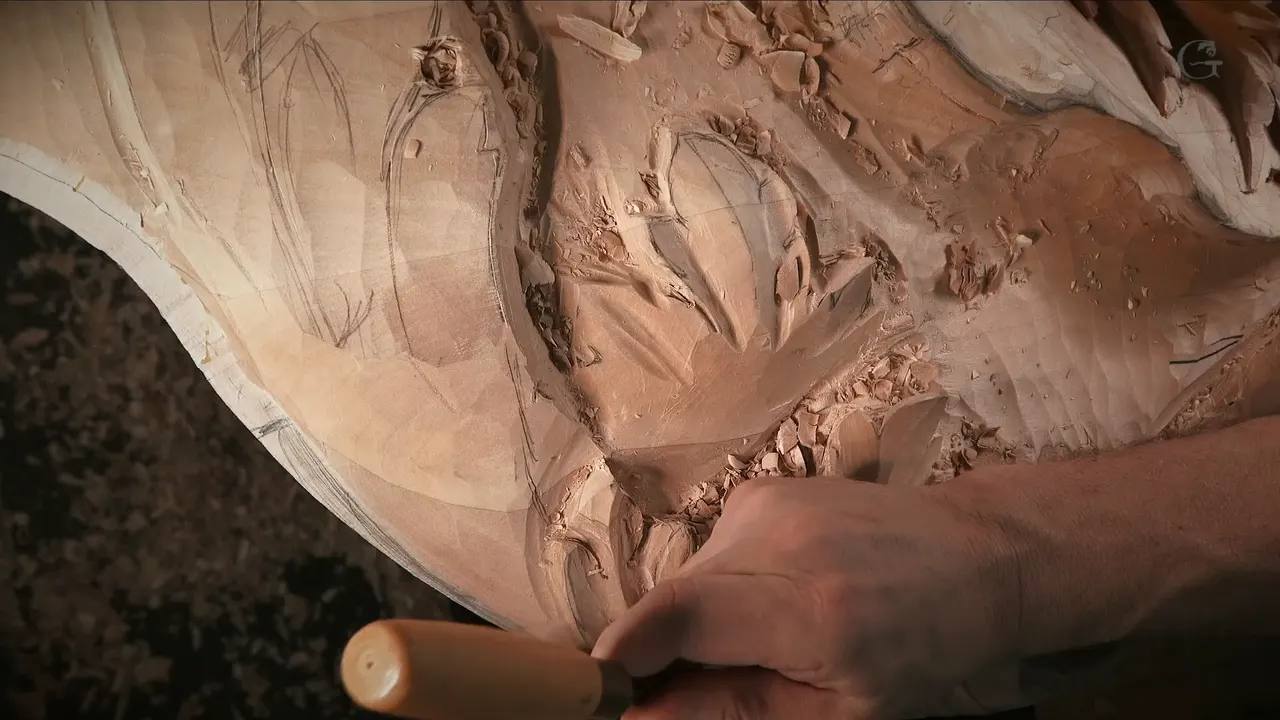

In part 9 of Venice Room 63, my words were "Looks like today I'm mumbling when I'm talking. Sorry." In other lessons I used the same word, and my reasons changed. I was thinking, I was working, I was tired, or I wanted to avoid a mistake.
This page follows that one line, then each lesson where I said sorry. For the craft in general, see wood carving on Wikipedia.
What was I doing when I said sorry in part 9?
It opened with a clean-up. "And now I need to clean a little bit this section," I said. The weather came in next. "It's getting dark outside today," and "We're having a storm." Yes, "we do have storms sometimes in Florida too." See thunderstorms on Wikipedia. A little later came "I'm not too happy about how not clean this section is."

Then a plan for the upper part. "Maybe I can create slight movement this way, just to give some more interest to the upper part." I was unhappy with the divisions on that particular section, and I said, "Maybe I can work a little more on that."
What had to happen next was a pair of pipes, and "on the sides of the pipes, I need to create concave cuts." For those, "I'll use just a really small number 11."

One line was a wish, "I want to create beautiful pipe." And "Even if the detail is small, it still makes sense for me to create something really nice even on a small detail." The wish ended on a plan, "And I'm going to go all the way."
Next came a wish for light. "I wish I have a lot more lights," I said. Then, "I've got a lot more lights now, so hopefully, I can see much better." Back to the storm. "It's about 11:00 AM, but we have for a couple of days already really stormy days." It was "not too common to Florida, especially to that time," I said, and "something unusual."

Next I wanted to show you "overall picture what I'm working on." My verdict was "I'm still not too happy about some of the movements," then "I still have to develop it more." It will be beautiful once it's done, I said. One more fix was on the list. "I need to fix also this movement since I chopped much deeper, so I need to work on it a little later." The side was "kind of messy," but "it's okay."
On to the pipe. "Get that pipe done," and "I guess I need to buff a little bit my tool." Later, "yes, I buffed a little bit off-camera, stropped a little bit off-camera, and now it works much better." My next words were "So I established one of the pipes."

After that came "let me clean that side," because "it needs to be gradual movement." Then, "Okay, that's good. It gave me really beautiful shadow. It did." My plan after it was "Let me chop a little bit sides of that pipe," and then "I'm really happy, don't want to overdo it."
A spot needed a decision. "I also need to figure out what I'm going to do right here, which I'm not sure if you see it or not. You should be." My idea for it was "to hide that chunk somehow. Not really hide, but to eliminate that extra detail without eliminating it."

There I said it. "Looks like today I'm mumbling when I'm talking. Sorry." No reason came with that sentence. Then came a tool, "Again, number 11 and 3 millimeters," which is 3 mm (about 0.12 in). Then, "So what happens now, I created that small eye."
Two lines followed about the eye, "I need to exaggerate that movement," and that it would go right underneath. And then, "from every eye, I really need the pipe." A warning came last, "I have to be really mindful because I have almost nothing left," and a call to you, "Get little different angle for you."

Was I thinking as I mumbled?
Sometimes the reason came in the next breath. In the Hashemi Flowers course, lesson 16, part 3, I said "Well, actually I could, I guess, but I don't have to. Sorry for mumbling. Just trying to think." Then "Let me do concave cut on the sides." A little further on I said "I'll take number seven" and "that's one inch" (about 25 mm), after "Let me think which tool I have to use."

My wording is in part 11 of workshop 14. "I'm sorry if I'm mumbling sometimes, but just want to make sure I'm just doing the right thing, okay?" What I wanted to be sure of was a part going "from underneath because I've got an eye." Then I said I could outline it with the number nine.
A piece had to be divided into sections in workshop 83, part 12. "Double check," I said, then "I'm sorry for my mumbling today, but I really have to figure that out." My count was five sections, "one, two, three, four, and five." And "it's going to be accurate to the Fibonacci sequence." For a tool I planned a number 11, and "I probably should take 7 millimeters" (7 mm is about 0.28 in).
The sorry stood alone in workshop 19, part 9. Next I said "let me double-check," then "I think I'll just use a big gouge," then "My number two." Next on the list was to "fix overall movement." Workshop 65, part 10, has a sorry after "if you remember, I explained the boat."


After the sorry I said I hoped a movement would "give me beautiful movement." Next came a plan for the pipes, "exactly the same operation," with a number 11 at seven millimeters. I added "quarter inch," so 7 mm (about 0.28 in).
The Furniture Panel course, lesson 35, part 1, has "My apologies for mumbling today." Next, "Number 11, again, get rid of all the mess." Later came "You could by the way, just use a knife and blend everything," and "Knife is just such a wonderful tool."

Is working a reason to mumble while I carve?
In my words, yes. The words in workshop 11, part 7, were "I'm sorry when I'm sounding like I'm just mumbling, and that's exactly what I'm doing, actually, because I'm working." The rest ran, "I'm working, and you pretty much like being with me in my shop," and "That's exactly how I work on a daily basis."

I put it differently in workshop 2, part 9. "Like I promised, that is a real work for me." Next, "It's not like I'm trying just to do a lesson or something. Yes, it is a lesson." Then came "I have to change a little bit something," and "I don't like this detail right here."

Pace came up in workshop 94, part 4. "I apologize if you don't like when I mumbling, but I'm just working and my normal pace trying to explain what I'm doing." Next, "let me excavate this eye."
A fuller answer came in Lily Box lesson 6, part 5. My words were "I do apologize when I'm mumbling and thinking out loud," and I called it "the process." It was "actually the goal of school," and the setting was "just like if you are with me in my shop working together."
I pictured a guild where wood carvers worked. They "would have apprentices," and those apprentices "would just watch pretty much what master does." Watching someone work gives "much better idea how it's done," I said. I used half a millimeter, number 11, for a "really nice defined concave" near my volute.

In Venetian Flowers Rosette lesson 5, I was trying to "communicate my best, but sometimes it's hard," I said. My tool was "number 11" at "4 millimeters" (about 0.16 in). Also, "one of the parts has to go underneath of another one."

The Q and A on the iPad for wood carving patterns says it the other way. "Of course, I don't want to mumble," I said, and I wanted you to "understand the process." My example was a huge project, "36 inches by 120 inches" (914 mm by 3,048 mm), "3 feet by 10 feet long."
Did tiredness come into it?
Floral and Molding lesson 5, part 1, says "I'm sorry for my mumbling today, so kind of tired." The size I needed was "one millimeter or even half a millimeter" (0.04 in or 0.02 in). The goal was a line that "goes right underneath."

Right after a sorry in workshop 61, part 10, I said, "So my apologies for mumbling today. It's too early yet." After it came "I'm not going to chop anymore," and "I have to make the decision how my division is going to work out."

In Carving Hazelnuts lesson 1, the words were "please accept my apology today, I'm kind of can't talk, just mumbling." Paper came next. "A piece of paper slightly bigger than my block of wood, but it's okay. I'm not going to worry about one-eighth of an inch" (about 3 mm). See hazelnut on Wikipedia.

Lily Box flower lesson 11, part 2, named a frustration. "Apologize for my mumbling. I'm a little frustrated that I lost some of the video footage, although I didn't do too much, but still, I just wish I did not lose it." Earlier the material was "5/8 of an inch" (about 16 mm), and "you're running out of the material, of the thickness, pretty quick."

Did I want to avoid a mistake?
That same lesson says so in part 8. "Now, I apologize if I'm mumbling little bit, but I want to make sure I'm not making any mistakes," I said, because "I'm already spent too much time doing this piece, and if I make the mistake, it's going to be really frustrating."
My tool was "two millimeters, number 11" (0.08 in). Then, "I'm actually supporting with finger." Later, "like everybody else, I am trying to do sometimes some stuff too quickly. And that would be a big mistake."

Lily Box flower lesson 10, part 10, paired a sorry with a size. "Take one millimeter and carefully," I said, right after "mumbling a little bit." Then the grain, with "this side just cuts with no problem" and "here, the grain changes," so "It's really hard to carve." Also, "That's why I'm kind of wiggling a little bit."

The first part of that lesson is shorter. "It is against the grain. I'm sorry. Just mumbling today." After it came "again, that's just preliminary. It's not the final form."

Did I say sorry with no reason at all?
Yes, in a few. "And sorry if I mumbled little bit," I said in workshop 58, part 9. Just before it, "You just take a little slice by slice," and "it's not like one swoop, one cut, and it's all done."

The words in workshop 53, part 8, were "Sorry for mumbling." Then, "Can you see this pipe? It's already visible." I took "number 11, 12 millimeters" (about 0.47 in), "little less than half an inch." In Furniture Panel lesson 21, part 8, I said "Sorry, sometimes I'm just mumbling. Babbling." Right after, "every little bit counts."


How do fifteen parts line up?
The table holds fifteen parts, with workshop 63 first. The middle column gives my words near the sorry, and the last gives what was in front of me. Where I named a size in millimeters, the inch figure sits beside it.
| Where | My words near the sorry | Setting |
|---|---|---|
| Part 9, 63.9 | to eliminate that extra detail without eliminating it | Small eye |
| Hashemi 16.3 | Let me do concave cut on the sides | Number seven |
| Venice 14.11 | doing the right thing, and a part going underneath | Number nine |
| Lesson 83.12 | but I really have to figure that out | Five sections |
| Room 19.9 | gradually, let me double-check, then a big gouge | Overall movement |
| Room 65.10 | I explained the boat, and the pipes came next | Seven millimeters |
| Panel 35.1 | Number 11, again, get rid of all the mess | Knife option |
| Workshop 11.7 | that is exactly how I work on a daily basis | Daily work |
| Part 2.9 | that is a real work for me, I said | Details to change |
| Lesson 94.4 | I apologize if you don't like when I mumbling | Eye to excavate |
| Lily 6.5 | I do apologize when I'm mumbling | Defined concave |
| Molding 5.1 | I need to use one millimeter or even | Line underneath |
| Venice 61.10 | my division is going to work out | Middle line |
| Flower 11.8 | and if I make the mistake | Two millimeters |
| Lily 10.10 | the grain changes and it's really hard to carve | One millimeter |
Where can you watch the full videos?
Every lesson named above sits inside one of my courses. This lesson holds all of workshop 63, and workshops 62 to 73 are in Venice Room Part 6. The gouge, Venice, acanthus plant and shadow pages linked here are for reading, and Florida is where part 9 was filmed. To watch the full videos, start here.
How it's done
- Start with the clean-up. Part 9 opened with a section I needed to clean, which I called not clean.
- Plan the pipes. I said there would be a pipe and a pipe, with concave cuts on their sides, made with a really small number 11.
- Buff the tool. I buffed and stropped a little off-camera, and it worked much better.
- Hide the chunk. The chunk was to be hidden somehow, not really hidden, in my words.
- Add the small eye. The 3 mm number 11 (roughly 1/8 in) made a small eye, and I said I needed the pipe from every eye.
Frequently asked questions
What did I say in part 9 about mumbling?
I apologized for mumbling while I talked, right after my idea to hide a chunk, and no reason came with it. The next words were about a number 11, 3 mm (about 1/8 in).
Does mumbling mean I was thinking?
In Lily Box lesson 6 the words were mumbling and thinking out loud, and I called that the process and the goal of school. In Hashemi lesson 16 the words that followed were about thinking.
Did tiredness come up?
In Floral and Molding lesson 5 the reason was being tired. Workshop 61 has a different line just after the sorry, which is that it is too early yet.
What to carve next
- Workshop 63 lesson
- Workshop 62 to 73 course
- Hashemi Flowers lesson 16
- Workshop 14 lesson
- Workshop 83 lesson
- Workshop 19 lesson
- Workshop 65 lesson
- Furniture Panel lesson 35
- Workshop 11 lesson
- Workshop 2 lesson
- Workshop 94 lesson
- Lily Box lesson 6
- Rosette lesson 5
- iPad for patterns Q and A
- Floral and Molding lesson 5
- Workshop 61 lesson
- Hazelnuts lesson 1