

Alexander Grabovetskiy, woodcarver, School of Woodcarving · Published 2020
What does a wood carver mean by "extra division"?
Quick answer: In Venice Room 63.8 I named the trouble as how wide that section is versus that section. A division on one side was my fix. Other lessons gave other reasons, such as hiding a shell and matching the opposite side.
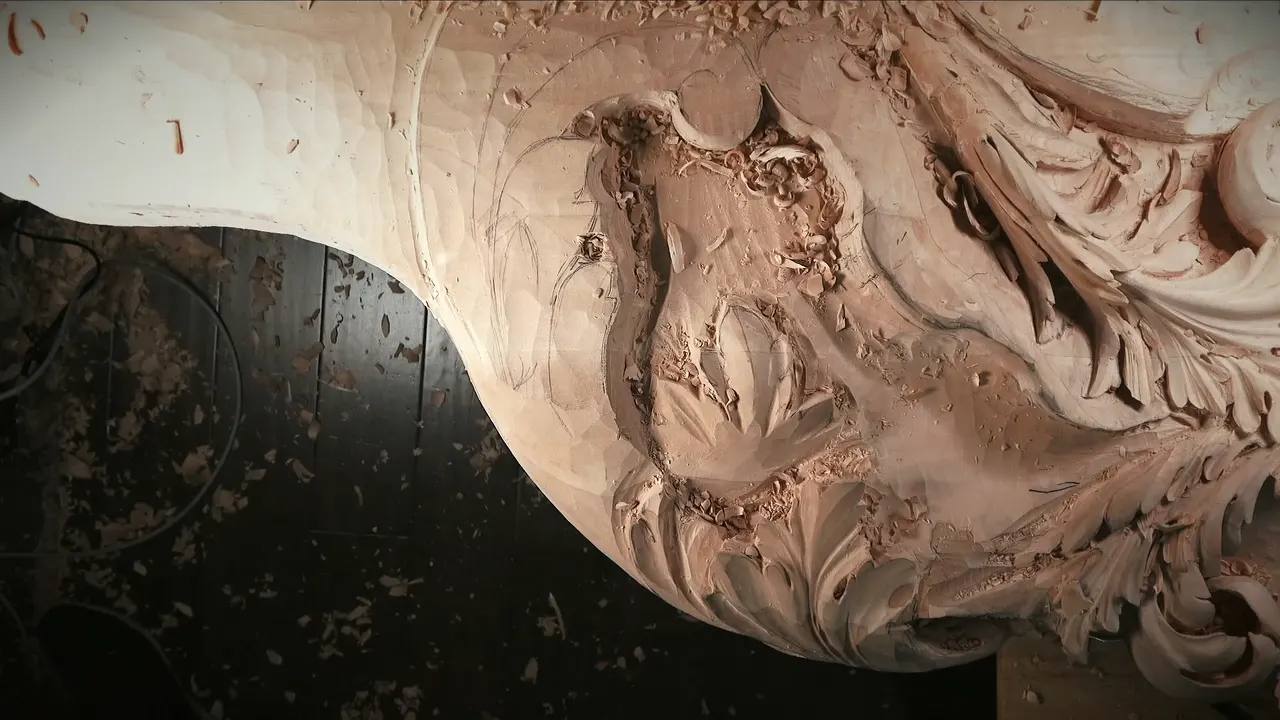

In part 8 of Venice Room 63, I said one more division on that side would fix a section that looked too wide next to its neighbor. In other lessons I used "extra division" for hiding a shell, matching the opposite side, and a spot that was too pointy.
This page follows that one line from workshop 63, and then each lesson where I gave a reason beside the same words. For the craft in general, see wood carving on Wikipedia.
What did I say about an extra division in part 8 of workshop 63?
It came in the middle of a fix. Early in the part I said I had "established just a big, huge eye on this section," and that I was "not too happy about this side." The trouble I named was width: "how wide that section is versus that section." One line held the plan. "So that way I can fix that and make extra division on that side, so it's going to be much better."

The eye came first. "I need to use a small or smaller number 11," I said, "just to create a small eye with the number 11." I stopped to think: "which is supposed to flip what." My call was that "this side is going to flip above." After that I needed to "blend a little bit" on that side, and a number five came next "to create a little nicer movement right here."

"I like that," I said, and "I think it's good." Even so, I still needed an eye. The tool for it would be "number 11 and a smaller version of it, 1.5 millimeters, like 1/16 of an inch."

The other side came next. It needed "to repeat that same thing on another side," I said. I thought about putting that one "underneath of this section." "I'm thinking," I said, "Let me think if it's going to be good or not." I wanted "to make sure it looks really good." Then: "And if I don't like it, I have plenty of material."

For the division itself I named a small tool. "Okay, going to use a smaller version of number 11, three millimeters," I said, which is 3 mm (about 0.12 in). My verdict was short, "That is not bad and all, I would say," and I planned to "shape a little better this side."

Next came the line about doing it on purpose: "Okay, that is actually good what happened. Nothing happened, actually. I did that on purpose." Here is how I put it: "I just created that movement on that side, and now I'll be able to fix whatever I don't like." "At least I can actually get the same distance on that side," I added. The "center line of that movement's supposed to go maybe all the way that way," I said, "because I have a long center line on this side."

One more plan closed the part. "Maybe I do like it. I'll just do another separation right here and remove that section." I told you that would make "a lot more sense." Last came a call for the small tool again, and the part ended on "That is good."
What came right after that in workshop 63?
Part 9 stays with the small tool. "On the sides of the pipes, I need to create concave cuts," I said. I would use "just a really small number 11." Even if the detail is small, I said, "it still makes sense for me to create something really nice even on a small detail."

The number 11 came back at 3 mm (about 1/8 in). "I created that small eye," I said. "I need to exaggerate that movement." But from every eye, "I really need the pipe." Next I said, "I have to be really mindful because I have almost nothing left." Part 8 had the line "I have plenty of material."
Does it help to hide a part?
In workshop 72, part 5, the reason was a shell. "Maybe I should actually end up right underneath of that movement," I said. "That would give me ability to actually hide that shell." I planned for "one of the main movements" to "go underneath," and said "which means I have to create extra divisions." I wanted to be sure about "the right position, something like that."

Workshop 55 has the same turn in part 10, and it starts with "That's going to go underneath." My point had to go "in the right position." I also said, "I can probably start creating extra divisions. And that way I'll see if I need to change something or not."

"So those divisions are really important," I said. Another line: "I can probably bring that a little closer and create that side a little bigger division." I named relief cuts, "same like you already saw hundreds of times I'm doing," and "the same number 11 tool."
A spot in workshop 59, part 11, did not read right. I had to think about how to "create extra division right here, because looks like I need to." My words were "It does not make too much sense how it looks." Then: "Maybe I shouldn't even mark. Let me clean it first, and then I'll decide what to do with that."

Then came the options. I could keep a division as part of the movement, or "get rid of altogether this chunk." Still, "I kind of like that returning effect." My other idea was "another separation right here in this area," with "exactly the same on the opposite side." Then I could "excavate underneath." Last, I did not like "this chunk," and "maybe I should get rid of it." See relief on Wikipedia.
Does an extra division go on both sides?
Workshop 143 set the rule in part 2. The rule was to match "whatever I just drew on inside" on the "opposite side." My words were "logically if I have a division this side, so I have to match that division on the opposite side as well." A limit came with it: the other side will not be at the same level, "because logically, it has some movement."

Part 1 of workshop 155 said it another way: "this part could be a counterpart of this part." That meant I was "able to put extra division." "I like it," I said. My plan was to "relieve those triangles first."

Workshop 72 also named it, in part 5: "like a dynamic symmetry." The example was a pair of sizes. A smaller detail on one side means a little bigger one opposite. The golden ratio came in through my own words, "five parts out of eight, two parts out of three, and whatever." For numbers I said, "if it would be five inches across from this point to that point, of course it's not, but if it would be five inches across, so I have to make eight on this side." Five inches is 127 mm. See symmetry on Wikipedia.
Acanthus over Moldings lesson 4, part 2, has an eye. My first figure was "approximately maybe about three millimeters," and I fixed myself with 3/8 of an inch (about 9.5 mm) "from this point." One more thing about it: "I do have division on another side."
Can an extra division fix a spot I don't like?
In workshop 66, part 8, I said there would be extra divisions "on inside because right now it's just too pointy." Then: "this one needs to be a little shortened also." "Maybe yes, maybe I don't need to." And: "We'll develop something new and get that thing done. That division."

Workshop 64 shows two sides of it in part 1, and the first gave me "super clean and beautiful look." I added, "Now, of course, that's what I think." A second line from that part: "I need to actually give extra division right here because it does not make too much sense." And: "Just chop a little section off here. Okay? Because otherwise it just doesn't look too good."

Workshop 69 had an overlap on the main body in part 8. It would "make more sense," I said, and I could "get extra division on inside." The depth I named was "about maybe 3 millimeters or so deep," a little under an eighth of an inch. Otherwise, I said, "I'm going to lose my feel of a sphere." See sphere on Wikipedia for the plain shape.

That same workshop, in part 10, had a bigger opening, and I said I was "not sure if I should or not." I could "do extra division" at one region and "completely open up that part." Then the idea: "I can actually create huge eye, huge opening. So which going to give me extra shadow." The tool I named was "a quarter inch, six millimeters, number nine." Wikipedia has a page on shadow.
Roman Acanthus lesson 15, part 1, has the other side of the coin. "Bring that to the edge. And that is not what I want to see. That's actually created an extra division line."
Do I call it a division, a separation or an eye?
Workshop 73 gave me another word in part 2, and I was "ready to create the extra divisions. Extra divisions on pretty much all of them." Another name came next: "I'm talking about on all of those, whatever things. Separations, I should say." A thought about thickness came with it. "I do have enough thickness on this side. Should I leave it flat like that or I could actually create some kind of curl."

Part 10 of workshop 66 has the logic. "I just added extra separations, what I did." I excavated that eye and that inside, and it was "nothing that special." Now it was "all about the detailing." The count was "three main divisions, and then I divide those divisions in another three."
Floral and Molding lesson 6, part 1, listed them out. There would be some divisions, I said, and one would be "division number one." Another division was coming, and "an extra division going this way." Removing a triangle called for "the small number 11," and "I'm pretty sure I can use three millimeters" (3 mm is 0.118 in).

Is every extra division planned before I carve?
Workshop 27 has a plan in part 3. I said I would "need extra division" at one spot, and I planned "a little opening on inside." Then: "We'll see." Workshop 30 shows me deciding in part 1: "make the decision" on how to divide it, because "right now it does not look too good and I need to make the divisions."
There I said, "But how I want to do that, that's the question." Another line: "it has to be logical movement." My call was "better that way." Workshop 157, part 1: "I still have to probably a little later work on my divisions, how they're going to look and so on."
How do fifteen parts line up?
The table holds fifteen parts, with workshop 63 first. The middle column gives my words, and the last gives what was in front of me. Where I named a size in millimeters, the inch figure sits beside it.
| Where | The words I said in that part | Setting |
|---|---|---|
| Part 8, 63.8 | Three millimeters | Two sections of different width, and three millimeters (about 0.12 in) |
| Part 9, 63.9 | Almost nothing left | Concave cuts on the sides of the pipes, and a pipe from every eye |
| Shell, 72.5 | Right underneath | A movement that ends underneath, so the shell can hide |
| Point, 55.10 | Right position | A point to place right, and relief cuts with number 11 |
| Chunk, 59.11 | Looks like I need to | A spot I did not like, and a chunk I might take out |
| Leaf, 143.2 | Match that division | A division on one side, matched on the opposite side |
| Triangles, 155.1 | A counterpart | Two parts that match, seen from above |
| Symmetry, 72.5 | Five and eight | A smaller detail on one side, a bigger one opposite |
| Molding, 4.2 | Another side | An eye, and a division across from it |
| Pointy, 66.8 | Too pointy | An inside that needed more divisions |
| Clean look, 64.1 | Super clean | A look I liked, then another spot that did not make sense |
| Overlap, 69.8 | More sense | An overlap on the main body, a little under 1/8 in deep |
| Big eye, 69.10 | Huge opening | A quarter inch (6 mm) number nine for the hole |
| Separations, 73.2 | I should say | The same extra divisions, called separations |
| Detailing, 66.10 | Another three | Three main divisions, each divided in another three |
Where can you watch the full videos?
Every lesson named above is inside one of my courses. This lesson holds all of workshop 63, and workshops 62 to 73 are in Venice Room Part 6. The gouge, Venice, acanthus plant, chisel and leaf pages linked here are for reading. To watch the full videos, start here.
How it's done
- Name the trouble. I was not too happy about this side, and the problem was how wide one section was versus the other.
- Start with a small eye. Number 11 was the tool, a small or smaller one, just to create a small eye.
- Pause before the move. I stopped to ask whether it would be good or not, and I said I wanted to make sure it looks really good.
- Put in the division. The smaller number 11 went in, and my verdict was that it was not bad.
Frequently asked questions
Which tool did I name for the division in part 8?
Number 11, at three millimeters (0.118 in). Right before that, a number 11 at 1.5 millimeters, like 1/16 of an inch, was named for an eye I still needed.
What was the trouble in part 8?
How wide one section was versus the other. The problem I was having right now was the one to fix, in my words, and an extra division was part of that fix.
Did I say a division could hide a part?
Workshop 72 said that ending right underneath of a movement would give me ability to hide a shell. Workshop 55 sent one movement underneath too.
What to carve next
- Workshop 63 lesson
- Workshop 62 to 73 course
- Workshop 72 lesson
- Workshop 55 lesson
- Workshop 59 lesson
- Workshop 143 lesson
- Workshop 155 lesson
- Acanthus over Moldings lesson 4
- Workshop 66 lesson
- Workshop 64 lesson
- Workshop 69 lesson
- Roman Acanthus lesson 15
- Workshop 73 lesson
- Floral and Molding lesson 6
- Workshop 27 lesson
- Workshop 30 lesson