

Alexander Grabovetskiy, woodcarver, School of Woodcarving · Published 2020
What does a wood carver mean by "I beg you for forgiveness"?
Quick answer: Begging forgiveness at the bench is my plea to the people watching when the camera cannot show what my tool is doing. In Venice Room 63, part 10, I said "I apologize, people. I know you don't see it," and other lessons give other reasons beside the same plea.
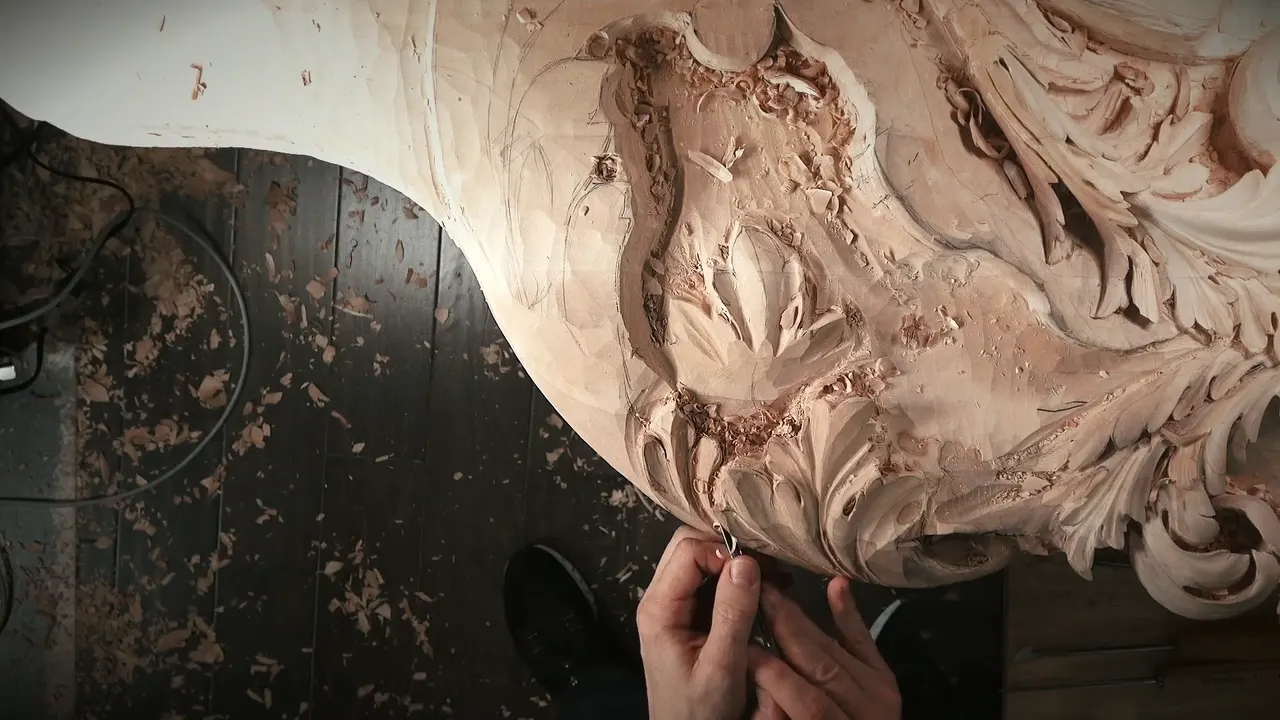

Begging forgiveness at the bench was my answer in Venice Room 63, part 10, when a step would not show on screen. Other lessons carry the same plea, and each one on this page comes with my reason, said in the same breath.
Have you ever watched a carver's hand sit right over the spot you came to see? Would you like to hear what he says to you when that happens? Then read my words from workshop 63 first, and from other lessons after it. Wikipedia has the general story on forgiveness and on apologies, if you want that before the lessons.
How did part 10 of workshop 63 go?
The first words in this part are about one movement. "That is a good movement," I said, and "And also going to do on another side of the pipe." My tool was doing the work, in my words "just the side of my tool pretty much." The next words were "Create that movement."
Roundness came next, in these words, "Okay, that is good, now I need to give a little bit roundness." Right after it I said "I apologize, people, I know you don't see it." I offered a way out, "Maybe I should do it off-camera, this section, but that's okay." The plea itself was "Please, I beg you for forgiveness."

I left the thought open. "I still have to do..." and "But I need to figure out maybe how to show that to you." Both are needs.
The next words in the part are about the surface, "So essentially what I'm doing is just the cleaning up because I really don't want to see those sharp ridges." The line right after it says it again. A verdict followed, "Okay, and that is good, I believe."

For that section I had a plan, "So let me give a separation cut right in this section also." Then, "Right in this section, just like that, and get that undercut little bit."
A tool number came next. "Now number five, number five, or this one is actually number six, and it's not going to work, I need number five." Soon I said "Okay, so that is much better," and "Although it's not yet exactly how it's supposed to look without the micro details, but at least that's somewhere right there."

One detail got a plan of its own, "And we're going to give a little twist outward to that detail right here." A need followed, with a way out, "But now I need to actually work on the pipe on this one, okay, I don't have to, but I think it's going to look better." On the pipe, "At least just some indication of this movement," and "At least a little bit of the shadow."
A little later came praise, "Okay, that is wonderful, I think it's wonderful." Right after, about the finish, "Clean little bit because I don't like to see those facets."

Next, "Okay and not okay, still kind of not too happy with overall." I named a tool with a maybe, "Use maybe number four," and said what I would try for, "And I'll try to give a better shape." After that, "And that would become eye, that's going to be eye right here." For the next movement I planned the veiner, not the gouge, and I still had to "clean little bit that."
The last lines in the part show me unsure, "Okay, maybe it is a little too sharp ridge, I'm not sure, maybe it is, maybe yes, maybe no." Then "Let me clean that movement little nicer." Doubt came again, "I'm not sure if I like that or not," and "But overall, it's okay." The final words go back to the surface, "But I'm still not too happy about those extra ridges, extra tool marks, really don't want to see them."

One plea in one part is a small thing, so this page follows it into other lessons. Along the way come a camera, a microphone, goggles, an elbow and some shadow, with a Wikipedia page for each. For the tool and the craft, see gouge and wood carving. Each came with a reason, said out loud.
What do I say when the camera cannot show the carving?
Workshop 62, part 4, has the plainest line, "Again, on a video, on a camera, it doesn't look like in real life." Then I asked, "So please forgive me that you don't really see the full development, how it's supposed to look." What came next was a plan, a part "going underneath." See the lesson.

Floral and Molding lesson 5 gave an angle, "you look at that piece from the angle because the camera position is somewhat at the front of me, and you don't really see the true how wide that is, but you should get an idea." Then, "It's impossible for me to always just rearrange the camera." My sorry named what you could not see, "if you don't see exactly what I see." Last, I asked for your trust.

A wiggle bugged me in workshop 81, part 9, "This bugs me, that is wiggling too much." I went on, "It doesn't bug me, but it bugs me that you see it's wiggling." Then came my plea, and "It's just the way."

Positions came up in workshop 85, part 3, "But I like the idea I can just position that to different positions." And "I know it little flimsy, and it's really hard sometimes to watch how I'm carving." Forgiveness was part of it. I put up with it for one reason, "So that is the only way as of now, I can attack all three sides." On a bench, "I would be able to carve only two sides."

Some work in workshop 133, part 3, was too small to show. Once I get close to my work, I said, I would not be able to show how I do it "because it's going to be really tiny undercut spots." My plan was "So most of it they're going to get done probably off camera. Please forgive me for that."
Why does my hand or head end up over the work?
Grain direction came first in workshop 84, part 2, "Got to be careful because the grain direction goes in, so I have to attack that from the right position." Next, "and I probably most likely going to cover the camera." Forgiveness came next, and soon I said, "Clean a little bit, and that way I will see much better what is going on."

My hand was in the way in Hashemi lesson 10, part 12, "And most likely, my hand's in the way, and it's almost impossible to see what I am doing underneath." I gave a reason for the hand, "See this finger? I'm actually supporting that piece because right now it's fragile, and I can easily break it." Of the grain I said "Especially the grain goes this direction," and called it "my weak point."

The Hazelnuts course, lesson 7, part 3, has a number 8 spoon gouge. I called it "a little too big, probably," and gave half an inch (about 13 mm). Then "If I'm covering with my elbow," and my sorry followed. Switches were next, "Probably have to constantly switch between number 3, maybe a flat gouge, and a spoon gouge to clean up."
Acanthus over Moldings lesson 6, part 3, gave me a size. Number five came up, one eighth of an inch, three millimeters (about 0.12 in), and then "But again, I have to be really close to my work. I have to use my goggles and just in case if my head gonna be in the camera." The sorry came along.

Workshop 18, part 12, has "the micro number three." My head might end up in the camera, I said, "I try not to cover that with my head, but sometimes I really have to look inside." A line about hair rode with my plea, "I'm not trying to show to you the color of my hair." See the lesson.
Carving in front of a camera and carving in daily life came up in the third lesson of the Lily Box course, part 9, "Because I don't have to think about that I'm covering anything or not." With the camera, in my words, "my hands could cover." Then "I'm trying, okay?" and the plea, and "I'm trying my best." A tool came next, one millimeter (0.04 in), with the half a millimeter (0.02 in) to follow.
How does the camera's place change my carving?
Later in that part of workshop 62, I said I would start "little by little with the smaller tool, seven millimeters" (about 0.28 in). Then, "And yes, I am breaking the rule and carving towards myself." The plea came, with "but I have to." The reason I gave was "Because I really don't have better position right now without sticking my head to a camera."

My angle had a reason in lesson 30 of the Furniture Panel course, part 3, "position of the camera." Then "I don't wanna rotate all the time."
I was not filming my sharpening in workshop 42, part 9, "And yes, I'm not filming my sharpening when I'm going and sharpen it, because the camera position." Repositioning everything would have cost me time, I said. My plea came right after.

What about the quiet stretches?
A quiet stretch got a plea in workshop 65, part 2, beside "And if I'm quiet sometimes." Then, "just watch what I'm doing, okay?" I gave a reason, "I'm also catching myself that I'm thinking in some moments and I forget that I'm supposed to talk." And "But I don't think I'm supposed to talk all the time."

Hashemi lesson 43, part 5, has this, "if I'm carving and not talking, because sometimes I really have to work and concentrate on exactly the same technique over and over." And "I sometimes even don't know what to say." Then, "Please be patient and forgive." Next, "Don't worry if it looks chunky a little bit at this point."
Names were the trouble in Hashemi lesson 5, part 2, "forget to name a tool I'm using at that moment." I added "I do understand that's not the beginner's project." Last, "And if I forget the name a tool, please just forgive and live with me."
Why does a long project need a sorry?
I had changed my gear in Roman Acanthus lesson 16, part 1, "Please understand that I'm actually using multi-camera setup, and when I'm recording everything and then I'm editing everything, it takes a lot of time." Then "So this time, I upgraded my equipment," and I would try to "switch right on the fly." My sorry came with "if there are some imperfections or if I'm going to make some mistakes." Part 2 has it with "if there's any mistake."

The project explained it in lesson 14 of the Furniture Panel course, part 3, "And I know it takes time because this project is not the production project for me." And "So it's not a priority project." After the plea, "I am really, really happy with this moment."
In lesson 15 of that course, part 7, a mess explained it, "because later on, I'm going to undercut, like I said." Then, "So that's why you see a little mess." After my plea came "Which is okay," and "That is not my final detail yet."
Telling you too much was my sorry in Grape Onlay lesson 2, part 3, "telling you too much about it." My reason, in my words, was "maybe I just saw so many people are doing the same, same mistake." Then, "Concentrating too much on detailing." And "It's too early."
Does a lamp or a microphone need forgiveness too?
A lamp was the reason in Lily Box lesson 2, part 8, "And I use number three in a small, tiny number three." Maybe I would "need my lamp," I said. I asked ahead, in case it was too bright, and said "for me, it's more convenient to see through the lamp." A magnifier lamp is what I was using. "And also, when I'm using my lamp and talking, I'm losing quality of the sound."

The eleventh lesson of the Lily Box course, part 10, brought a lamp again, "I decided to use a magnifying or magnifier lamp." The lamp had a reason, "because we're working on tiny spots," and "so I want to make sure I see at least closer to what you see." It might "affect a little bit how my microphone is pointing," and my sorry covered a sound that might not be perfect.
How do eleven parts line up?
The table holds eleven parts, with workshop 63 first. The middle column gives my reason near the plea, and the last names the topic. Where I named a size in millimeters, the inch figure sits beside it in the text above.
| Where | Why I asked | Topic |
|---|---|---|
| Part 10, 63.10 | Roundness the viewer could not see | Sharp ridges |
| Venice 62.4 | A video does not look like real life | A part underneath |
| Molding 5.1 | The camera is somewhat in front, so width is hard to see | Asking for trust |
| Venice 133.3 | Tiny undercut spots will not show | Off camera |
| Hashemi 10.12 | My hand blocks what I do underneath | A fragile piece |
| Lily 3.9 | Hands could cover the work on camera | Trying my best |
| Panel 30.3 | I do not want to keep rotating | Camera position |
| Hashemi 5.2 | I may forget the name of a tool | Tool names |
| Roman 16.1 | Live switching may leave some imperfections | Multi-camera setup |
| Panel 14.3 | A project that takes time and is no priority | Slow project |
| Lily 2.8 | A lamp that may be too bright | My lamp |
Where can you watch the full videos?
Each lesson named on this page has a page of its own, and workshop 63 sits in Venice Room Part 6. To watch the full lessons, start here.
How it's done
- Name what the viewer misses. In part 10 I told the people watching they did not see the roundness I needed to give.
- Offer a way out. I floated the idea of doing that section off-camera, and I said I needed to find a way to show you.
- Give the reason. In other lessons I gave the reason at once. Sometimes it was a hand or head over the work, and sometimes a lamp or a quiet stretch.
- Go back to the work. After the plea in part 10, my words went to the surface and the sharp ridges I wanted gone.
- Say what still bugs you. At the end of the part I was still unhappy about extra ridges and extra tool marks, and I said so.
Frequently asked questions
What did I say in part 10 about forgiveness?
I apologized to the people watching and asked forgiveness, because they did not see the roundness I needed to give. I floated the idea of doing that section off-camera. My words were a maybe, and I said I still had to find a way to show it.
Is forgiveness a sign of a mistake?
Sometimes. In workshop 130 I caught myself using a phrase too many times, and I said that was okay. In Roman Acanthus lesson 16 I asked before any mistake came, about imperfections while I planned to switch cameras live, and in Furniture Panel lesson 15 about a mess I planned to undercut later.
Does a camera change how my hands work?
In Lily Box part 9 I said I do not have to think about covering anything in daily life, and with a camera on I do. In Hashemi lesson 10 my hand blocked what I was doing underneath, and my finger was supporting a fragile piece.
What to carve next
- Workshop 63 lesson
- Workshop 62 to 73 course
- Workshop 62 lesson
- Floral and Molding lesson 5
- Workshop 81 lesson
- Workshop 85 lesson
- Workshop 133 lesson
- Workshop 84 lesson
- Hashemi lesson 10
- Hazelnuts course
- Acanthus over Moldings lesson 6
- Workshop 18 lesson
- Lily Box lesson 3
- Furniture Panel lesson 30
- Workshop 42 lesson
- Workshop 65 lesson
- Hashemi lesson 43