

Alexander Grabovetskiy, woodcarver, School of Woodcarving · Published 2020
What does a wood carver mean by "feel guilty"?
Quick answer: In part 5 of workshop 63, after a clean pass from my number seven skew gouge, I said I did not have to feel guilty anymore, or to grab rasps for it. In other lessons I said guilty about rasps and sandpaper, rushing, cranking, overdoing it and going too deep.
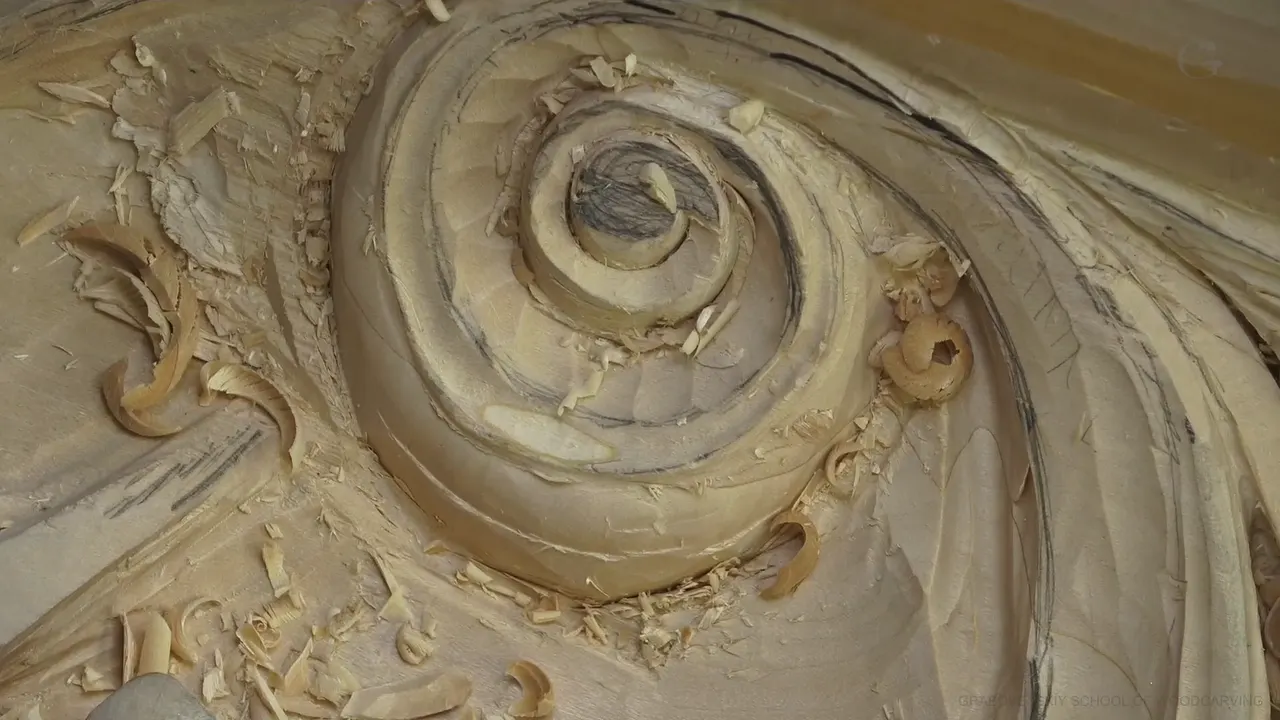

In part 5 of Venice Room 63, a clean pass from a number seven skew gouge got me saying I no longer had to feel guilty, or grab a rasp for that pass. In other lessons I said guilty over rasps, sandpaper, rushing, cranking, going too deep and overdoing it.
Does a rasp sit in your drawer because picking it up feels a little bad? Has a gouge ever gone faster than you meant it to, and you knew it while it happened? Both of those I said out loud, on camera. Below is the part where it came up, then each lesson where I used the word.
What was I doing before I said guilty?
At the start of this part I planned to lower the area "with just the spoon gouges," and spend "a little longer, just again, like I said, off camera probably, to clean that." What I had then was "a lot easier surface to work with." I needed "a really smooth transition," and I had to "ride right on the edge and hit the high spots." I also said to "feel it if it transitions nicely or not."
A check from the side came too. I had to look from there and make sure it "really nicely transitions down." It did not look good yet, and I said as much: "I really don't worry about that it doesn't look good yet." All I needed was "just in 3D, in three dimensions, how tangent that line is to the overall..." I asked, "Is it the right word, tangency?" The geometry has a name for it, a tangent, and there is a short note on a tangent line if you want one.

"Maybe I have to use a long bent," I said. "Let me see." Right behind it came "Sometimes long bent helps a lot to hit those high spots," and then the tool: "Number four, that's what I'm using. Long bent." "See, it's just really smoothly going up, and that's what I'm after," I said.
"Now, that slopes really nicely," I said. I could "just put the semi-final line, which is approximately about three millimeters away, one-eighth of an inch away from our initial cut." A long bent was my plan for that line too: "That way, it's going to be really continuous line. Continuous and clean."

Next, the edge itself: "See, it gives me really sharp edge." "Don't worry about this part," I said. It would be "undercut," and it would "give me a shadow." All I wanted was "just that line." Maybe a smaller tool, I said, "like three-eighths of an inch. About 10 millimeters." About the line: "That is really good line."
Sorry about the view, too: "I'm sorry that you didn't see when I was in this area because the camera, I forgot to turn other camera." The overall development was something I would show too, and I said it "doesn't look too bad at all."

Which gouge was clean enough to skip the rasp?
A number 7 skew gouge. I needed a concave "much deeper because I need the shadow," and I was "really not too happy about this section right here." For the concave, "I could probably use also a long bent," and then I caught myself: "But it could be mistake. Hold on just a second. Let me think, and let me think twice, because I don't want to make mistake." Next came "Maybe I can just use a little smaller tool and start."
The tool in my hand was "a skew, and that's slightly bent," a "skew gouge, number seven." Then: "Maybe skew the opposite direction," and "going to give me a much better cut." Of the gouge itself I said, "Nothing special." The bend was "a short bend," or "actually a medium bend, I would say." The size: "about 14 millimeters, about half an inch."

On why I like the skew idea: "I'm just pushing and it's already slicing," and "it just gives me much cleaner cut pretty much out of the gouge." I corrected myself: "Out of the push, I should say." And one note on the edge: "maybe I have to sharpen it a little bit. Or buff it, I should say."
What did I say the moment the pass came out clean?
Next I said, "And carefully, careful," and that I could keep going "until it grabs some of the material." Then: "But see how clean cut is?" It was "absolutely beautiful, clean cut." Right after that: "I really don't have to feel guilty anymore. I don't have to grab rasps for this cut and all."

The limit I named was the number. "It's really digging in. So got to be careful because, like I said, there is already limitations of this tool, and that this is number seven." Then: "Number eight wouldn't do that." The concave was "really beautiful and pronounced," I said. I did not need more depth. "Yes, I could go a little bit from here," I said, but "it's going to be a mistake if I press it too much." I named the mistake too: "Mistake of overdoing it, okay?" Also: "I guess I've done it too many times."
Did the other parts of workshop 63 say anything about mistakes too?
Over in part 4, "I don't want to do mistake," and "I need to double-check my curvature." Part 6 has "I have limitations. I mean, I'm limited by this part of eye." An even smaller gouge was the plan then, "like one and a half millimeters" (0.06 in).

The end of part 5 held a plan: "I'm going to take this side, I'm going to undercut," with "the same tool that I used before, just number sevens." "A boring process," I called it, and all of that I would "clean off camera." The skew came up once more: it "helps a lot, actually," and I called the pass "a beautiful, beautiful clean cut." For the rest I planned to "excavate just like that, little by little, until I meet those two cuts together."
Why did I feel guilty about rasps and sandpaper?
In Venice Room 28, part 6 (workshop 28), I had new tools, rasps, and with them I could "probably use shortcut and kind of create semi-final shape with that." Of the shortcut: "I like it a lot." The apology: "I'm still feeling guilty every time when I'm grabbing those rasps or sandpaper. I feel guilty of not utilizing the true woodcarver's approach." Then: "Maybe I shouldn't feel guilty."

Some furniture makers, I said, "even in the past, they used some kind of techniques like that. Either scraping or something else." One trick was "just a normal razor blade," from a store or a lumber yard, and I said there was no need to buy specialty tools for it. It would also give "really nice results."
Later in that part: "Every time, I feel guilty. Maybe at some point I won't." One favor I asked: "I would like to find out if you feel guilty if you would use it." I named people in my school, "professional woodworkers and professional furniture makers," who are "trying to be really authentic" and "doing reproduction." About myself, I said, "I'm still going to probably do it because it just gives me much quicker result."
Where did that guilt come from?
Venice Room 14, part 10, has my reason. "I have to be honest with you, I just stayed for many years away from those rasps. I really did not believe in them." I looked at them "like not authentic to the woodcarving world for many years because my teacher never used them and some other famous woodcarvers in the past, they did not use them." I saw one woodcarver use them, with good results, and I said to myself, "Why not to try?" I called it "a special project like that," one that would be painted.
The Lily Box course has a line in the same family. In Lily Box 4, part 13, I said, "Let me actually take my rasp again and see how everything flows." Next: "I actually like the rasp. Although it just feels like I'm cheating." Other carvers came up: "But I know some other carvers, they always use it." And: "It's actually working really good." Even so, "I still have to recut that," because "I need to see really nice facets from our carving tools." I did not want to see just the rasp marks.

My livestream of April 13, 2020, covered knife work (see the April 2020 livestreams). A viewer asked about using tools with the knife work, and I said, "With the knife work, absolutely no." Then, about knives: "I tell you that, and I still feel guilty." About those tools: "I stayed away from those tools for many years of my life because I feel guilty because it's not authentic to the wood carving world, I thought, okay, that my teacher would teach me." And: "those tools actually, I still don't use them a lot."
On knife work, I said, "I never use them." Of "this same board I just cut," I said, "those walls, those bevels, they really clean." And of the project, I said there was "no sandpaper" in it, and "it's just pretty much only one knife."
Was rushing on my guilty list too?
Rushing came up in Hashemi Flowers 3, part 3. My tool for the inside: "I guess I could use number seven right now," and then "you could use probably a smaller number five." Next: "Important not to rush it. But I am guilty myself. I do have a tendency to rush it because I want to make sure I'm done quickly. But it's better just to work your way in than rushing."

Greek Acanthus 11, part 1, says it too. I said I would take "number 3, just about half an inch, about 13 millimeters," "just to start digging deeper." Next: "Just try not to take too much at once, because you can make a big mistake if you'll do that." Also: "I know it's tempting. I'm guilty also. When you're trying to do too fast, too quick, but that's a big mistake." After that I would take a small V-tool, "number 15, but only 3 millimeters" (0.12 in).

Which habits besides rushing did I call guilty?
In Hashemi Flowers 47, part 1, I said I would continue with "the number 11 and 1 millimeter" (0.04 in), and "make my really deep excavation again." Then a warning: "Just be careful not to crank against the edge," because cranking it would break the edge. After the warning: "I found myself guilty also when I'm making cuts like that. I have a tendency to crank." My next plan was a smaller one, "half a millimeter" (0.02 in).

Roman Acanthus 14, part 1, was about tiny tools. "There is almost no limit which you can do with the tiny, small tools. The only limitation is if you're going to force it, you will overdo it, and I do that all the time." I added, "I am also guilty of overdoing it." A small gouge came next in my plan, "a 16th of an inch" (about 1.6 mm), for "even deeper cut on the middle."

In the Carving Hazelnuts course, lesson 7, part 2, I said, "Just don't go too deep because you still want to create some kind of undercutting underneath for the shadow." Number 11 again was the plan, "the seven millimeters" (about 0.28 in), "and excavate." Then: "keep an eye how deep you're going to go," because you do not want to go "deeper than the background." And: "I've done it, so that's why I'm telling you." One word followed: "Guilty." Then, "Not in this case, but previously on other jobs."

Can a tool you love make you guilty too?
In Venice Room 107, part 2, I wanted to take "it all the way to 30 millimeters" (about 1.2 in). I could "probably eyeball it," I said, but "for me, that would be much easier to use that pointing machine again." Then: "And yes, I'm guilty. I really, really, really like, love pointing machine." My next words were "So let me measure first," and then "let me check."

Which lessons use the word guilty, and for what?
Nine lessons sit in one table, this one first. The second column holds what I said I was guilty of, and the third holds the tool and size I named in that passage. Where I gave one unit, the other is in parentheses. The livestream names no tool, so that cell says what I said.
| Lesson | What I called myself guilty of in each case | Tool and size |
|---|---|---|
| This lesson | Grabbing rasps, not needed after this pass | Skew gouge, number 7, 14 mm (0.55 in) |
| Workshop 28 | Grabbing rasps or sandpaper | Rasps, with a razor blade as the trick |
| Hashemi Flowers 3 | Rushing, to be done quickly | Maybe a number 7, or a smaller number 5 |
| Greek Acanthus 11 | Going too fast, too quick | About 13 mm (0.51 in), a number 3 |
| Hashemi Flowers 47 | Cranking against the edge | 1 mm (0.04 in), a number 11 |
| Roman Acanthus 14 | Overdoing it with tiny tools | Small gouge, a 16th of an inch (about 1.6 mm) |
| Hazelnuts 7 | Going deeper than the background | 7 mm (about 0.28 in) with a number 11 |
| Venice Room 107 | Loving my pointing machine | Depth of 30 mm (about 1.2 in) |
| April 2020 livestream | Avoiding those tools for years | A single knife, with no sandpaper in the project, as I said in the livestream |
Where can you watch the full video of each lesson?
Every lesson named above lives inside one of my courses. This lesson holds all of workshop 63, and workshops 62 to 73 are in Venice Room Part 6. The wood carving and woodworking lessons I quoted are linked where I named them, and each one shows the work in real wood. To watch the full videos, start here.
How it's done
- Lower the area. My plan was to lower it with just the spoon gouges, then spend longer cleaning it off camera.
- Ride the edge. A really smooth transition was the goal. I had to ride right on the edge, hit the high spots and feel whether it transitioned nicely.
- Plan the semi-final line. My idea was to put it about three millimeters, one-eighth of an inch, from the initial cut, with a long bent.
- Push the skew. The deeper concave got the skew, number seven. I was just pushing and it was already slicing.
- Stop before pressing too much. I said farther would be a mistake of overdoing it, and more depth was not needed.
Frequently asked questions
What did I say about guilt right after the clean pass?
That I could drop the feeling, and then, right next to it, that rasps were not needed for that pass. Before both lines I had called it absolutely beautiful and clean.
Which gouge made that pass?
Number seven, a skew gouge, about 14 millimeters (about 0.55 in). The bend: a short bend, actually a medium bend. As I pushed, it was slicing, and that is why I liked the skew idea.
Did I plan to keep using rasps in workshop 28?
Part 6 has me saying I would probably still do it, because it gives me a much quicker result. Maybe at some point I won't feel guilty, I said. I also asked how you feel about it.
What to carve next