

Alexander Grabovetskiy, woodcarver, School of Woodcarving · Published 2020
What does a wood carver mean by "change the position"?
Quick answer: In Venice Room 63.7 I said I had to change position so as not to damage it, while I planned a number seven on a pipe. In other lessons I said it about grain, something I could not rotate, the camera and the tool in my hand.
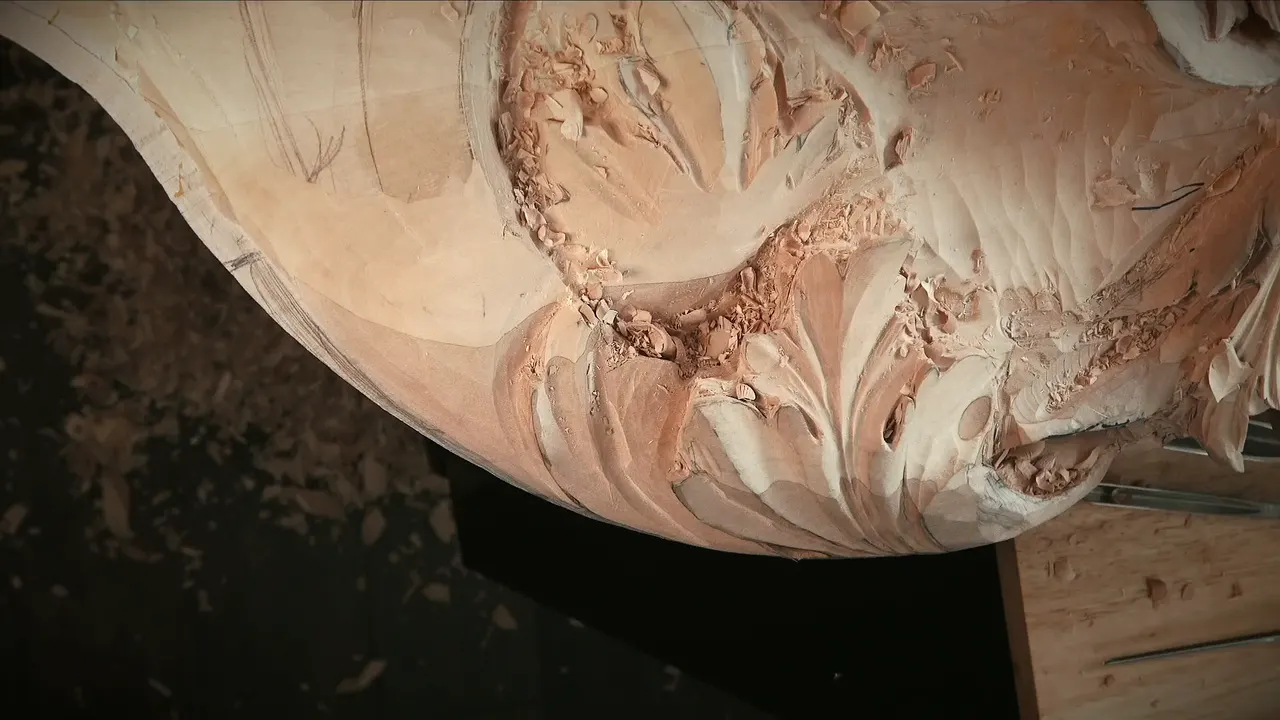

In part 7 of Venice Room 63, while planning a number seven on a pipe, I said I had to change position so as not to damage it. In other lessons the same move came with grain, a piece I could not turn, the camera and the tool in my hand.
This page follows one line from workshop 63, and then each lesson where a reason sat beside the same move. See wood carving on Wikipedia for the craft in general.
What did I say about the position in part 7 of workshop 63?
The pipe came first. "Now I need to exaggerate that pipe," I said, "because that pipe has to be rounded, and now it is not." My plan was "number seven to give that pipe roundness."

The pause came a little later. "So I have to change the position, otherwise I'm going to damage it." Then: "That's not good. It's not what I want to do." The way to go was "around like this" with "the right movement toward uphill." One more line: "It has to have a correct movement."

Next came a look: "Okay, now I can see that is also casting shadow, which is good thing, and that is exactly what I'm after." I planned to "clean little bit overall movement, although you don't see it." My apologies followed, and I asked you to take my word for the rest. Wikipedia explains shadow in plain terms.
What was going on in part 7 before I reached the pipe?
The shadow came first in part 7. "See, it just gives me beautiful shadow. Really deep shadow." A moment later I called it gorgeous. The camera was a problem: "I know the camera doesn't let you see it, and I don't know if I'm going to be able to do anything about it." Still, "I like it what I see."

I planned the same thing again, going "inside that direction," and I said again, "I don't want to overdo it." The tool was "Quarter inch, number nine" (about 6 mm). The word position was already in that part, in the plural: "attack that from all the positions, and even undercut uphill like that to make it really deep and nice."
I called it "Really good excavation" and said I was "really happy about that." Later I said I could probably get a "spoon veiner, I should say, maybe two millimeters" (about 0.08 in) and "number nine and maybe about five millimeters" (about 0.2 in). The gouge has a short Wikipedia page too.
Near the end: "There's always possibility to overdo what you don't have to overdo." I said, "Clean little bit the side of the eye, give a slight of wall." And "This is going to give also extra interest." The part closes with an apology: "sorry if you can't see what I'm doing, and you absolutely can't."
Is there an earlier line in workshop 63?
The same lesson has one, in part 3. I said I would switch position and go "that direction," and added that "this direction I could probably use just a skew," which would be "much quicker I think." A little further on: "Again, I could probably slope it even more."

Why switch position when the grain fights you?
In workshop 68, part 3, the grain was the reason. Wherever I'm "catching grain," I said, I needed to change position and come at it from the "opposite side." The wood grain page on Wikipedia is short if you want the plain definition.
Workshop 37, part 7, was a rougher spot, and I needed more care on that side: "It's against the grain." The answer was to shift and "go that direction."

The tool in workshop 78, part 8, came with the words "because of the grain" and "go opposite direction." "Use a different back bent," I said, a "little, little bigger." "I would use probably three millimeters," I said, which is 3 mm (about 1/8 in), the "same number five."

Another spot, in workshop 69, part 12, goes the other way. "I have to be careful and be mindful to the grain, what the grain does." The grain was also why I could not switch position there. Next: "I've got the feel of concave, and it casts some shadow, which is really good. But it doesn't feel good right here."

Modern Acanthus lesson 3, part 2, has this: "you always feel what the grain does." And: "Don't push it if it fights you." The fix was to "attack from other angle and you're gonna be safe." In Corinthian Acanthus lesson 4, part 1, I pointed to the marriage line: "you can see marriage line right here when the grain meets," and you really must move "your position of your tool." Then: "that cut is really clean." My October 2020 livestream uses the same name: "That's a really tricky area. I call it marriage line," with a need to attack "from opposite direction."

In Lily Box lesson 7, part 9, I was shifting my positions "just because of the grain and how it behaves." I added that a gouge leaves a rough side and a clean side. That's why you "still have to change position no matter what, and just work one of the sides at a time." And: "I kind of like what I see right now."

In lesson 12 of the Lily Box course, part 4, the grain gave a rough result: "Just rubbing, and that just creates a really, really rough cut." The fix I named was to alter "the position of my cut" or the "direction of the tool cut," and "find the better one."

The clean side in workshop 58, part 1, was the right: "it's the right-hand side that's clean." I would change position "from what I'm cutting." The angle was "almost 45-degree," and "That way, it slices much better."

What happens when the piece will not move?
A piece that will not turn comes up in workshop 53, part 5. I was "carving against the grain, which is not the best idea." Then: "sometimes I just can't" move, "because this piece, particular project, I cannot rotate and I can't walk around my bench." The cost was time: "I really don't want to lose time."

Part 8 of that workshop has me saying "Carefully," and then that I needed a new position. A warning came with it: "I'm not suggesting that you do that because it's actually breaking the rule." The rule was about working toward yourself, "because you can cut yourself."
If you lock your hands, I said, "really placing your hand right on a piece of wood and holding that strongly, I believe it's safe enough." Then: "But I'm not advising anybody to do that." About this piece: "in this case, I can't rotate this piece."

A smaller case is workshop 54, part 3. I had dug "just a hole on inside," and the next step was a turn to "go a little more on angle and go as far as I wish." That was "a quarter inch, of course" (about 6 mm). I was using "three millimeters right now," I said, "one-eighth of an inch." If my hands covered the view, I said, "please understand why, okay? My apologies."

Later, in workshop 71, part 7, I planned to "start somewhere right here in this area," where an eye was coming. Obviously I had to shift and "go that way." And: "for me, it's better not to rush and do little by little smaller cuts and go up like that." Near the end of that part I planned to shift again and try "to do it this way now."
Another plan, in workshop 62, part 7: I would "take number 11 and seven, same what I used before," and shift again to "excavate whatever depth I need." Then: "Even if I'm destroying previous cuts, that's okay because I'm still establishing what's supposed to be good."

Why did I talk about the camera when I said it?
At times the position was the camera's. In workshop 59, part 11, "you don't see most of what I'm doing underneath." About moving the camera: "I really don't." And: "It's going to slow me down, and all it is just a cleanup job."

Moving it again costs time in workshop 89, part 11: "Unfortunately, you don't see," and moving the camera "just takes so much time." Part 6 of that lesson has this: "I need to stick my head in the camera too because I need to make sure I see exactly what is going on."
In that part I was "looking from a position when I don't see the true shape of it." And: "when I don't see the true shape, I can make a mistake, which I do not want to do."

The camera shows up in my April 2020 livestream too, with the lights. I had dug a "really deep, deep, deep cut." About the next step: "how I'm working, and my lights also." And I was trying to avoid "my head in the camera, which sometimes it's almost impossible."
Do the tool and your hands change position too?
In Furniture Panel lesson 17, part 3, the heel of a tool came up: "your heel is always on a higher spot." The turn goes on: "you'll notice you're still cutting in a place where you supposedly already cut, but not really. It just doesn't work that way." Then "you have to" shift "the position of the tool, how you cut it."
Tray of Blessing lesson 7, part 1: "if the tool is not too sharp, it's better to attack like what I did." I told you to switch "to the right position and again, with just a corner, with just the corner of the tool." And: "the main idea is not to push too hard, not to take too much material at once." Wikipedia's page on sharpening is short.

In the Hazelnuts course, lesson 3, I planned to move the tool and "attack from the other side." I added, "I have to be careful how I attack it." Back to care in workshop 86, part 4, with "just number seven."
My own hands came up in Swapping Hands. "While I'm just rotating the tool, I changed my position of this." "That is a really fun trick." Then: "the position of your hands like this." And: "the closer to the blade you hold your second hand, more cleaner cut is going to be, more control."

What else made me say it?
A metal part sat nearby in workshop 77, part 3. "Sometimes it's a good idea" to move, I said, and the care was "not to hit the metal part." A plan followed: "maybe I could glue little pieces of wood, which is probably a smart idea to do."

In Floral and Molding lesson 1, part 2, "some stuff is in my way," I said, and I had to shift how I measure it. "Just want to make sure I'm doing the right thing, how I measure it."
How do fourteen parts line up?
The table holds fourteen parts, with workshop 63 first. The middle column gives my words, and the last gives what was in front of me. Where I named a size in millimeters, the inch figure sits beside it.
| Where | The words I said in that part | Setting |
|---|---|---|
| Pipe, 63.7 | Number seven | A pipe I was rounding, and number seven for the job |
| Earlier, 63.3 | That direction | A skew, probably, for that direction |
| Grain, 68.3 | Opposite side | Grain that caught, so I attacked from the opposite side |
| Rough spot, 37.7 | Rougher spot | A rougher spot, and more care on that side |
| Bigger tool, 78.8 | Opposite direction | Same number five, now three millimeters (about 1/8 in), a little bigger |
| Concave, 69.12 | Mindful | A concave that casts some shadow, though it did not feel good |
| Stuck piece, 53.5 | I cannot rotate | A project I could not rotate, and a bench I could not walk around |
| Smaller case, 54.3 | More on angle | A smaller tool, three millimeters, one-eighth of an inch |
| Camera, 59.11 | Slow me down | A cleanup job, with the camera staying where it was |
| Seeing, 89.6 | True shape | A view that hid the true shape, and a head at the camera |
| Furniture Panel 17.3 | How you cut it | The heel of a tool, always on a higher spot |
| Tray of Blessing 7.1 | The corner | A tool that is not too sharp, and just the corner of it |
| Swapping Hands | Second hand | Hands that swap, the second one close to the blade |
| Lily Box 7.9 | Rough, clean | A gouge with one rough side and one clean side |
Where can you watch the full videos?
Every lesson named above is inside one of my courses. This lesson holds all of workshop 63, and workshops 62 to 73 are in Venice Room Part 6. The relief, Venice, hazelnut, acanthus plant and chisel pages linked here are for reading. To watch the full videos, start here.
How it's done
- Name what the part needs. That pipe had to be rounded, and it was not. A number seven was the plan, to give that pipe roundness.
- Move before the damage. Change position, I said, and damaging it was not what I wanted to do.
- Go around with the movement. Go around like this, and make sure it has the right movement toward uphill. It has to have a correct movement.
- Look at the shadow. I could see that it was also casting shadow, a good thing, and exactly what I'm after.
Frequently asked questions
What came right after the line about damage in part 7?
Damaging it was something I did not want, I said, and next came the way to go around.
Which tool did I name for the pipe?
A number seven. Earlier in the part I had named a quarter inch number nine (6.35 mm).
Did the grain ever come up beside the move?
Yes, in workshops 68, 78 and 69, and in Lily Box 7. Workshop 78 kept the number five and went to three millimeters (0.12 in).
Why did the camera come up beside the move?
What to carve next
- Workshop 63 lesson
- Workshop 62 to 73 course
- Workshop 68 lesson
- Workshop 37 lesson
- Workshop 78 lesson
- Workshop 69 lesson
- Modern Acanthus lesson 3
- Corinthian Acanthus lesson 4
- Lily Box lesson 7
- Lily Box lesson 12
- Workshop 58 lesson
- Workshop 53 lesson
- Workshop 54 lesson
- Workshop 71 lesson
- Workshop 62 lesson
- Workshop 59 lesson